After the first date · parenting and distance
Plan the next conversation without sharing your child's routine
Parents dating across distance can follow up after a first date with an adult-only call, realistic travel planning and privacy for their children's details.

Offer a manageable call; make travel and child involvement separate choices.
Written and edited by Ruth Akinyi · Local Dating Editor
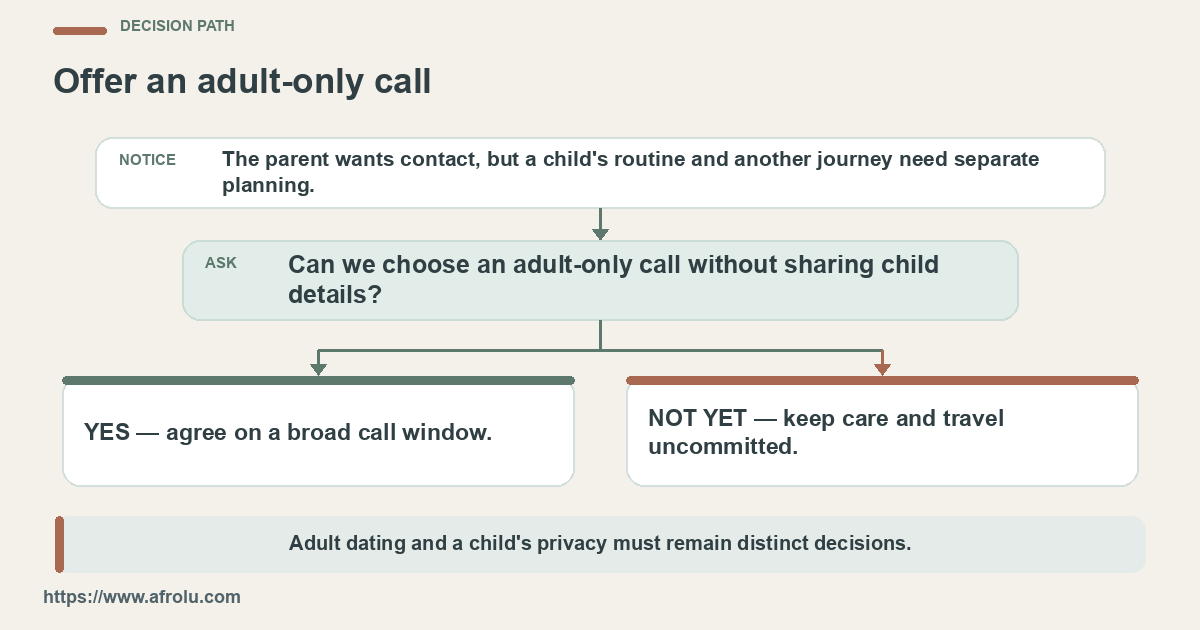
Mention what you enjoyed and offer an adult-only call at a broad time you can manage. You can say that family commitments affect your availability without sharing a child's name, school, photographs, custody details or daily routine. Treat another journey as a separate choice that needs care coverage, fare, time, lodging and a safe return plan. If the other adult needs more access or faster travel than you can offer, say what fits your life now and let them choose.
First dates · Parents Returning To Dating
How can I follow up after a first date across distance while keeping my child's schedule private and deciding whether another visit is possible?
A parent-aware long-distance follow-up offers a realistic adult next step while protecting a child's information and the parent's care commitments. A warm first date does not give a new romantic contact a role in family routines or an entitlement to repeated visits.
Illustrative scenario: A parent travels to a nearby town for an adult social event and enjoys a first date afterward. Back home, they would like to talk again but must arrange care before travelling. They send a note about the conversation and suggest a call later in the week. They mention that a visit needs more planning, without sending a child's timetable or proposing an early introduction.
Adult connection · child privacy · travel
Keep the next step about the two adults
A parent can be interested in someone and still have care duties that make time and distance real constraints.
Offer a call without exposing a child's routine. Test any later visit against care, fare and independent arrangements before confirming it.
What time is broad enough?
Offer a window without a child's timetable.
Who is affected?
Plan coverage before offering travel.
What stays with family?
Keep names, schools and photos private.
Can it truly work?
Check cost, lodging and return before agreeing.
Follow up as an adult
The first message can concern the date, not your family file
After a date away from home, you may want to say that you enjoyed the other adult's company while also thinking about the family routine waiting for you. Those feelings can coexist. Mention the conversation, event or walk that mattered to you, then ask whether a call would interest them. The message does not need to explain your entire parenting arrangement.
Choose a call window that is realistic but broad. 'Later Thursday evening' may be enough; a detailed account of school pickup, childcare handoffs or bedtime is not needed to arrange adult contact. If your availability is uncertain, say when you can confirm. A suggested call is an option the other adult may accept, change or decline.
If you do not want to keep dating, do not offer a call because it feels more polite than a clear ending. A short thanks and a direct statement can close the loop. If you do want contact, an honest invitation is kinder than leaving them to infer interest from a safe-arrival message alone.
Protect the care window
Availability can be clear without disclosing a child's routine
Parenting often makes free time contingent on another person's needs. A call after your own responsibilities are covered is reasonable, but you do not have to disclose where a child will be or who is caring for them. Discuss the adult-level effect: which windows you can offer and when you will know whether they remain free.
The other adult may want spontaneous calls or a daily text rhythm. You may enjoy contact but need planned conversations. State what is workable in an ordinary week, not just on the unusually free day when you first met. If that rhythm is too limited for them, the difference is useful information rather than a judgment of either person's affection.
love is respect encourages discussion of digital contact expectations rather than relying on assumptions. Its examples are U.S.-based relationship education, not a universal timetable for parents. Here the practical lesson is to make adult availability visible while keeping the child's location and routine outside the early dating exchange.

Do not use photos or routines as proof of dating interest.
Test a later visit
A second journey has care and travel costs
Before proposing another in-person date, ask whether both adults actually want one. Then consider the full plan: care coverage, time away, transport cost, lodging if needed and the route home. Someone without children may not see these steps, but you can explain the practical constraint without giving identifying details about the child or asking the other adult to solve it for you.
A person may offer to travel to your town. That can reduce your journey but introduces a different choice about where to meet and what personal information to reveal. A public adult meeting place can be discussed without inviting a new contact into the home. RAINN's U.S. safer-dating guidance suggests public early meetings and independent transport; it is not a guarantee about any individual date.
If a visit requires a cost or care arrangement you cannot responsibly manage, say that it must wait. A good first date does not create a debt to travel. The other adult may decide they need someone geographically closer or with more flexibility. Recognizing that now protects both people from building plans on an imagined opening.

The other adult can choose whether the call suits them.
Keep the child outside early dating
Interest in you does not require photographs or an introduction
You can say that you are a parent and that care affects your availability. That is different from sharing a child's full name, school, image, address or daily movements with someone new. Australia's eSafety Commissioner warns that children's photographs and posts can reveal identifying information and locations. Its guidance is Australian online-safety advice, not a rule about Kenyan family law.
A request to meet a child early or to receive photographs is a separate decision, not the next automatic step after a pleasant first date. You may say that introductions are not being considered now. Do not use a child's story as a way to prove that your reason for rescheduling is genuine. A new romantic contact can accept a boundary without being given a child's private details.
Protect the other parent's or carer's information as well if applicable. You need not describe custody, disputes or handoff locations to justify a call window. If the relationship develops, there may be more to discuss with time and care. For the first follow-up, the question is simply whether the two adults want a manageable conversation under present constraints.
Review the adult fit
Distance and care may permit a pace, or they may not
After a call, ask what each adult actually offered. Was there a workable contact window? Did the other adult respect the limit on child information? Could either person make a visit without disrupting care or taking on an unwanted expense? These questions concern observable choices. One kind call cannot forecast how someone would behave in a family context.
If you both want to continue, agree on one adult next step and leave any child introduction for a much later, separate conversation. If the other person needs frequent visits or immediate family access, say what you can and cannot offer. They are free to decline the arrangement, and you are free to keep a boundary without persuading them that it is correct.
Sometimes the most honest answer is that the distance does not fit your care responsibilities right now. A brief, respectful close can acknowledge the pleasant date while ending the romantic plan. A parent can remain open to connection without putting a child, a care network or personal finances into an early-dating obligation.

The child remains outside this early adult dating decision.
When parenting and distance meet a new date
A call invitation
The parent wants another conversation but has care duties that week.
Offer a broad adult-only window.A child question
The other adult asks for the child's name or school.
Keep identifying details private.A photo request
The new contact wants to see family pictures.
Decline or defer that separate disclosure.A spontaneous visit
Someone suggests traveling tomorrow.
Check care, cost and interest before accepting.A local meeting
The other adult offers to come to the parent's town.
Choose a public adult place without sharing home.A care change
A planned call window becomes unavailable.
Update and offer another window if you want to talk.An early introduction
The other adult suggests meeting the child after one date.
Say introductions are not being planned now.A distance mismatch
One person needs weekly visits the parent cannot make.
Name the practical difference and choose whether to stop.Notice adult plans that respect child privacy
The message names a real adult moment from the event or date.
A call is offered at a broad window the parent can manage.
The child is not named in the invitation.
No school, home, activity or handoff location is shared.
The other adult can ask for another adult-level call window.
Parenting is described as a commitment, not an excuse that needs proof.
No child photo or video is requested after one date.
A visit idea waits for care coverage and travel cost checks.
The local adult is not assumed to host the traveller.
A public meeting place can be discussed without a home address.
Neither adult expects early access to the child.
A different need for contact is heard without blame.
The parent can revise a plan when care needs change.
A distance mismatch is named before repeated trips are promised.
Keep the call, visit and introduction distinct
| Situation | What it may mean | What to do next |
|---|---|---|
| After the event | The adult conversation can continue without introducing a child. | Thank them for the talk and offer an adult-only call. |
| When choosing a call window | Care may make an exact timetable difficult to share or keep. | Offer a broad period and confirm closer to it. |
| When they ask about your child | Curiosity does not require identifying details. | Describe parenting as part of your life while withholding names and school. |
| When a photo is requested | An image can carry location and identity clues. | Decline or defer sharing; it is not a test of interest. |
| When a visit is floated | Childcare, fare and personal desire all need separate checks. | Keep the idea open until those conditions are real. |
| When they offer to visit | A local meeting can still avoid home and care locations. | Choose a public adult venue if both want the date. |
| When they offer to help with care | A new contact should not acquire a family role after one date. | Make care arrangements independently. |
| When your call window moves | A care need can change an adult plan. | Update promptly and offer another broad window if wanted. |
| When frequent travel is expected | The other adult's preferred rhythm may exceed family capacity. | State the likely visit frequency without promising change. |
| When child introduction comes up | That question belongs to a later, separate decision. | Say no introduction is being planned now. |
Words for adult contact without child details
“I enjoyed talking with you after the event.”
“Would a call later this week suit you?”
“I can confirm an evening window once family plans are settled.”
“I keep my child's details private while getting to know someone.”
“I am not sharing family photos at this stage.”
“I would need to arrange care before planning another visit.”
“If we meet again, I would prefer a public place in town.”
“I am not planning any child introductions now.”
“My availability changed; I can call on Sunday if that suits you.”
“An intercity trip is beyond my budget this month.”
“I understand you want more frequent visits than I can manage.”
“I enjoyed meeting you, but this travel rhythm does not fit my family life.”
Know the difference
An adult call does not open a child's private life
A call is chosen using broad availability; the child is not part of the new contact's plan.
A warm date is treated as permission to see child photos, routines, home or an early introduction.
Adult dating and a child's privacy must remain distinct decisions.

A first date creates no child introduction plan.
Adult dating does not grant family access
| Type or dimension | What it describes | Best next question |
|---|---|---|
| Adult-only call | Contact between two people who dated. | Offer a broad manageable window. |
| Family timetable | Private information about care and movement. | Keep it out of early messages. |
| Being a parent | A relevant fact about available time. | Share at the level needed for adult choice. |
| Child identity | A separate person's private information. | Do not use it as dating proof. |
| A possible visit | An idea dependent on care, interest and expense. | Test feasibility before inviting. |
| A booked trip | A committed expense and calendar decision. | Make it only after agreement. |
| Public adult venue | A location for a next date. | Choose it without disclosing home. |
| Child introduction | A later family decision. | Do not attach it to a second date. |
| Distance mismatch | Different needs for calls or visits. | Name it before repeating promises. |
What to keep private while exploring contact
Parenting explains capacity
A broad call window tells a date what they need without exposing the child's schedule.
A photo travels farther than a text
Identifying child images can be retained or shared beyond the original conversation.
Care is not a test
A parent need not rearrange essential responsibilities to prove romantic interest.
A local visit stays adult
Even when someone comes to town, a public meeting need not include the home or child.
Travel needs three checks
Care coverage, total cost and genuine desire must all work before a visit is promised.
Introduction is later
Adult contact can continue without deciding whether a child will ever meet the person.
Questions about care, privacy and travel
Choose a few prompts that fit the moment. This is a reference library, not a list to complete.
Before a call
Keep the next step between adults.
- Which broad window can I manage?
- Am I including child details unnecessarily?
- Can I confirm closer to the time?
Before sharing
Think about another person's privacy.
- Does this image reveal a school?
- Would a new contact need this detail?
- Can I describe my capacity without it?
Before travel
Test care and cost before commitment.
- Is independent care available?
- Can I afford fare and lodging?
- Do I want this adult date?
If distance strains
Make a fair continuing choice.
- What visit rhythm can I keep?
- What does the other adult need?
- Would a close be more honest?
What the guidance supports and where it stops
Child privacy
Australia's eSafety Commissioner explains how child photos can reveal names, school and location.
Evidence limit: Australian online-safety guidance, not Kenyan family-law advice.
Online dating
eSafety recommends limiting information about children in dating profiles.
Evidence limit: Profile advice does not assess a person met in real life.
Adult boundaries
love is respect advises discussing personal boundaries and expectations.
Evidence limit: U.S.-based education does not prescribe family introduction timing.
Texting terms
love is respect suggests talking about digital-contact expectations.
Evidence limit: It does not define a parent's required response time.
Safer meetings
RAINN offers general public-place and transport suggestions for early dates.
Evidence limit: U.S. guidance cannot guarantee another person's behavior.
Early disclosures and promises to avoid
Sending a child's timetable
A call only needs a broad adult availability window.
Using a photo as proof
A new contact does not need child images to believe you are a parent.
Promising spontaneous visits
Care coverage and travel cost cannot be assumed.
Assigning the new date childcare
Adult dating does not create a family role.
Naming the home meeting point
A public adult location can serve the next date.
Treating one call as introduction
A child meeting is a different decision for another time.
Keep adult contact and child privacy separate
Explore adult contact and privacy choices while keeping a child outside the new connection.
Explore the guide library
Show more related guides
Continue with Afrolu
Show more Afrolu guides
Sources and their scope
Afrolu reviewed these health, research, safety, or public guidance resources while editing this page. They support the behaviour and safety guidance; they do not diagnose any individual described by a reader.
Questions about parenting and distance
When should I mention that I am a parent?
You can say so when it affects your availability or the other adult's choice, without giving your child's identity or routine.
Do I need to explain my care arrangements to schedule a call?
No. A broad time window is enough to propose adult contact.
Should I send a photo of my child to someone I just dated?
No photo is needed for a call or second date. Protect identifying images and let any disclosure be a separate, considered choice.
Can I date across towns without promising frequent travel?
Yes. Discuss what calls and visits are feasible; let the other adult decide if that pace fits.
Who should arrange childcare for a second visit?
The parent should first decide whether care coverage is available and acceptable; a new date should not be assigned a family role.
What if they offer to come to my town?
You can discuss a public adult meeting while keeping home, school and care locations private.
Does a call mean they can meet my child next?
No. Any child introduction is a later, separate decision.
What if they want to know my child's school?
You may keep that identifying information private. It is not required for adult dating plans.
How do I answer if travel is unaffordable?
Say that another visit does not fit your care or budget now; offer only contact you genuinely want and can manage.
What if this distance arrangement does not work?
Acknowledge the pleasant date and close respectfully without promising that your family schedule will change.
One thing to do now
Let adult contact develop without involving a child
Choose an adult-only call first; explore travel only when care, cost and privacy can all be respected.