After the first date · new chapter
Explain serious hopes while keeping today's dating terms clear
After a first date, explain how serious relationship hopes fit casual dating now. Use a clear message, ask what the other adult wants and avoid future promises.
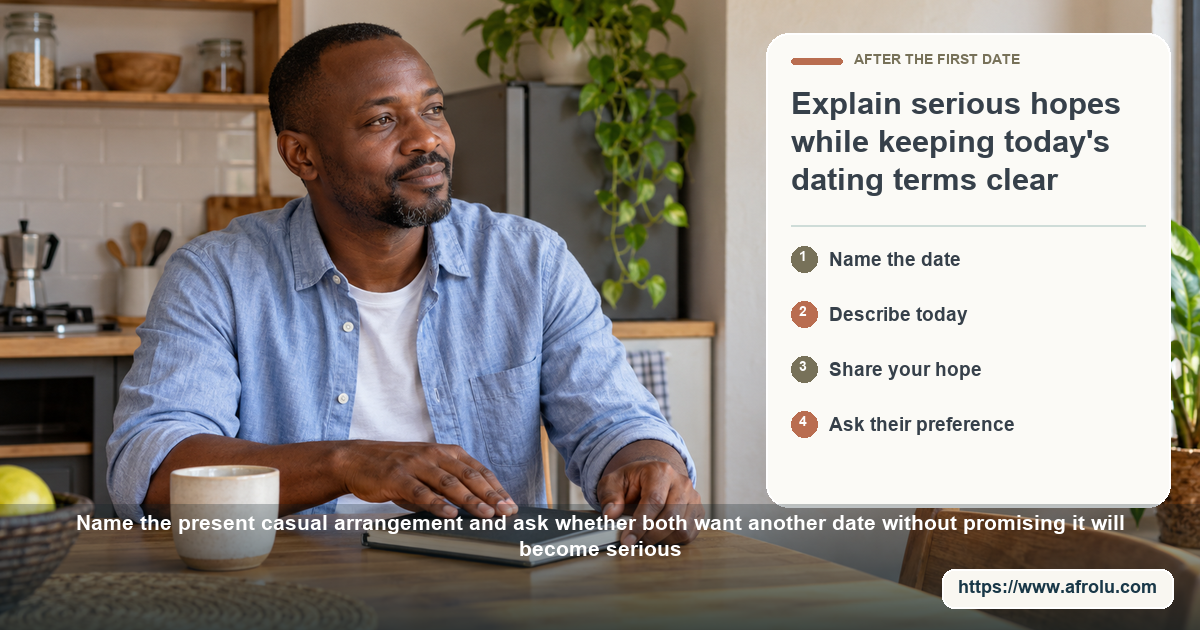
Distinguish the relationship you hope for from what you are offering now.
Written and edited by Miriam Otieno · Senior Kenya Editor
Say what you enjoyed, describe what you can offer now, and name a serious relationship as a hope rather than a guarantee. Ask the other adult what casual and serious mean to them. If you want another date, invite one without implying exclusivity. You do not need to disclose private history to explain your present preference, and the other person does not need to wait for your terms to change.
First dates · New Relationship Starters
How do I text after a first date when I want something serious eventually but am dating casually right now?
A clear new-chapter follow-up distinguishes a present arrangement from a hoped-for future. Casual may describe current exclusivity, frequency or pace; serious may describe a long-term goal. Neither word becomes a mutual agreement until both adults explain what it means to their next choice.
Illustrative scenario: After an enjoyable first date, one adult realizes they hope for commitment eventually but are not ready to date exclusively now. They send a note about the evening, explain that they are getting to know people casually at present and ask how that fits the other adult's wishes. They offer another date only if both want one under those present terms.
Today · hope · agreement
Name the arrangement available now
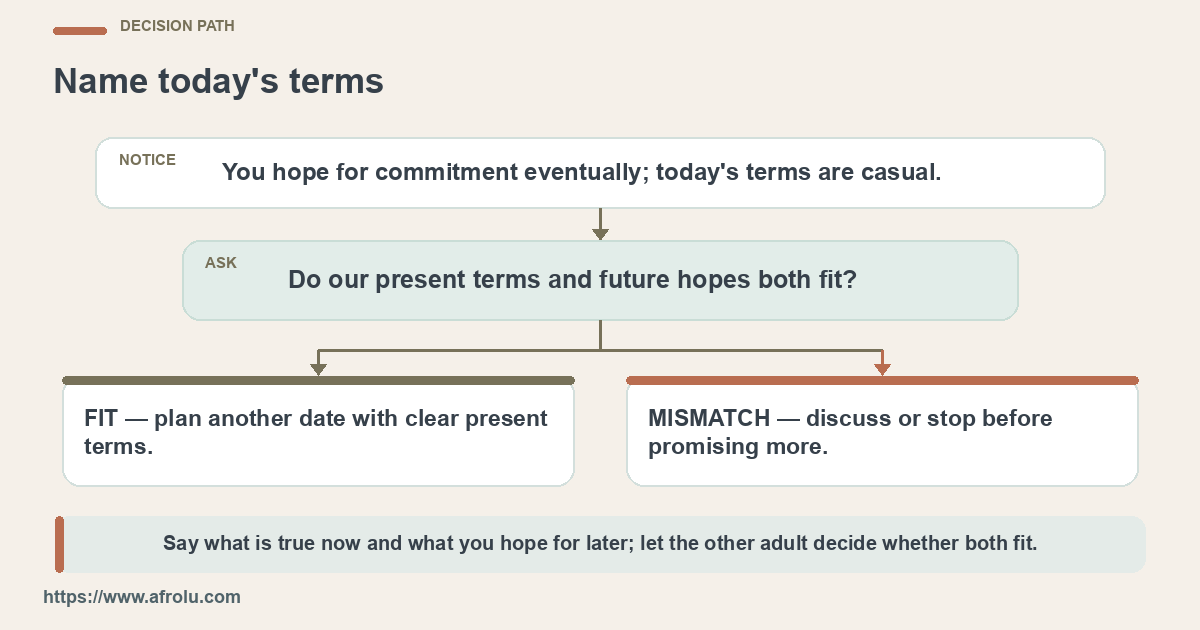
A wish for commitment someday can sit beside a casual pace today, but the other adult needs the present terms to choose.
Explain what casual means in your current dating life, describe serious as a hope and invite a second date only under terms both understand.
What is on offer?
Say whether you are dating others now.
What may develop?
Describe your direction without a deadline.
What is agreed?
Ask rather than infer exclusivity or affection.
When to revisit?
Discuss new terms when a real preference shifts.
Begin with today's truth
Your present offer should be understandable on its own
A new dating chapter can make your feelings more complex than one label. You might sincerely hope for a committed relationship in the future while wanting to meet people without exclusivity now. After a first date, describe the part that affects the other adult's immediate choice: what you enjoyed and what sort of contact or second date you are actually offering.
Casual can mean different things to different adults. It may concern exclusivity, frequency, emotional pace or simply the absence of a defined commitment. Use plain words about the part that matters rather than expecting the label to carry a shared agreement. You can say your preference may evolve without asking someone to count on that change.
A warm text or physical affection during the date does not itself establish a relationship. RAINN's general education describes consent as specific to an interaction. That principle does not define dating labels or local law, but it supports the practical distinction: one welcome moment cannot promise future contact, exclusivity or a change in terms.
Name the future honestly
A serious hope is a direction, not a guarantee
It can be useful to say that you hope for a serious relationship eventually. That information helps someone looking for an entirely different arrangement decide whether to continue. Yet you cannot guarantee that this date will become that relationship or that your readiness will change on schedule. Separate the direction you hope to explore from what you can offer now.
If the other adult wants a committed relationship immediately, listen without trying to persuade them to wait indefinitely. Ask which present agreement they need, such as exclusivity or a clearer dating pace. If you cannot offer it, say so. Respecting their choice may mean ending a promising conversation before either person invests under different assumptions.
If they also want to proceed casually, define the practical terms that affect both of you. Can each person date others? How much contact feels comfortable? What should happen if someone develops a different preference? You need not negotiate an entire relationship contract by text, but an honest second-date invitation should not hide a major current mismatch.

A positive date does not establish exclusivity or a promised outcome.
Keep personal history yours
Clarity now does not require a full account of the past
Beginning again after a previous relationship may shape your pace, but a first-date follow-up does not require a detailed account of that history. You can explain that you are taking time to get to know people and are not ready for exclusivity. If the other adult asks a question you do not want to answer yet, say that you prefer to discuss it later, if at all.
A boundary can concern conversation topics, physical contact, message frequency or who knows you are dating. love is respect offers educational prompts for naming boundaries; its examples are U.S.-based rather than a universal script. The useful idea is to describe the choice you can make now. The other adult may have boundaries of their own, and both should be heard.
Do not use private history as a reason the other adult must accept unclear terms. They need enough information about the present arrangement to choose freely, even if the reasons behind your preference stay private. If you are unsure what you can offer, describe the uncertainty and avoid sending a definite invitation you do not mean.

Ask about today's arrangement without promising a future relationship.
Invite one next date
A second meeting can be a choice without a relationship promise
If both adults understand the current arrangement and want another date, offer a manageable activity or time. A specific invitation is easier to answer than a compliment that leaves the next step unclear. Confirm the details only after the other person says yes. The plan is a meeting, not a promise about exclusivity, future intimacy or a permanent label.
If the other adult asks what you mean by serious, answer with the aspect relevant to your long-term hope, such as a committed partnership. Then return to today's decision: what are you willing to offer with this person now? Neither adult should have to infer that answer from an eventual aspiration. If a mismatch appears, decide whether another date would be fair and useful.
A no can be disappointing without being unfair. The recipient is free to choose an arrangement that fits them. You are equally free to pause if you discover you want more certainty than you thought. Treat a change in preference as a reason to revisit the terms, not as evidence that either adult misled the other when earlier words were honest.
Review what is agreed
Choose from present evidence, not an imagined endpoint
After another conversation, notice what the two of you actually agreed to. Did each explain casual in practical terms? Was exclusivity discussed separately? Did the interaction respect privacy and physical boundaries? A second date may add context, but it is not a test with a predetermined result. You can decide whether the current arrangement suits you now.
If your preference changes, say so while the other adult can still choose. For example, you may become ready for exclusivity, decide that casual dating is no longer right, or prefer not to continue with this person. Ask whether they want the new arrangement instead of silently behaving as though a shared agreement has already changed.
If the answer is no, end or adjust the connection without bargaining for a future promise. A clear follow-up gives each adult accurate information and room to act on it. That is valuable even when two people decide they want different things; neither has to remain in an arrangement that no longer fits.

Neither a second date nor affection silently changes an agreement.
When today's terms meet tomorrow's hopes
The date felt promising
You enjoyed meeting but still want casual terms.
Say both things in the follow-up.A serious future is mentioned
One person hears it as a relationship promise.
Clarify that the hope is not an agreement today.Casual means different things
One means non-exclusive; the other means slow pace.
Define the practical term before planning more.Exclusivity is assumed
A warm reply is treated as a commitment.
Ask explicitly rather than letting an assumption stand.Prior history is requested
They ask for details of your last relationship.
Share only what you choose.A second date is proposed
Both want another meeting but not the same pace.
Discuss the difference before confirming.One person wants certainty
They want a guarantee that casual will become serious.
Do not promise a future feeling.Your preference changes
You now want a different arrangement.
Say so before continuing under old terms.Notice which present terms are actually shared
The follow-up refers to one real moment from the date.
The present casual arrangement is described in understandable terms.
The long-term hope is named as a hope, not a guarantee.
No one assumes exclusivity from a positive first date.
The other adult can describe a different goal without blame.
An invitation for another date has an optional, realistic plan.
Physical affection is not treated as agreement to a relationship.
A past relationship is discussed only if the adult chooses.
Neither person asks the other to wait indefinitely for a future change.
A reply delay is not used to infer a commitment level.
The adults can revisit terms when actual preferences change.
Different definitions of casual are explained before proceeding.
A no to another date is accepted without trying to negotiate it.
A second date is evaluated on present fit, not an imagined endpoint.
Say what you can offer at this stage
| Situation | What it may mean | What to do next |
|---|---|---|
| Writing the first follow-up | You enjoyed the person while still dating casually. | Thank them and state the present arrangement before inviting more. |
| They ask if you want serious | The word can mean a future hope or a current commitment. | Describe both your long-term aim and what you can offer now. |
| They assume exclusivity | No mutual exclusivity has been discussed yet. | Clarify whether you are dating other people before another date. |
| They want to be exclusive now | Their current need may differ from your present capacity. | Say plainly if you cannot offer it and leave them free to decline. |
| They ask why you are cautious | Your past may shape the pace without needing full disclosure. | Explain the present preference and keep private history private. |
| You want a second date | An invitation can be specific without forecasting a relationship. | Offer one activity under the terms you have explained. |
| Physical affection is mentioned | A welcome first-date moment does not establish future consent or terms. | Discuss the next choice directly if it matters. |
| They are comfortable with casual | The label still may mean different things to each of you. | Ask about contact and exclusivity before treating it as agreement. |
| Your readiness changes | A new preference can change the arrangement but not retroactively alter it. | Tell them what you now want and ask whether they choose it too. |
| You no longer want another date | A sincere earlier hope does not require continuing. | Send a brief, honest closing rather than promising to revisit later. |
Words for casual terms and serious hopes
“I enjoyed our walk and the conversation about books.”
“I am dating casually while I get to know people.”
“I hope for a serious relationship eventually.”
“How does that fit what you are looking for now?”
“For me, casual means I am not exclusive at this point.”
“Are you asking about being exclusive, or about our general hopes?”
“Would you like to meet again next weekend and keep talking?”
“I am not ready to discuss my last relationship in detail.”
“I cannot promise that my feelings or terms will change.”
“It sounds as if we want different arrangements now.”
“I need time to decide whether another date is right for me.”
“I appreciated meeting you, but I do not want to keep dating.”
Know the difference
Today's terms are not a future guarantee
An adult explains the current casual pace and an eventual interest in commitment.
One person hears serious interest and assumes exclusivity or a relationship timeline has been agreed.
Say what is true now and what you hope for later; let the other adult decide whether both fit.

Clarify exclusivity and current contact before another date is chosen.
Present terms differ from future hopes
| Type or dimension | What it describes | Best next question |
|---|---|---|
| Present casual pace | This describes what you can offer with someone now. | Explain the contact and exclusivity terms that affect them. |
| Serious long-term hope | This describes a direction you value, not a promised outcome. | State it without a deadline or guarantee. |
| Enjoyed first date | A pleasant evening is an experience, not a relationship agreement. | Decide whether you want another meeting. |
| Second-date invitation | A concrete activity offers another encounter under current terms. | Confirm only after the other adult chooses it. |
| Dating others | This present fact may affect the other adult's choice. | Be direct rather than relying on the word casual. |
| Exclusivity | A mutual decision to stop dating others needs an explicit conversation. | Ask, answer and do not infer it from affection. |
| Physical closeness | Consent to one moment does not decide future touch or commitment. | Check comfort each time. |
| Private history | Past events can explain your pace but are not owed in full. | Share present terms even if your reasons remain private. |
| Changed preference | Wanting more or less later differs from having agreed to it now. | Reopen the conversation before acting on new terms. |
Six ways to keep the offer honest
Two time frames can both be true
You can hope for commitment eventually while being honest that you are not offering it with this person today.
Labels hide different decisions
For one adult casual may mean non-exclusive dating; for another it may mean infrequent contact. Ask which detail matters.
Another date is only another date
A concrete invitation creates an opportunity to learn, not an implied transition to exclusivity.
Privacy needs a present answer
You can decline to discuss past relationships while still explaining the arrangement available now.
Hope cannot hold someone in place
The other adult is free to seek a current commitment elsewhere instead of waiting for your readiness.
New terms need a new conversation
If one person's preference shifts, describe the change before acting as though both agreed.
Questions about terms, choice and change
Choose a few prompts that fit the moment. This is a reference library, not a list to complete.
Separate the time frames
Draft one sentence for now and one for later.
- What contact can I offer this month?
- Am I currently dating other people?
- What serious hope do I hold without promising an outcome?
Clarify the terms
Ask about the decision the other adult faces.
- What would casual mean to them today?
- Does either person need exclusivity before another date?
- Which expectation would change their answer?
Invite fairly
Make the next meeting a real option under stated terms.
- Do I genuinely want another date?
- What specific activity can I propose?
- Have I left them free to decline the present arrangement?
Revisit later
Use changed preferences rather than a preset milestone.
- What has actually changed for me?
- What agreement would I like now?
- Can I accept it if they do not want that change?
What research and guidance can—and cannot—tell you
Boundaries
love is respect provides language for naming personal boundaries and preferences.
Evidence limit: Its U.S. examples do not set a dating timetable.
Consent
RAINN explains that consent is voluntary and specific to an interaction.
Evidence limit: This general U.S. resource does not define relationship status or local law.
Physical boundaries
love is respect discusses physical boundaries in relationships.
Evidence limit: It cannot infer what an individual date meant.
Expectations
love is respect explains why partners should discuss relationship expectations rather than assuming them.
Evidence limit: Its U.S. examples do not define what casual must mean for these adults.
Respectful texting
love is respect discusses considerate digital communication while getting to know someone.
Evidence limit: The resource does not establish a universal reply window or commitment test.
Digital privacy
eSafety explains privacy considerations for dating services.
Evidence limit: Australian platform guidance does not guarantee confidentiality.
Promises a casual label cannot make
Calling a hope a promise
Wanting commitment eventually does not offer it with this person now.
Leaving casual undefined
The other adult needs to know which present terms affect them.
Assuming exclusivity
A pleasant first date or second invitation is not an exclusivity agreement.
Demanding a private history
Present preference can be clear without past relationship details.
Asking someone to wait
No one should be promised an eventual change that cannot be guaranteed.
Treating affection as agreement
A welcome moment does not settle later dating or contact.
Describe today's terms and tomorrow's hope
These information links are clearly labelled, non-commercial and do not promise a relationship outcome.
Explore the guide library
Show more related guides
Continue with Afrolu
Show more Afrolu guides
Research and practical guidance used for this guide
Afrolu reviewed these health, research, safety, or public guidance resources while editing this page. They support the behaviour and safety guidance; they do not diagnose any individual described by a reader.
Questions about casual dating and serious hopes
Can I want something serious eventually and date casually now?
Yes. Be clear about what casual means now and describe a serious relationship as a hope rather than a promise.
What should I text after this first date?
Mention a moment you enjoyed, state your current terms, and ask what the other adult wants.
Does serious intent mean we are exclusive?
No. Exclusivity requires its own conversation and mutual agreement.
Should I tell them about my previous relationship?
Only if and when you want. You can describe today's preference without disclosing private history.
What if they want a serious commitment now?
Listen and decide whether you can offer that now. Do not invite them to wait for a change you cannot promise.
What if they only want casual dating indefinitely?
Ask what that means and choose whether it suits your present needs.
Can a second date help clarify?
It can add context if both adults want one, but it does not obligate either person to change terms.
When should we revisit expectations?
When a preference or choice changes enough to affect the other person's decision.
Does affection on the date signal a relationship?
No. Affection and consent to one moment do not establish exclusivity or future contact.
What if I realize I do not want another date?
Say so respectfully if appropriate. A positive first date does not create a duty to continue.
One thing to do now
Make today's offer clear before the next date
Tell the truth about the arrangement available today and the hope you hold for later; ask whether both fit the other adult's choice.