After the first date · new chapter and work
Follow up honestly when you are dating again during a busy work season
Starting to date again during a busy work season? Send a clear first-date follow-up, offer a time you can keep and repair changed plans without vague promises.
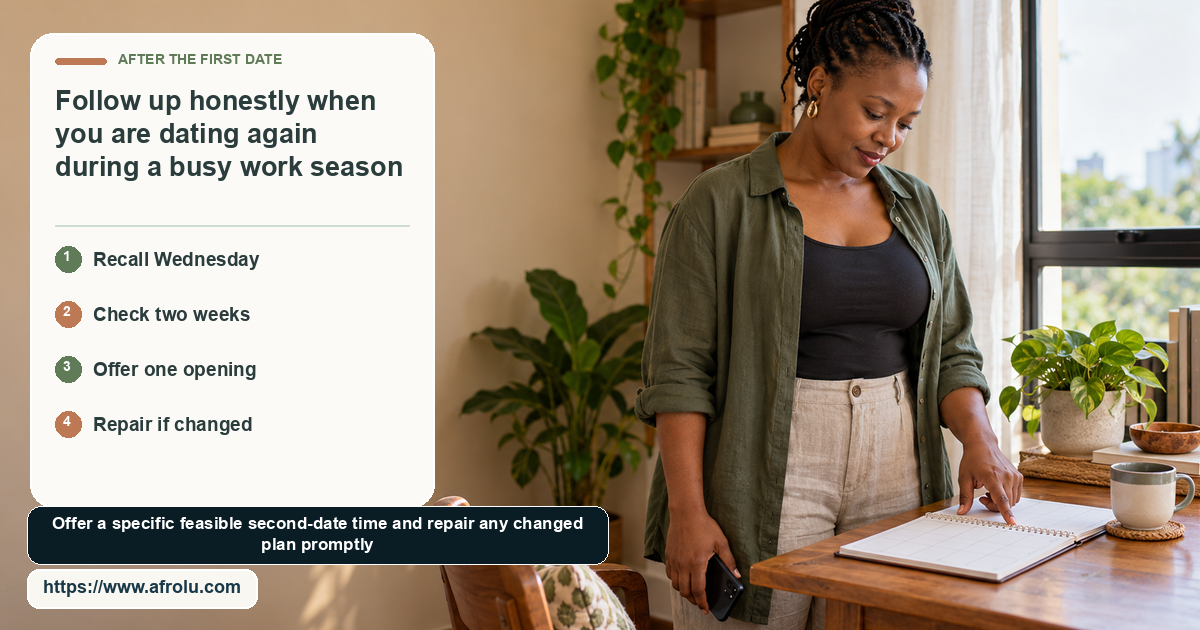
Check the next two weeks and offer only the time you can protect.
Written and edited by Miriam Otieno · Senior Kenya Editor
Say what you enjoyed, check your real calendar and offer one time you can keep. If the next two weeks are uncertain, explain the uncertainty without making a date you cannot confirm. Agree on a contact rhythm that fits both adults. If work changes a chosen plan, tell the person promptly and offer one feasible alternative if you still want to meet; if you cannot make space to date now, say so rather than asking them to wait indefinitely.
First dates · New Relationship Starters
What can I text after a first date if I want to keep seeing someone but my work calendar may change?
A career-aware follow-up makes current interest and actual availability visible. It distinguishes a genuine invitation from an indefinite 'when work calms down' placeholder, while leaving the other adult free to want a different pace.
Illustrative scenario: An adult beginning to date again enjoys a Wednesday evening conversation. A project deadline fills next week's weekdays, but next Saturday afternoon is free. They mention what they liked, invite one Saturday activity and say work evenings are limited. When a client meeting later moves, they send an update and one replacement option rather than disappearing or describing the other person's response as a test.
Capacity · invitation · repair
Match the follow-up to your real calendar
Beginning again can make a busy period feel like a referendum on whether you are ready to date at all.
Look at the next two weeks, offer one real opening and state how you will handle a change without demanding that someone wait.
What did you enjoy?
Name one part of the first meeting.
Which slot exists?
Offer an opening you can protect.
What can repeat?
Choose a sustainable message rhythm.
What if work moves?
Give a prompt update and one true option.
Begin from the date
An honest note can be warm and answerable
When you are dating again, a first-date message can feel like it needs to prove both interest and readiness. It does not. Recall one real exchange that made you want to continue, then decide whether there is an actual second step you would like to offer. A thank-you, a suggested meeting and a clear no are different messages; choose the one that reflects your position.
Avoid a large apology for having work commitments. The other adult needs useful availability, not a detailed defense of your calendar. You can say that a particular weekday is full and suggest Saturday afternoon. An invitation is easier to answer when it includes an activity or time window, and it remains an invitation until the other person accepts it.
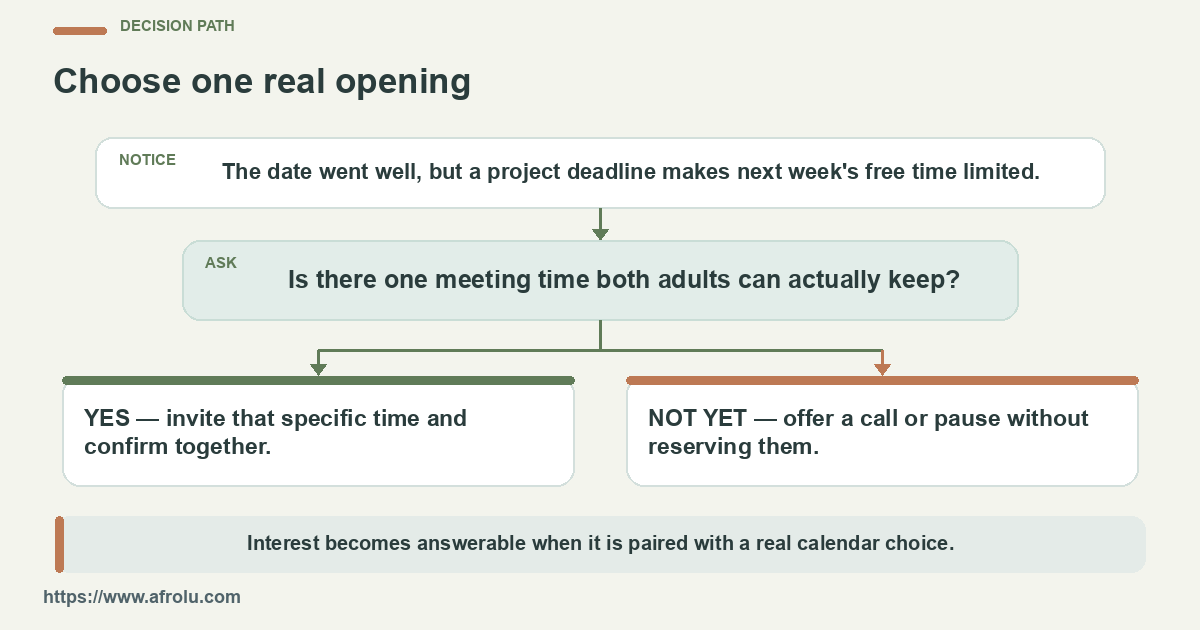
If no free time exists in the foreseeable next weeks, do not invent a date to sound interested. You may offer a call if you genuinely have room for one, or explain that you are unable to plan another date now. The other adult can choose whether to stay in touch; they should not have to guess whether 'soon' means a day, a month or never.
Audit capacity
A calendar opening should survive an ordinary workweek
Look at the next two weeks rather than the ideal week you wish you had. Include the time to reach a venue, return home and recover from a demanding day. A Saturday morning that is technically empty may be the only rest you have. You can choose a shorter meeting or another date; neither choice makes your interest less sincere.
A changing project or shift pattern creates uncertainty. Say which part of the plan is firm and which part is still conditional. 'I can confirm by Thursday' is more useful than reserving someone else's entire weekend while you wait for work to settle. If you cannot commit to a date until a specific point, let the other adult decide whether that timetable suits them.
The other person's capacity matters too. They may have work, care duties or other plans and may not be free on your only opening. Ask what works for them instead of presenting your calendar as the only one that counts. If there is no overlap now, decide whether a later call or a respectful pause is preferable to repeated tentative plans.

The other calendar deserves equal weight.
Set the contact rhythm
A full workday is not a message-timing verdict
A clear follow-up can include a simple note about ordinary contact: perhaps you can reply after work or enjoy a brief call once a week. Do not turn a reply hour into evidence of another person's interest, and do not ask them to treat your own late replies as proof of seriousness either. The meaningful question is whether the rhythm each adult offers is acceptable.
love is respect's digital-boundaries guidance asks people to discuss expectations for texting and social media. That is U.S.-based education, not a required reply schedule. Use it to make your own terms explicit. If you only want to message when arranging dates, say so; if you prefer conversation between meetings, ask whether they enjoy that too.
New dating can change your sense of how much contact feels manageable. You are allowed to revise a preference after you learn more. Tell the other adult when the practical terms change rather than withdrawing and hoping they infer the reason. They remain free to say that a slower or less predictable rhythm is not what they want.

A changed plan calls for a prompt update, not a detailed work defense.
Repair a changed plan
A cancellation needs a truthful next action
Work can move a meeting you honestly expected to keep. As soon as you know the date will not happen, send a plain update. You need not reveal confidential work details. If you still want to meet and can identify a replacement time, offer it. The other adult may be disappointed or unavailable, and they do not owe you another chance because the work reason is real.
There is a difference between one repaired cancellation and a pattern of unkept invitations. Notice whether your calendar can support the pace you have proposed. If the second suggested date also becomes uncertain, it may be kinder to stop booking their time and say that you will not make another plan until your capacity changes. Do not label their frustration as pressure simply because they value reliable plans.
If the other adult changes a plan, give the same fair reading you would want. Ask whether a replacement suits you, or decline if it does not. A cancelled date alone cannot explain motive. What matters for your own decision is the actual information available: how changes are communicated, whether any new plan is feasible and whether you still want to continue.
Choose the season
Dating again can be a present choice or a later one
After one or two exchanges, compare what you hoped to offer with what you have actually managed. Is there a meeting both adults can choose? Does the message rhythm feel comfortable rather than like another task? Are you making room because you want this person in your life, or only because you feel that beginning to date again obliges you to keep going? Those are questions for your own choice, not a score for the other adult.
If a modest pace works for both people, agree on the next real step and revisit it when ordinary work demands change. If the other adult needs weekly dates and you can offer only an occasional call, acknowledge the mismatch. Neither adult must accept an arrangement that drains them, and neither needs to prove the other is wrong.
If you cannot currently offer a date or contact you can keep, say that you are stepping back from dating for now. You may be interested in the person and still not have the capacity for a fair invitation. Avoid promising to return when work calms down unless you have a specific, mutually chosen plan; otherwise let both adults move forward freely.

A clean pause is available if another meeting cannot be offered.
When a workweek changes the next date
A deadline week
The sender enjoyed the date but the next seven days are full.
Name one later slot or say there is none yet.A Saturday opening
One real afternoon is free after accounting for rest.
Invite that window without claiming the whole weekend.A tentative meeting
A client schedule may change before Friday.
Say when you can confirm the date.A weekday text gap
Neither adult has discussed contact during work hours.
Ask what rhythm feels comfortable.An unavailable partner
The other adult cannot make your only free slot.
Ask for another opening without treating theirs as rejection.A moved client call
Work removes a confirmed plan.
Update promptly and propose one checked replacement.A second cancellation
Your proposed dates keep disappearing.
Pause booking their time until capacity changes.A different pace
The other adult wants more frequent meetings.
State your real capacity and let them decide.Notice kept plans and honest updates
The follow-up mentions an actual part of Wednesday's conversation.
A proposed date has a specific feasible time window.
The sender has checked work, travel and needed rest first.
The other adult can suggest a different window.
A tentative plan has a stated point when it will be confirmed.
Work details remain broad rather than confidential or performative.
Weekday reply speed is not presented as proof of interest.
Both discuss the amount of between-date contact they enjoy.
A moved meeting is communicated before the other adult travels.
A replacement offer names a time that really exists.
A second cancellation leads to a capacity review, not another vague promise.
The other adult's frustration can be heard without assigning blame.
If there is no room to date now, the sender says so directly.
Each adult can continue or leave based on the available arrangement.
Match every invitation to available time
| Situation | What it may mean | What to do next |
|---|---|---|
| After Wednesday | The shared conversation is a basis for a personal note. | Mention what you enjoyed before discussing availability. |
| When reviewing next week | A deadline may leave no honest weekday opening. | Inspect two weeks rather than promising 'soon'. |
| When Saturday appears free | An empty cell may still be needed for travel or rest. | Protect essentials before offering the afternoon. |
| When the slot is tentative | A client change could affect a proposed date. | Name when you can confirm, and let them choose whether to hold it. |
| When they suggest a weekday | Their opening need not match your work pattern. | Offer one checked alternative without treating the difference as rejection. |
| During workday silence | Response time alone does not show intent. | Agree on a contact rhythm you can both repeat. |
| When work moves | A confirmed date has real impact on another calendar. | Update promptly, then offer one feasible replacement. |
| After a second cancellation | Your available season may not support the pace offered. | Stop booking their time until capacity changes. |
| When they want weekly dates | A reliable preference may exceed your current capacity. | State what you can keep and let them decide. |
| When no date exists | An indefinite invitation would ask them to wait without terms. | Pause respectfully instead of extending a placeholder. |
Words for an honest, answerable calendar offer
“I enjoyed our conversation on Wednesday.”
“Would Saturday afternoon suit you for another meeting?”
“The workweek is full, but I can protect Saturday.”
“If Saturday is difficult, what time works better for you?”
“I can confirm the final time by Thursday evening.”
“I am usually free to text after work; how do you like to keep in touch?”
“A work commitment changed my Saturday. I wanted to tell you now.”
“I can meet next Sunday afternoon if you would still like to.”
“I understand that changing the plan was inconvenient.”
“I cannot offer weekly dates at the moment.”
“I do not have room to plan another date fairly right now.”
“I appreciated meeting you, but I am stepping back from dating for now.”
Know the difference
A protected date is clearer than an indefinite opening
A specific date or call is proposed with an honest update point if work changes.
One person asks the other to remain available without knowing when a meeting can happen.
Interest becomes answerable when it is paired with a real calendar choice.

Interest alone does not hold a date in the calendar.
A real slot versus a career-season placeholder
| Type or dimension | What it describes | Best next question |
|---|---|---|
| An actual opening | Time left after work, travel and rest. | Offer it specifically. |
| A calendar gap | Empty on paper but not necessarily usable. | Test it against ordinary demands. |
| A tentative date | A possibility awaiting a known decision. | Set a confirmation point. |
| A firm invitation | A slot you expect to keep. | Ask whether it suits them. |
| A contact preference | How often you want to talk between meetings. | Discuss it separately. |
| A work explanation | Useful context about availability. | Keep confidential details private. |
| One cancellation | A changed plan to repair. | Tell them promptly. |
| A repeated pattern | Evidence your proposed pace may not fit. | Review capacity before rebooking. |
| A dating pause | A current choice to stop making plans. | Release the other adult from waiting. |
What matters in the next two weeks
Warmth needs a calendar
A sincere message becomes easier to answer when it offers a time that exists.
Rest is capacity
A free-looking Saturday may be essential recovery time; count it before inviting.
A confirmation point protects both
If work is uncertain, a specific update deadline prevents an entire weekend from floating.
Reply speed is a poor proxy
A workday timestamp should not substitute for a conversation about contact.
Repair is observable
Prompt notice and a real alternative matter more than a detailed account of the project.
Pausing is a choice
Starting to date again does not oblige you to continue during an unworkable season.
Questions for the calendar and its changes
Choose a few prompts that fit the moment. This is a reference library, not a list to complete.
Before inviting
Test the calendar, not the ideal version of it.
- What is truly free in two weeks?
- Have I counted transit and rest?
- What activity would fit that window?
While messaging
Offer useful context without oversharing.
- Which work limit affects the date?
- What reply rhythm fits me?
- When can I confirm?
If a plan moves
Repair impact with specifics.
- When did I learn of the change?
- What checked replacement exists?
- Can I accept their disappointment?
If time disappears
Decide whether to continue fairly.
- Have I cancelled more than I kept?
- Is a call truly possible?
- Should I pause without asking them to wait?
What the guidance supports and where it stops
Expectations
love is respect discusses checking relationship expectations rather than assuming them.
Evidence limit: U.S.-based education does not set a required dating frequency.
Digital rhythm
love is respect encourages discussion of texting expectations.
Evidence limit: It does not make a workday reply time a diagnostic sign.
Personal boundaries
love is respect includes time and digital space among relationship boundaries.
Evidence limit: It does not determine whether this particular pair has compatible schedules.
Readiness
love is respect asks readers to consider what dating would require in their present life.
Evidence limit: That reflection does not decide whether this adult has enough time to keep a particular plan.
Calendar habits that leave someone waiting
Leading with a long work apology
The other adult needs useful availability more than a defense.
Counting only meeting time
Travel and rest can make a technically empty slot unworkable.
Saying 'when things calm down'
No one can answer an invitation without a useful horizon.
Sharing confidential details
A date does not require client, employer or project information.
Repeating uncertain bookings
Several moved dates can keep another adult's time on hold.
Calling frustration pressure
Someone may reasonably value reliable plans without accusing you.
Offer one time you can protect
Use these guides to check your time boundary and make any change to a date clear.
Explore the guide library
Show more related guides
Continue with Afrolu
Show more Afrolu guides
Sources and their scope
Afrolu reviewed these health, research, safety, or public guidance resources while editing this page. They support the behaviour and safety guidance; they do not diagnose any individual described by a reader.
Questions about first-date texts and work
Can I text that I liked the date if I cannot meet this week?
Yes. Be clear about the next time you could actually talk or meet; do not imply a date is set when it is not.
How much work detail should I share?
Share the effect on availability. A new date does not need client, employer or project details.
Is 'when work calms down' enough?
It is usually too indefinite for someone asked to wait. Offer a real update point or say you cannot plan a date now.
What if Saturday is the only time I have?
Offer it as an option, then hear the other adult's calendar. One person's opening is not an obligation for the other.
Do I need to reply during work?
No universal schedule applies. Discuss a contact rhythm each adult can accept.
What if my work deadline moves?
Tell them promptly, then offer one feasible replacement if you still want to meet.
How many times can I reschedule?
There is no rule, but repeated unkept plans are a practical signal to reconsider what you can offer now.
What if the other adult wants weekly dates?
Say whether you can offer that. A pace mismatch can be acknowledged without fault.
Does being busy mean I am not ready to date?
Only you can decide. Check whether you can make and keep a plan you genuinely want.
Can I pause dating without promising to return?
Yes. Say that you cannot offer a fair next step now and leave the other adult free to move on.
One thing to do now
Offer one date you can keep or pause cleanly
Offer the time you can genuinely protect; repair a changed plan with one honest alternative or pause dating if no real opening exists.