After the first date · faith and clarity
Ask what shared faith means after a first date in Nairobi
After a faith-led first date in Nairobi, send a warm text and ask one practical question. Clarify values, boundaries and family timing before assuming a match.

Ask how a value affects a present choice before treating it as shared agreement.
Written and edited by Liya Bekele · Horn of Africa Editor
Mention a real part of the date you appreciated and ask one practical question about what faith-led dating means to the other adult now. Share your own answer too. A common faith word does not settle worship practices, family timing, physical boundaries, pace or another date. If a difference matters, describe it respectfully and decide whether to keep talking. Either adult remains free to decline.
First dates · Faith-Led Daters
How can I follow up after a faith-led first date while finding out whether our values and present dating choices actually align?
A faith-aware post-date text uses a shared value as the start of a conversation rather than as an agreement already made. It asks how that value shapes present choices while respecting that each adult may practice, interpret or prioritize it differently.
Illustrative scenario: Two Nairobi adults meet after a public community event and enjoy talking. Both describe faith as important, but one hopes to involve family soon while the other wants to get to know someone privately first. A follow-up asks what faith-led dating means in practice and shares a preference for a slower family timetable. The answer helps them decide whether to arrange another date.
Values · practice · choice
Ask what a shared value changes today
Using the same faith word may open a conversation; it does not settle the next date, physical limits or family timing.
Choose one present decision, explain your own preference and invite the other adult's answer without testing their devotion.
Which practice matters?
Ask how a value affects dating now.
What activity fits?
Choose a next date both adults would enjoy.
What is welcome?
Name physical and communication limits directly.
When are introductions right?
Treat timing as a separate choice.
Start with a real meeting
A warm note can invite a thoughtful values conversation
If the first date included a meaningful conversation about faith, refer to the actual moment rather than opening with an abstract test. You might mention a story, question or activity you enjoyed. Then ask whether the other adult would like to keep talking about a specific choice that matters to you, such as pace or what kind of date would feel comfortable next.
A direct question is kinder than assuming that the same word carries the same expectations. Faith-led might describe worship, prayer, community participation, marriage hopes, physical limits or a broader value system. Each person should be able to describe their own meaning. You can offer your view and listen without requiring the other adult to match it.
There is no single correct hour to send this text. A delayed reply does not measure belief or seriousness. Give the other adult time to decide what they want to share. If you ask one clear question and receive no answer, you can decide whether to follow up once or leave the invitation open without turning silence into a spiritual judgment.
Turn a label into a choice
Shared language is useful only when both can explain it
Suppose you both say faith is central, but one adult wants to attend a service together quickly and the other wants a quiet public coffee first. The difference matters to the immediate plan. Ask about it as a choice: “What would feel right for another meeting?” Neither adult needs to defend their whole tradition to answer a practical question.
If worship or prayer practices matter to you, explain why they affect your dating decisions and ask how the other person approaches them. Avoid treating denomination, attendance or language as a short code for character. A specific answer gives more information than a label alone, and it can reveal a difference without assigning blame.
You may discover that your values overlap while the relationship pace does not. That can be enough to pause. Conversely, a difference in practice may not prevent another date if both adults understand it and want to continue. The decision belongs to the people involved; this guide does not rank forms of belief or declare who is compatible.

A common label does not decide physical boundaries or relationship pace.
Keep consent personal
Belief is not a substitute for an explicit boundary
A statement about faith may influence how someone wants to date, but it does not by itself tell another adult what touch, contact or disclosure is welcome. If a physical boundary matters, say what you are comfortable with now. Invite the other person to name their own limits. No one needs to debate religious doctrine to respect a clear no.
RAINN's public education describes consent as voluntary and specific to an interaction. This is general U.S. education, not Kenyan legal advice or an interpretation of any tradition. The practical lesson is straightforward: agreement to one date, conversation or gesture does not decide the next one. Either adult can change their mind.
Privacy is another boundary. You may discuss values without disclosing a congregation, faith leader, family address or personal counseling history. Kenya's Office of the Data Protection Commissioner describes rights concerning organizational processing of personal data; those rights are not a promise of confidentiality from a date. Share only what you choose for the decision at hand.

Ask one practical values question and offer your own answer too.
Talk about family timing
A good first date does not set an introduction schedule
For some adults, family or community input is important early; for others, introductions come after a longer period of getting to know someone. Neither approach should be assumed from a shared faith label. If timing matters to you, ask what the other adult hopes for and state what you would be comfortable doing now.
An invitation to meet relatives, a leader or friends is a separate step. You can say yes, suggest later or decline. A request to involve a faith leader should also remain a choice rather than a test of seriousness. If one person needs early involvement and the other does not want it, the mismatch deserves an honest conversation.
Keep the next plan proportionate to what you know. You might choose a daytime public activity in Nairobi that both adults like and leave family questions for a later conversation. If a proposed place or activity conflicts with a personal practice, offer another option. Confirm the practical details only when both people freely want the meeting.
Choose with clearer information
You can continue, ask more, or decide the fit is not there
After the follow-up, consider what was actually learned. Could each adult explain what their value means for current choices? Was a boundary accepted? Did both want another meeting? These observations are more useful than trying to infer hidden devotion from reply speed, clothing, a phrase or a community label.
If you want another date, choose one activity and a time that fits both adults. There is no need to promise commitment, exclusivity or family approval in order to learn more. If an important difference remains, ask one focused question before confirming. A clear answer can make the decision easier even if the answer is not the one you hoped for.
You may also decide to stop. A respectful ending can say that your expectations do not fit without judging the other person's faith. The purpose of clarity is to let both adults exercise choice, not to win an argument about who is more serious or worthy of a relationship.

Keep physical limits, family timing and the next date as personal choices.
When a shared value needs a practical meaning
A shared label appears
Both people mention faith but no practice.
Ask what it means for the next date.Worship routines differ
One attends regularly and the other does not.
Discuss whether the difference affects your choice without ranking either.Family comes up early
One person expects introductions soon.
Ask about timing before agreeing.A physical limit is named
One adult states a present boundary.
Respect it without using belief as an argument.A leader is mentioned
Someone suggests involving a faith leader.
Choose independently whether that fits at this stage.A second date is proposed
The activity suits one person's practice but not the other's.
Suggest an option both can freely accept.Personal details are requested
They ask for a congregation or family address.
Share only what you choose.The terms do not match
Values overlap but relationship pace differs.
Name the difference and decide whether to continue.Listen for explained choices, not faith labels
The follow-up names a real enjoyable part of the date.
A question asks what faith shapes now rather than demanding a declaration.
Both adults can describe practice in their own words.
Neither treats a shared label as consent to a physical step.
A preference about pace is heard without debate or moral ranking.
Family introductions are discussed rather than assumed after one date.
Neither adult shares congregation or household details before choosing to.
A next meeting is invited with a specific but optional activity.
The conversation leaves space for a different denomination or practice.
A request for guidance from a faith leader remains the person's own choice.
A delayed reply is not treated as evidence of devotion or disinterest.
The adults can disagree respectfully and decide whether to continue.
A change of comfort is accepted even after an earlier yes.
The chosen plan fits both adults' actual schedules and boundaries.
Ask how faith shapes this next choice
| Situation | What it may mean | What to do next |
|---|---|---|
| Remembering the community event | The conversation gave you a real shared moment to mention. | Thank them for that exchange before asking about a value. |
| Both use 'faith-led' | A shared phrase has not established the same dating practice. | Ask how the value shapes a present choice, such as the next date. |
| They suggest a service together | A worship activity may be meaningful to them but may not fit your pace. | Accept, suggest another public activity or decline without evaluating their devotion. |
| You prefer coffee first | Your preference concerns this meeting, not a verdict on their belief. | Explain the meeting you would enjoy and invite their view. |
| A physical boundary comes up | Religious language cannot communicate every person's comfort with touch. | State your own limit directly and ask what they prefer. |
| They ask for a leader's contact | Community involvement is a separate privacy and timing decision. | Keep identifying details private until you choose to involve someone. |
| Family expects an introduction | A family timetable may differ between adults. | Discuss when an introduction would feel appropriate before inviting anyone. |
| A reply differs from your practice | A difference is information about a present choice, not a measure of worth. | Ask one clarifying question or say that the arrangement does not fit. |
| No answer to the values question | Silence does not establish devotion, character or intent. | Decide whether one follow-up suits you, then leave room for your own plans. |
| You plan another Nairobi date | The next activity needs an actual time, place and willing answer. | Offer one public option compatible with both adults' stated practices. |
Words for values, boundaries and family timing
“I enjoyed our conversation after the community event.”
“What does faith-led dating mean to you in practice now?”
“For me, it means taking time to discuss values before making commitments.”
“What pace would feel comfortable for another date?”
“I am not comfortable with that physical step.”
“I would prefer to know each other better before family introductions.”
“I can talk about the value, but I am keeping my congregation details private.”
“Would you like to meet at a public café on Saturday afternoon?”
“It sounds as if we practice differently. Does that affect what you want now?”
“I do not want to be tested on my beliefs to continue this conversation.”
“I want to think about our different expectations before making another plan.”
“I appreciated meeting you, but I do not think our dating expectations fit.”
Know the difference
Shared faith words are not shared dating terms
Each adult says which practices and boundaries matter to the next decision.
One person assumes a common faith word settles worship, family involvement or physical pace.
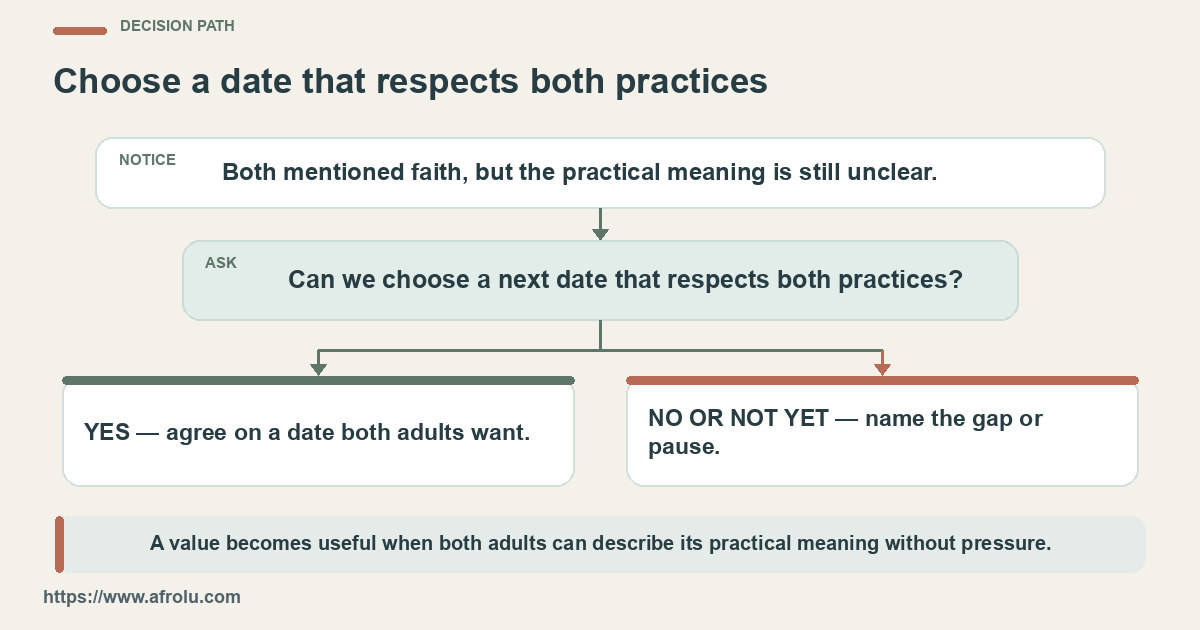
A value becomes useful when both adults can describe its practical meaning without pressure.

Discuss practice, pace, family and a next date before assuming agreement.
Explained values differ from an assumed label
| Type or dimension | What it describes | Best next question |
|---|---|---|
| Shared faith label | The same word may cover different practices or priorities. | Ask what it affects in dating now. |
| Explained practice | A person can describe a value through a concrete choice. | Listen without treating the answer as a test score. |
| Prayer invitation | A shared activity is an invitation, not proof of compatibility. | Choose whether it suits this stage. |
| Next-date venue | A place can fit one adult's practice and not the other's. | Compare alternatives both would freely choose. |
| Physical limit | Consent and comfort are personal to each interaction. | Ask or state the boundary directly. |
| Community detail | A congregation or leader's identity is personal information. | Share only when it serves a chosen step. |
| Family introduction | Meeting relatives is a separate action with its own timing. | Agree on whether and when it belongs in the plan. |
| Marriage hope | A long-term aspiration does not make this first connection committed. | Discuss today's pace before future plans. |
| Respectful mismatch | Different interpretations can coexist with mutual respect. | Continue only if the actual choices fit both people. |
Six ways to make values discussable
Translate values into verbs
Ask what each adult would do on a next date rather than asking the other person to define an entire tradition.
A belief question needs your answer too
Sharing your own practice makes the conversation reciprocal instead of a one-sided examination.
Consent needs plain words
A spiritual or community identity does not replace a direct question about physical comfort.
Introductions affect more people
Before involving relatives or leaders, check that the other adult wants that step and understands its meaning.
Privacy still applies
A values conversation can remain useful without disclosing a congregation, family address or counseling history.
Respect is observable
You can notice whether a stated limit was accepted without claiming to know someone's inner faith.
Questions for belief and the next date
Choose a few prompts that fit the moment. This is a reference library, not a list to complete.
Recall the date
Begin with an actual conversation, not a compatibility verdict.
- What did we discuss after the community event?
- Which part would I like to explore further?
- Am I thanking them before asking a difficult question?
Make a value practical
Connect a belief to one next-date decision.
- What does this value change for me now?
- How might it change the activity or pace?
- What is one question I can ask without testing devotion?
Set a boundary
Keep consent and privacy explicit.
- What touch or contact feels welcome at this stage?
- Which community or family details stay private?
- Can I say my limit without defending a tradition?
Consider another date
Use explained choices rather than assumed alignment.
- Did each person describe a practice in their own words?
- What public activity would suit us both?
- Is any family or community step still premature?
What research and guidance can—and cannot—tell you
Boundaries
love is respect gives examples of how to name personal boundaries.
Evidence limit: It is U.S.-based education and does not define any religious tradition.
Physical boundaries
A second love is respect resource discusses physical boundaries.
Evidence limit: Its examples do not replace personal consent or local law.
Consent
RAINN describes consent as voluntary, specific and reversible.
Evidence limit: This is general U.S. education, not an interpretation of faith or Kenyan law.
Safer dating
RAINN offers practical online and in-person dating considerations.
Evidence limit: Its recommendations cannot guarantee safety in Nairobi.
Digital privacy
Australia's eSafety Commissioner discusses dating privacy.
Evidence limit: Its guidance does not establish what a faith community will do with disclosed details.
Kenyan data rights
Kenya's Office of the Data Protection Commissioner explains data-subject rights.
Evidence limit: Those rights concern organizational data processing, not a promise of confidentiality between dates.
Assumptions that turn shared faith into pressure
Assuming shared practice
A common faith word does not define worship, pace or priorities.
Treating belief as consent
Physical and communication boundaries still need each adult's choice.
Scheduling family for both
Introductions require a separate timing conversation.
Testing devotion
Questions about a next decision help more than judging another adult's faith.
Demanding community details
A new date need not disclose congregation or family addresses.
Reading reply speed as belief
A timestamp cannot establish spiritual or dating intent.
Ask how faith shapes the next choice
These information links are clearly labelled, non-commercial and do not promise a relationship outcome.
Explore the guide library
Show more related guides
Continue with Afrolu
Show more Afrolu guides
Research and practical guidance used for this guide
Afrolu reviewed these health, research, safety, or public guidance resources while editing this page. They support the behaviour and safety guidance; they do not diagnose any individual described by a reader.
Questions after a faith-led first date
What should I text after a faith-led first date?
Mention something you appreciated, then ask one practical question that matters to you now.
Does using the same faith label mean we are compatible?
No. People may differ in practice, priorities, family expectations and physical boundaries.
Can I ask about worship or prayer after one date?
Yes, if it matters to your choice. Ask respectfully and allow the other adult to decline or answer in their own words.
Should I involve family immediately?
That is a separate choice. Ask what timing each person wants rather than treating a first date as family approval.
How do I state a physical boundary?
Name what you are or are not comfortable doing now, and expect that choice to be respected.
What if our practices differ?
Ask which difference affects a current plan, then decide whether the arrangement works for you.
Can I invite another date before resolving every belief question?
Yes, if both adults want one and the unresolved point does not prevent an informed choice.
What if they press me to prove my faith?
You may keep private practices private and decline a test. Pressure is information about whether the interaction suits you.
Is a quick reply a sign of serious faith-led interest?
No. Reply timing does not reveal values or intent by itself.
What if I do not want to continue?
Say so respectfully if it is safe to do so. A shared faith label does not create an obligation to date.
One thing to do now
Let the next date reflect explained values
Ask how a value affects one present choice; share your meaning and leave the other adult free to answer differently.