After the first date · diaspora weekends
Follow up after a weekend date when you live far apart
After a weekend first date across borders, send a clear follow-up. Explore a call, realistic travel costs and future hopes without promising another visit yet.

Keep the next conversation small and make another weekend a separate practical decision.
Written and edited by Amina Wanjiru · Senior Dating Apps Editor
Mention a moment you enjoyed and ask whether the other adult would like a manageable call. If that conversation feels useful to both of you, discuss another visit as a separate choice: time zones, fares, leave, lodging and comfort all matter. You can say you hope for a serious relationship without promising relocation or exclusivity. Keep identity documents, private addresses and money separate from a new romantic connection.
First dates · Diaspora Daters
How can I show serious interest after a weekend date across distance without promising the next trip or a future move?
A distance-aware post-date text expresses interest in the person and proposes one feasible next conversation. It does not convert a good weekend into an agreement about travel, finances, immigration, where either adult will live or how the relationship will develop.
Illustrative scenario: A Nairobi-based adult and a diaspora visitor spend an enjoyable Saturday together. On Monday, the visitor has returned to their usual city and would like to keep talking. They thank the other adult for a particular conversation, offer a call next week and leave the next weekend unbooked until both have discussed time and expense.
Distance · money · future
Separate the call from the journey
A weekend together can create momentum while leaving the expensive and life-changing questions open.
Make one small invitation first. Give a later visit its own discussion about dates, costs, lodging and both adults' ability to decline.
Would a call fit?
Offer a time across your actual time zones.
Who can travel?
Compare leave, fares and separate accommodation before booking.
What stays private?
Keep identity documents and account details outside the exchange.
Where might life fit?
Discuss relocation only when both want that conversation.
Start with what happened
One good weekend deserves an honest, modest follow-up
A weekend date can feel unusually concentrated when one person is visiting. The time together may have been pleasant and scarce, but the follow-up still needs to describe only what you know. Refer to a conversation, shared walk or activity you genuinely enjoyed. If you want contact, ask for it directly instead of letting a grateful message sound like an itinerary.
A suggested call can be a useful next step because it requires less time and money than another visit. Offer a window across the actual time zones, then ask what works for the other adult. A call is optional for both of you; it is not a test of loyalty or evidence that every profile detail is true.
You may be looking for a serious relationship and still be uncertain whether this particular connection can work across distance. State that distinction if it matters to the other person's choice. Avoid saying that you will visit every month or move cities simply to keep the conversation warm. Your words should match a plan you could responsibly consider.
Keep travel separate
Another weekend needs its own time and money decision
A second visit can involve a fare, time away from work, accommodation and changes to family plans. Those costs exist even if the first date went well. Ask whether another meeting interests both adults before comparing practical options. If the trip is beyond either budget, you can say so; affection does not create an obligation to fund it.
The U.S. Federal Trade Commission describes urgent fare and emergency requests as stories used in online romance scams. Its categorical warning about sending money applies to someone you have not met in person; these adults have met. The pattern is still worth recognizing, but it cannot establish this person's motive. You can decline a transfer simply because it does not fit your finances.
Even when no one asks for money, a visit should be chosen rather than assumed. Discuss where to meet, how each person will travel and where a visitor will stay if the plan reaches that stage. Retaining your own accommodation and return arrangements can help you make a decision freely. A call does not replace those choices.

Observe the actual invitation and agreement before spending on travel.
Speak about the future carefully
Serious intent does not decide where either adult will live
A person may hope for a committed relationship and still have a job, community, family responsibilities or immigration limits in their current location. You do not need to solve those realities in the first post-date text. If location becomes a meaningful question, ask how each person imagines managing distance for now, not which adult must eventually move.
A joke about visas, airports or future homes can land as a commitment when someone is already hopeful. If that happens, clarify your actual position: you are interested in learning more, and you have not agreed to relocate. Do not request passport, visa or other identity documents as a way to prove seriousness. Those details are unnecessary for arranging a call.
If one adult can only continue under a near-term relocation plan, that is important information. The difference can be named without fault or a prediction about the relationship. Ask what each person could realistically offer over the next few weeks. If the terms do not fit, it is kinder to say so than to imply an eventual move you cannot promise.

Offer a real call window without promising another trip.
Protect the conversation
A personal connection need not expose travel or identity details
When two people live far apart, the urge to provide proof can be strong. A screenshot of a ticket, live location, passport or home address is not required to show that you enjoyed a date. Australia's eSafety Commissioner describes the privacy risks of disclosing personal details through online dating. Its guidance is Australian platform advice, not a guarantee about this connection.
A video call may provide useful context and make a conversation easier, but it cannot authenticate every statement or predict conduct. Treat it as one interaction chosen by both adults. Keep financial account details and private documents outside the exchange. If someone presses for them, you can end the conversation or seek help that suits your circumstances.
Privacy also includes the other adult's information. Do not share their photographs, address or personal story with friends to seek reassurance without considering their wishes. You can discuss your own experience with a trusted person while limiting identifying detail. The practical question is what information is needed for the next choice, and who has chosen to share it.
Choose the next step
A call can add context; only both adults can choose a visit
After a call, consider what was actually said and what each person can offer. Did the conversation feel respectful? Was a future visit discussed as a possibility or agreed with dates and costs? Did either person feel pushed to decide on relocation? These observations help you choose your own next step without turning one interaction into a compatibility score.
If another weekend suits both adults, confirm its date, meeting place, budget and travel arrangements before spending. If the proposed pace or distance is too much, say that plainly. A serious hope can remain sincere even when this particular arrangement does not fit. A different answer from the other adult is information, not proof of bad intent.
If the other person does not respond to your clear invitation, decide how long you want to leave it open and then continue with your life. You may follow up once if you wish, but repeated messages will not create a shared plan. The purpose of a post-date text is to make your present choice legible, not to control the answer.

Price dates, travel and lodging before a second weekend becomes a booking.
When a weekend becomes a travel question
A warm reply arrives
They say they enjoyed the weekend but mention no next plan.
Ask about a call if you want one; keep travel unbooked.The time zones conflict
Your available evenings overlap poorly.
Offer one feasible slot or decide the rhythm does not fit.A ticket idea appears
One adult suggests another visit without discussing cost.
Check budget, leave and lodging before booking.A relocation joke lands heavily
A playful comment sounds like a promise to move.
Clarify that a future home is still an open question.Documents are requested
A new match asks for passport or visa images.
Keep documents private and consider ending contact.Money is requested urgently
The other adult asks for a fare or emergency transfer.
Decline a transfer if it does not fit; a first date creates no financial obligation.A call is declined
They prefer messaging or do not want another conversation.
Respect the preference and choose whether it works for you.The visit becomes impractical
Fares or time off change.
Say the trip no longer fits; do not invent a replacement promise.What you can observe between visits
The follow-up refers to a real shared moment rather than a generic future promise.
The invitation names a call window that works across the actual time zones.
Both adults can decline a call without having to justify a travel decision.
No one books a ticket on the strength of an affectionate message alone.
Visit costs, lodging and time off are discussed before either person commits.
A request for money or a ticket is treated separately from normal dating interest.
Neither adult asks for a passport, visa image or private address to prove commitment.
The recipient's location is discussed as a practical fact, not as a loyalty test.
A video call adds context but is not presented as complete identity verification.
Existing work and family plans can remain in place while the connection is explored.
A possible future city is framed as a question rather than a relocation pledge.
The pair can discuss different contact rhythms without demanding daily proof of interest.
If a proposed weekend becomes unaffordable, either adult can say so plainly.
A second visit is confirmed only after both choose its details.
Which distance decision is actually here?
| Situation | What it may mean | What to do next |
|---|---|---|
| The first message | You want to see them again but have no date or fare in mind. | Thank them for Saturday and invite a call, leaving travel out of the offer. |
| A narrow time-zone overlap | The suggested evening is the other adult's working day. | Offer two short windows with both local times and accept another suggestion. |
| A reply that only says 'soon' | The next conversation is still undefined. | Ask once for a call window; keep your calendar open if none is chosen. |
| A video-call suggestion | Video may help conversation but is not identity or character proof. | Choose audio or video together without requesting sensitive documents. |
| A proposed next weekend | An appealing idea still lacks a budget and separate arrangements. | Discuss feasible dates, leave, fares and lodging before anyone books. |
| A request to send a ticket screenshot | A booking can be discussed without transferring a document or live itinerary. | Confirm only the agreed meeting details you are comfortable sharing. |
| A request for fare money | The other adult may need help, but a new date is not a financial obligation. | Decline a transfer and decide whether contact still suits you. |
| A question about relocating | The future location question matters but cannot be settled by one weekend. | Explain your current home and ask what distance would require in the near term. |
| Family asks when the next visit is | Outside excitement can make an unchosen trip sound settled. | Say you are getting to know each other and have no confirmed journey. |
| After the first call | You now have a little more context, not a complete answer about compatibility. | Choose another call, discuss a visit, or step back based on what both can actually offer. |
Words for a call, cost and future question
“I enjoyed the walk and our conversation on Saturday.”
“Would a short call next week suit you?”
“I am free Sunday afternoon my time; what window works for you?”
“I would like to talk more before either of us books another trip.”
“Another visit would take planning and cost; I want to check whether it is realistic.”
“If we meet again, I will arrange my own stay.”
“I am keeping my travel documents and address private.”
“I am open to discussing distance, but I cannot promise a move.”
“It sounds as if we want different contact rhythms. What would work for you?”
“I will not send money for travel.”
“This month does not work for another trip, although I enjoyed meeting you.”
“I appreciated meeting you, but I do not want to continue dating.”
Know the difference
A chosen call is not a booked journey
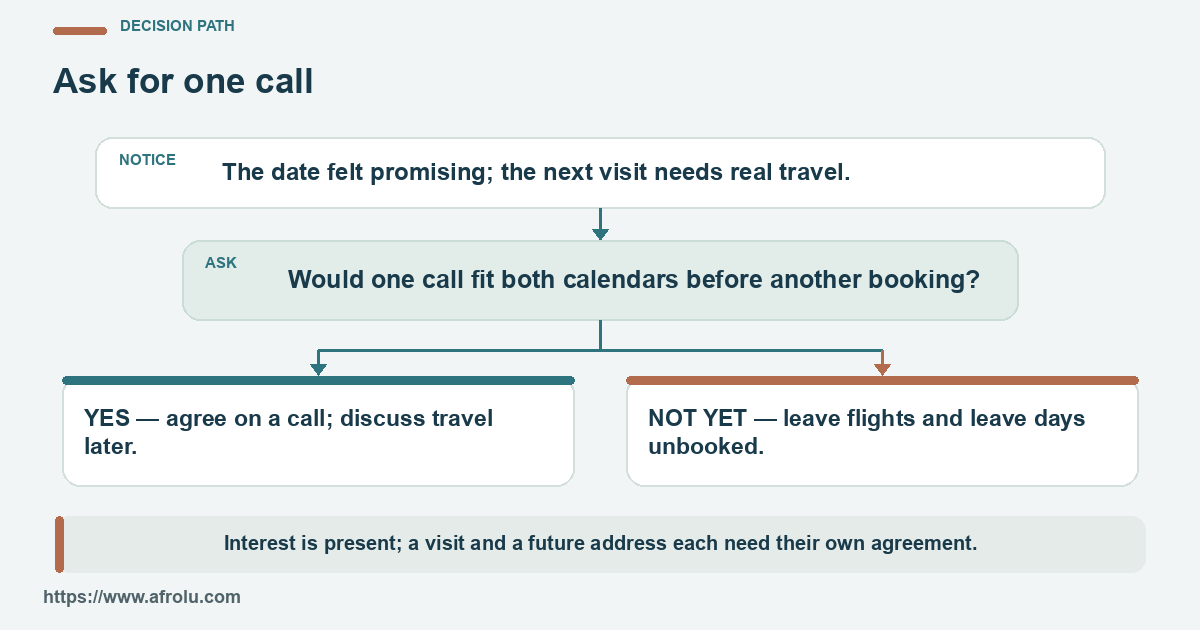
Both adults choose a convenient call; neither has promised a journey or future home.
One person treats a kind reply as permission to book travel or discuss relocation as settled.
Interest is present; a visit and a future address each need their own agreement.

Keep present contact separate from paid travel and relocation questions.
A chosen call and an assumed journey are different
| Type or dimension | What it describes | Best next question |
|---|---|---|
| Warm thanks | A message can appreciate the weekend without proposing a new trip. | Add a call question only if you want contact. |
| Call invitation | A suggested time is an option, not an appointment. | Wait for the other adult to choose a window. |
| Confirmed call | Both have agreed to talk at a particular time. | Keep the call manageable and revisit if a schedule changes. |
| Visit idea | Talking about another weekend does not reserve leave or lodging. | Check interest and feasibility separately. |
| Paid booking | A ticket or room creates a real cost for one adult. | Spend only after dates and independent arrangements are agreed. |
| Hosting request | A date at someone's home is a separate privacy and comfort decision. | Choose accommodation and a meeting place freely. |
| Money request | A fare or emergency story asks for funds, not proof of affection. | Keep finances separate from early dating. |
| Relocation talk | Exploring future possibilities is different from agreeing to move. | State what remains unknown about work, family and legal realities. |
| Serious intention | Hoping for commitment does not make this particular connection exclusive. | Discuss present terms if the connection continues. |
Six ideas for dating across distance
A scarce weekend can feel conclusive
Time together may be intense because visits are rare. Give ordinary conversations room to reveal how contact works between trips.
Name both clocks
Writing the two local times in a call invitation removes a small but common source of confusion.
A budget is information
If a journey is unaffordable, saying so early helps both adults plan honestly without making either person's resources a measure of care.
Separate accommodation preserves a choice
When another visit becomes realistic, lodging can be planned without assuming either adult will host.
An imagined home is not a plan
Long-term location depends on jobs, family and legal conditions that deserve their own conversation.
A call adds one observation
A good call may encourage another step; it cannot verify every claim or predict how a relationship will develop.
Questions for a call and possible visit
Choose a few prompts that fit the moment. This is a reference library, not a list to complete.
Draft the follow-up
Make the invitation small enough to answer today.
- Which Saturday detail can I mention truthfully?
- What call time works in both cities?
- Am I asking about a call rather than implying a ticket?
Price the possible visit
Do this only if both want to explore another meeting.
- What would the full fare and lodging cost me?
- Can I travel and return without depending on the other adult?
- Which date fits leave and family duties?
Discuss serious hopes
Separate near-term contact from a major life choice.
- What does serious mean for contact this month?
- Which questions about distance are still open?
- Would either of us require a move soon?
Review the answer
Base the next step on chosen actions.
- Did we agree on a call or only mention one?
- Was money or private proof requested?
- Do I want another conversation under these terms?
What research and guidance can—and cannot—tell you
Romance fraud
The FTC documents travel and emergency money requests in online romance scams.
Evidence limit: Its categorical do-not-send advice is for someone never met in person; this guide's pair has met, and the pattern is not a diagnosis.
Travel-money requests
A second FTC resource addresses requests for money from an online match.
Evidence limit: It describes an online scam pattern, not ordinary agreed travel expenses after an in-person date.
Digital privacy
Australia's eSafety Commissioner describes risks of sharing personal and location details on dating services.
Evidence limit: Its advice is Australian and cannot authenticate a profile.
Safer dating
RAINN recommends practical control over meeting place and transport.
Evidence limit: No checklist guarantees safety; RAINN's support contacts are U.S.-based.
Consent
RAINN explains voluntary, specific consent and respect for changing boundaries.
Evidence limit: This is general education, not Kenyan or destination-country legal advice.
Communication
love is respect offers prompts for describing personal boundaries.
Evidence limit: The examples are U.S.-based and do not prescribe a cross-border relationship timetable.
Travel assumptions that make a weekend heavier
Booking from a warm reply
A positive message is not agreement on a ticket, lodging or leave.
Treating one call as verification
A video conversation adds context but cannot prove every claim.
Assuming a future home
Serious interest does not decide whose city or country will become home.
Sharing identity documents
A new dating contact does not need passport or visa images for a call.
Funding a trip by pressure
A first date creates no duty to transfer fare or emergency money.
Reading time-zone gaps as motive
Reply timing alone cannot explain intent across different routines.
Suggest a call before another journey
These information links are clearly labelled, non-commercial and do not promise a relationship outcome.
Explore the guide library
Show more related guides
Continue with Afrolu
Show more Afrolu guides
Research and practical guidance used for this guide
Afrolu reviewed these health, research, safety, or public guidance resources while editing this page. They support the behaviour and safety guidance; they do not diagnose any individual described by a reader.
Questions after a cross-border weekend
Should I text after a weekend date when I live abroad?
If you want contact, mention a moment you enjoyed and propose one small next step. You need not promise another journey.
Do we need to decide which country to live in now?
No. A first date cannot settle work, family, immigration or housing decisions. Discuss those questions only as the connection develops.
Is a call before another visit reasonable?
Yes, if both adults want one. A call can add context while travel remains a separate choice.
What if our time zones make daily texts difficult?
Suggest a rhythm each person can sustain. Message frequency is not a reliable measure of care or intent.
Should I pay for their flight?
A first date does not obligate you to fund another journey. The FTC documents travel-money stories used in online romance scams; its categorical warning concerns someone you have not met in person.
Does a video call prove the person is who they say?
No. It can offer more context, but it cannot verify every claim or predict future conduct.
What if they ask for my visa or passport details?
Keep identity documents private. A new dating connection does not need document images to arrange a call.
Can I say I am serious without promising relocation?
Yes. Say what kind of relationship you hope to explore while keeping location and timing open.
What if another weekend is too expensive?
Say the expense does not work for you and decide whether a call or pause is preferable.
What if they go quiet after my invitation?
You can leave the invitation open for a time you choose, follow up once if you want, or move on without guessing the reason.
One thing to do now
Offer a call; decide on the journey later
Offer one conversation that fits both calendars; decide about another journey only after both adults choose its practical details.