After the first date · diaspora and casual terms
Explain casual terms after a first date across distance
After a first date away from home, explain casual dating terms clearly. Discuss calls and possible visits without implying exclusivity or promising travel.

Describe the contact and non-exclusive terms available now before discussing travel.
Written and edited by Amina Wanjiru · Senior Dating Apps Editor
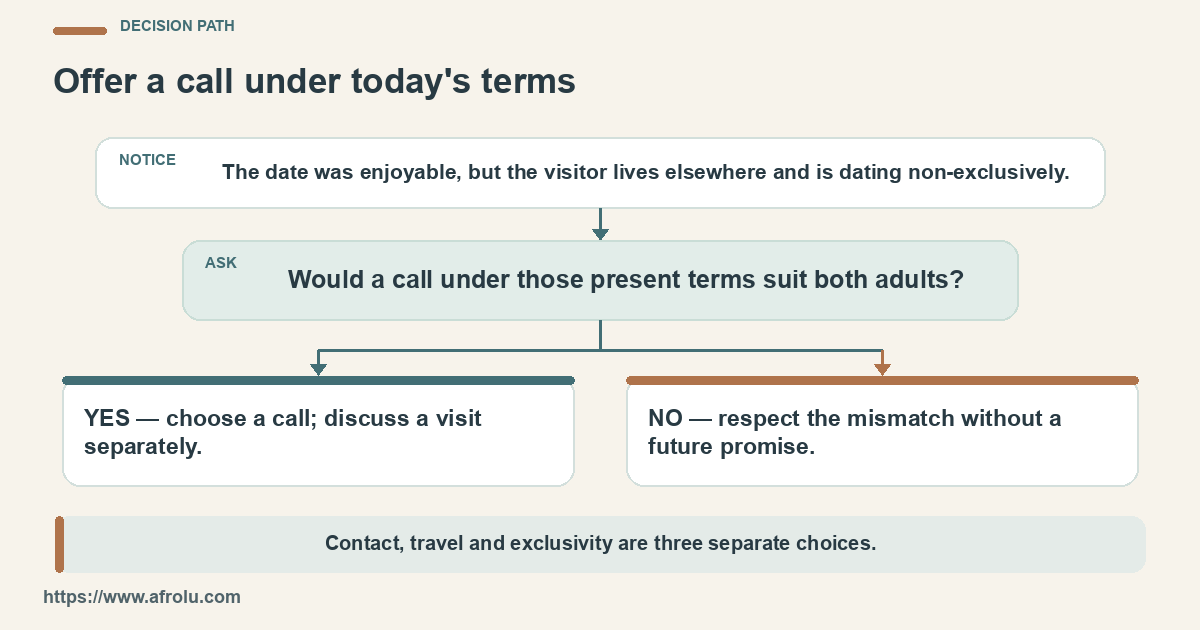
Thank the person for a real part of the date, then explain the arrangement you can offer now: perhaps an occasional call and non-exclusive dating. Ask whether that works for them. Treat any return trip, lodging or spending as a separate decision, and do not use the cost of distance to imply commitment. If they want exclusivity or a near-term visit, respect that difference rather than asking them to wait for a change you cannot promise.
First dates · Diaspora Daters
How can I follow up across distance when I would like to talk again but am dating casually and cannot promise another visit?
A clear casual-distance follow-up names present dating terms and one possible next conversation. It does not turn a warm date, a phone call or a journey into agreement about exclusivity, future travel or where either adult will live.
Illustrative scenario: A diaspora visitor and a local adult enjoy an afternoon walk through an open-air market before the visitor's coach home. Back in their usual city, the visitor wants to keep talking but is dating non-exclusively and has no return ticket. They mention a conversation at the market, describe the casual terms they can offer and invite one call. The local adult can accept, ask for a different arrangement or decline without being made to feel unreasonable.
Present terms · distance · choice
Make the current offer clear before discussing travel
Distance can make a rare date feel unusually important, while casual dating can mean different things to each adult.
Explain contact and exclusivity first. Discuss a trip only if both adults want one and its cost and accommodation are realistic.
What can repeat?
Offer a call rhythm you can keep from home.
What is true now?
Say plainly if you are dating other people.
What is still open?
Leave return fares and lodging unbooked.
Does this fit them?
Invite a different answer without bargaining.
Write the first note
Let the message describe the date you actually had
After returning to your usual city, it can be tempting to write as though the short visit made everything urgent. Begin with something that really happened: the market stall you explored, a conversation you enjoyed or a small kindness you appreciated. If you want another conversation, say so. The message can be warm without implying that you will travel again soon.
A first follow-up should not make the other adult decode a stack of travel hints. An invitation to call is easier to answer than a vague claim that you will be back before long. Offer a time window that fits both locations if you know one, while leaving room for them to suggest another time or decline altogether.
If you simply want to thank them and do not want more contact, a courteous close is more honest than proposing a call to soften disappointment. Conversely, if you would like contact, do not hide behind a safe-arrival receipt and hope they infer the rest. Make only the invitation you genuinely want to keep.
Define casual today
Non-exclusive should be understandable without a label test
Casual can refer to non-exclusivity, infrequent contact, no immediate relationship label or simply a slower pace. Those are different arrangements. Identify the part that matters here and say it in ordinary language. If you are also dating other people, that fact may affect whether this adult wants another call or date; do not rely on the word casual to communicate it for you.
Ask what the other adult would need to know before continuing. They may prefer exclusivity, regular calls or no cross-border connection. Their answer is not evidence that one of you is better at dating. It tells you whether the present arrangement can work without one adult silently waiting for the other to change.
love is respect distinguishes expectations from boundaries and encourages people to discuss terms instead of assuming the same meaning. Its guidance is U.S.-based education, not a rule for every relationship. Here the practical use is simple: state what you offer, hear what they want and decide whether those terms overlap now.

A fare or quick reply is not proof of exclusivity.
Keep travel separate
A return ticket is a purchase, not a measure of interest
If another meeting sounds appealing, let the idea remain an idea until both adults want to explore it. A return journey may need leave, a fare, lodging and local transport. The adult who lives nearby may have commitments of their own. Before anyone spends, ask whether a visit would suit both people and what each could realistically arrange without dependence on the other.
A person can afford a trip and still prefer casual dating; another may care deeply and be unable to travel. Money spent on a date does not establish exclusivity or a future home. Avoid suggesting that a paid journey proves how serious someone is. If one adult expects repeated visits as a condition of contact, that expectation deserves a direct answer before any booking.
Keep accommodation and private addresses as separate choices. An invitation to meet does not oblige a local adult to host, and a traveller need not hand over an itinerary or identity document to demonstrate interest. Discuss a public meeting plan when a visit is genuinely being arranged. A call now can be useful even if the next journey never becomes feasible.

Adapt the message to your own date and current arrangement.
Keep the exchange bounded
A casual call does not need private travel proof
A rough time zone and a call window are enough to arrange a conversation. Passport images, home addresses, account details and real-time travel routes are not needed for that purpose. Australia's eSafety Commissioner advises limiting personal information on dating services; the guidance is about platform privacy and cannot verify the intentions of a particular person you met in real life.
Digital boundaries also cover contact frequency. One adult may enjoy occasional calls while the other expects daily updates whenever the traveller is away. Discuss the rhythm as an adult preference rather than using response time as an honesty test. Each person can choose how much of their ordinary routine to share, and a change in contact preference should be said aloud.
Protect the local adult's information too. A date does not give you permission to send their photograph, workplace or personal account of the day to others. You can talk with a trusted friend about your own feelings without passing on identifying details. The goal is to keep the next decision informed while retaining ordinary privacy for both people.
Respect the answer
A mismatch is clearer than a hopeful placeholder
If they want exclusivity now and you do not, saying 'maybe after my next trip' can turn an honest difference into a waiting room. Acknowledge what they want and explain what you can offer. They may decide a casual-distance arrangement is not worth their time. Let that decision stand without treating it as rejection of your character or proof that your first date meant nothing.
If both want another call, agree on one time and see how the conversation feels. You need not pre-negotiate a month of texts or a flight. After more contact, ask whether the same terms still fit. A change in your preference is possible, but it should be described when it happens, not sold as a likely outcome in the first message.
You can also decide that distance makes even casual contact too difficult. In that case, a short, considerate close is useful. The purpose of clarity is to let two adults make real choices with the information available now. It cannot ensure that a promising date becomes a continuing connection.

Any future visit needs its own agreement and budget.
When distance makes a small offer sound large
A warm reply
The local adult likes the idea of talking again but has not agreed to casual terms.
Explain the terms before setting a call.A second city
One person suggests a call at a time that is late in the other city.
Offer windows with both local times.An exclusivity question
The other adult asks whether either person is seeing others.
Answer about the present, not a hoped-for future.A ticket offer
Someone proposes buying a return fare after one date.
Discuss desire and cost before either adult spends.A hosting assumption
The traveller suggests staying at the other person's home.
Treat lodging as its own optional decision.A daily-chat request
One adult wants constant contact while the other offered occasional calls.
Compare rhythms without diagnosing interest.A serious preference
The recipient wants an exclusive relationship now.
Respect the difference instead of promising to become ready.A changed preference
After more contact, one adult wants new terms.
Ask whether both choose the revised arrangement.Look for understood terms, not dramatic gestures
The message recalls a real part of the in-person date.
The sender says whether they are dating non-exclusively now.
A call is invited without suggesting a booked return trip.
The other adult can ask what casual means to the sender.
Neither adult infers exclusivity from an expensive journey.
Time zones are checked before naming a call window.
The local adult is free to want a relationship now and say so.
A visit idea stays separate from a fare purchase.
Lodging is not assumed to be at the other adult's home.
No identity or itinerary proof is demanded for a call.
The contact rhythm fits ordinary weeks in both locations.
A different answer is acknowledged without trying to bargain it away.
Any change to exclusivity is discussed before either acts on it.
A clear ending is available if the arrangement does not fit.
Keep each call, fare and label a separate choice
| Situation | What it may mean | What to do next |
|---|---|---|
| Before writing | A vivid market date can make a rare visit feel larger than the available arrangement. | Decide whether you want a call, another date or only a thank-you. |
| At the first sentence | The recipient needs to recognize this as a response to your real meeting. | Recall a market conversation before introducing terms. |
| When saying casual | The word can cover non-exclusivity, pace or limited contact. | Name the specific fact that may change their answer. |
| When offering contact | An occasional call is different from daily long-distance messaging. | Suggest a frequency and invite their preference. |
| When naming a call time | The same hour may be work or sleep in the other location. | Give both local times or ask for their window. |
| When travel comes up | Desire for a visit does not make a ticket or lodging feasible. | Discuss cost and separate accommodation before a booking. |
| When they ask about other dates | The answer informs whether they want non-exclusive contact. | State your current practice without promising a future change. |
| When they want exclusivity | The present arrangements may be incompatible. | Respect the preference and do not ask them to wait. |
| When a fare is requested | A new date creates no duty to fund a journey. | Decline the transfer and reconsider the contact plan. |
| After a call | More conversation may clarify fit without settling future travel. | Choose another call, a separately arranged visit or a kind close. |
Words for contact without a travel promise
“I enjoyed our walk through the market.”
“I am dating non-exclusively at the moment.”
“Would you like to talk next week while I am back home?”
“What would casual contact mean to you across distance?”
“A call now and then fits me better than daily updates.”
“I cannot promise another visit yet, but I would enjoy a call.”
“If we plan another date, I will arrange my own place to stay.”
“I am not comfortable paying for someone else's trip.”
“I understand that you want exclusivity now.”
“I cannot offer that arrangement at this stage.”
“My preference has changed; would you want to discuss new terms?”
“I appreciated meeting you, but this distance-and-pace arrangement does not fit me.”
Know the difference
Contact now is not a travel or exclusivity promise
Both know whether contact is non-exclusive, and a call is the only present plan.
A warm reply or costly ticket is treated as a promise of exclusivity or a future home.
Contact, travel and exclusivity are three separate choices.

A planned call does not decide a future home.
Separate today's terms from an imagined journey
| Type or dimension | What it describes | Best next question |
|---|---|---|
| Occasional calls | One possible present contact rhythm. | Ask if it fits both locations. |
| Daily messages | A different commitment of time. | Agree only if it can repeat. |
| Non-exclusive dating | A current term that can affect the choice to date again. | Say it directly. |
| A serious hope | A personal possibility, not today's offer. | Keep it separate from present terms. |
| A return visit | A discretionary journey with cost and leave needs. | Plan only after mutual interest. |
| A paid ticket | A purchase, not a relationship agreement. | Avoid treating spending as proof. |
| Independent lodging | A way to avoid an assumed host role. | Arrange it before travel if needed. |
| An exclusivity agreement | A new arrangement two adults must discuss. | Revisit explicitly when preferences change. |
| A respectful close | A legitimate answer to incompatible distance or terms. | End without a waiting promise. |
What a casual-distance follow-up can establish
Rarity amplifies meaning
A short visit may feel unusually important; the message still needs to describe only what is available now.
A label needs translation
Non-exclusive, occasional contact and no fixed next trip are different pieces of a casual arrangement.
Two time zones are two routines
A call window should be checked against work and sleep in both places.
Cost is not commitment
A person can pay for a journey without choosing an exclusive relationship, or care without affording travel.
Privacy belongs to both
Neither adult needs to disclose documents, home details or a live itinerary to arrange a call.
A mismatch can be useful
A clear no to present terms prevents a hopeful but unchosen waiting period.
Questions before a call or return fare
Choose a few prompts that fit the moment. This is a reference library, not a list to complete.
Before the note
Separate warmth from promises.
- Do I want a call or just a thanks?
- Which part of casual matters for their decision?
- Am I hinting at a trip I cannot plan?
Before the call
Make a small plan repeatable.
- Which window works in both places?
- What contact frequency can I sustain?
- Can they answer without pressure?
Before any visit
Keep expense and housing distinct.
- Do both adults actually want another date?
- Who will arrange lodging?
- Can each pay their own essentials?
If terms differ
Choose a respectful ending or new conversation.
- Is exclusivity a present need for them?
- Can I offer it now?
- Would a close be kinder than a future hint?
What the guidance supports and where it stops
Expectations
love is respect distinguishes personal boundaries from unspoken relationship expectations.
Evidence limit: U.S.-based education, not a rule defining casual dating for these adults.
Digital terms
love is respect suggests discussing expectations for text and social media contact.
Evidence limit: It does not prescribe a cross-border reply schedule.
Dating privacy
Australia's eSafety Commissioner advises limiting personal and location details in dating services.
Evidence limit: Australian platform advice does not verify an in-person date's motives.
Travel choice
RAINN offers public-meeting and independent-transport suggestions for early dates.
Evidence limit: U.S. guidance cannot guarantee safety or determine a specific travel plan.
Assumptions that turn casual contact into pressure
Using casual as shorthand
It may conceal non-exclusivity or an irregular contact plan.
Offering a phantom visit
A trip mentioned to sound warm can create an expectation no fare supports.
Treating expense as proof
A costly journey does not settle relationship terms.
Assigning a host
An enjoyable local date gives no right to stay in someone's home.
Reading a time gap as motive
Different locations and routines make timestamps weak evidence.
Selling eventual exclusivity
A future possibility should not be offered to retain someone who wants it now.
Name the casual terms before another journey
Read about casual terms and distance before deciding whether one call suits you.
Explore the guide library
Show more related guides
Continue with Afrolu
Show more Afrolu guides
Sources and their scope
Afrolu reviewed these health, research, safety, or public guidance resources while editing this page. They support the behaviour and safety guidance; they do not diagnose any individual described by a reader.
Questions about casual dating across distance
Can I ask for a call if I only want casual dating?
Yes. State the present non-exclusive terms and let the other adult choose whether a call fits.
Does buying a return ticket make the connection serious?
No. Travel costs are a practical choice and do not establish exclusivity or a future home.
Should I say that I am seeing other people?
If that fact affects the other adult's decision, say it clearly before another date rather than expecting 'casual' to explain it.
What if they want exclusivity now?
Acknowledge their preference and say what you can offer. Do not promise a later change to keep the conversation going.
Do I need to call every day across distance?
Only if that rhythm suits both adults. Discuss ordinary contact rather than using response speed as a test.
Could we meet again without deciding a relationship label?
Yes, if both understand the current terms and freely choose a feasible visit.
Should the local person host me?
A date does not obligate anyone to provide lodging. Discuss accommodation separately if travel becomes real.
Is a video call proof that everything they say is true?
No. It can add context but cannot verify every claim or predict future conduct.
What if distance makes casual contact too difficult?
Say so plainly and close the romantic plan instead of leaving an invitation open indefinitely.
When should we revisit exclusivity?
When one adult's actual preference changes and both want to discuss a new arrangement.
One thing to do now
Choose the arrangement both adults can accept now
Say what contact and exclusivity you can offer now; make travel a later, separately chosen expense.