Six tabs · no silent relationship upgrade
Keep a Casual Talking Stage Clear Without Forcing Commitment
An adult-student guide to honest casual talking stages: clarify contact, exclusivity, partners, testing, protection, consent, study boundaries and closure.
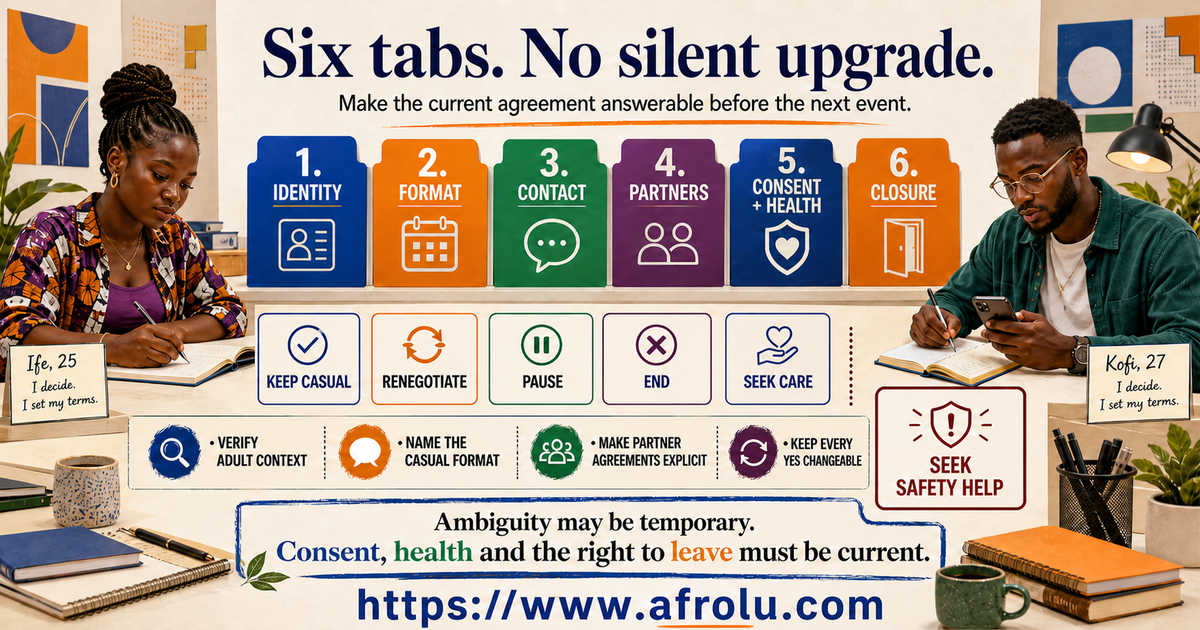
Casual can be honest when identity, format, contact, partners, consent, health and closure are answerable.
Written and edited by Nia Kato · Profile Advice Editor
Open six current tabs: IDENTITY, FORMAT, CONTACT, PARTNERS, CONSENT + HEALTH and CLOSURE. Name whether casual means exclusive, non-exclusive or undecided; protect classes, work, sleep and privacy; and update decision-relevant partner information without exposing third parties. Before sex, discuss testing, prevention and contraception relevant to the encounter. Messages, labels, gifts, alcohol, kissing, images, sex and future contact are separate choices. Keep casual, renegotiate, pause or end when facts or feelings change. Coercion, stealthing, stalking, outing, image abuse or blocked exit uses suitable safety help.
Early relationship discovery · Students
How can adult students keep a casual talking stage honest without forcing commitment, silently assuming exclusivity or treating a relationship label as consent?
A talking stage is a temporary low-agreement discovery period. Casual dating can remain ethical and clear when adults share the same present information about format, contact, partners, sexual health, consent and ending. Low commitment is not low responsibility, and commitment itself does not guarantee honesty or safety.
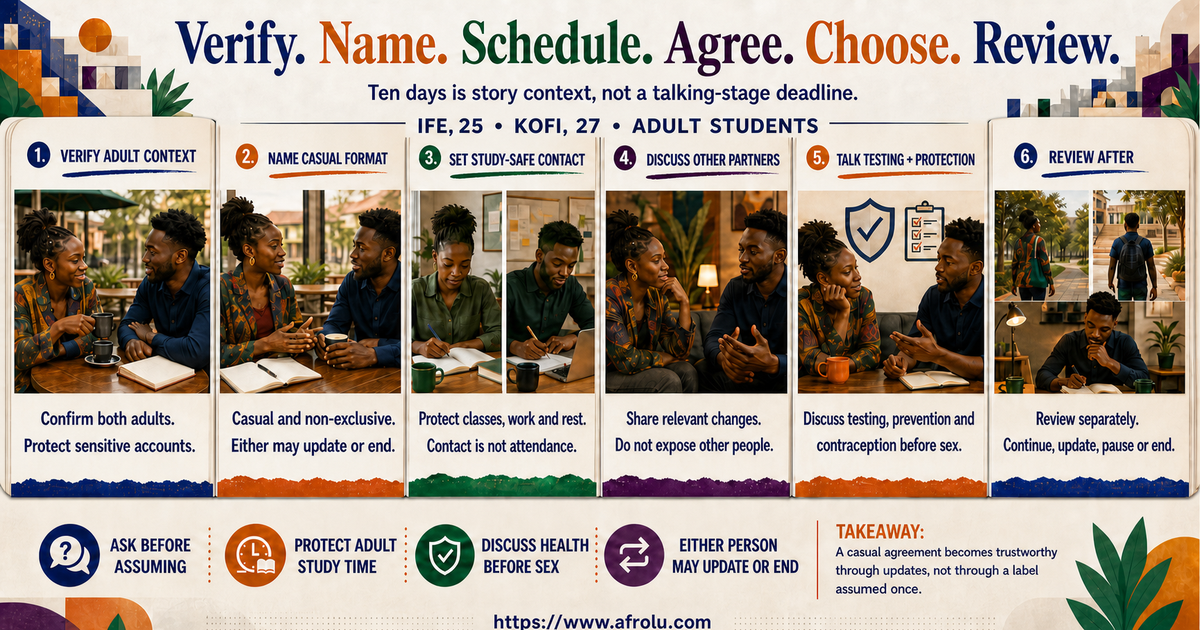
Ife, a fictional 25-year-old adult student, asks Kofi, 27, what casual means before a second coffee. They name non-exclusivity, study-safe contact, partner updates and health questions. Ife chooses kissing but not going home, and Kofi accepts. On day ten they keep casual contact, treating the timing as story context rather than a deadline.
The six-tab adult-student casual clarity lab
Keep commitment optional while partners, health, consent and closure stay explicit
Nia treats casual dating as a legitimate adult format and refuses the idea that ambiguity removes responsibility.
Name the format, protect student life, update partner context, talk health before sex and keep every ending available.
Name the present offer
Verify proportionately and describe what casual does not promise.
Prevent silent contracts
Protect study and state exclusivity or non-exclusivity directly.
Ask before the event
Discuss testing and prevention while every act keeps its own yes.
Keep the exit current
Renegotiate, pause or end without punishment or disappearance.
Open six agreement tabs
Identity, format, contact, partners, consent, health and closure stay current
IDENTITY asks whether each person is an adult and whether basic context is consistent, while protecting documents, portals and exact routines. FORMAT names casual, exploratory, friends-with-benefits, exclusive, non-exclusive or undecided in the adults' own words. 'Undecided' is valid when it is genuinely shared and does not hide a known incompatibility.
CONTACT covers message rhythm, study hours, public meetings and whether late-night calls are invitations or expectations. PARTNERS asks about exclusivity and what updates are required if other romantic or sexual connections exist. It does not demand names or gossip. The purpose is to support informed choices and reduce silent assumptions.
CONSENT and HEALTH remain distinct even though they share a tab on the visual. Consent is specific, voluntary, informed, reversible and affected by capacity; coffee, kissing, sexual messages, images, sex and overnight stays are separate. Health conversation includes relevant partners, testing, prevention, contraception where applicable and what each person needs before choosing sex.
CLOSURE states how either adult can pause, renegotiate or end. A talking stage should not require disappearing simply because it lacks commitment. Safety is the exception: when direct closure could increase risk, blocking, evidence preservation and suitable support may be more appropriate than a final message. No agreement removes the right to leave.
Follow a ten-day casual clarification
Ife and Kofi replace private assumptions with six current tabs
Ife and Kofi exchange messages after meeting at a public student event. They enjoy the attention but protect class and work hours. Before a second coffee, Ife asks what casual means to Kofi. He says he is not seeking exclusivity or a committed relationship now, and she says that format may fit if communication stays honest.
They agree on two message windows rather than constant contact and state that each may date other adults. They do not share other people's names. Before considering sex, they discuss current partner context, recent testing, prevention and contraception relevant to them. Neither treats a verbal summary or appearance as a medical result.
At a later public meeting, Ife chooses kissing and declines going home together. Kofi accepts immediately, arranges no transport for her and does not use their casual label to argue. They each leave independently. The next day, both confirm that no sexual exclusivity or automatic next meeting was created.
On day ten they keep the connection casual and agree to update before another sexual-health or format change. Ife could instead pause or end without failing the talking stage. Ten days is simply this fictional sequence, not a universal duration, consent window or deadline for defining a relationship.
Read twelve agreement signals
Every tab has a clear reading and a question or stop reading
IDENTITY is clear when adult context is proportionately consistent and sensitive accounts remain protected. Ask or stop when age, name, images or story repeatedly conflict. FORMAT is clear when both can describe what casual permits and does not promise. Redesign euphemisms that leave known differences hidden.
CONTACT is clear when study, sleep, work and friendship remain available and a reply gap is not punishment. PARTNERS is clear when exclusivity or non-exclusivity and update expectations are explicit. Stop surveillance, demands for third-party identity or claims that regular attention automatically creates romantic ownership.
CONSENT is clear when each act receives a freely changeable yes and intoxication, money, housing or academic power is not used to obtain it. HEALTH is clearer when partners can discuss testing, prevention and contraception without stigma. No statement, app badge or visual impression guarantees health status.
CLOSURE is clear when either adult can renegotiate, pause or end without threats, outing, image abuse or cross-account pursuit. A casual connection deserves basic communication when safe, but no one owes direct contact that increases danger. Appropriate support depends on whether the issue is mismatch, health, fraud, coercion or immediate safety.

No score can make consent or testing information true; direct conversation and freely chosen action remain necessary.
Use ten plain agreement lines
A clear casual format names contact, partners, health, consent and closure
For format Ife can say, 'I am open to casual, non-exclusive dating and not a committed relationship now.' For contact, 'I answer after class and do not treat daily messages as required.' These lines state what she offers. Kofi can accept, counter or decide that a different format would fit him better.
For exclusivity, 'We have not agreed to exclusivity' is clearer than relying on labels. For partners, 'I may date other adults, and I will tell you before a change that affects our sexual-health choices' shares decision-relevant information without identifying anyone else. Agreements should be revisited when facts change.
For health, Ife asks about recent testing, partners, prevention and contraception before sex. For consent, she can say that kissing is wanted and going home is not. For alcohol, she can state that she will not make sexual decisions when impaired. Each answer applies to the current event and remains reversible.
For privacy, neither adult shares student portals, intimate images as proof or another partner's health record. For closure, 'This casual connection no longer fits me, so I am ending it here' is complete. When contact becomes threatening or coercive, explanation stops and problem-specific safety action begins.

A casual label never answers a health, consent or exclusivity question by itself.
Update before the next event
Keep casual, renegotiate, pause, end or use the right support route
KEEP CASUAL when both adults still want the format and identity, contact, partners, health, consent and closure tabs remain clear. RENEGOTIATE when feelings, partner context, contact needs or sexual-health choices change. A proposal can be declined; asking for commitment does not create it, and preferring casual does not freeze the arrangement forever.
PAUSE when study, work, health, capacity or simple preference makes contact unwanted for now. END when the format, person or ambiguity no longer fits. Either decision can occur after affection or sex. Courtesy does not require an essay, and prior consent does not create continued access to body, home, phone or attention.
SEEK CARE when testing, contraception, exposure, symptoms or persistent distress needs qualified local assessment. A partner conversation is important but cannot substitute for appropriate clinical advice or results. Partners should not diagnose each other or use health disclosure to shame, threaten or force a relationship outcome.
SEEK SAFETY HELP for assault, coercion, stalking, outing threats, fraud, image abuse, blocked exit or exploitation of impairment. Depending on location and conduct, relevant routes may include campus, platform, health, legal or emergency support. The responsibility for abuse belongs to the person who commits it, not to the casual format.

An agreement stays honest only while either adult can update it without punishment.
Compare eight nearby formats and states
Casual, discovery, situationships, friendship, commitment, mismatch, impairment and pressure differ
HONEST CASUAL dating names low commitment, relevant partners, sexual-health choices and closure. A DISCOVERY STAGE keeps the future undecided while still answering present consent and health questions. Both can be ethical. Neither requires one adult to suppress feelings or pretend that changes will never occur.
A SITUATIONSHIP usually describes repeated closeness with important agreements left unclear or contested. FRIENDS WITH BENEFITS adds an existing friendship but still needs partner, health, privacy and closure agreements. Friendship can support easier direct communication, yet it does not automatically establish consent, exclusivity or safety.
COMMITTED DATING includes a mutually accepted relationship agreement but does not inherently guarantee honesty or prevent harm. MISMATCH appears when adults want different commitment, contact, partner or sexual arrangements without coercion. A respectful no or ending is sufficient; no format has a moral right to convert the other.
PERSISTENT IMPAIRMENT concerns severe or enduring difficulty with ordinary functioning and deserves qualified care when appropriate. UNSAFE PRESSURE includes coercion, stealthing, threats, stalking, image abuse, outing or blocked exit and uses a direct safety response. Casual dating never causes or excuses another person's abusive conduct.
Eight adult-student moments where a casual talking stage needs an update
Daily messages imply exclusivity to one person
Ife sees frequent contact as casual while Kofi assumes neither is dating anyone else.
Ask directly whether exclusivity exists and record the present answer.Study hours become an availability test
A delayed reply is treated as evidence that the casual connection is disrespectful.
Name the contact window and reject monitoring or academic sabotage.Another partner enters the picture
A change may affect what Ife needs to know before choosing sexual contact.
Update decision-relevant partner and health information before the next sexual event.Testing is discussed as a guarantee
A verbal statement is treated as proof that prevention and consent no longer need discussion.
Use qualified testing and keep each prevention and sexual choice explicit.Kissing is wanted and going home is not
The adults agree on one act, but the casual label is used to suggest the rest should follow.
Keep the yes specific and leave independently when the current plan ends.Feelings change after several meetings
Ife wants to explore commitment while Kofi still wants casual contact.
Propose renegotiation once and accept agreement, counteroffer or closure.A pause is interpreted as ghosting
Kofi wants space but has not stated whether the connection is ending.
Send one safe, concise update with no false return promise.Closure triggers image threats
Private material is used to demand continued contact or silence about harm.
Stop ordinary negotiation, preserve relevant evidence and seek suitable safety support.Twelve signals across identity, format, contact, partners, health, consent and closure
{'name': 'Adult identity context', 'detail': 'Basic facts are proportionately consistent without sharing portals, documents or exact routines.'}
{'name': 'Named casual format', 'detail': 'Both adults can describe what the current arrangement does and does not promise.'}
{'name': 'Study-safe contact', 'detail': 'Classes, work, sleep and friendships remain outside availability tests.'}
{'name': 'Explicit exclusivity', 'detail': 'Exclusive, non-exclusive or undecided is stated rather than inferred from attention or sex.'}
{'name': 'Relevant partner updates', 'detail': 'Changes affecting informed health or relationship choices are shared without exposing third parties.'}
{'name': 'Health conversation', 'detail': 'Testing, prevention and contraception where relevant are discussed before sex.'}
{'name': 'No health guarantee', 'detail': 'Neither adult treats appearance, trust, a label or one statement as proof of status.'}
{'name': 'Specific consent', 'detail': 'Messages, images, kissing, sex and overnight stays each retain separate answers.'}
{'name': 'Capacity-aware alcohol choice', 'detail': 'No sexual agreement is obtained through pressure or impaired decision-making.'}
{'name': 'Separate money and housing', 'detail': 'Fares, gifts, loans, rent, room access and study resources do not purchase intimacy.'}
{'name': 'Updateable agreement', 'detail': 'Either adult can ask for change without retaliation or automatic acceptance.'}
{'name': 'Complete ending', 'detail': 'Casual contact can end without threats, outing, image abuse or cross-account pursuit.'}
Review the current casual agreement through ten independent questions
| Situation | What it may mean | What to do next |
|---|---|---|
| Is adult identity context consistent? | Fits: Basic facts fit proportionate checks. Needs review: Important details repeatedly conflict. Stop: Documents, portals or codes are requested. | Verify proportionately and protect sensitive accounts. |
| Can both describe the format? | Fits: Casual and its limits mean the same thing. Needs review: Undecided hides different known expectations. Stop: A label is used to claim ownership or sex. | Define the current offer or end the mismatch. |
| Does contact fit adult study life? | Fits: Reply pace is chosen and respectful. Needs review: Attention becomes an all-day expectation. Stop: Delay triggers monitoring or academic sabotage. | Name the window and stop controlling access. |
| Is exclusivity explicit? | Fits: The current agreement is stated. Needs review: Frequency or sex is treated as implied exclusivity. Stop: Partner information is hidden despite a relevant agreement. | Ask directly and update before another affected choice. |
| Are partner updates sufficient? | Fits: Decision-relevant changes are shared. Needs review: Privacy and concealment are confused. Stop: Third parties are exposed, tracked or threatened. | Share needed facts without names and protect all privacy. |
| Has health been discussed before sex? | Fits: Testing, prevention and contraception are answerable. Needs review: Trust is offered instead of information. Stop: Coercion, stealthing or false documents appear. | Pause sex and use qualified health or safety support. |
| Is consent specific right now? | Fits: Each act has a free changeable yes. Needs review: One yes is being stretched into another. Stop: Pressure, impairment or threats remove free choice. | Stop, leave and use suitable support when needed. |
| Can the agreement change? | Fits: Either adult may propose and decline change. Needs review: Feelings are hidden to protect access. Stop: Renegotiation triggers retaliation or outing. | Ask once, accept the answer or protect access. |
| Can contact end cleanly? | Fits: A concise ending is accepted. Needs review: Ambiguity repeats instead of closure. Stop: Stalking, image abuse or cross-account pursuit follows. | Close when safe or move directly to safety response. |
| What does the current evidence support? | Fits: The honest casual route still fits. Needs review: Renegotiation or pause would create clarity. Stop: Danger bypasses ordinary discussion. | Keep casual, renegotiate, pause, end or seek help. |
Ten lines for format, partners, testing, protection, consent and closure
“I am open to casual, non-exclusive dating and not a committed relationship now.”
“I answer after class and do not treat daily messages as required.”
“We have not agreed to exclusivity; if either of us wants that, we need a direct conversation.”
“I may date other adults, and I will update you before a change that affects our choices.”
“Before sex, I want us to discuss recent testing and what the results do and do not cover.”
“I need us to agree on prevention and contraception relevant to this encounter before we continue.”
“Kissing is a yes; going home together is not part of tonight's plan.”
“I do not make sexual decisions when I am impaired, and I am leaving separately.”
“I do not share portals, intimate images as proof or another partner's private information.”
“This casual connection no longer fits me, so I am ending it here.”
Know the difference
Casual and committed formats differ in agreements, not moral worth
Format, contact, partners, sexual health, consent and closure are explicit even when a future relationship is not promised.
Important agreements remain contested, hidden or coerced and need renegotiation, closure, care or safety support.
Low commitment never means low responsibility.

The label matters less than whether both adults share the same present information and can leave freely.
Separate eight nearby casual, discovery, committed, mismatch and safety states
| Type or dimension | What it describes | Best next question |
|---|---|---|
| Honest casual dating | Low commitment, partner context, health, consent and ending are explicitly understood. | Keep updates current and revisit before affected events. |
| Discovery-stage dating | The future is undecided while present contact, consent and health questions remain answerable. | Set a review question without imposing a universal deadline. |
| Situationship | Repeated closeness exists while important format or exclusivity agreements remain unclear or disputed. | Ask directly, renegotiate or close instead of relying on attention. |
| Friends with benefits | An existing friendship and sexual contact coexist without automatic romance or exclusivity. | Protect friendship privacy and make partner, health and closure agreements explicit. |
| Committed dating | A mutually accepted relationship agreement exists but does not guarantee consent, honesty or safety. | Continue updating partners, health, boundaries and future expectations. |
| Ordinary mismatch | Adults want different commitment, contact, partner or sexual formats without coercion. | Decline the conversion and end respectfully. |
| Persistent impairment | Severe distress interferes with sleep, study, appetite, enjoyment or ordinary tasks over time. | Seek qualified local assessment rather than asking a label to solve it. |
| Unsafe pressure | Coercion, stealthing, stalking, threats, outing, image abuse or blocked exit changes the problem. | Protect access and use suitable campus, platform, health, legal or emergency support. |
Use the six-tab casual agreement board in six moves
Name the present format
Casual, exclusive, non-exclusive or undecided should mean the same thing to both adults.
Open six tabs
Identity, format, contact, partners, consent/health and closure stay current.
Protect study life
Attention never becomes a requirement to abandon classes, work, sleep or friends.
Talk health before sex
Testing, prevention and contraception need time for informed choices.
Keep every yes specific
A message, kiss, visit or label does not agree to another act.
Update or end cleanly
Feelings and circumstances can change without forcing commitment or disappearance.
Questions for format, partners, health, consent and closure
Choose a few prompts that fit the moment. This is a reference library, not a list to complete.
Format
Name what casual means now.
- Are we committed?
- Are we exclusive?
- What contact is expected?
- What is undecided?
- What would require an update?
Partners
Share needed context without surveillance.
- May we date others?
- What change must be shared?
- Which details stay private?
- What agreement affects health?
- Can either person renegotiate?
Health + consent
Ask before the event.
- What testing is recent?
- What prevention fits?
- What contraception applies?
- Which act is wanted now?
- What would stop the plan?
Closure
Keep the right to leave current.
- Does casual still fit?
- Do feelings need an update?
- Would a pause help?
- Can this end safely?
- Which support route fits?
What casual-partner, communication and sexual-health evidence can support
A daily-diary study compares evaluations and plans across casual sexual experience types
The work supports treating casual dating, friends-with-benefits and one-time encounters as diverse contexts rather than one uniform category.
Evidence limit: A small emerging-adult sample cannot predict an individual's outcome or prescribe a preferred casual format.
A qualitative study examines how young women describe sexual health across partner types
Participants' accounts support the importance of communication and show that relationship categories may not fit neat committed-versus-casual boxes.
Evidence limit: Qualitative perceptions from one sample cannot establish safety, consent or health status for another person.
Research characterises agreements with recent serious, casual and non-dating partners
The study supports asking directly about agreements and sexual-health communication across relationship types.
Evidence limit: The young MSM sample does not generalise to all adult students or supply a universal agreement model.
Research examines sexual communication and goals during the transition to college
The findings support making verbal communication, consent and goal differences visible in adult-student contexts.
Evidence limit: The study's setting, measures and age distribution cannot determine an individual's intentions or consent.
WHO frames sexual health around respect, safety and freedom from coercion
The current global resource supports a positive approach that includes information, care access and freedom from violence or discrimination.
Evidence limit: A global overview is not individual clinical advice, a test result or jurisdiction-specific consent law.
CDC recommends talking about testing and prevention before sex
The guidance supports discussing partners, testing and prevention with enough time for informed choices.
Evidence limit: U.S. general guidance should be adapted to relevant local clinical services and circumstances.
Six ways a casual stage becomes a silent contract or unsafe assumption
Treating casual as no rules
A format becomes permission to conceal or pressure. Repair: name present agreements.
Inferring exclusivity from attention
Message frequency becomes a silent contract. Repair: ask directly.
Demanding third-party details
Health clarity becomes surveillance. Repair: share decision-relevant facts without names.
Using trust as a test result
Affection replaces qualified information. Repair: discuss testing and prevention explicitly.
Stretching one yes
Kissing or a visit becomes assumed sex. Repair: keep each act separate and reversible.
Ghosting ordinary mismatch by default
Ambiguity continues unnecessarily. Repair: offer a concise ending when safe.
Use a reviewed resource that matches the decision
This guide focuses on the relationship decision, so it does not rank dating apps. Check current prices, safety tools, and local availability before choosing a service.
Explore the guide library
Show more related guides
Continue with Afrolu
Show more Afrolu guides
Adult casual-relationship research and current sexual-health guidance
Afrolu reviewed these health, research, safety, or public guidance resources while editing this page. They support the behaviour and safety guidance; they do not diagnose any individual described by a reader.
Adult-student casual talking-stage questions
What does a casual talking stage mean?
It means only what the adults currently agree it means. It may involve non-exclusive dates, sexual contact, companionship or simple discovery without commitment. Ask about format, contact, partners, health, consent and closure. Casual is not permission to conceal important facts, assume sex, avoid sexual-health discussion or punish someone for leaving.
How long should a talking stage last?
There is no universal duration. Ife and Kofi's ten days are fictional story context, not a deadline. Review whenever the current ambiguity affects choices about time, exclusivity, partners, sex or emotional investment. A direct conversation may preserve casual dating, support renegotiation or reveal a mismatch that should end.
Does daily texting make us exclusive?
No. Attention, affection, sex and exclusivity are different agreements. If exclusivity matters, ask directly and state what it would require from both adults. Until a mutual agreement exists, do not assume ownership. Also do not hide a relevant partner change when it affects an explicit health or relationship agreement.
Do I have to name other people I am dating?
Usually the other adult needs decision-relevant information, not names or private histories. Discuss whether other romantic or sexual partners exist, what exclusivity agreement applies and what changes require an update. Protect third-party privacy. Qualified health professionals can advise on testing and prevention relevant to your circumstances.
How should adult students discuss STI testing?
Talk before sex about recent testing, what was tested, timing, partners and prevention. A verbal summary is not a guarantee, and many infections may have no symptoms. Use qualified local services for personal testing and care. Testing never substitutes for consent, and a result does not force sex or a relationship.
Can I consent to kissing but not going home together?
Yes. Kissing, sexual messages, images, touch, sex, an overnight stay and future contact are separate choices. A yes can change. A casual label, earlier consent, alcohol, a gift or transport never creates entitlement. If someone pressures, threatens or blocks your exit, prioritise safety and appropriate support.
What if I develop feelings in a casual arrangement?
State the change without presenting it as a debt. You may ask to explore commitment or a different contact format. The other adult may agree, counter or decline. If casual no longer fits you, pause or end. Honest feelings do not force conversion, and preferring casual does not justify misleading you.
Should I ghost a casual talking stage?
When ordinary safety allows, a concise ending often reduces unnecessary ambiguity: say the connection no longer fits and contact is ending. You do not owe a debate. Skip direct closure when engagement may increase danger, and use blocking, evidence preservation or suitable platform, campus, legal or emergency support instead.
When should distress receive professional care?
Consider qualified local support when severe or persistent distress interferes with sleep, concentration, appetite, enjoyment, study, work or ordinary tasks. A relationship label cannot diagnose or treat it. Immediate self-harm risk or danger requires urgent local help rather than waiting for a talking-stage conversation.
What conduct should bypass renegotiation?
Assault, coercion, stealthing, stalking, fraud, outing threats, image abuse, exploitation of impairment or blocked exit is not an agreement misunderstanding. Stop ordinary negotiation when engagement increases risk. Preserve relevant records where safe and use appropriate campus, platform, health, legal or emergency resources for your location.
One thing to do now
Keep commitment optional and honesty current
Continue only while the current format, contact, partner agreements, health conversation, consent and closure route remain shared and freely changeable. Renegotiate, pause or end without forcing commitment. Use qualified local care for testing, exposure, contraception or severe persistent distress and appropriate campus, platform, health, legal or emergency support for unsafe conduct.