Eight-dial clarity room · careers and parents
Keep Careers and Parents Outside the Talking-Stage Decision
A practical talking-stage guide for busy adults: clarify intent, protect work and parent privacy, define status, keep consent specific and close safely.

Parent interest is context, not relationship authority.
Written and edited by Thabo Mokoena · Dating Trends Editor
Use eight independent dials: INTENT, RHYTHM, WORK, PARENTS, PLAN, STATUS, CONSENT and EXIT. Ask what exists now, turn real work constraints into specific counterproposals, protect employers and family networks, make public plans complete, and define status adult-to-adult. Choose CONTINUE, ASK ONCE, SCHEDULE, DEFINE, REDUCE, PAUSE, CLOSE, SEEK CARE or SEEK SAFETY HELP. There is no universal talking-stage deadline. Persistent impairment belongs with care; fraud, threats, tracking, coercion or workplace pursuit bypass ordinary review.
Early relationship discovery · Parents Returning To Dating
How can busy adults clarify a talking stage while keeping career constraints answerable and parents outside relationship authority?
A talking stage is an explicit exploratory adult route before mutually defined relationship status. It is not secret engagement, a family vote or permission for indefinite vagueness. Slow dating, ordinary work delay, situationship, mismatch, parent pressure, respectful closure, impairment and unsafe control are different routes.
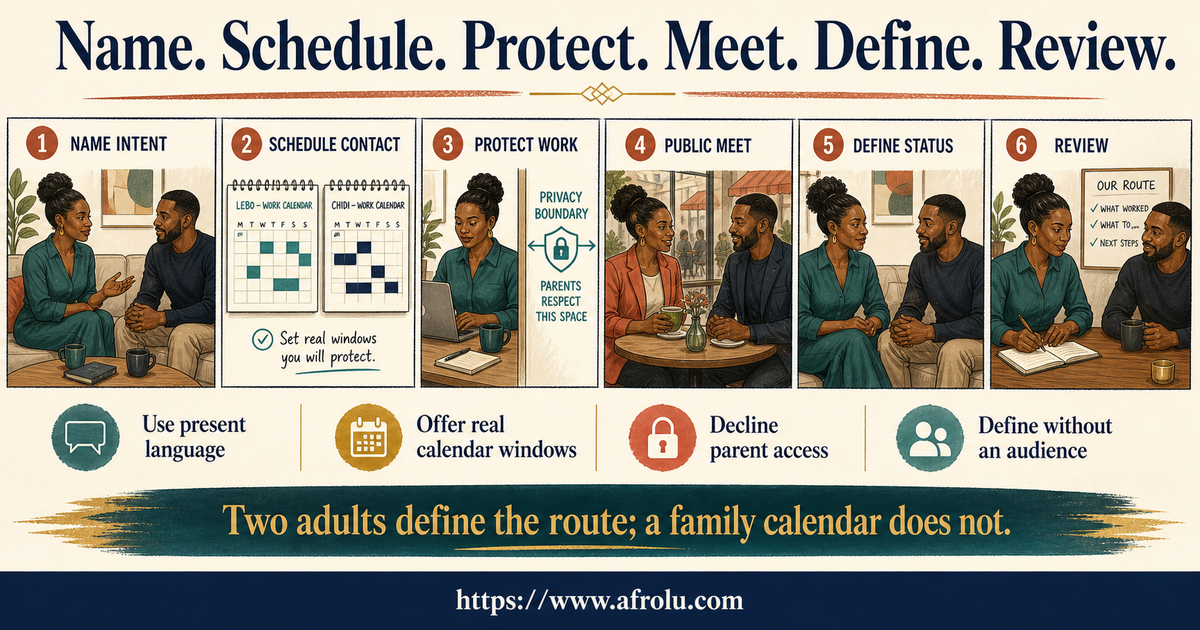
Across six fictional meetings, Lebo, 35, and Chidi, 39, name exploratory intent, choose two planned calls, protect work and parent privacy, and complete one public date. When their exclusivity offers differ, Lebo closes and Chidi accepts without involving family or colleagues.
The eight-dial career and parent clarity room
Let two adults operate the relationship calendar
Thabo separates intent, rhythm, work, parents, plan, status, consent and exit so third parties cannot silently define the route.
Ask what exists now, offer real windows, protect third-party privacy and route mismatch, care or danger precisely.
Name intent
Exploration and exclusivity remain separate agreements.
Make busy answerable
A real constraint receives a delivered counterproposal.
Protect third parties
Employers and parents stay outside status authority.
Keep exit direct
No can close work, family and contact routes.
A full calendar does not answer a relationship question
Give careers, parents and the talking stage separate places in the room
Career pressure creates real constraints: deadlines, travel, shift work, study, caregiving and professional privacy can narrow availability. Busy is not automatically vague. The useful distinction is whether a stated constraint produces a realistic counterproposal and delivered follow-through, or whether every request for clarity receives another indefinite future promise.
Parents may be curious, hopeful or worried, especially where family involvement carries cultural meaning. Their views can be heard without giving them authority over identity verification, introductions, exclusivity, timelines, money, home access or consent. Two adults define their route; parent enthusiasm cannot promote it and parent disappointment cannot end it.
Ask one present-tense question: are we exploring casually, exploring toward a relationship, exclusive, or not continuing? Then name contact rhythm and the next plan. Offer real calendar windows rather than unlimited availability. A counterproposal, honest mismatch or respectful no provides more clarity than prolonged schedule analysis.
Pause or close whenever the route is unwanted; no proof of bad motive or inadequate ambition is required. Persistent impairment belongs with qualified care for the affected person. Fraud, threats, tracking, coercion, workplace interference or defeated exits require direct protection rather than another family meeting or status conversation.
The eight-dial calendar control room
Separate intent, rhythm, work, parents, plan, status, consent and exit
INTENT asks what each adult is exploring now. RHYTHM names frequency, channel and how missed contact is repaired. A serious intention may still use limited contact; daily conversation may remain casual. The agreement is made through explicit language and delivered behaviour, not intensity alone. Either adult can reopen the question.
WORK protects employer names, locations, calendars, colleagues, devices and confidential information. PARENTS protects family names, contacts, schedules and influence. A parent may advise their adult child, but should not be recruited to investigate, persuade, negotiate status or pursue someone who has paused or closed contact.
PLAN names place, date, start, duration, ordinary cost and exit. STATUS states whether the route is exploratory, exclusive or closed without borrowing a family timeline. Schedule difficulty becomes answerable when it produces a real counterproposal. Repeated future talk without a workable plan leaves the current route unchanged.
CONSENT applies separately to information, images, introductions, touch and physical intimacy. Work success, family approval, gifts or time invested cannot pre-authorise access. EXIT keeps profiles, channels, workplaces, family networks, plans, money and physical space separately closable, and danger bypasses ordinary dial review. Every no must remain workable in practice.
Six meetings with no family vote
Watch Lebo and Chidi create one present agreement around demanding careers
Lebo says she is exploring toward a relationship but is not exclusive. Chidi says the same. They choose two planned calls a week instead of all-day messaging. When a deadline disrupts Chidi's call, he offers two specific replacement windows and completes the one Lebo chooses.
Lebo's mother asks to speak with Chidi. Lebo replies that introductions are not part of the current route and does not share his workplace or number. Chidi tells his father the same. Their families can hold opinions, but neither adult uses a parent to verify identity or pressure the other for status.
They complete one public dinner with separate transport, ordinary costs and a stated end time. After several weeks, Lebo asks whether the route should become exclusive. Chidi says he is interested but cannot offer that status now. He does not use work as a promise that exclusivity will appear later.
Lebo decides the mismatch does not work for her and closes the romantic route. Chidi accepts without involving parents, colleagues or new channels. The useful outcome is not exclusivity; it is an answerable agreement followed by respectful closure when offers differed. Both adults retain dignity and privacy.
Sixteen signals across a busy talking stage
Distinguish delivered clarity, schedule noise, parent pressure and unsafe access
At INTENT and RHYTHM, clarity means present language and a workable contact agreement. Vague contact repeatedly restarts warmth while status questions move into the future. Ordinary career delay names the constraint, offers a realistic alternative and completes it; a packed diary without a counterproposal is still no plan. Frequency alone proves neither route.
At WORK and PARENTS, respect protects professional and family information. Pressure appears through demands for employer proof, calendar access, colleague contact, parent interviews or family lobbying. Shared culture and good intentions do not convert third parties into relationship authorities or identity guarantees. Privacy can remain firm without disrespecting family.
At PLAN and STATUS, delivery means complete public logistics and an explicit current agreement. A parent dinner, holiday invitation or workplace event cannot silently create exclusivity. If adults want different routes, counterproposal or closure is clearer than letting family expectations carry an unresolved status. Attendance never substitutes for adult definition.
At CONSENT and EXIT, every introduction, disclosure and physical step stays reversible. Workplace pursuit, family channel bypass, threats, tracking, impersonation, financial exploitation or blocked movement changes the problem. Protect access and use fitting support without waiting for a final talking-stage verdict. Safety does not depend on first defining the relationship.

Busy adults still deserve answerable agreements.
Twelve lines for clarity without a performance review
Use words for intent, schedules, work privacy, parents, status, consent and closure
Intent can be direct: 'I am exploring toward a relationship, and I am not exclusive now.' Rhythm can be practical: 'I can call Tuesday or Thursday; which can you complete?' These lines name current offers without pretending either adult can guarantee future availability. A clear no remains an acceptable answer.
Work privacy can be brief: 'I do not share employer contacts, calendars or device access in a talking stage.' Parent privacy can be equally clear: 'Our parents may advise us, but they will not define or negotiate our status.' A respectful contact does not seek a second answer through family.
Plan language asks for public place, date, time, duration, ordinary cost and exit. Status language asks whether the route remains exploratory, becomes exclusive or closes. Gifts, career help, family introductions and schedule sacrifices never purchase consent, home access or relationship promotion. Gratitude is not romantic debt.
Closure needs no career or family verdict: 'We want different current routes, so I am closing the romantic contact.' When safe, one sentence is enough. If a contact reaches a workplace, relative or new channel after no, protect those routes rather than sending a longer definition.

Clear words protect both ambition and connection.
Choose the smallest supported agreement
Continue, ask once, schedule, define, reduce, pause, close, seek care or seek safety help
CONTINUE keeps the current wanted agreement. ASK ONCE requests one missing answer. SCHEDULE offers real windows and accepts a counterproposal. DEFINE names current status without demanding a future guarantee. These moves should be transparent rather than hidden tests of pursuit, ambition or family loyalty. Each permits an honest refusal.
REDUCE changes frequency or scope. PAUSE may be indefinite and does not reserve either adult. CLOSE ends the romantic route without declaring someone unserious, career-obsessed or disloyal to family. Shared time and parent enthusiasm can remain meaningful without obligating continued access. Closure does not erase what was valued.
SEEK CARE addresses persistent impairment in the affected adult through qualified local support, not remote diagnosis of a contact. SEEK SAFETY HELP addresses fraud, threats, tracking, coercion, workplace interference, channel bypass or blocked movement. Care and safety can coexist while using different evidence and authorities.
Review when real information changes, not against a universal talking-stage deadline or parent calendar. A question may produce agreement, counterproposal or mismatch. The aim is an answerable present route that protects work, family, money, consent and exit, not maximum speed toward status. Clarity can include a clean ending.

Definition is an adult choice, never a parent deadline.
Nine nearby routes around the shared calendar
Separate talking stage, slow dating, work delay, situationship, mismatch, parent pressure, closure, impairment and control
A TALKING STAGE is an explicit exploratory route. MUTUAL SLOW DATING is a jointly chosen lower-speed route that may carry defined intention. ORDINARY WORK DELAY states a constraint, gives a realistic counterproposal and delivers it. All three remain answerable despite different contact frequency, and all allow either adult to leave.
A SITUATIONSHIP is used here for ongoing intimacy or relationship behaviour without a mutually clear status. PLAN MISMATCH means adults want different availability or future scope while each remains free to close. PARENT PRESSURE recruits family expectation to compel access, status, patience or disclosure. None requires a motive diagnosis.
RESPECTFUL CLOSURE ends a mismatch without punishment. PERSISTENT IMPAIRMENT belongs with qualified assessment of the affected adult. UNSAFE CONTROL includes threats, tracking, workplace intrusion or defeated exits and belongs with protective planning. Fraud or immediate danger should also use their direct current authorities without another relationship test.
Several routes can coexist: slow dating can meet work delay, and mismatch can coexist with parent pressure. The strongest safety-relevant fact decides the immediate response. Relationship interpretation can wait until work, identity, family privacy, accounts, money and movement are protected. Concrete harm should never be averaged against family approval or career success.
Eight career and parent moments where the talking stage needs an adult answer
A planned call needs to move
A real constraint becomes clear through a specific replacement that is later completed.
Offer two workable windows.A mother asks for the other adult's number
Interest does not create access to a talking-stage contact or authority over status.
Keep the channel private.A job title becomes a demand for proof
Professional detail and colleague contact are not identity guarantees.
Use proportionate verification instead.Family inclusion is treated as exclusivity
A social invitation cannot silently define the adult relationship.
Ask the status question directly.A trip interrupts the usual rhythm
A named period and counterproposal differ from indefinite schedule language.
Review the delivered alternative.A referral is offered during the talking stage
Professional assistance can create pressure or privacy exposure before trust exists.
Keep work routes separate.One adult wants exclusivity and one does not
Neither offer is wrong, but the current routes differ and require a decision.
Counter or close cleanly.A closed contact reaches a colleague
Bypassing exit through work changes the question from mismatch to unwanted access.
Protect work and use fitting help.Fourteen signals across intent, rhythm, work, parents, plans, status, consent and exit
Exploratory or relationship-seeking intent is stated in present language.
Contact rhythm fits both adults and missed contact receives a real counterproposal.
Career constraints explain specific windows rather than indefinite future access.
Employer names, locations, calendars, devices and colleagues remain private.
Parents advise their adult child without contacting or negotiating with the other adult.
Family introductions do not silently create exclusivity or home access.
Meeting proposals include public place, date, duration, ordinary cost and exit.
Current status can be accepted, countered or declined without punishment.
Career help, gifts and family warmth never purchase relationship promotion.
Consent stays specific to each disclosure, image, touch and physical step.
A bounded question produces an answer, counterproposal or clear no.
Pause and closure work across profiles, parents, workplaces and physical access.
Persistent impairment is routed to qualified care without diagnosing a contact.
Fraud, threats, tracking, coercion or workplace pursuit bypass pattern review.
Review the shared calendar through ten independent questions
| Situation | What it may mean | What to do next |
|---|---|---|
| Is intent current? | Fits: Both adults name today's route. Needs review: One term needs definition. Stop: Only future promises appear. | Ask what exists now. |
| Is rhythm mutual? | Fits: Frequency and channels fit both. Needs review: One counterproposal is pending. Stop: Availability is demanded or decoded. | Agree, reduce or close. |
| Does busy become answerable? | Fits: A constraint gets a completed revision. Needs review: One real window is pending. Stop: Work repeatedly replaces a plan. | Count delivered alternatives. |
| Is work privacy intact? | Fits: Professional access stays separate. Needs review: One detail needs a boundary. Stop: Employer or colleague proof is demanded. | Protect professional routes. |
| Are parents advisory? | Fits: Each adult speaks for themselves. Needs review: One introduction needs review. Stop: Family negotiates status or access. | Return authority to the adults. |
| Is the plan complete? | Fits: Place, date, duration and exit are clear. Needs review: One detail is missing. Stop: A future event carries the route. | Complete or decline it. |
| Is status explicit? | Fits: The current label is mutual. Needs review: A definition talk is needed. Stop: Family events imply promotion. | Define without an audience. |
| Is consent separate? | Fits: Every step stays reversible. Needs review: One expectation needs wording. Stop: Effort or help is treated as access. | Separate gratitude from consent. |
| Does exit work? | Fits: No is respected everywhere. Needs review: One safe closure may help. Stop: Parents or workplaces bypass no. | Protect access directly. |
| Which authority fits? | Fits: Difference remains adult choice. Needs review: Impairment may need care. Stop: Fraud or danger needs protection. | Prioritise the strongest fact. |
Twelve lines for schedules, work privacy, parents, status and closure
“I am exploring toward a relationship, and I am not exclusive now.”
“Two planned calls a week work for me; all-day messaging does not.”
“I can meet Tuesday or Thursday; which can you genuinely hold?”
“I do not share employer contacts, calendars or device access.”
“Our parents may advise us, but they will not negotiate our status.”
“I am not arranging family introductions in this talking stage.”
“Please name a public place, date, duration and exit.”
“Are we exploratory, exclusive, or ending the romantic route?”
“Career help, gifts and family support do not purchase status or access.”
“Time invested never pre-authorises disclosure, touch or intimacy.”
“I am pausing this contact and will not set a return date.”
“We want different routes, so I am closing the romantic contact.”
Know the difference
A talking stage and a situationship need different evidence
An explicit exploratory route has a named rhythm, current intention and answerable next step.
Ongoing intimacy or relationship behaviour continues without a mutually clear current status.
Ask what is agreed now; do not infer status from frequency, work sacrifice or parent involvement.

Name the narrowest supported route before choosing the next authority.
Separate talking stage, slow dating, work delay, situationship, pressure, care and control
| Type or dimension | What it describes | Best next question |
|---|---|---|
| Talking stage | Exploration, rhythm and next step are explicit. | Continue or define when wanted. |
| Mutual slow dating | Both adults choose a slower developing route. | Review the shared pace. |
| Ordinary work delay | A real constraint receives a delivered revision. | Use the counterproposal. |
| Situationship | Relationship behaviour continues without mutual status. | Ask once and decide. |
| Plan mismatch | Adults want different availability or future scope. | Counter, reduce or close. |
| Parent pressure | Family expectation compels access, status or patience. | Restore adult authority. |
| Respectful closure | One adult ends the route without punishment. | Accept the ending. |
| Persistent impairment | Wider daily functioning remains affected. | Seek qualified local care. |
| Unsafe control | Threats, tracking or workplace intrusion defeats exit. | Protect access and use safety help. |
Use the eight-dial calendar control room in deliberate moves
Name present intent
Exploration and exclusivity are separate agreements.
Make busy answerable
A real constraint produces a delivered counterproposal.
Protect work
Employer, calendar and colleague access remain private.
Keep parents advisory
Adults define status and introductions themselves.
Separate plan and status
A family event does not create exclusivity.
Route precisely
Mismatch, care, fraud and control need different responses.
Questions for intent, work, parents, plans, status and exit
Choose a few prompts that fit the moment. This is a reference library, not a list to complete.
Intent and rhythm
Make the talking stage answerable now.
- What are we exploring?
- Which rhythm fits?
- What counts as repair?
- When do we review?
Work and parents
Protect two third-party worlds.
- What work stays private?
- What may parents know?
- Who speaks for whom?
- Which access is not offered?
Plan and status
Separate logistics from promotion.
- Which public plan?
- What is current status?
- What counterproposal exists?
- What closes the route?
Consent and exit
Match the response to the strongest fact.
- Continue or define?
- Reduce or pause?
- Does care fit?
- Does danger bypass review?
What current safety, fraud, privacy, consent and wellbeing guidance supports
eSafety covers privacy and safer meetings
The guidance supports proportionate verification and public, leaveable plans.
Evidence limit: No practice certifies another adult.
FTC guidance describes money and investment requests
The material supports separating career claims and affection from transfers.
Evidence limit: U.S. routes do not replace local remedies.
Kenya ODPC explains personal-data scope
The context supports protecting work, family, location and identity information.
Evidence limit: It is not personalised legal advice.
eSafety explains voluntary consent
The guidance supports specific, informed and reversible agreement.
Evidence limit: It does not replace local law.
eSafety describes technology-facilitated control
The material supports taking workplace pursuit and channel bypass seriously.
Evidence limit: Australian services may differ locally.
WHO describes wellbeing and functioning
The context supports qualified care for persistent impairment.
Evidence limit: A fact sheet cannot diagnose an individual.
Six ways busy schedules and family hope can replace an adult answer
Treating busy as an answer
A calendar replaces the relationship question. Repair: ask for a counterproposal.
Using parents as investigators
Family becomes identity proof. Repair: preserve private routes.
Letting an introduction imply status
Warmth silently promotes the route. Repair: define directly.
Sharing work access to prove trust
Professional privacy becomes exposure. Repair: verify proportionately.
Running an availability test
Silence provokes pursuit. Repair: offer real windows.
Waiting for a perfect moment
Indefinite future language carries the route. Repair: decide from today.
Use a reviewed resource that matches the decision
This guide focuses on the relationship decision, so it does not rank dating apps. Check current prices, safety tools, and local availability before choosing a service.
Explore the guide library
Show more related guides
Continue with Afrolu
Show more Afrolu guides
Current safety, fraud, privacy, consent, control and wellbeing guidance
Afrolu reviewed these health, research, safety, or public guidance resources while editing this page. They support the behaviour and safety guidance; they do not diagnose any individual described by a reader.
Talking-stage questions about careers, parents and clarity
How long should a talking stage last?
There is no universal deadline. Review whether current intent, rhythm, next plan and status are answerable and wanted. You may ask once, define, reduce, pause or close whenever the present route no longer fits.
Does being busy excuse unclear communication?
A real workload can reduce availability, but clarity remains possible. A useful delay names the constraint, offers a realistic alternative and completes it. Indefinite future language without a counterproposal leaves the relationship question unanswered.
When should parents know about a talking stage?
There is no required moment. Each adult controls what family knows and whether introductions occur. Parents may advise their adult child, but they should not contact, investigate, negotiate with or pressure the other adult.
Does meeting parents mean we are exclusive?
No. A family introduction and relationship status are separate agreements. Ask directly whether the route is exploratory, exclusive or ending. Warmth, cultural significance and parent enthusiasm do not create consent or status.
Can I keep my workplace private?
Yes. A talking-stage contact is not owed employer names, precise locations, calendars, colleague contacts, devices or confidential information. Use proportionate identity steps and keep work routes outside romantic proof.
How do I ask for clarity without creating pressure?
Describe the current pattern, state what you need and offer one bounded question. The other adult may accept, counter or decline. A decision point becomes pressure only when no or mismatch is punished.
What if our career plans do not align?
Name the specific difference: location, hours, travel, contact rhythm or future scope. Counter if a workable design exists; otherwise reduce or close. Incompatibility does not prove that either adult lacks ambition or commitment.
Should parents help verify someone?
A parent may support reflection, but cannot certify identity or safety. Protect family contacts and schedules. Use platform controls, proportionate identity steps, public meetings and independently verified logistics instead.
When does stress belong with professional care?
Persistent changes in sleep, concentration, appetite, enjoyment or daily functioning deserve qualified local assessment. Care supports the affected adult without diagnosing a dating contact from work habits or message frequency.
What should bypass a status conversation?
Threats, tracking, impersonation, fraud, image abuse, account compromise, workplace pursuit, family channel bypass or blocked movement need direct protection. Use relevant platform, employer, financial, legal, health or emergency routes.
One thing to do now
Let adults define the route and keep work, parents and consent separate
Continue only while intent and rhythm are explicit, busy periods produce delivered counterproposals, work and parents remain protected, plans and status are separate, consent is specific and every exit works. Define, reduce, pause or close without career or family judgment. Route impairment to care and danger to protection.