Eight junctions · one visible Nairobi turn
Map a New Nairobi Talking Stage One Low-Pressure Turn at a Time
A Nairobi talking-stage guide to identity, messaging rhythm, intent, public meeting routes, fares, consent and closure—without invented status or pressure.
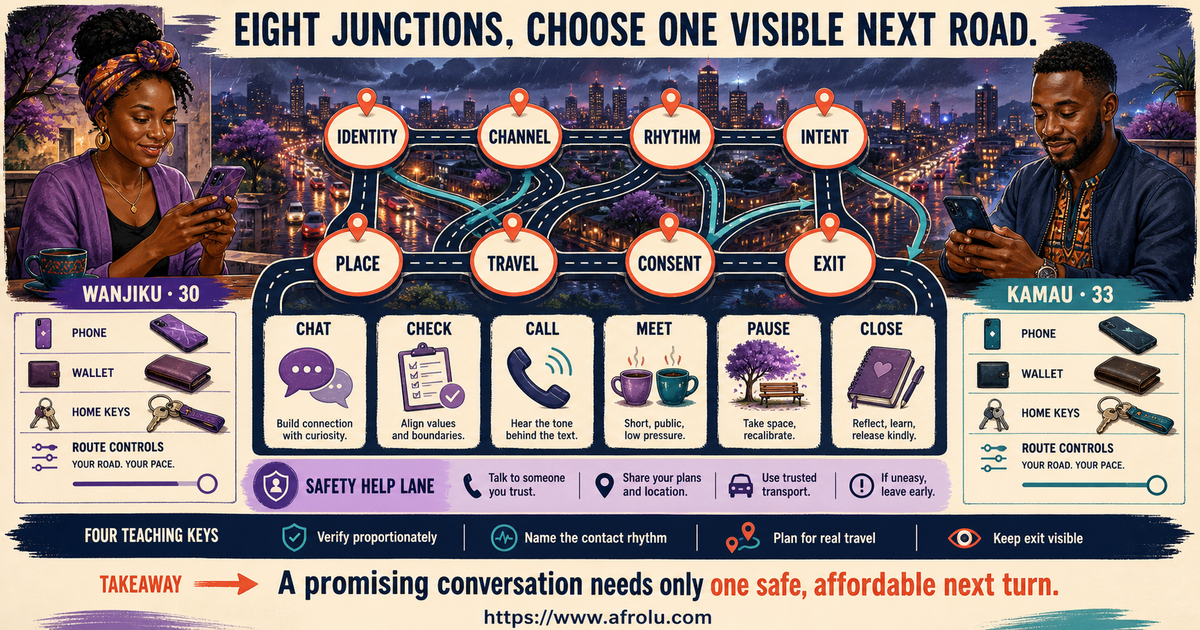
Low pressure is a route with a real no, not a route with no signs.
Written and edited by Grace Mutiso · Kenya Guides Editor
Use eight independent junctions: IDENTITY, CHANNEL, RHYTHM, INTENT, PLACE, TRAVEL, CONSENT and EXIT. Request one proportionate identity check, keep channel changes voluntary and name whether the adults are chatting, exploring casually, open to serious partnership or undecided. Build one public staffed meeting with real time, fare, weather, accessibility and separate return, without sharing a home pin. Keep every image, touch and health decision separate. Then CHAT, CHECK ONE FACT, CALL, MEET ONCE, PAUSE, CLOSE, SEEK CARE or SEEK SAFETY HELP. Only mutual agreement—not message volume or city effort—creates status.
Early relationship discovery · New Relationship Starters
How can two adults move a promising Nairobi talking stage toward one safe, affordable and answerable next step while keeping identity, channels, intent, consent and exit independently controlled?
A talking stage is an informal period when adults communicate and learn about one another before a defined dating agreement. In Nairobi it may include real city logistics, but it does not automatically establish a date, casual arrangement, serious relationship, exclusivity, identity or safety. The eight-junction route separates those questions and nearby risks; it cannot verify a person, rank neighbourhoods, calculate compatibility or replace current local advice.
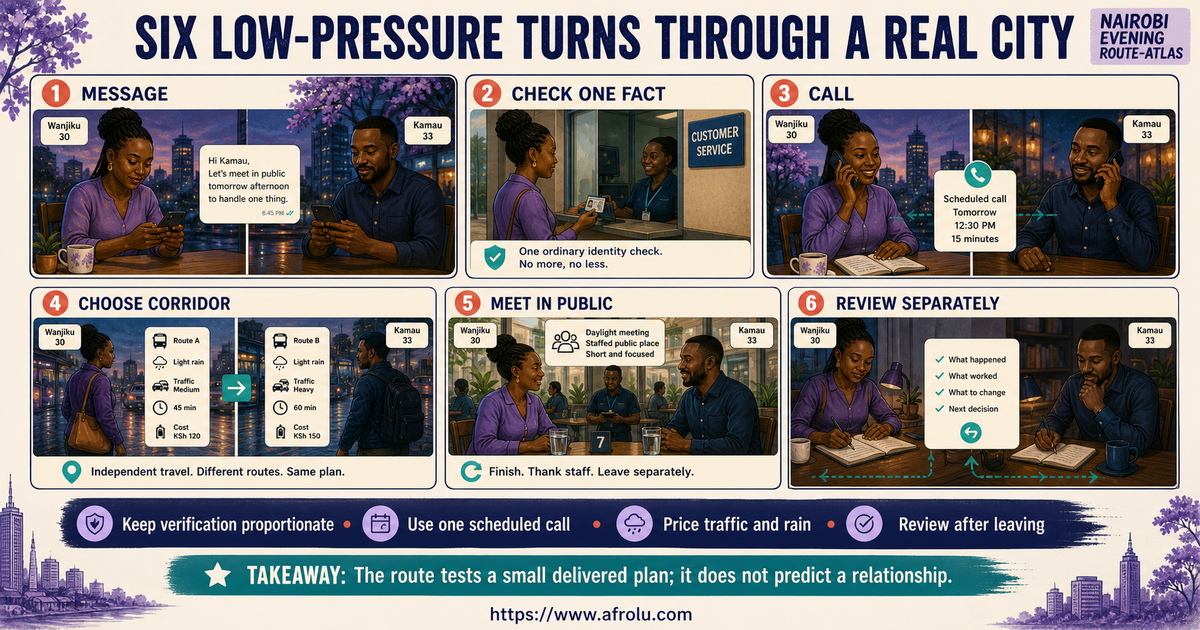
Wanjiku, a fictional 30-year-old Nairobi adult, and Kamau, 33, take five conceptual turns from messages to one public meeting. They keep a channel move optional, schedule a call, name early intent, choose a mutually workable corridor, account for traffic and rain, pay and travel independently, and review after leaving. Their route uses no real business, exact address, transit operator, copied map, app screen or claim that Nairobi itself is dangerous.
The Nairobi eight-junction low-pressure talking-stage route
Translate message energy into one visible city turn without inventing status
Grace maps identity, channel, rhythm, intent, place, travel, consent and exit as independent Nairobi choices rather than one chemistry score.
Ask only for the fact that changes the next step, plan the entire public journey and let mutual agreement—not effort—name the relationship.
Keep identity checks ordinary
One proportionate call can inform a choice without documents, codes or fees.
Name the rhythm and intent
Real daily life and present purpose matter more than message volume.
Route the whole city
Public place, traffic, weather, fare, accessibility and return form one plan.
Leave status to agreement
A meeting can end warmly without creating exclusivity or another date.
Begin before the first junction
Treat the talking stage as an informal period, then name every agreement it does not contain
A bright new Nairobi conversation can move quickly across voice notes, calls and imagined plans because the city feels both close and logistically large. Wanjiku may enjoy Kamau's daily messages while still knowing almost nothing about identity, dating scope or availability. Calling that period a talking stage is convenient, but the label does not decide whether either adult is casual, serious, exclusive or ready to meet.
Low pressure is sometimes mistaken for refusing to ask direct questions. In practice, pressure stays low when a proposal has edges: one purpose, one time, one place and a usable no. 'We should link up somewhere' makes the recipient carry route design. 'Would you like coffee Saturday at two for an hour near a corridor we both use?' creates an option rather than a cloud.
Nairobi logistics belong in the decision without becoming stereotypes. Traffic can expand travel time, rain can change walking conditions, fares can shift, a night route can be less convenient and two neighbourhoods can require an awkward crossing. These are planning facts, not evidence that the city or a person is unsafe. Each adult can choose a staffed public venue and independent return suited to current conditions.
The eight-junction map keeps questions separate. IDENTITY, CHANNEL, RHYTHM and INTENT describe the connection; PLACE and TRAVEL build one meeting; CONSENT and EXIT preserve control. A pleasant answer at one junction never grants another. Wanjiku can verify one ordinary fact, enjoy a call and still decline the meeting, while Kamau can decide the offered rhythm does not fit.
Read the city one turn at a time
Move through identity, channel, rhythm, intent, place, travel, consent and exit
IDENTITY asks for proportionate consistency rather than a document dump. A scheduled video or voice call, ordinary answers and details that remain coherent can inform a decision without guaranteeing account control. CHANNEL asks where contact will happen and what data that change exposes. Moving off-platform can be freely chosen; it should not be demanded as proof of interest.
RHYTHM defines how often and when contact is welcome. Nairobi commutes, work shifts, caregiving, faith, study and rest may make asynchronous conversation practical. The explanation does not need surveillance. INTENT names whether the adults are chatting, considering a first date, exploring casually, interested in serious partnership or undecided. None of those answers creates exclusivity unless both explicitly agree it.
PLACE turns the imagined city into a real public setting. Choose a staffed venue, an accessible meeting point and a duration that allows either adult to leave. TRAVEL includes realistic time, weather, fare, route changes and a complete independent return. Neither adult needs an exact home pin, live tracking or control of the other's transport to make the plan believable.
CONSENT keeps messages, calls, photos, location sharing, meeting, touch and intimacy separate. EXIT ensures a counteroffer, pause or no is accepted. If closure produces threats, impersonation, cross-account pursuit, blackmail, non-consensual tracking or blocked movement, bypass the route map and use appropriate platform, legal, health or emergency support.
A new journey with no express lane
One fictional story converts message energy into a public meeting and a separate review
Their first turn is a lively message exchange. Kamau asks to move immediately to a private channel. Wanjiku says she prefers one scheduled voice call before sharing another contact point. He agrees without complaining. That response is useful present evidence at CHANNEL, but it does not verify every identity claim or entitle him to her location.
During the call, both say they are open to meeting and are not yet making a relationship agreement. Wanjiku offers a Saturday daylight window. Kamau suggests a public staffed venue along a corridor both can reach. They compare likely journey time, keep their fares separate and agree to confirm before either leaves if heavy rain materially changes the route.
On Saturday, traffic makes Kamau late. He sends notice before the agreed time and offers Wanjiku a complete choice: wait fifteen minutes, shorten the meeting or reschedule. She chooses the shorter meeting. They talk for an hour, pay separately, do not exchange home details and leave by their own routes. A delivered meeting remains one event rather than implied status.
Later, Wanjiku reviews whether the contact rhythm, intent and city effort fit her. Kamau does the same. Either can ask for another date, counter with a slower rhythm, pause or close. The story's useful result is not that Nairobi chemistry wins; it is that the adults translate a large city into small decisions while every junction remains visible.
Use route language that can receive a no
Make identity, rhythm, location and intent answerable without turning clarity into an interview
At IDENTITY, Wanjiku can say, 'Before we move channels, I would like one scheduled call.' She does not need Kamau's ID number, workplace file or neighbourhood address. At RHYTHM, she can say, 'I enjoy our messages, and weekday replies may be slow. A planned evening call works better than all-day checking.' Kamau may want something different and say so.
At INTENT, use present categories rather than a future performance: 'I am open to a serious relationship over time, but this is still an early conversation,' or 'I am exploring casually and not offering exclusivity.' If the answers do not match, the adults can close before designing a city route. Low pressure includes a clean mismatch, not just an agreeable outcome.
For PLACE and TRAVEL, offer a corridor, not a residence: 'A staffed public place near this general area works; I will arrange my own trip home.' Add a duration and cost ceiling. If rain or traffic changes the route, send a concrete update before departure and give a choice. Vague delays become less burdensome when nobody is stranded or forced to reveal a live location.
At EXIT, direct language is enough: 'I do not want to continue this dating conversation. Please do not contact me through another account.' There is no requirement to meet for closure. When unwanted contact escalates, preserve relevant evidence where safe, protect accounts and devices and choose the local support route that matches the actual conduct.

A clear city plan protects warmth from guesswork.
Protect the roads around the date
Keep personal data, payments, movement, consent and sexual health independently controlled
Kenya's data-protection context makes a simple point practical: names, contact details, online identifiers, locations and documents may be sensitive personal data. Share only what the present action needs. A dating contact does not require an ID copy, account code, exact home pin, employer system or financial credential to arrange one public meeting.
Fake verification and romance-fraud routes can arrive as fees, emergency fares, investments, account recovery or a link that requests identity and payment details. Do not send money or credentials to keep a new journey moving. Contact platforms, banks or relevant authorities through details you find independently, and preserve only the records that are useful and safe for a legitimate process.
Meeting safety is practical rather than theatrical. Choose a public staffed setting, tell a trusted person what is useful, maintain communication and keep an independent return. Consider accessibility, weather, battery, fare and the time a chosen route operates. These controls should fit the adults and current conditions; they are not claims that every Nairobi meeting carries the same risk.
Consent remains specific, voluntary, informed and reversible. Agreement to move channels does not grant images; agreement to meet does not grant touch; a previous yes does not control a later choice. Before sex, adults can discuss partners, testing, prevention and contraception. If fear, coercion, intoxication or blocked movement affects choice, stop the ordinary route and seek appropriate help.

One unsafe fact overrides every pleasant message and completed turn.
Do not let the talking stage absorb every route
Separate first-date planning, casual dating, serious exploration, relationship, mismatch, fraud and control
A talking stage is an informal period of learning before a defined dating agreement. First-date planning is narrower: adults are building one meeting without promising a continuing arrangement. Casual dating involves an agreement to see each other without a current serious commitment, while serious exploration names a long-term direction that remains provisional. Each route needs its own questions about frequency, partners and closure.
An agreed relationship exists only after mutual discussion, not because the adults message daily, cross town or meet several times. Exclusivity remains a separate agreement even within serious exploration. Scope mismatch occurs when one adult believes the route is casual and another treats it as exclusive, or when contact and meeting expectations cannot be reconciled. Clarity may reveal a respectful ending.
Persistent impairment can coexist with any label when sleep, concentration, appetite, enjoyment or ordinary functioning changes severely or across settings. Qualified local assessment is more appropriate than trying to optimise the talking stage as treatment. Ordinary nervousness, traffic frustration or disappointment should not automatically be medicalised.
Romance fraud and unsafe control are not relationship stages. Money requests, fake verification, impersonation, threats, tracking, blackmail, isolation or blocked movement require direct protective action. A good call, shared serious intention or completed public date cannot average them away. Use the narrowest factual route and the authority suited to it.
End the map at a real decision
Chat, check, call, meet, pause, close, seek care or seek safety help
CHAT when the conversation itself is wanted and no meeting is being implied. CHECK ONE FACT when a proportionate identity or logistics question would change the next action. CALL when a scheduled conversation offers useful context without unnecessary data. MEET ONCE when scope, place, travel, money, consent and exit are sufficiently clear for one public plan.
PAUSE when contact displaces rest or ordinary life, or when no action is wanted. CLOSE when the rhythm, intent, logistics or connection does not fit. Neither choice needs an accusation, a final in-person discussion or a promise to reconsider. A city with many routes does not make every promising message a missed chance.
SEEK CARE when distress or impairment is severe, persistent or widespread enough to need qualified assessment. SEEK SAFETY HELP when fraud, threats, coercion, tracking, impersonation, image abuse or blocked movement is present. The local platform, financial, legal, health or emergency route should be selected from current facts, not from the talking-stage label.
After the choice, release unnecessary location and contact data, stop checking another person's activity and keep only records needed for a safe legitimate process. Wanjiku and Kamau can meet again, take different roads or end here. The map succeeds when both adults remain able to choose—not when every junction reaches a relationship.

A paused or closed route is complete; the city does not owe every conversation a meeting.
Eight Nairobi talking-stage turns where one junction changes the route
The instant channel move
The all-day reply expectation
The vague city invitation
The rain-adjusted plan
The cross-city sacrifice
The home-pin request
The verification fee
The closure detour
Sixteen signals across identity, channel, rhythm, intent, place, travel, consent and exit
{'label': 'Identity opens choice', 'description': 'Ordinary details remain coherent and a proportionate check is accepted.'}
{'label': 'Identity narrows choice', 'description': 'Documents, codes or money are demanded as proof.'}
{'label': 'Channel opens choice', 'description': 'A platform move is optional and privacy consequences are understood.'}
{'label': 'Channel narrows choice', 'description': 'A private number or image becomes a loyalty test.'}
{'label': 'Rhythm opens choice', 'description': 'Reply expectations fit real work, travel and rest.'}
{'label': 'Rhythm narrows choice', 'description': 'Delayed replies trigger guilt, monitoring or punishment.'}
{'label': 'Intent opens choice', 'description': 'Current purpose is stated without silently creating exclusivity.'}
{'label': 'Intent narrows choice', 'description': 'Future promises are used to bypass present agreement.'}
{'label': 'Place opens choice', 'description': 'The venue is public, staffed, accessible and mutually chosen.'}
{'label': 'Place narrows choice', 'description': 'Home or isolated access is pressed after a decline.'}
{'label': 'Travel opens choice', 'description': 'Time, fare, weather and independent return are workable.'}
{'label': 'Travel narrows choice', 'description': 'Live location or transport control is demanded.'}
{'label': 'Consent opens choice', 'description': 'Every step can receive a yes, counteroffer, pause or no.'}
{'label': 'Exit narrows choice', 'description': 'Closure leads to threats, impersonation or cross-channel pursuit.'}
Read the new journey through ten independent city questions
| Situation | What it may mean | What to do next |
|---|---|---|
| Is the identity check proportionate? | Fits: One ordinary call or consistency check is accepted. Needs review: A single fact remains unclear. Stop: Documents, codes, money or fake links are demanded. | Ask only for what changes the next action; protect credentials. |
| Is the chosen channel voluntary? | Fits: Both understand and accept the privacy change. Needs review: One adult wants more time on-platform. Stop: Off-platform access becomes a pressure test. | Stay on the safer channel or close without defending the choice. |
| Does the rhythm fit real life? | Fits: Expectations allow work, travel and rest. Needs review: A scheduled call may replace constant checking. Stop: Guilt or surveillance follows ordinary delays. | Name a sustainable rhythm and observe the response. |
| Is intent currently named? | Fits: Chatting, casual or serious exploration is explicit. Needs review: The adults remain genuinely undecided. Stop: Future language creates assumed exclusivity. | Separate purpose, status and partner agreements. |
| Is the place public and workable? | Fits: It is staffed, accessible and mutually chosen. Needs review: A more balanced corridor is needed. Stop: Home or isolated access is pressed. | Redesign the venue or decline the meeting. |
| Can each adult complete the journey? | Fits: Fare, time, weather and return are controlled. Needs review: One condition needs confirmation before departure. Stop: Movement, location or transport is controlled by the contact. | Do not leave until an independent route exists. |
| Are money and data separate? | Fits: No transfers or credentials are required. Needs review: A claim needs independent checking. Stop: Fees, investments, account codes or identity files are requested. | Stop the transaction and use independent channels. |
| Is consent unbundled? | Fits: Each step can change freely. Needs review: A health or intimacy conversation is needed. Stop: Fear, coercion or intoxication removes choice. | Pause access and use the appropriate health or safety route. |
| Is ordinary functioning intact? | Fits: The talking stage remains one bounded part of life. Needs review: Checking is displacing rest or focus. Stop: Severe or persistent impairment spans settings. | Reduce optional contact and seek qualified assessment when appropriate. |
| Is exit respected? | Fits: A pause or no ends access. Needs review: One practical closing exchange remains. Stop: Threats, pursuit, tracking or blocked movement continue. | Skip another meeting and use appropriate protective support. |
Twelve lines for identity, rhythm, Nairobi logistics, money, consent and closure
“Before we move channels, I would like one scheduled call.”
“I am keeping this conversation here until I choose otherwise.”
“Weekday replies may be slow; a planned evening call works better for me.”
“I am open to serious partnership over time, and this is still an early conversation.”
“I am exploring casually and I am not offering exclusivity.”
“A staffed public place near a corridor we both use works for me.”
“I will arrange my own trip home; let us confirm before either of us leaves.”
“That journey is beyond my budget today. A closer plan or another day would work.”
“I am not sharing my exact address or offering a home meeting.”
“Meeting does not decide photos, touch or intimacy; I will choose each step separately.”
“Before sex, I want a direct conversation about partners, testing and prevention.”
“I do not want to continue this route. Please do not contact me through another account.”
Know the difference
Talking stage or an agreed dating relationship?
Adults are learning about one another before a defined agreement; message volume does not establish status or exclusivity.
Both adults have explicitly discussed and accepted the current relationship and its relevant agreements.
Only mutual agreement changes status; a Nairobi journey, daily messages or chemistry cannot do it silently.

Name the current agreement before choosing the next Nairobi route.
Separate eight nearby conversation, dating, relationship, mismatch, fraud and control routes
| Type or dimension | What it describes | Best next question |
|---|---|---|
| Talking stage | An informal period of learning with no automatic status, exclusivity or meeting obligation. | Name the next question and keep every access category separate. |
| First-date planning | The task is one meeting rather than a continuing dating arrangement. | Complete place, time, travel, money and exit. |
| Casual dating | Adults agree to date without a current serious commitment and define partners, health and closure. | State the arrangement rather than relying on the casual label. |
| Serious exploration | A long-term direction is welcome while present status remains provisional. | Discuss pace, exclusivity and practical compatibility directly. |
| Agreed relationship | Both adults explicitly accept the current status and relevant agreements. | Keep agreements updateable and consent reversible. |
| Scope mismatch | The adults assign different meaning, frequency or exclusivity to the same contact. | Clarify once, redesign or close respectfully. |
| Romance fraud | Identity performance leads toward fees, credentials, transfers or fake verification. | Stop transactions and use independently found reporting channels. |
| Unsafe control | Threats, surveillance, coercion, isolation, impersonation or blocked movement are present. | Reduce exposure and use appropriate local safety support. |
Use the eight-junction Nairobi route without inventing status
Use eight junctions
Keep identity, channel, rhythm, intent, place, travel, consent and exit independently controlled.
Make low pressure visible
Every proposal needs a usable yes, counteroffer and no.
Plan the real city
Traffic, weather, fare, access and return belong in the meeting design.
Protect exact location
A public corridor is enough; residence and live pins remain private.
Let agreement create status
Messages, effort and chemistry cannot silently establish a relationship.
Route danger directly
Fraud, coercion, tracking and blocked movement bypass ordinary dating review.
Questions for connection, city, access and decision junctions
Choose a few prompts that fit the moment. This is a reference library, not a list to complete.
Connection junctions
Name what exists before planning movement.
- Which identity fact matters?
- Which channel is welcome?
- What rhythm fits?
- What is the current intent?
- What status is not agreed?
City junctions
Turn a general Nairobi idea into one complete route.
- Which public corridor?
- What duration?
- What fare fits?
- What if weather changes?
- How does each return?
Access junctions
Keep data, home and consent independent.
- Which detail is necessary?
- What stays private?
- Which step is offered?
- Can it change?
- What ends access?
Decision junction
Choose one next turn without predicting the destination.
- Chat or call?
- Meet or redesign?
- Pause or close?
- Does care fit?
- Does safety override?
What disclosure research and current Kenyan privacy and safety guidance support
Survey research documents varied adult online-dating experiences and unwanted contact
The evidence supports planning for both positive connection and privacy or harassment concerns.
Evidence limit: A U.S. survey cannot estimate one Nairobi adult's experience or safety.
Relationship research has examined online disclosure and intimacy
It supports treating disclosure as contextual rather than proof that more information always creates closeness.
Evidence limit: Established-relationship findings cannot be applied directly to a new talking stage.
The ODPC explains personal-data categories and privacy rights
The material supports limiting contact, location, identity and account information to what a present action needs.
Evidence limit: An official FAQ is not individual legal advice or match verification.
Kenya's national incident-response resources publish public best-practice guidance
The material supports protecting accounts, avoiding suspicious links and using legitimate reporting routes.
Evidence limit: General cyber guidance cannot investigate a specific contact or guarantee recovery.
Official guidance covers privacy, platform controls, meetings and unwanted contact
It supports public venues, independent travel and safe evidence preservation.
Evidence limit: Australian guidance does not replace current Kenyan law or emergency services.
Consumer guidance identifies money requests and independently verified reporting routes
It supports refusing fees, transfers, investments and credentials regardless of the story.
Evidence limit: U.S. guidance must be adapted to current Kenyan financial and legal institutions.
Public-health guidance encourages conversations about partners, testing and prevention
It supports direct adult health conversations before sex.
Evidence limit: General information cannot establish an individual's status or replace clinical care.
Six ways a promising city conversation loses its exits
Calling vague low pressure
Missing signs create invisible labour. Repair: make one answerable proposal.
Letting messages create status
Frequency becomes assumed exclusivity. Repair: discuss the actual agreement.
Publishing the home pin
Location proves availability. Repair: offer a public corridor instead.
Ignoring the whole journey
A venue is chosen without fare, weather or return. Repair: route both ways.
Buying verification
A fee or credential is used as trust evidence. Repair: stop and verify independently.
Averaging danger against chemistry
Good calls excuse control. Repair: use the direct safety route.
Use a reviewed resource that matches the decision
This guide focuses on the relationship decision, so it does not rank dating apps. Check current prices, safety tools, and local availability before choosing a service.
Explore the guide library
Show more related guides
Continue with Afrolu
Show more Afrolu guides
Online-dating research plus Kenyan privacy, cybersecurity, fraud and health guidance
Afrolu reviewed these health, research, safety, or public guidance resources while editing this page. They support the behaviour and safety guidance; they do not diagnose any individual described by a reader.
Low-pressure Nairobi talking-stage questions for a genuinely new journey
What is a talking stage?
It is an informal phrase for a period when adults are learning about one another before a defined dating agreement. It does not automatically create relationship status, exclusivity, sexual consent or an obligation to meet. Name the current purpose and each practical agreement instead of asking the label to do that work.
How long should a talking stage last in Nairobi?
There is no universal number of messages, calls, days or dates. Five turns belong only to Wanjiku and Kamau's fictional story. Move when identity, intent, place, travel, consent and exit are sufficiently clear for the next chosen action, or close whenever the route is unwanted or mismatched.
What does low-pressure dating actually mean?
It means proposals remain answerable: either adult can say yes, offer a smaller alternative, pause or decline without punishment. It does not mean avoiding questions, accepting vague plans or hiding intent. One clear city route can feel lighter than weeks of implication because nobody must guess or carry invisible logistics.
Should I share my exact Nairobi location before meeting?
No. A public venue or general corridor can be enough to plan. Keep your residence, live pin, routine, identity documents and account details private unless a later, freely chosen context genuinely requires them. A new contact should not need home evidence to believe that you can attend a public date.
How should traffic or rain change the plan?
Treat conditions as logistics, not a character test. Confirm before either person leaves, provide an updated arrival estimate and allow shortening, relocating, rescheduling or cancelling. Each adult should keep enough fare, battery and information to complete an independent return under current conditions.
Does daily messaging mean we are exclusive?
No. Frequency, affection, city effort and several dates do not silently establish exclusivity. Discuss whether either person dates others, what serious or casual intent means, what sexual-health agreements apply and how updates work. If the answers differ, redesign or close rather than relying on assumed status.
Is a video call enough to verify identity?
A call can add useful consistency but cannot guarantee account control, honesty or safety. Keep checks proportionate, protect documents, passwords and codes, and observe conduct over time. Never pay a fee or use a link supplied by a match as mandatory verification; contact legitimate services through details you find independently.
Who should pay for the first Nairobi date?
Agree before the meeting in a way that keeps both adults free. Separate payment is a clear default, but any voluntary arrangement can work if it creates no access debt. Keep enough money for an independent return and never let a meal, fare or gift purchase private location, touch, images or another date.
When does talking-stage stress need care?
If checking, worry or distress changes sleep, appetite, concentration, enjoyment or ordinary functioning severely or persistently across settings, qualified local assessment may help. A pause can reduce optional load and provide information, but it is not a diagnosis or treatment. Choose care independently of whether the connection continues.
When should I seek safety help instead of another clarity talk?
Threats, coercion, stalking, impersonation, fake verification, financial exploitation, non-consensual tracking or image sharing and blocked movement do not require another meeting. Protect accounts and devices, preserve relevant evidence where safe and use appropriate current platform, financial, legal, health or emergency support for your location.
One thing to do now
Take one visible turn and leave every unagreed road closed
Continue only while identity checks are proportionate, channels and rhythm are voluntary, intent is current, the public place and whole return route fit both adults, money stays separate, consent remains specific and exit is respected. Seek qualified local care for severe or persistent impairment. Use appropriate platform, financial, legal, health or emergency routes for fraud, threats, coercion, tracking, impersonation, image abuse or blocked movement.