Four zones for one serious weekend date
Build Serious Dating Around an Adult Student Weekend
A slow serious weekend dating runway for adult students: protect study, repair changes, bound public dates, sleep and review the pattern.

Serious direction can move one complete weekend at a time without borrowing sleep, deadlines or unlimited access.
Written and edited by Thabo Mokoena · Dating Trends Editor
Separate serious direction from speed. Say that you are evaluating a possible committed partnership, then build one four-zone weekend runway: protect a named academic block; leave a work-to-date handoff; make the public meeting complete with start, finish, affordable scope and independent return; and preserve a landing for sleep, medication and Monday obligations. Slow progress still confirms plans, shares effort, repairs changes and reviews exclusivity. A cancellation needs timely news, ownership, one specific alternative and room for no. Keep institutional email, portals, classmates and confidential work outside dating access. Review six ordinary weekends without grading either adult, then continue, resize or end from the pattern.
Intentional dating · Students
Does our slow weekend rhythm produce complete mutual evidence while study, sleep, consent and independent adult life remain intact?
Slow serious weekend dating for adult students combines a long-term direction under evaluation with a deliberate pace shaped around education and the rest of adult life. The academic weekend runway separates protected study, transition, a bounded public date and recovery. It is not a universal schedule: its purpose is to make each small action complete enough to create evidence without turning study, sleep, money or consent into proof of commitment.
Zuri and Kamau are fictional postgraduate students aged 29 and 32. They state serious direction and choose one weekend date most weeks. When Kamau's group deadline changes, he cancels early, owns the change and offers a complete Sunday alternative that Zuri may decline. Zuri protects the finish time, and both review after sleep. They retain their six-week review because a repaired cancellation gives useful evidence without erasing its cost.
The adult-student weekend runway
Give serious direction four protected zones instead of every available-looking hour
Adult learning shares space with work, health, care and ordinary life. Thabo designs a relationship rhythm that respects that full reality.
The runway protects academic work, creates a real transition, bounds the public date and reserves a landing before review.
Protected study
Name the academic block without opening portals, grades or confidential systems.
The handoff
Create enough food, quiet, medication and travel space to arrive as a choosing adult.
The public date
Confirm place, start, finish, affordable scope and independent return.
Landing and review
Protect sleep and Monday life before deciding what the date means.
Direction and pace have different jobs
Let serious describe the destination under evaluation and slow describe the available speed
Slow serious dating for adult students combines a stated long-term direction with deliberate relationship pace. Serious means both adults are evaluating a possible lasting partnership; it does not guarantee one. Slow means contact, disclosure, intimacy and commitment expand through fewer considered steps. The labels can coexist because one answers where the adults may be heading and the other answers how quickly evidence and access grow.
Adult study is not spare time. A student aged 25 or older may also work, parent, provide care, commute, manage disability, worship, run a household or return to education after years away. Do not infer availability from the word student. Each adult should name fixed academic work, flexible study, paid work, sleep, care and recovery before offering dating time. A serious partner needs an honest window, not ownership of every blank calendar square.
A slower rhythm still needs movement. Confirmed public dates, reciprocal planning, honest structure, repaired changes and a scheduled review create evidence. Repeated maybes, one-way effort and exam-season guilt do not become healthy simply because the couple calls them slow. The purpose of pace is to protect choice and improve the quality of information, not to keep one person waiting indefinitely for a relationship that exists only in future language.
Start with one weekend offer that includes a protected study block, a transition, a bounded public date and recovery. Keep transport, money, devices, assignments and institutional access independent. Discuss exclusivity and sexual health before acting on assumptions. After several ordinary weekends, choose whether the serious direction is supported by conduct, needs a smaller rhythm or no longer fits the lives available.
The academic weekend runway
Protect study, handoff, public date and landing as four separate zones
The study zone contains the work that must happen before the date: a named reading block, lab preparation, group task, placement duty or revision session. Protect a realistic block rather than claiming the entire weekend for either study or romance. A partner does not need course portals, grades, classmates' details or proof of every assignment. They need the availability answer connected to the shared plan.
The handoff zone moves the adult from academic demand into a social choice. It may include food, medication, prayer, a shower, quiet, accessible travel or simply thirty minutes without screens. Do not schedule the date at the exact moment a class, shift or deadline ends and then interpret stress as relationship incompatibility. A transition cannot remove all nerves, but it gives the body a fairer context for reading the encounter.
The date zone is complete before either person travels: public staffed place, start, finish, affordable scope and independent return. A serious goal does not require an expensive all-day itinerary. One walk and meal can reveal punctuality, curiosity, consent, adaptability and whether academic boundaries receive respect. Payment never purchases extra hours, touch, a private venue or a second date.
The landing zone protects return, sleep, food, medication, Monday obligations and time before a relationship verdict. Avoid late-night pressure to define everything while tired or euphoric. A brief safety check may be immediate; compatibility can wait until the body settles. The date is not incomplete because both adults go home. The landing makes the experiment independently survivable and the later review more accurate.
A deadline changes the route
Zuri and Kamau learn more from one repaired cancellation than a flawless schedule
Zuri is 29, works four days a week and is completing a postgraduate public-health diploma. Kamau is 32 and finishing a part-time engineering qualification. They meet online, verify in stages and state that both eventually want a committed partnership. They choose one weekend date most weeks, no expectation of replies during class or protected study, and a review after six weekends before discussing exclusivity.
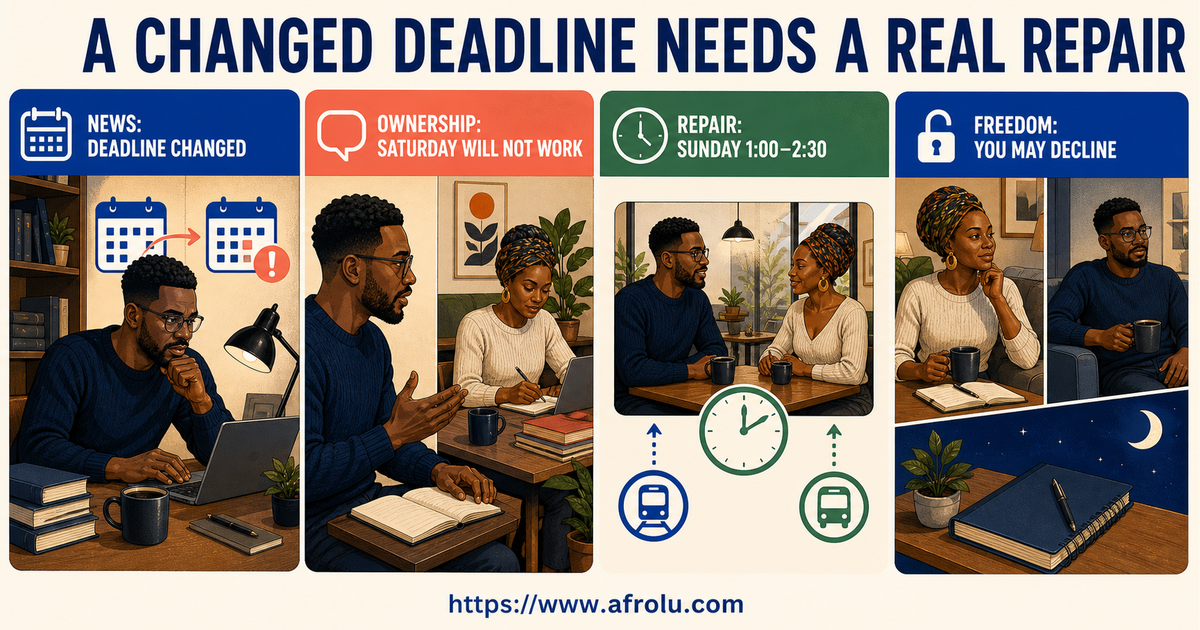
On Friday, Kamau learns that his group submission needs substantial Saturday revision. Their date was scheduled for Saturday afternoon. He tells Zuri as soon as the change is clear, owns that he cannot keep the plan and offers Sunday from 1:00 to 2:30 at a staffed cafe near a route both can use. He says she may decline and does not send a photograph of the assignment or blame teammates to make the cancellation acceptable.
Zuri is disappointed because she had protected Saturday. She says Sunday works only if they retain the planned finish. Kamau agrees. He completes the new plan and does not convert the change into an overnight study session followed by an exhausted date. They enjoy lunch, discuss what serious direction means during term and leave separately. Neither demands a relationship verdict that evening.
On Monday, Zuri notes that the cancellation carried real cost but the repair was timely, specific and respectful. Kamau notes that Zuri could state a limit without punishment. They keep the six-week review. The incident is not proof of lifelong reliability, but it is better evidence than a promise never to cancel. Their slow pace protects the academic truth while still requiring movement.
The relationship flight board
Count complete actions, reciprocal repair and clearer answers—not message volume
Movement looks like complete small plans. The venue and time arrive before travel. A date happens or a change is repaired. Both adults ask questions, offer options and sometimes organise. Serious direction becomes more specific through present agreements about contact, exclusivity, study seasons and review. The relationship may still end, but it produces enough usable information for each adult to choose rather than requiring faith in future potential.
Academic spillover occurs when dating claims course portals, institutional email, classmates, group work, grades, assignments or every study break. A partner can know that Saturday morning is protected without verifying the module. Never ask someone to share another student's information or breach professional, placement or research confidentiality. Work and study systems remain with their owner; romance belongs on personal channels.
Low effort looks different from slow pace. One person repeatedly says they are busy while the other chooses every venue, initiates every conversation and repairs every cancellation. Ask for one concrete reciprocal action, such as a complete next offer by a date. Do not construct elaborate tests. The result is whether the action occurs and whether the available relationship fits—not a diagnosis of character or attachment.
Pressure may use seriousness as a threat: ‘If this mattered, you would skip revision,’ ‘share your timetable,’ or ‘stay over because we meet only weekly.’ Those statements turn a future goal into present authority. Protect sleep, coursework, money, devices, consent and independent return. If stalking, threats, sexual coercion, fraud or blocked exits appear, shift from schedule interpretation to appropriate safety support.

Measure completed small actions; do not confuse fewer dates with indefinite waiting.
Words for the four zones
Make academic boundaries and serious direction understandable in the same conversation
For protected study, use availability language rather than an academic defence: ‘Saturday morning is committed to my course. I can meet Sunday from one to two-thirty.’ The date needs the shared window, not access to your timetable or evidence that study is real. If the window does not fit, the other adult can offer a different one or conclude that the rhythm is incompatible.
For a change, combine news, ownership, alternative and freedom: ‘My group deadline changed and I cannot keep Saturday. I can offer Sunday lunch for ninety minutes; I understand if that does not work.’ Avoid vague postponement, overexplaining or asking the other person to solve the calendar. A repaired change is specific. Repeated repairs still deserve pattern review because good language cannot erase chronic cost.
For seriousness, state the present job of the label: ‘I am dating toward a possible committed partnership. I am not promising exclusivity before we discuss it.’ Then define when to review structure and what conduct matters before that point. Serious intention cannot supply consent to sex, device access, all-weekend time or a future move. Each additional choice retains its own answer.
For recovery and review, say when the decision will happen: ‘I am going home at nine and will reflect after sleep. I can talk Monday.’ A safety concern never needs to wait, but ordinary uncertainty can. If either adult needs immediate reassurance after every date, discuss a small contact plan that both can sustain. Do not make exhaustion the condition for proving emotional availability.

Name the protected block, the date offer and the review point in separate sentences.
Six ordinary weekends
Use a factual logbook to decide whether serious direction has a sustainable rhythm
For each weekend, note whether protected academic work stayed protected, the plan became complete and each adult contributed an action. Keep the record short and private; it is not surveillance or a case file to confront the other person with. The aim is to correct memory's pull toward one brilliant date or one disappointing cancellation by looking at a small ordinary pattern.
Record changes and repair. Who brought the news? Was there a specific alternative? Did the affected person have room to decline? Did either adult repeatedly lose paid work, study, sleep or safe return? A repaired change can support trust, while too many costly changes can still make the relationship unworkable. Intent does not cancel impact.
Review clarity. Can both adults describe serious direction, current exclusivity, contact rhythm, academic boundaries, consent and relevant health choices? What remains unknown, and is that uncertainty appropriate to six weeks? Slow dating need not answer a whole future, but it should not keep every consequential present question blank.
Choose the next rhythm: continue the same runway, reduce frequency during exams, add one modest step, pause without demanding that someone wait, or end because the available lives do not fit. Do not use a six-week review as a romantic exam. The useful outcome is an accurate choice that protects both education and relationship dignity.

Use the six-week pattern to continue, resize or end; never trade sleep or coursework for relationship proof.
Four patterns, no universal frequency
Separate deliberate pace from low effort, vagueness and weekend intensity
Slow dating has a reason, mutual rhythm, complete actions and a review. Fewer dates or messages leave room for adult life while each meeting produces evidence. Low effort leaves planning, initiation and repair to one person. A busy explanation may be true and the available contribution still may not fit. Ask for one concrete action, then choose from what happens.
Vagueness leaves a necessary answer unusable: the venue is always unknown, exclusivity is repeatedly deferred or future seriousness substitutes for current conduct. Slow dating may preserve many unknowns, but it names which ones and when they deserve review. A clear ‘I cannot offer exclusivity this term’ can be more respectful than indefinite romantic possibility.
Weekend intensity compresses too much into limited time: all-day dates, overnights, constant messaging, expensive activities and major relationship decisions without landing. Intensity can feel like progress because it creates emotion and sacrifice. It may also conceal ordinary incompatibility and make consent or return harder. A serious direction benefits from ordinary contexts and enough recovery to interpret them.
Low pressure describes freedom around each choice, not necessarily low frequency. A frequent relationship can be low pressure if no remains free; a monthly date can be coercive if academic guilt, money or sexual expectation controls it. Use the correct label for the problem, then decide whether the present pattern protects study and creates enough mutual evidence to continue.
Eight adult-student weekends where pace and effort need separate answers
Miriam names study time without opening her timetable
Miriam is 35 and protects Saturday morning for a professional qualification. She offers a Sunday walk rather than sharing course portals or proving the assignment exists.
Give the availability answer the date needs and keep academic systems private.Kamau owns the deadline change
Kamau is 32 and cannot keep Saturday. He tells Zuri early, offers a complete Sunday alternative and accepts that she may decline.
Use news, ownership, a specific offer and room for no.Zuri proposes a temporary smaller rhythm
Zuri is 29 and wants serious direction but has four assessment weeks. She proposes one short call and one fortnightly public date until the review date.
Time-bound the smaller rhythm so it protects study without creating indefinite ambiguity.Samuel asks for one complete offer
Samuel is 38 and has organised five meetings. He asks his date to propose the next public plan by Wednesday. When no offer arrives, he stops carrying the relationship alone.
Request one observable reciprocal action and decide from the result.Amina closes the class email route
Amina is 27 and a match finds her institutional email after a missed reply. She blocks that route, saves evidence and reports through appropriate channels.
Keep dating on chosen personal channels; unexpected institutional contact is a boundary issue.David keeps the landing zone
David is 31 and declines an overnight after a late date because he needs medication, sleep and a safe return. Serious interest does not make the overnight automatic.
Treat lodging, sex and extended time as separate present decisions.Lebo offers a free public activity
Lebo is 26 and cannot sustain restaurant dates during tuition month. She offers a staffed public garden walk. Her date accepts without treating spending as investment.
Choose an affordable plan that protects essentials and return.Fatou and Idris end a real mismatch
Fatou is 34 and needs weekly time; Idris can offer one date a month for the coming year. They believe each other and end rather than calling either pace morally wrong.
Let capacity incompatibility remain a valid reason to close.Evidence that serious direction is moving without academic spillover
Both adults are explicitly 25 or older and their study context is treated as adult life.
Serious direction is stated without guaranteeing exclusivity, marriage or a fixed timeline.
Protected academic blocks are accepted without demands for portals, grades or evidence.
Dates have public place, start, finish, affordable scope and independent return.
A work-to-date handoff reduces spillover instead of scheduling every minute back to back.
Both adults initiate, plan, confirm and repair some of the shared rhythm.
A cancellation includes timely news, ownership and a specific optional alternative.
Exam or placement seasons receive a dated temporary rhythm rather than indefinite disappearance.
Consent, sexual health and lodging remain separate from serious intent and time invested.
Institutional devices, email, classmates and confidential work stay outside dating access.
Sleep, medication and Monday obligations remain part of the date design.
A six-week review can lead to continue, resize or end without a romantic grade.
Route each deadline, cancellation or invitation to the right runway zone
| Situation | What it may mean | What to do next |
|---|---|---|
| A student protects Saturday study. | A real adult commitment is being named, not necessarily avoidance. | Ask for the available date window rather than proof of coursework. |
| A deadline changes the date. | The change may be legitimate while still creating cost. | Look for early news, ownership, a specific alternative and room to decline. |
| Every weekend remains tentative. | Slowness may be functioning as unusable vagueness. | Require a confirmation point or stop reserving the time. |
| One adult makes all plans. | Low effort may be hiding inside a busy explanation. | Request one complete reciprocal offer and assess whether it occurs. |
| Exams reduce availability. | A temporary smaller rhythm may fit if its scope and review are clear. | Name the reduced contact and the date for reassessment. |
| A match contacts institutional email. | A chosen personal-channel boundary has been bypassed. | Close the route, preserve useful evidence and use platform or institutional support if needed. |
| An overnight is expected after a rare date. | Scarcity and seriousness are being used to infer lodging or sexual consent. | Keep end time, return, lodging and every intimate choice separate. |
| An expensive plan is called investment. | Spending is being recruited as evidence of commitment. | Choose a plan that protects tuition, essentials and return; payment buys no access. |
| A date ends with intense uncertainty. | Fatigue or arousal may be amplifying the need for immediate certainty. | Complete the safety check, sleep and review ordinary compatibility later. |
| Six weekends show reciprocal completion. | A useful modest pattern supports considering the next step. | Choose only one additional decision and keep all other boundaries intact. |
| Available rhythms do not overlap. | A capacity mismatch can exist without misconduct. | End honestly if neither adult freely wants the available structure. |
| Threats or blocked return appear. | This is no longer a scheduling problem. | Create distance where possible and use suitable local safety or emergency support. |
Scripts for study, offers, repair, seriousness, sleep and review
“Saturday morning is committed to my course; I can meet Sunday afternoon.”
“I am dating toward a committed partnership and still choosing each present step.”
“One planned weekend date is the rhythm I can sustain this term.”
“I cannot keep Saturday. I can offer Sunday from one to two-thirty if that works for you.”
“For four assessment weeks I can offer one call and one fortnightly date; let us review on the fifth.”
“I will share my availability, not my course portal, timetable or classmates' details.”
“I am leaving at nine and sleeping at home; that is separate from whether I want another date.”
“A serious goal and a rare free weekend do not decide this activity for me.”
“I need a free or low-cost public plan that protects tuition and return.”
“I organised the last two dates; please make the next complete offer.”
“I will reflect after sleep and can talk on Monday.”
“The rhythm available to us does not meet my needs, so I am ending the romantic contact.”
Know the difference
Slow progress versus a relationship stall
Fewer complete steps have a reason, mutual effort, present answers, repair and a scheduled review.
Plans, structure or effort remain repeatedly unusable while one adult reserves time and carries uncertainty.
The calendar cannot decide alone; the difference is whether small actions become real and improve the evidence.

Frequency alone cannot classify the relationship—look at clarity, effort, completion and repair.
Compare slow movement with stalls, low effort and intensity
| Type or dimension | What it describes | Best next question |
|---|---|---|
| Serious dating | Direction toward evaluating a possible lasting partnership. | Which present agreement expresses that direction? |
| Slow dating | Deliberate pace across contact, disclosure, intimacy or commitment. | Which domain moves slowly and what modest progress remains visible? |
| Low-pressure dating | Freedom to accept, decline, pause or counter without punishment. | Does each answer remain genuinely optional? |
| Low effort | One adult contributes too little planning, initiation or repair for the other's needs. | Which concrete reciprocal action is missing? |
| Vagueness | A consequential plan or answer stays too unclear to use. | What confirmation point or structure answer is needed? |
| Weekend intensity | Large amounts of time, spending or intimacy are compressed into limited contact. | Which part should shrink so choice and recovery remain possible? |
| Exclusive dating | A present agreement about dating or seeking others. | What exactly is agreed and when is it reviewed? |
| Academic boundary | Study systems and time stay controlled by the adult learner. | Which availability answer does the shared plan actually need? |
| Consent | A free present agreement to a specific activity that can be withdrawn. | What does each adult choose now, independent of seriousness? |
| Capacity mismatch | The sustainable rhythms available to two adults do not overlap enough. | Is there a smaller mutual structure, or is ending more honest? |
Build one academic weekend runway in six moves
Draw four runway zones
Protect study, handoff, public date and landing before offering the weekend.
Name serious direction
State the future under evaluation while present structure remains explicit.
Make plans complete
Confirm place, start, finish, affordable scope and separate return.
Repair without exporting
Bring news, ownership, one alternative and room for a free no.
Log six weekends
Record completion, reciprocity, repair, clarity and academic impact without grading.
Choose the next rhythm
Continue, resize or end from the pattern rather than urgency.
Questions organised by runway, direction, repair and review
Choose a few prompts that fit the moment. This is a reference library, not a list to complete.
Academic runway
Protect study and transition before offering the date window.
- Which block must be protected?
- What availability can I share without opening systems?
- What handoff does my body need?
- Which public time works?
- What landing protects Monday?
Serious direction
Make the future under evaluation distinct from present structure.
- What does serious mean now?
- Are we exclusive?
- Which conduct matters before the review?
- What remains unknown?
- When will we revisit structure?
Change and repair
Make a moved weekend informative without exporting all cost.
- Who brings the news?
- What cannot be kept?
- Which specific alternative exists?
- Can the other person decline freely?
- Is the pattern becoming too costly?
Six-week review
Choose the next rhythm from facts instead of intensity.
- Did study stay protected?
- Did plans complete?
- Did both adults act?
- Did change receive repair?
- Do we continue, resize or end?
What student, sleep and safety sources can actually support
Student time management and sleep are related in one study
A study of traditional-entry university students modelled time-management behaviours as predictors of global sleep quality. Afrolu uses it narrowly to justify treating study planning and sleep as real constraints, not to prescribe a dating timetable.
Evidence limit: The sample and model do not represent every adult learner or prove that one dating schedule improves sleep.
Adults need adequate sleep, not relationship all-nighters
CDC public guidance gives age-based sleep recommendations and identifies adequate sleep as important to health. The practical lesson is to preserve a realistic landing zone rather than making sleep sacrifice a seriousness test.
Evidence limit: General guidance does not diagnose sleep problems or prescribe an individual's schedule or care.
Online dating safety includes limited sharing and public meetings
Police Scotland advises avoiding personal information, using trusted services, meeting publicly during the day and bringing a friend. Afrolu applies those general practices while recognising that support and reporting routes vary.
Evidence limit: The policing and reporting context is Scottish; readers need relevant local, legal and platform support.
Romance stories can turn into money requests
FTC consumer guidance describes trust-building followed by urgent requests involving travel, health or other needs. Do not treat tuition, fare, devices or emergency stories as verified because serious language is present.
Evidence limit: Warning patterns cannot prove one person's intent; reporting and recovery routes vary by country.
Consent remains active and withdrawable
NHS guidance explains that sexual activity requires active consent, that a relationship or earlier yes is not consent and that consent can be withdrawn. Rare free time, spending and serious direction do not change that principle.
Evidence limit: Public health information is not jurisdiction-specific legal advice or an individual incident assessment.
Sexual-health conversations belong before relevant choices
CDC guidance encourages partner conversations before sex about relevant STI information and testing. A relationship label, appearance or exclusivity assumption cannot establish status.
Evidence limit: General public-health guidance cannot provide individual diagnosis, testing, prevention or treatment.
Six shortcuts that make study or dating absorb the other
Calling all free-looking time available
Adult study, work, care, sleep and recovery remain real commitments even when the calendar appears blank.
Using seriousness as access
A future direction does not create constant replies, overnights, exclusivity or sexual consent.
Calling every delay slow
Deliberate pace has complete actions and review; repeated blanks may be vagueness or low effort.
Exporting the cancellation
The person changing a plan should bring timely news, ownership and a specific optional repair.
Invading academic systems
Course portals, institutional email, classmates and confidential work are not relationship proof.
Skipping the landing
Exhaustion and intensity can distort review while harming sleep and Monday obligations.
Use a reviewed resource that matches the decision
This guide focuses on the relationship decision, so it does not rank dating apps. Check current prices, safety tools, and local availability before choosing a service.
Explore the guide library
Show more related guides
Continue with Afrolu
Show more Afrolu guides
Research and public guidance reviewed for this weekend runway
Afrolu reviewed these health, research, safety, or public guidance resources while editing this page. They support the behaviour and safety guidance; they do not diagnose any individual described by a reader.
Slow serious weekend dating questions for adult students
Can adult students date seriously with only weekend time?
They can evaluate a serious relationship if the available rhythm genuinely fits both adults. Define serious direction, current structure, contact, public date windows, cancellation repair and a review point. Fewer meetings can still produce evidence when plans complete and both contribute. If one adult needs more time than the other can sustainably offer, the mismatch may be real.
Does slow serious dating require daily texting?
No universal message frequency proves seriousness. Choose a rhythm both adults can sustain around work, study, care and sleep. The useful pattern includes direct answers, complete plans and repair. Daily contact can fit some couples and overwhelm others; infrequent contact can be deliberate or too little. Decide from shared needs and observed follow-through.
How should we handle exam season?
Name the temporary period, the smaller contact or date rhythm and a specific review date. Do not demand that someone wait indefinitely, and do not use exams to avoid every necessary present answer. Either adult can decide the reduced relationship no longer fits. Protected study is legitimate; so is an honest capacity mismatch.
What makes a cancellation respectful?
Share the change promptly, own what you cannot keep, offer one specific alternative if you want to continue and leave room for the other adult to decline. You do not need to expose assignments or blame classmates. Even well-repaired cancellations can become too costly when repeated, so review the pattern rather than language alone.
Should my partner see my class timetable?
Not as proof. Share the availability and constraints the date needs. Course portals, grades, institutional email, IDs, classmates and confidential placement or research information remain controlled. If you freely choose to share a broad timetable later, that still does not create monitoring rights or access to academic systems.
Is an overnight reasonable because we meet only on weekends?
It is a separate decision, never a requirement. Scarcity, serious intent, travel or date cost does not supply lodging or sexual consent. Preserve independent return, medication, sleep and the ability to stop. Each activity needs a current free answer, and either adult may leave at the planned finish.
How much should adult students spend on dates?
There is no universal amount. Choose a cost that protects tuition, food, housing, care obligations and safe return. Free or low-cost public plans can provide excellent ordinary evidence. Payment does not buy extra time, touch, disclosure, transport, an overnight or another date.
How do we know slow dating is not a stall?
Slow progress has a reason, a mutual rhythm, complete small actions and a review. A stall repeatedly leaves plans, structure or effort unusable while one adult waits. Name the missing action or answer and a decision date. If the pattern remains blank, resize or leave without diagnosing the other person.
When should adult student daters become exclusive?
There is no fixed week. Discuss what exclusivity means, whether either dates or seeks others, relevant disclosure and how change is requested. Use enough ordinary evidence for both adults to choose freely. Serious direction does not create exclusivity automatically, and exclusivity does not guarantee a lasting outcome.
What if our study and relationship needs do not fit?
Believe the available capacities rather than negotiating through guilt. Try a smaller mutually wanted rhythm only if it still meets both adults' minimum needs. Otherwise, ending can be honest. Education is not a rival to defeat, and the person needing more connection is not wrong; the present lives may simply be incompatible.
One thing to do now
Offer one complete weekend without pledging every future weekend
Draw study, handoff, date and landing before offering the weekend. Keep every plan complete and every change owned. Measure reciprocal completion, repair and clearer answers rather than message volume. Protect academic systems, consent, health, money and sleep. After six ordinary weekends, choose the next rhythm without treating either adult or relationship as an exam.