Slow dating · professionals · clear weekend plans
A weekend date can be clear without taking over your work week
Plan a deliberate weekend date around a demanding job: name the time, place, transport and boundary that fit without using availability or work access as proof.
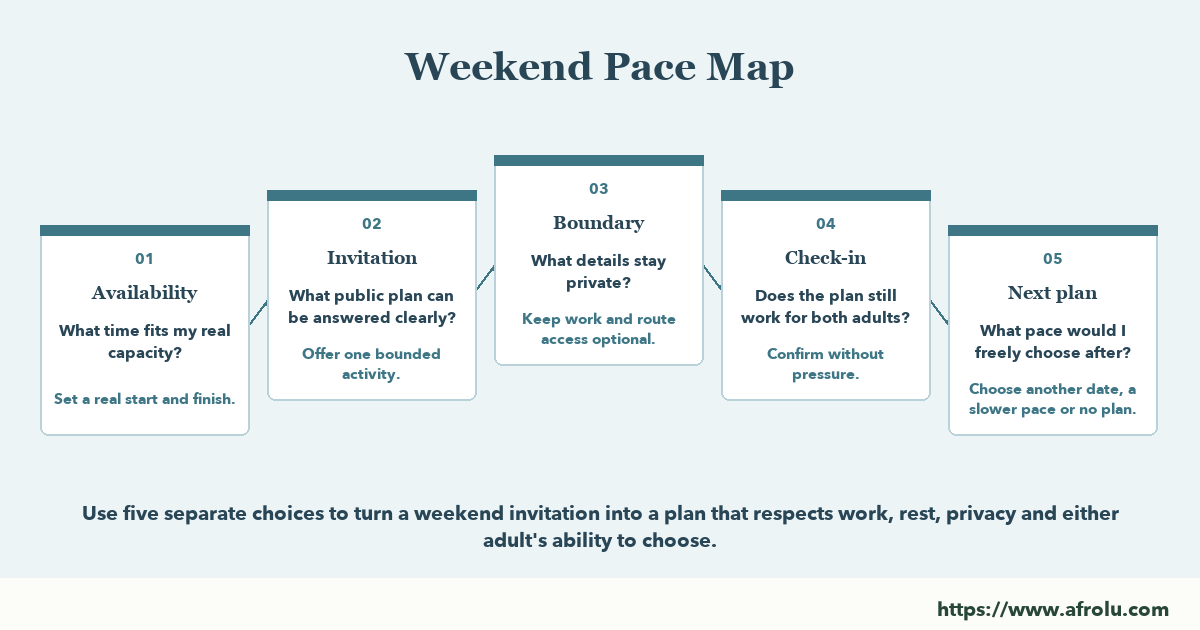
Weekend Pace Map
Use five separate choices to turn a weekend invitation into a plan that respects work, rest, privacy and either adult's ability to choose.
- Availability
- Invitation
- Boundary
- Check-in
- Next plan
Read the five questions and actions
-
Availability
- Question
- What time fits my real capacity?
- Action
- Set a real start and finish.
-
Invitation
- Question
- What public plan can be answered clearly?
- Action
- Offer one bounded activity.
-
Boundary
- Question
- What details stay private?
- Action
- Keep work and route access optional.
-
Check-in
- Question
- Does the plan still work for both adults?
- Action
- Confirm without pressure.
-
Next plan
- Question
- What pace would I freely choose after?
- Action
- Choose another date, a slower pace or no plan.
A weekend invitation is clear when it states a proportionate plan and preserves room for either adult to accept, change or decline without trading work access, sleep or privacy for reassurance.
Written and edited by Nala Okafor · Africa Dating Platforms Editor
Choose a plan that can be described in one message: a public place, a realistic start and end time, a way each person can arrive and leave, and a simple way to change it. You do not have to turn a delayed weekday reply, an office address or a full calendar into proof that you care. If a person wants more time than you can genuinely offer, you can say so and see whether a smaller plan fits. A slow pace is useful when it still produces clear, voluntary choices.
How can I make a clear weekend plan while protecting my workload, rest and professional privacy?
Slow dating for professionals means setting a pace that leaves room for work, rest and ordinary life without leaving the connection indefinitely undefined. Professional is a work-context description, not a claim about income, maturity, status or availability.
Availability is information, not a performance
A busy week can make people over-offer: they promise to text all day, keep both weekend days free, or accept a late plan they cannot enjoy. That creates a mismatch before the date begins. Slow dating asks a simpler question: what amount of time can I offer with attention and good will? Your answer might be one hour on Saturday morning, a Sunday walk, or no date this week. All are clearer than vague availability that leaves another adult waiting.
WHO's current mental-health-at-work material identifies excessive workload, long or inflexible hours and conflicting home-work demands as psychosocial risks. It does not prescribe how often a professional should date. The narrow lesson is that capacity is real. A work deadline is not a character test, and a date does not become more meaningful because you exhausted yourself or gave a new person access to the details of your work.
Build the plan from what is real, not what looks most impressive
A demanding week can make a vague invitation feel loaded. A smaller, explicit plan lets someone respond to the date itself rather than to an imagined level of commitment.
Decide your maximum time, public setting, travel plan and fallback before you invite. If you would resent changing a work, rest or family commitment, do not offer it to make the invitation sound grander.
- Time window
A beginning and an end
A short plan can be more reliable than an entire weekend held open in uncertainty.
- Meeting setting
A public, accessible place
The venue can support a conversation without requiring workplace or home access.
- Change path
A plain alternative or a no
A respectful response to a schedule conflict is data about fit, not a cue to over-explain.

Plan or availability test
Open full-size visualA clear plan
One public activity has a time window, independent travel and room for a different answer or an ordinary reschedule.
An availability test
A vague or escalating invitation asks someone to surrender rest, work privacy or an entire weekend to demonstrate interest.
- Time
- Venue
- Privacy
- Exit
A clear date protects ordinary commitments; an availability test turns sacrifice into evidence.
A clear plan gives a real choice
Instead of 'let's see what happens Saturday,' offer something that can be accepted as described: 'Would you like to meet at the gallery café at 10 for an hour?' That gives the other person enough information to consider comfort, timing and transport. If either of you needs to change the plan, do so directly. A changed invitation is not proof of bad intent; it is a new plan that deserves a new yes.
A public setting and independent arrival are practical preferences, not accusations. eSafety advises people who date online to consider how much identifying information they share and to use safety tools a service provides. Its Australian scope matters: it is not a Kenyan legal standard and cannot tell you whether a particular person is safe. It does support treating a work pickup, office route or home address as optional information rather than the price of a Saturday plan.

Four details make a plan answerable
Open full-size visual- Activity
- Name what you will do.
- Time window
- Set a beginning and end.
- Public setting
- Choose an accessible venue.
- Change path
- Allow an alternative or a no.
Specificity supports a freely chosen answer; it does not create a contract.
Check whether the invitation is genuinely manageable
Complete this before you offer a plan, so the date is built around a real capacity rather than a performance of availability.
- 01
Time I can offer
A real start and finish that leaves room for work, rest and existing commitments.
- 02
Public plan
One accessible activity and meeting point, not an open-ended private invitation.
- 03
My transport and exit
How I will arrive and leave without depending on new access or disclosure.
- 04
If it changes
A simple alternative, or permission for either person to decline.
Let the answer guide the next step
- The plan fits both adultsConfirm the small plan and keep other decisions for another time.
- The time or setting does not fitOffer one realistic alternative or decline without over-explaining.
- The plan requires work access or a boundary changeReturn to a public, independent option or pause the invitation.
Keep this separate A workable weekend plan needs a time and place, not an office route, employer, calendar image, home address or device access.
Interest does not require professional access
If someone asks why you cannot reply during a meeting or suggests an office pickup before you are comfortable, you can keep the response short: 'I do not share work details early on, but I can meet at the café at 10.' Repeating a boundary is not a failure of communication. If the request continues or turns into pressure, that conduct matters more than trying to decode whether the person is insecure, curious or strategic.
Kenya's ODPC sets out rights of data subjects in relation to personal data processing by organizations. That information does not resolve an ordinary dating disagreement. It is relevant to the boundary behind this example: a new date is not entitled to your account, location history, employer directory or screenshots just because you have arranged a weekend meeting. Choose what you disclose because you want to, not because you need to earn belief.

Offer the plan you can actually keep
Open full-size visualI would enjoy seeing you this weekend. I can do brunch at the public courtyard from 10 to 11:30 on Saturday and will make my own way there; would that work for you?
- One activity
- One window
- Room to change
A clear invitation can leave work, rest and privacy outside the proof test.
A changed plan can reveal a useful fit question
After the date, separate at least two questions: did I enjoy this person's company, and did the plan leave enough room for my ordinary life? You may like someone and still find that their desired contact rhythm, spending expectation or spontaneity does not fit your capacity. That is a reason to choose a different pace or stop, not a reason to turn your calendar into an argument about devotion.
WHO's sexual-health framework emphasizes respect and freedom from coercion in sexual relationships. Its narrow relevance here is physical intimacy and intimate images: a successful brunch, second meeting or growing attraction does not create standing permission for either. Whether to make another date, share a location or accept an overnight plan is a separate editorial choice for each adult, not a WHO rule.

Does the invitation fit ordinary life?
Open full-size visualA vague Saturday plan conflicts with work recovery and another commitment.
Can the date happen without sacrificing rest, privacy or a clear exit?- Yesagree on a short public plan.
- Nooffer another time or decline.
A workable weekend is more useful than an open-ended promise.

Review fit after the date
Open full-size visual- Did I enjoy it?Separate attraction from scheduling.
- Did the plan fit?Notice whether capacity remained real.
- Was my boundary respected?Keep private access optional.
- Do I want another?Choose the next pace freely.
The next date should fit both adults, not make one of them perform availability.
Review fit after the date
A weekend invitation is clear when it states a proportionate plan and preserves room for either adult to accept, change or decline without trading work access, sleep or privacy for reassurance.
About these links These information links are not affiliate buttons and are clearly labelled. They do not promise a match, identity check or relationship outcome.
What supports a proportionate weekend plan
WHO supports acknowledging workload and, separately, current voluntary agreement for physical intimacy or intimate images; eSafety supports proportionate privacy; ODPC describes data rights. None determines intent or guarantees a safe date.
Questions about work, weekends and clear invitations
Is one short weekend date too little if I am interested?
No. Offer an amount of time you can give freely. A clear shorter plan can be more considerate than a long one you cannot sustain.
Should I explain every work conflict?
No. You can say you are unavailable and offer a time you can keep. Client details, an office routine and calendar evidence are optional, not proof.
What if they only want a last-minute plan?
You can say that does not work for you and offer a specific alternative. If no workable plan exists, you can decline.
Does independent transport sound distrustful?
No. It is an ordinary planning preference. You can state it matter-of-factly without making a claim about another person's intent.
What if a date runs late and I want to leave?
You can leave. A changed plan needs a new yes; a pleasant conversation does not remove your ability to end it when you choose.
Do I need to spend a lot for a weekend date to show interest?
No. Choose an activity that fits your own budget. Spending is not a reliable measure of affection or compatibility.