Five honest clocks with no catch-up countdown
Enter Slow Serious Dating Later in Nairobi Without Rushing
A respectful later-entry Nairobi guide to slow serious dating, sustainable pace, privacy, money, sexual health, exclusivity and clear reviews.
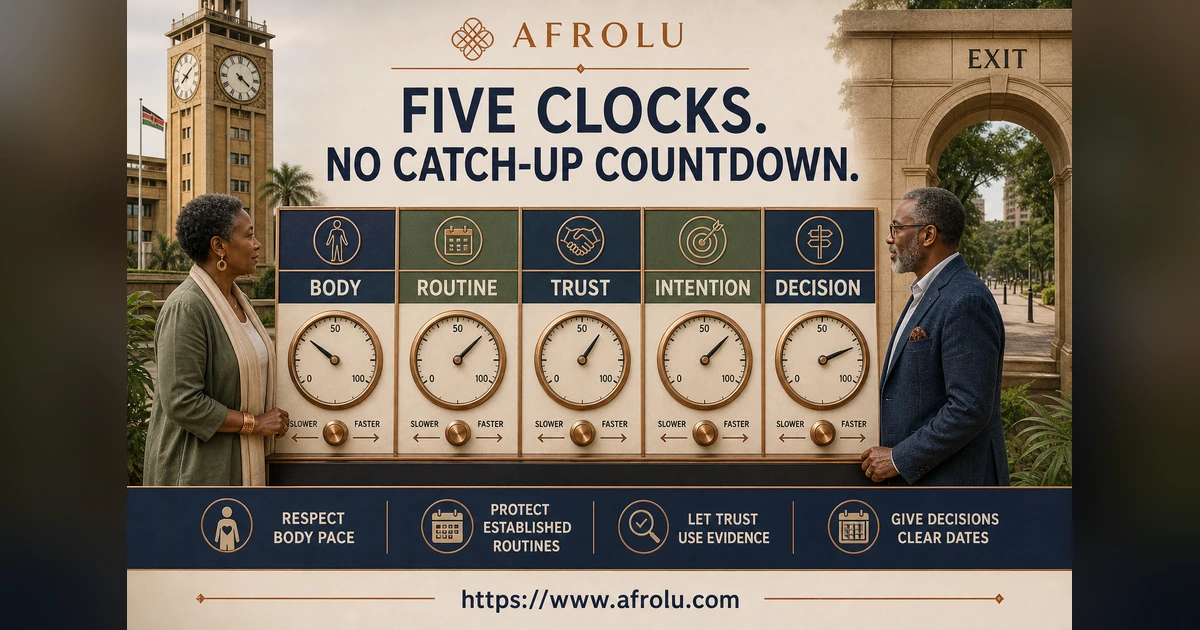
Later entry needs an honest pace, not a race to catch up.
Written and edited by Grace Mutiso · Kenya Guides Editor
Later entry means beginning or returning after time away; it is not tardiness or a deficit. Set five separate clocks: BODY chooses comfortable conditions, ROUTINE protects established life, TRUST uses ordinary evidence, INTENTION states the lasting direction, and DECISION sets a review with real outcomes. Slow pace stays clear through specific rhythm and repair. Never use age or serious goals to rush devices, documents, money, exclusivity, health disclosure or consent.
Intentional dating · Late Entrants
How can later-entry adults date slowly toward a serious relationship without turning age, time, technology, property or loneliness assumptions into pressure?
Purposeful later-entry slow dating is an adult relationship route in which body conditions, routine, trust access, serious intention and decision timing are explicitly set, independently adjustable and freely reviewable without age-based urgency.
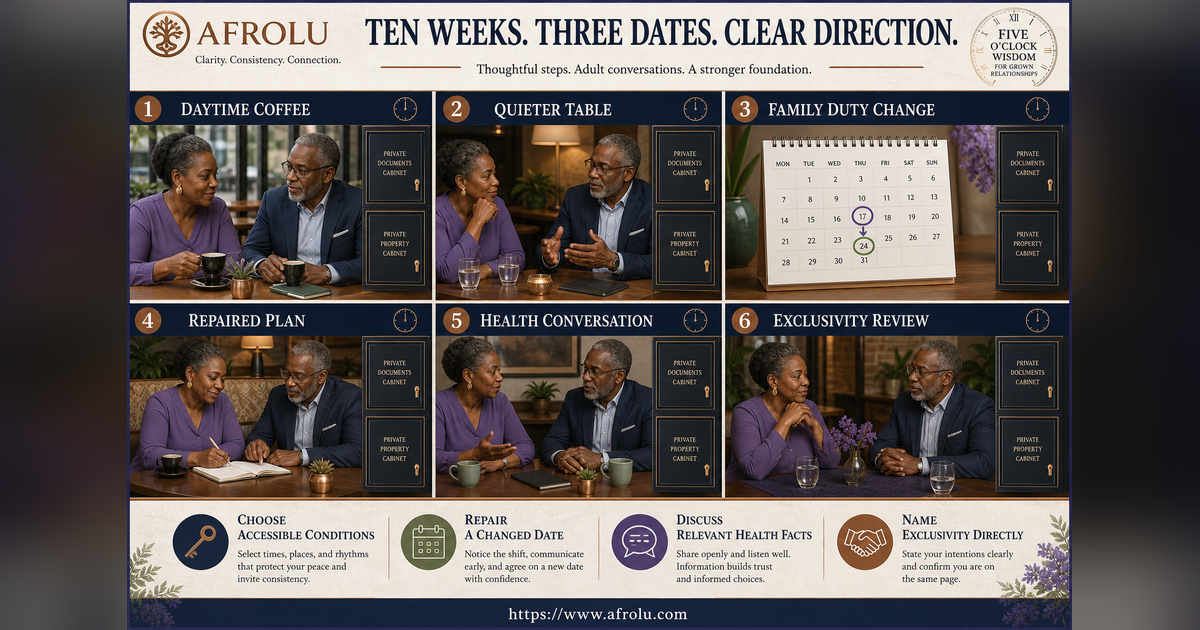
Ruth and Joseph are fictional Nairobi adults, 52 and 57. Over ten weeks, three public dates, a quieter-table request, a repaired family-duty cancellation, an independently handled investment message and a direct exclusivity review show how a sparse calendar can still produce meaningful evidence.
The five-clock later-entry pace house
Let serious direction stay clear while each part of the route finds its pace
Grace removes the catch-up story and gives body, routine, trust, intention and decision their own adult controls.
Independent clocks allow one planning adjustment without turning the whole connection into a rush or indefinite wait.
Body
Choose comfortable venues, activity, health conversations and current consent.
Routine
Protect established work, care, community, friendships and rest.
Trust
Read repeated conduct while devices, documents and money stay independent.
Intention and decision
Name serious direction and make every review produce a choice.
Enter from the life you have
Later-entry dating is a starting position, not evidence that an adult is behind
Someone may arrive at dating later because work, study, caregiving, faith, health, bereavement, divorce, migration, choice or simple circumstance shaped earlier years. None of those histories creates a debt to romance. They also do not make one person automatically cautious, lonely, inexperienced, wealthy, traditional, vulnerable or ready for marriage. Ask the adult instead of assigning an age story.
Serious direction and slow pace are compatible dimensions. Serious says a lasting relationship is a desired possibility. Slow says frequency, disclosure or escalation will be limited while evidence accumulates. The combination should not become vague. Name the present arrangement, minimum rhythm, important boundaries, relevant health conversations and a review date so patience does not become indefinite access without accountability.
Avoid the catch-up bargain: because time feels precious, a person may be urged to skip public meetings, share a home address, merge travel, disclose property, lend money, accept exclusivity or tolerate sexual pressure. None of those actions repairs a timeline. The correct pace is the one both adults can freely sustain while retaining independent judgment, support, finances and an exit.
A later-entry adult may also prefer a faster conversation about long-term values because compatibility matters. Direct questions need not create fast access. It is possible to ask about partnership, geography, faith, caregiving or retirement horizons early while leaving documents, accounts, private family facts, home access and physical intimacy behind their own evidence-based gates.
Set five clocks independently
Body, routine, trust, intention and decision rarely need the same speed
BODY covers energy, mobility, sensory access, medication schedules, sexual health, comfort and every current consent decision. Offer what helps the date work, such as a quieter table or daytime plan, without requiring medical disclosure. A request can be accepted, adjusted or declined. No age, diagnosis, relationship goal, gift or journey creates entitlement to touch or private health records.
ROUTINE includes work, care, community, faith, friendships, sleep, hobbies and home responsibilities accumulated across an established life. Slow dating should fit around those structures rather than demand their demolition. Share the practical constraint that affects a meeting; keep third-party details private. Mutual flexibility matters more than which adult has the busiest-looking calendar.
TRUST advances through consistent context, plans kept, changes owned, proportionate answers and boundaries respected. It does not advance through passwords, title deeds, financial statements, live location or tests of technical skill. A person new to apps can learn controls from an independent helper or official guidance. The match should never become the administrator of their device, identity or money.
INTENTION states the desired direction; DECISION names what is mutual now and when it will be reviewed. A couple can share serious intention while remaining in bounded discovery. At a scheduled review, they might continue, redesign rhythm, discuss exclusivity, pause or close. A clear decision clock makes slow dating purposeful while leaving every adult free to choose a different route.
Follow ten unhurried weeks
Ruth and Joseph gather useful evidence from three dates and two repairs
Ruth, 52, was beginning to date after years focused elsewhere. Joseph, 57, had returned after divorce and a long pause. Both wanted partnership eventually. They chose ten weeks of bounded discovery: one planned call most weeks, three public daytime meetings if capacity allowed, no exclusivity assumption and a final review. Each retained independent transport, accounts and home privacy.
At their first meeting Ruth requested a quieter table because the music made conversation tiring. She did not offer a diagnosis, and Joseph did not ask for one. They moved seats. Later, Joseph cancelled a gallery visit to handle an existing family responsibility. He gave notice, acknowledged the inconvenience and offered two dates rather than narrating someone else's private circumstances.
A message then appeared to offer Ruth investment help supposedly recommended by Joseph. She refused, verified through their usual phone channel and reported the account through the relevant service. Joseph had sent nothing. They agreed that neither would manage devices, investments, property documents, codes or emergency transfers for the other. The incident created a shared security rule, not a demand for reciprocal access.
At week ten, the pair reviewed their three dates, consistent calls, repairs, values, outside dating and relevant sexual-health questions. They chose exclusivity and another twelve-week review. They did not exchange keys, wills, account access or promises about cohabitation. The route became more defined while the body, routine, trust and property boundaries continued at their own pace.
Read three states on each clock
Continue, review and stop categories separate deliberate pacing from evasion or control
On BODY, continue means requests and limits are heard without embarrassment. Review means a venue, time or activity needs adjustment. Stop means touch, sex, substances, health disclosure or caregiving is pressured. Ordinary discomfort can support a redesign; coercion requires stopping the act. Qualified health care belongs outside a partner's amateur assessment.
On ROUTINE, continue means advance plans coexist with established life. Review means frequency or notice is unsustainable. Stop means friends, faith, family, work or rest are treated as obstacles to be removed. Slow dating should add a chosen relationship possibility, not isolate either adult from independent support and identity.
On TRUST, continue means information is proportionate and systems remain personal. Review means an unfamiliar feature or claim needs independent checking. Stop means passwords, authentication codes, property files, loans, investments or urgent transfers are requested. The FTC documents common financial manipulation patterns; its U.S. examples do not prove that any particular person is deceptive.
On INTENTION and DECISION, continue means serious direction is shared and each review produces an answer. Review means values fit but the current rhythm or horizon differs. Stop means marriage language is used to rush access or every review is indefinitely postponed while privileges grow. Slow is a chosen pace, not a shelter for unaccountable ambiguity.

Judge the affected clock separately instead of averaging a relationship score.
Use ten spacious questions
Direct language can make a slow route kinder without turning experience into an examination
For pace: 'Two unhurried dates a month is what I can sustain now.' For body: 'A quieter daytime venue helps me enjoy the meeting.' Those statements identify a workable condition without asking either person to justify age, disclose a diagnosis or perform youthfulness. The response should focus on planning, not evaluation.
For routine: 'I protect existing family, community and rest commitments, so I plan ahead.' For technology: 'If I need help with an app, I will use an independent source; my passwords and codes remain private.' Established life and unfamiliar tools can coexist. A caring date supports autonomy instead of taking control of a device.
For privacy: 'My home, property and financial documents are not dating evidence.' For money: 'I do not send emergency or investment funds through a relationship.' For health: 'Before intimacy, let's discuss current facts and qualified care relevant to our choice.' These boundaries are suitable for adults of any age and do not accuse the other person.
For direction: 'I hope for partnership, while our present type is bounded discovery.' For status: 'Exclusivity changes only when we both define it.' For review: 'At week ten, let's choose continue, redesign, pause, exclusivity or closure.' The decision remains mutual because every outcome, including an ending, is genuinely available.

Ask one bounded question and leave room for an unhurried answer.
Give slow dating a review rail
Rhythm, repair, direction and pressure reveal whether patience is producing clarity
RHYTHM asks whether calls and dates are frequent enough for both adults to learn anything while respecting routine and energy. Count usable contact, not an ideal number. If one person needs weekly meetings and the other can offer monthly contact, neither is defective. Try one realistic adjustment or accept that the fit is wrong.
REPAIR asks what happens after cancellation, misunderstanding, delayed replies or an accessibility request. Ownership, proportionate context, a practical return and no punishment are useful evidence. Elaborate explanations are not required. Repeated disappearance, contempt, age-based mockery or demands for proof belong in a different category from an ordinary scheduling miss.
DIRECTION asks whether serious values remain compatible and whether present status is mutual. PRESSURE checks for catch-up language, marriage deadlines, isolation, sexual bargaining, device control, property interest or financial urgency. One stop issue should not be averaged away by pleasant dates elsewhere. Protect the affected system and seek appropriate help when risk exceeds a relationship conversation.
CONTINUE when the present route works. REDESIGN one clock when a bounded test is reasonable. PAUSE when health, grief, care, work or emotional capacity needs space without a romantic promise. CLOSE when desire, need, direction or safety cannot fit. A completed review is valuable even when it ends the connection; clarity is not wasted time.

Slow is clear when both adults know what the next review decides.
Compare eight later-entry routes
No arrangement ranks an adult's life or proves that time has been recovered
Conversation is early contact before recurring romance. Bounded discovery adds a limited learning period. Open slow dating allows other connections under clear terms while deliberately controlling frequency or escalation. Any may hold serious future intention when the present agreement is honest and health information reaches relevant decisions in time.
Focused slow dating means one adult concentrates attention without claiming reciprocity. Exclusivity is mutual and defines which outside dating or sexual contact stops. Sparse dates do not prove either status because caregiving, work, body pace and routine shape visibility. Ask directly; do not treat age or perceived traditional values as evidence of exclusivity.
Partnership adds chosen mutual responsibilities and a coordinated horizon. It does not automatically merge homes, money, devices, property, estate plans, caregiving or consent. Those systems require specialised conversations and sometimes qualified financial, legal or health advice. Romantic seriousness cannot replace independent counsel or freely revisable decisions.
Pause suspends progression while capacity or facts settle without holding someone to an unchosen future. Closure ends the dating route. Compare all eight by whether both adults can repeat the present terms, preserve independent support, refuse access and make the next review count. The suitable route is sustainable now; it does not compensate for when dating began.
Eight later-entry moments where slow pace can be misunderstood
A match assumes marriage must happen quickly
Birth year is being used as a deadline rather than context.
Restate serious direction and the chosen slow pace.Conversation is tiring in a loud restaurant
The setting is interfering with an otherwise wanted meeting.
Request a quieter place without demanding medical disclosure.A family duty changes the second date
Capacity shifts but a practical return remains possible.
Give notice, acknowledge impact and offer bounded options.A date offers to take over account setup
Convenient help would reveal credentials and recovery access.
Use independent assistance and keep codes private.Serious intent prompts questions about title deeds
A future value conversation is becoming document access.
Discuss principles while withholding records and identifiers.An investment opportunity arrives through romance
Trust language is being attached to a financial decision.
Do not transfer; verify and seek independent advice.Intimacy becomes possible after several dates
Material information now belongs before the physical choice.
Discuss current facts, prevention, testing and consent.Ten weeks have passed with no status answer
Slow pace may be turning into indefinite ambiguity.
Complete the scheduled decision or close the route.Signals across body, routine, trust, intention and decision
Later entry is described as a life circumstance rather than a defect, emergency or personality type.
Serious intention and present relationship status can be repeated without contradiction by both adults.
Date rhythm fits energy, access needs, work, care, community and restorative time.
Venue or communication adjustments are handled without ridicule, diagnosis or unwanted caretaking.
Plans that change receive ownership and a realistic return instead of disappearance or interrogation.
Technology help preserves the user's passwords, codes, recovery channels and independent control.
Property, benefits, wills, accounts, investments and essential money remain outside early romance.
Relevant sexual-health facts and qualified care precede intimacy rather than following assumption.
Every physical answer is current, freely communicated and able to change without punishment.
A dated review produces continue, redesign, pause, exclusivity or closure instead of automatic delay.
Choose the next slow-serious step through ten grounded questions
| Situation | What it may mean | What to do next |
|---|---|---|
| Is later entry free of catch-up pressure? | Fits: The route begins from present desire and capacity. Needs review: A social timeline is shaping urgency. Stop: Age is used to demand commitment or access. | Remove the deadline and restate free choices. |
| Does body pace support the plan? | Fits: Comfort and access requests are respected. Needs review: Venue, timing or activity needs adjustment. Stop: Touch, health detail or substances are pressured. | Redesign the plan or stop the act. |
| Can routine hold the rhythm? | Fits: Dates coexist with established responsibilities. Needs review: Frequency or notice needs revision. Stop: Independent life is mocked or isolated. | Protect the routine and reduce access. |
| Does repair replace proof? | Fits: Changes receive ownership and a practical return. Needs review: One missed plan needs clarification. Stop: Surveillance or punishment follows ordinary delay. | Set a repair boundary or close contact. |
| Is technology assistance independent? | Fits: The user controls accounts and recovery. Needs review: A feature needs official guidance. Stop: A match requests a password or code. | Refuse and secure the account independently. |
| Are money and property protected? | Fits: Values can be discussed without access. Needs review: A shared cost needs a limit. Stop: Loans, investments or documents are requested. | Do not transfer; obtain independent advice. |
| Is serious direction shared? | Fits: Both seek a compatible lasting possibility. Needs review: Horizons differ but can be discussed. Stop: Marriage language masks present incompatibility. | Clarify direction before enlarging access. |
| Is the current status mutual? | Fits: Both name the same arrangement. Needs review: Frequency is carrying an assumption. Stop: Unagreed exclusivity is policed. | Define status directly or step back. |
| Are health and consent current? | Fits: Relevant facts and free answers precede intimacy. Needs review: A care step or discussion remains open. Stop: Past experience or gifts override no. | Pause intimacy and prioritise safety. |
| Does the scheduled review decide? | Fits: A clear next route is chosen. Needs review: One bounded test needs a short date. Stop: Reviews repeat while privileges keep growing. | Continue, redesign, pause or close now. |
Ten spacious lines for pace, privacy, health, status and review
“I am beginning dating from the life I have, not trying to catch up.”
“Two unhurried dates a month is what I can sustain now.”
“A quieter daytime venue helps me enjoy the meeting.”
“I protect existing commitments, so I prefer several days of notice.”
“I use independent help; my passwords and recovery codes remain private.”
“My home, property and documents are not dating evidence.”
“I do not send emergency or investment funds through a relationship.”
“Before intimacy, let's discuss current facts and care relevant to us.”
“I want partnership eventually; today we are in bounded discovery.”
“At week ten, let's choose continue, redesign, exclusivity, pause or closure.”
Know the difference
Pace, direction, private access and decision timing remain separate
Sets a workable rhythm, names serious direction, protects systems and makes each scheduled review produce a real choice.
Uses age stories, loneliness assumptions, urgency or financial and physical access to make speed look inevitable.
Choose the route that fits the adults' present capacity while making ambiguity answerable.

Choose a route that is sustainable now, not one designed to erase lost time.
Compare eight later-entry routes without an age or prestige ladder
| Type or dimension | What it describes | Best next question |
|---|---|---|
| Conversation | Early adult contact before a recurring romance or future claim exists. | Enough interest and context for a bounded period |
| Bounded discovery | A time-limited slow learning route with clear privacy and a decision date. | Ordinary plans and one useful repair |
| Open slow dating | Recurring low-frequency romance while outside dating remains possible under stated terms. | Comfort with the mutual open arrangement |
| Focused slow dating | One adult concentrates attention without assuming the other has made the same choice. | A direct status conversation |
| Exclusive slow dating | Both stop defined outside dating or sexual contact while keeping other systems independent. | Sustained conduct at the chosen rhythm |
| Partnership | Mutual responsibilities and a long horizon grow without automatic property, device or care access. | Purpose-specific integration with independent advice |
| Pause | Progression stops while capacity, grief, health, care or a material fact is addressed. | A dated return without holding a promise |
| Closure | The dating connection ends when desire, fit, capacity, direction or safety does not support it. | A clear boundary and suitable support |
Build a purposeful slow route in five clock moves
Reject the catch-up clock
Later entry does not create urgency, deficiency or a debt to partnership.
Set body conditions
Choose timing, venue and activity that support comfort without forced health disclosure.
Protect established routine
Fit dating around work, care, community, friends and restorative time.
Let trust stay independent
Read repeated conduct while keeping devices, documents, money and recovery personal.
Name serious direction
Discuss lasting hopes without converting them into a current relationship status.
Make reviews decide
Every review should continue, redesign, pause, change status or close the route.
Questions for body conditions, routine, trust and decisions
Choose a few prompts that fit the moment. This is a reference library, not a list to complete.
Body questions
Design comfort without medicalising the date.
- Which time supports energy?
- Which venue helps conversation?
- What activity feels accessible?
- What health facts affect this choice?
- Can any answer change?
Routine questions
Fit dating into established life.
- What frequency is sustainable?
- How much notice helps?
- Which commitments stay protected?
- How do we repair a change?
- What contact is enough?
Trust questions
Keep evidence and autonomy together.
- Which fact matters now?
- How can it be checked independently?
- Which access is unnecessary?
- How was no received?
- Are money and property separate?
Decision questions
Make serious direction accountable.
- What is our present type?
- Which horizon do we share?
- What has repeated?
- Which clock needs redesign?
- What will this review decide?
What ageism, connection, Kenyan privacy, security, fraud and consent sources support
WHO evidence warns against stereotypes and discrimination based on age
The World Health Organization's Global Report on Ageism describes ageism as stereotypes, prejudice and discrimination based on age and outlines strategies to reduce it. That supports asking later-entry adults about preferences instead of assigning urgency, frailty or traditional values.
Evidence limit: The report addresses ageism broadly; it does not prescribe dating pace or assess an individual's health and capacity.
Connection and loneliness are distinct from relationship readiness
The World Health Organization distinguishes objective social isolation from the subjective experience of loneliness and describes social connection through structure, function and quality. Dating may be one chosen connection, but it should not be prescribed as a cure or proof of wellbeing.
Evidence limit: This health information cannot diagnose loneliness, prescribe romance or determine whether a particular relationship is beneficial.
Purpose and data minimisation support selective disclosure
Kenya's Data Protection Act requires lawful, fair and transparent handling for explicit purposes, with personal data limited to what is necessary. Those principles support restraint with identification, health, family and property information online.
Evidence limit: The statute provides general context, not individual legal advice or verification of another dater.
Account controls should remain with the account holder
CISA recommends strong passwords, multifactor authentication, phishing recognition and updates through Secure Our World. Later-entry adults can learn unfamiliar tools without granting a match administrative or recovery access.
Evidence limit: Technical protections reduce some digital risks but do not certify identity, intent, compatibility or physical safety.
Romance and investment pressure deserve independent action
The U.S. Federal Trade Commission documents changing scam tactics affecting older adults across messages, calls, social media and payments. Refusing transfers and seeking independent financial or platform help is proportionate.
Evidence limit: The examples and reporting routes are U.S.-specific; use appropriate Kenyan providers, banks and authorities.
Specific present agreement matters at every age and stage
NSW Government guidance describes consent as voluntary, communicated, specific, ongoing and withdrawable. Experience, age, serious intention, gifts or a previous yes cannot answer for the current moment.
Evidence limit: Legal definitions and support services vary; use suitable Kenyan health, legal or emergency resources for actual events.
Six ways slow serious dating can borrow a catch-up story
Calling later entry lost time
A rich life becomes a deficit story. Repair: begin from current values and capacity.
Making slow mean vague
No review ever decides. Repair: set a date and legitimate outcomes.
Diagnosing an adjustment
A quieter venue becomes a health interrogation. Repair: solve the planning need only.
Letting help become control
A match administers devices or accounts. Repair: use independent assistance.
Treating property as seriousness
Documents or investments are requested early. Repair: discuss values without access.
Assuming exclusivity from age
Cultural or age stereotypes replace agreement. Repair: define status directly.
Use a reviewed resource that matches the decision
This guide focuses on the relationship decision, so it does not rank dating apps. Check current prices, safety tools, and local availability before choosing a service.
Explore the guide library
Show more related guides
Continue with Afrolu
Show more Afrolu guides
Official ageism, connection, Kenyan privacy, security, fraud and consent sources
Afrolu reviewed these health, research, safety, or public guidance resources while editing this page. They support the behaviour and safety guidance; they do not diagnose any individual described by a reader.
Slow serious Nairobi dating questions for later-entry adults
What does late-comers mean in this dating guide?
It means adults entering or returning to dating later than they expected or after a long interval. It does not mean arriving late, failing at life or needing to catch up. People begin from different histories. Choose a present pace and direction without assuming age, experience, health, loneliness, wealth, faith or relationship goals.
Can slow dating still be serious?
Yes. Serious describes the desired long-term direction; slow describes the current frequency or escalation. Name both. Agree a workable rhythm, present status, privacy limits and review date. Slow dating becomes unclear only when reviews never produce choices or when serious language is used to receive access without ordinary reliability.
How often should later-entry adults meet in Nairobi?
There is no universal frequency. Choose enough contact for both people to learn while respecting energy, access needs, work, care, community, travel and rest. Two monthly dates may suit one pair and not another. State the rhythm, observe its effects and adjust or close if it cannot meet both adults' minimum needs.
Should I disclose a health condition before a first date?
Share what the immediate plan or informed choice genuinely needs, not a complete health history. You can request a quieter venue, shorter meeting or accessible route without naming a diagnosis. Before intimacy, discuss current facts and qualified care relevant to sexual health. A date is not entitled to private records or amateur assessment.
What if I am not confident using dating apps?
Learn through official instructions, an independent trusted helper or a class while keeping control of the device. Never share passwords, one-time codes or recovery access with a match. Use strong unique passwords and multifactor authentication where available. Technical unfamiliarity is a skill gap, not permission for someone else to administer your identity.
When may we discuss property, pensions or inheritance?
You may discuss broad values and future expectations when compatibility requires it. Keep addresses, account numbers, title deeds, benefits, wills, tax records and signatures private. Any real financial or estate decision deserves independent qualified advice and time outside romantic pressure. Serious intention does not make a new date a financial adviser or beneficiary.
Does regular contact mean we are exclusive?
No. Frequency, age, serious goals and social expectations do not create exclusivity. Ask whether either adult dates others, what outside dating or sexual contact would stop and when the agreement begins. Even mutual exclusivity leaves devices, property, money, health records, homes and physical consent separately controlled.
How should we discuss sexual health later in life?
Before relevant intimacy, discuss current partners, testing, prevention, health considerations and qualified care without age-based embarrassment. Share information needed for informed choice rather than demanding unrelated history. Every physical act still needs a present voluntary answer, and either person may pause or change that answer at any time.
What if someone pressures me because time is running out?
A biological, social, family or birthday deadline does not remove free choice. Slow the affected decision, keep homes, devices, documents and money closed, and consult independent support where useful. Threats, coercion, stalking or financial manipulation require protective action appropriate to the facts, not another attempt to prove serious intent.
How do we know whether slow dating is progressing?
Review rhythm, repair, direction and pressure at the date you agreed. Progress may mean the same route works, one clock is redesigned, exclusivity is mutually chosen, a pause is needed or the connection closes. The test is clearer mutual choice and sustainable evidence, not a fixed number of dates or a relationship milestone.
One thing to do now
Let the relationship move at the speed of evidence and free choice
Continue when five clocks remain respectful, specific and sustainable. Redesign one clock when access, rhythm or communication needs a fair test. Pause for health, grief, care, work or emotional capacity without promising a future. Close when desire or direction differs, reviews never decide, or ageism, deception, surveillance, financial manipulation, coercion or retaliation appears.