Six lanterns for patient progress without pressure
Build a Gentle Faith-Led Pace Across Distance
A faith-aware guide to slow long-distance dating with visible progress, community privacy, reciprocal effort, safe visits, money boundaries and consent.
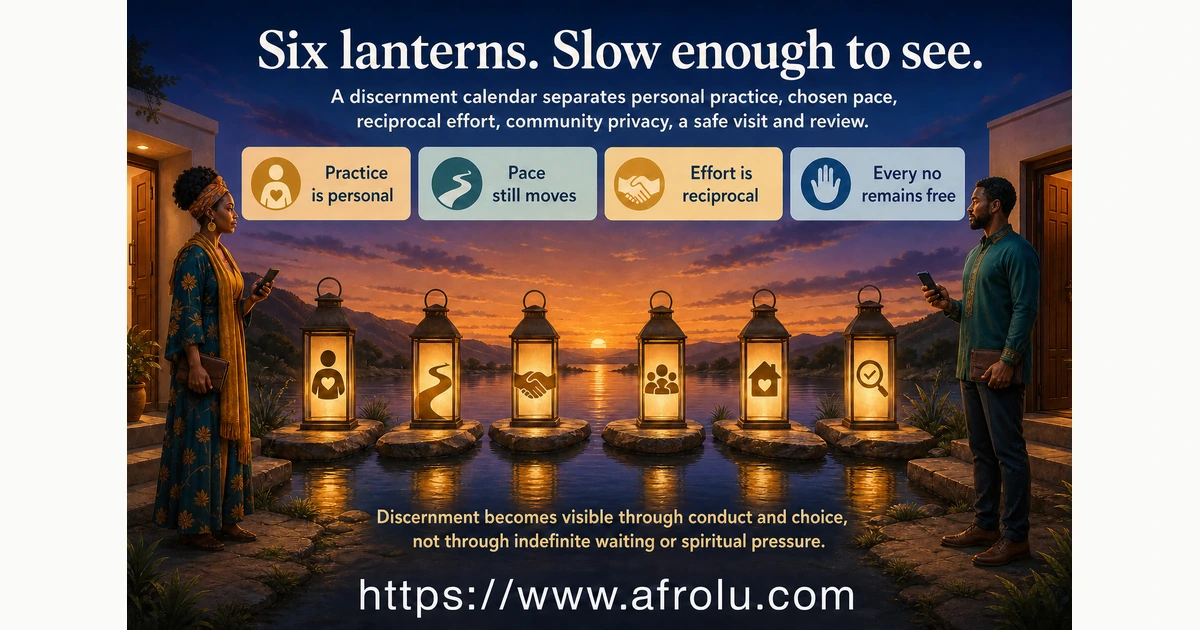
A gentle pace still has reciprocal effort, observable steps and a review point.
Written and edited by Samira Benali · Faith and North Africa Editor
Use six lanterns: personal practice, chosen pace, reciprocal effort, privacy, one independent visit and a review point. Shared faith does not verify identity or create relationship status. Slow dating still needs specific plans, honest answers and repair. Keep community disclosure invited, accounts and money controlled, travel leaveable and every physical or digital yes current. Continue only while the rhythm produces evidence and both adults remain free to revise or leave.
Intentional dating · Faith-Led Daters
Is faith supporting deliberate and observable patience, or being used to excuse low effort and narrow adult choice?
Faith-led slow long-distance dating is a deliberately paced relationship process in which personal conviction informs each adult's own choices while progress, structure, community disclosure, access, travel and consent remain explicit, mutual and reviewable.
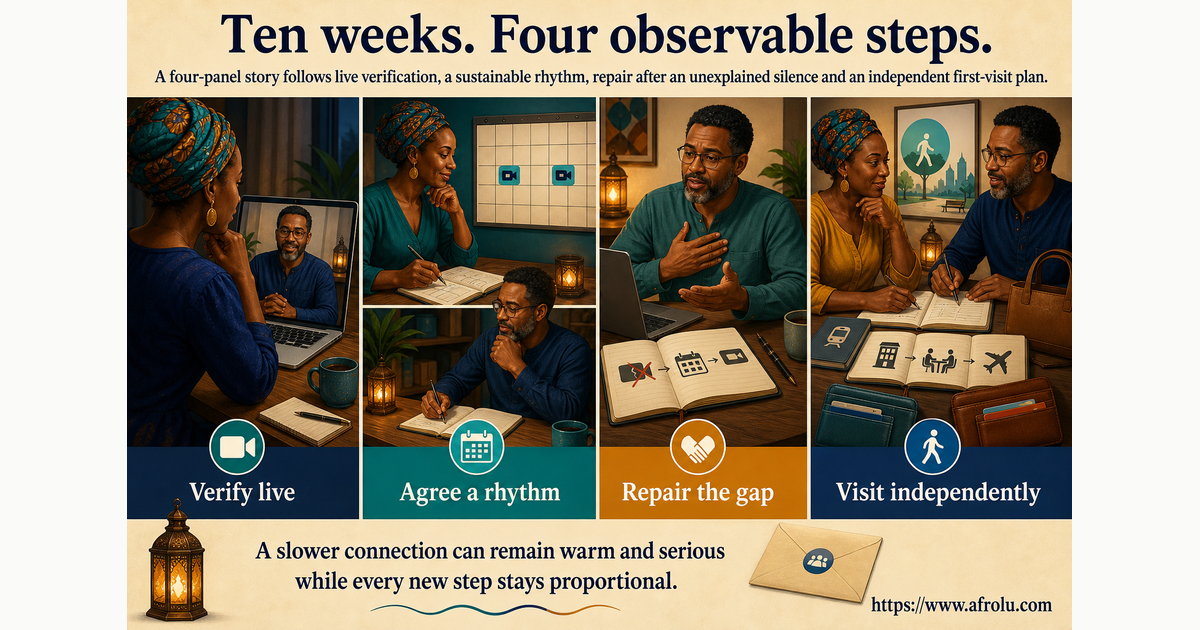
Noura and Dawit are fictional adults, 35 and 39. Across ten weeks they verify live, establish a sustainable call rhythm, repair an unexplained silence, choose exclusivity and plan a public first visit with independent lodging, documents, money and return.
The six-lantern discernment calendar
Let faith deepen honesty without turning patience into passive waiting
Samira separates personal practice from relationship agreement, then tests pace through effort, privacy, a leaveable visit and review.
The calendar follows a ten-week fictional connection and compares healthy patience, visible progress, avoidance and pressure through observable conduct.
Practice
Translate a faith label into lived choices without assigning authority.
Pace and effort
Choose a sustainable rhythm whose next steps are reciprocal.
Privacy and visit
Protect audiences, accounts, money, documents and return.
Review
Continue, revise, define or close from present conduct.
Begin with voluntary discernment
Faith can guide your pace without answering for another adult
A faith-led connection may include prayer, reflection, teachings, community customs or a desire to align relationships with deeply held values. Those practices can help you slow down and ask better questions. They do not verify identity, guarantee kindness or decide compatibility. Your conviction can guide the boundary you set and the future you seek. It cannot create the other adult's consent, relationship status, disclosure obligation or willingness to follow the same practice.
Long distance adds space in which hopeful meaning can grow faster than shared experience. Scheduled calls may feel deliberate. A match may speak fluently about faith before you have seen how they handle a changed plan, a difference or a complete no. Treat the words with respect but test the pattern through ordinary actions: live contact, specific plans, reciprocal initiation, proportionate disclosure and repair. Spiritual vocabulary is context, not an exemption from verification or accountability.
Low pressure does not mean low information. You can say that you need time, keep physical intimacy bounded, decline community disclosure and still ask direct questions about relationship direction, other partners, sexual health, travel, money and future geography. An answer that differs from yours may be painful without being disrespectful. Compatibility includes practice and timing, but neither adult must be argued into it.
A healthy slow pace preserves capacity and produces visible movement. It has a current reason, a next step, reciprocal effort and a review point. Indefinite vagueness is different. So is pressure dressed as patience: asking one adult to wait while the other retains emotional, financial or physical access without a shared agreement. Use faith to widen honesty and care, never to make a boundary harder to use.
Use the six-lantern calendar
Light practice, pace, effort, privacy, visit and review separately
The practice lantern asks what each person actually does and what it means in daily life. Compare observance, community involvement, holidays, food, physical boundaries and expectations without turning the conversation into an examination. Shared labels can conceal different practices; different labels can sometimes coexist. Ask which choices are personal, which would affect a partner and which questions should remain open until the relationship has earned them.
The pace lantern sets contact and disclosure. Choose call windows that respect work, sleep, worship, care and time zones. Decide how quickly to discuss family history and when to meet. The effort lantern asks whether both adults initiate, confirm, repair and complete the next step. Patience is not one person waiting for messages or doing all the planning. A low-frequency rhythm can be serious when it is mutually understood and reliable.
The privacy lantern covers community audiences, home details, intimate images, digital accounts and family information. Advice is invited by the adult receiving it; it is not a vote on the relationship. Ask before sharing a photo, message or private story with a leader, friend or relative. Keep passwords, authentication codes and live location outside the relationship. Faith-based trust and cybersecurity are not competing values.
The visit lantern turns remote hope into one bounded in-person stage. Keep identity checks proportionate, meet publicly, retain lodging, transport, documents, payment and a trusted contact. The review lantern asks what has actually changed: has communication become clearer, has effort stayed reciprocal and has a boundary remained usable? Continue, revise, define the relationship or close without calling one outcome more faithful than another.
Noura and Dawit test a ten-week rhythm
A repaired silence tells them more than a stream of devotional language
Noura, 35, and Dawit, 39, met through friends in different countries. Both described faith as important and said they were open to serious partnership. They began with a live call and two weekly windows rather than continuous messaging. Noura kept her address and family details private. Dawit did not ask for a photograph to show his community. Their shared vocabulary created warmth, but they treated present structure as open exploration until they had a direct conversation.
During week five, Dawit missed a planned call and then stayed silent for several days. Noura did not diagnose his character or turn the delay into a spiritual test. She named the impact and asked whether the agreed rhythm was still workable. Dawit explained that he had avoided an uncomfortable conversation after a work problem. He apologised, proposed a lighter schedule and confirmed the next call. The useful evidence was not his explanation alone; it was whether the next month worked differently.
The revised rhythm held. Each adult initiated, a difference about community disclosure was discussed without recruiting an audience and Noura's physical boundaries were accepted without bargaining. They chose exclusivity but explicitly excluded passwords, live location and a promise of marriage. When Dawit raised a first visit, Noura declined private lodging. He supported a public plan, separate hotel, personal ticket and independent return rather than calling her caution a lack of faith.
At ten weeks they reviewed the six lanterns. Practice seemed compatible enough to keep learning. Pace and effort were sustainable. Privacy had survived a disagreement. The visit plan remained independent. They chose to continue and set another review after meeting. Their patience was not passivity: it contained verification, repair, a changed structure and a concrete next step while preserving both adults' freedom.
Distinguish four quiet paths
Patience, progress, avoidance and pressure require different responses
Healthy patience protects capacity and lets information arrive at a manageable rate. Plans may be infrequent but are specific. Questions receive honest answers, including uncertainty. Boundaries remain usable. Visible progress adds completed steps: a live conversation, reciprocal planning, repair, a public meeting or a clear structure review. Neither path guarantees compatibility, but both produce evidence that can change the next choice.
Avoidance repeats uncertainty without owning it. Calls remain vague, reviews move indefinitely and one adult carries initiation. A person may offer warm reassurance whenever distance is named but no complete next step. One delay is not a pattern. Ask for a bounded action and date. If the answer remains diffuse, treat the repeated system as information rather than adding more emotional labour to prove patience.
Pressure narrows choice. It may use divine certainty, prophecy, community reputation, gender roles, sacrifice language or fear of being unfaithful to demand secrecy, money, travel, exclusivity, marriage or physical access. No spiritual claim supplies another adult's consent. If a clear no produces shame, threats, isolation or retaliation, stop debating the interpretation and protect the relevant access. Seek support that respects both your safety and your beliefs.
Context still matters. A genuine practice difference can create incompatibility without abuse. A busy week can interrupt a good rhythm. A request for counsel can be freely invited. Use severity, repetition and repair. The question is not whether the other person appears devout or calm; it is whether truth can be spoken, plans can be tested and either adult can leave a step without punishment.

Read conduct, repair and agency before calling every delay patient discernment.
Use language that leaves two voices
A faith-led conversation should make the truth more usable
Begin with personal language: 'My faith shapes how slowly I approach physical intimacy.' Then ask: 'What practice and pace are right for you?' Avoid statements that claim authority over the other adult's body, clothing, contacts or timetable. If a difference matters to long-term compatibility, say so plainly. You can end a match because the practices do not fit without calling the other person morally defective.
For effort, say: 'A slower pace works for me when both of us initiate and complete plans.' For privacy: 'Please do not share my photo or our messages with your community without asking.' For counsel: 'I may speak with one trusted adviser about my own decision; I will protect your identifying details.' These boundaries allow support without turning private information into collective property.
Money and travel need direct sentences: 'I do not send fare, fees or investment money through a new connection.' 'I will keep my own lodging, ticket and documents.' A respectful adult can propose a later plan that both can afford. Religious charity, hospitality or generosity cannot be demanded as romantic proof. Verify claims independently and do not use essential funds to keep a connection alive.
Consent stays present tense: 'I am not agreeing to that now.' An earlier conversation, exclusivity, a visit, gifts, community knowledge or serious direction cannot answer for a new act. Close with review: 'After the visit, let us decide whether the pace and relationship structure still fit.' A different answer is not a failed discernment process; it may be the honest result the process was meant to reveal.

Personal conviction can guide your request; it cannot provide another adult's answer.
Plan one independent first visit
Faith can accompany the journey while logistics preserve choice
Use live contact and proportionate consistency checks before travel, while remembering that a video call cannot verify every identity, relationship or employment claim. Confirm current transport, venue and accommodation details through independent sources. Share the broad plan with a trusted person of your choosing. If community privacy matters, choose a supporter who will not publicise the relationship or take control of the decision.
Keep the ticket, passport or identity document, phone, payment and return route under your control. Separate lodging is a strong early option. Meet first in a current staffed public place and use a time box. Do not accept an isolated venue, vehicle, home or sudden cross-border change because money has already been spent. A genuine change can be verified and replanned; a pressured change can be declined.
Agree payment expectations without turning hospitality into debt. Protect essential funds and do not carry money, packages or documents for claims you cannot independently verify. Avoid sharing intimate images to maintain closeness before the trip; image possession can create privacy and coercion risks. Use personal devices and accounts rather than shared credentials or workplace systems.
During and after the meeting, consent remains specific. Either adult may end a plan, skip an activity, choose separate time or leave. Afterward, review facts separately from gratitude, community excitement and travel cost. Ask whether the in-person conduct matched remote claims and whether any boundary produced pressure. One successful visit supports another choice; it does not settle marriage, relocation or permanent access.

Postpone any visit that depends on secrecy, debt, surrendered documents or pressure.
Compare pace patterns
Slow is a relationship rhythm, not a moral rank or an endless holding place
Asynchronous text or voice notes fit mismatched schedules but can hide tone and delay hard questions. Scheduled audio or video offers focused interaction while exposing more privacy and attention. A low-frequency rhythm may protect work and practice when both adults know the schedule. Daily contact may also be freely chosen, but frequency is not commitment, verification or permission to monitor.
Guided reflection can mean each adult considers values or seeks chosen counsel before a review. It becomes pressure when an adviser receives authority over the other adult or private material without consent. Exclusive discernment answers whether either adult dates others; it does not promise marriage or grant access. Visit planning tests logistics and in-person interaction while leaving relationship outcome open.
Indefinite delay is not simply the slowest card. It describes contact with no owned next step, no review point or repeated refusal to name structure. Some adults may freely choose an online-only connection, but the limit must be explicit. If one person waits for a future the other avoids discussing, ask for a specific review and be prepared to act on the answer.
Combine channels and stages rather than seeking one perfect pace. For example, use asynchronous updates, one weekly live call, a monthly relationship check and a safely planned visit when affordable. Review whether the system produces warmth, accurate knowledge and reciprocal movement without consuming work, sleep, faith practice or private agency. Keep, revise or close the rhythm based on what it actually does.
Eight faith-led distance moments where slow pace needs an observable answer
Both profiles mention faith
Actual practice, relationship direction and physical pace remain unspoken.
Ask three separate questions rather than assuming compatibility.One week becomes quiet
The reason and repair are not yet known.
Name the impact and request one complete next step.A photo is shown for advice
Private identity has entered an audience without permission.
Repair the disclosure and define future scope.Spiritual language becomes intense
Warm meaning is growing faster than verified ordinary conduct.
Keep the pace and observe concrete follow-through.Travel help is framed as generosity
The connection is new and the claim cannot be independently checked.
Do not transfer; choose a later affordable plan.Separate lodging is called distrust
Faith language is being used to narrow an independent exit.
Retain lodging or postpone the trip.Exclusivity is treated as physical readiness
A relationship agreement is being made to answer a new act.
State a current no and leave if pressure continues.The gentle rhythm has real progress
Both adults initiate, repair, protect privacy and want the next stage.
Define one new step and what remains ungranted.Signs of patience, progress, avoidance and pressure
{'label': 'Practice', 'title': 'Faith is described through lived choices', 'detail': 'Labels are not treated as complete compatibility proof.', 'reading': 'Specific'}
{'label': 'Pace', 'title': 'The rhythm protects both lives', 'detail': 'Work, sleep, worship and care remain possible.', 'reading': 'Sustainable'}
{'label': 'Effort', 'title': 'Both adults initiate and complete steps', 'detail': 'Patience does not transfer all planning to one side.', 'reading': 'Reciprocal'}
{'label': 'Questions', 'title': 'Uncertainty receives honest language', 'detail': 'A spiritual phrase does not replace an answer.', 'reading': 'Clear'}
{'label': 'Community', 'title': 'Advice is invited with limited disclosure', 'detail': 'The audience does not control the relationship.', 'reading': 'Bounded'}
{'label': 'Privacy', 'title': 'Accounts and intimate information stay chosen', 'detail': 'Trust is not enforced by access.', 'reading': 'Protected'}
{'label': 'Repair', 'title': 'An apology changes the next rhythm', 'detail': 'Conduct rather than eloquence carries accountability.', 'reading': 'Observable'}
{'label': 'Money', 'title': 'Generosity remains voluntary and safe', 'detail': 'No transfer is required to keep the connection.', 'reading': 'Independent'}
{'label': 'Consent', 'title': 'A different answer remains honourable', 'detail': 'No is accepted without spiritual or romantic punishment.', 'reading': 'Free'}
{'label': 'Review', 'title': 'Slow progress has a checkpoint', 'detail': 'The relationship cannot drift indefinitely by silence.', 'reading': 'Reviewable'}
Choose the next step from six lanterns and four quiet paths
| Situation | What it may mean | What to do next |
|---|---|---|
| Is faith practice specific? | Fits: Both describe lived choices and differences. Needs review: A shared label hides practical assumptions. Stop: Faith is used to claim authority over the other adult. | Translate labels into present practices. |
| Does the slow pace have a reason? | Fits: Capacity and values explain the rhythm. Needs review: One delay needs a direct answer. Stop: Vagueness preserves access without responsibility. | Name the reason, next step and review date. |
| Is effort reciprocal? | Fits: Both initiate, confirm and repair. Needs review: One adult has carried the last stage. Stop: All work and consequences stay on one side. | Ask the other adult to complete one plan. |
| Can questions be answered plainly? | Fits: Uncertainty and differences receive honest words. Needs review: One topic is postponed with a date. Stop: Spiritual certainty replaces verifiable facts. | Return to the concrete question. |
| Is community involvement chosen? | Fits: Each adult controls advisers and disclosure. Needs review: A boundary needs repair after oversharing. Stop: An audience shames or directs the relationship. | Close access and seek independent support. |
| Does privacy remain intact? | Fits: Accounts, location and intimate material stay controlled. Needs review: A convenience request needs a limit. Stop: Passwords, images or surveillance are demanded. | Secure accounts and reduce access. |
| Did repair change the rhythm? | Fits: The next plan is specific and completed. Needs review: One follow-through remains untested. Stop: Repeated apologies preserve the same absence. | Judge the new conduct, not the tone. |
| Is the first visit independent? | Fits: Lodging, return, documents and money stand alone. Needs review: One current detail needs verification. Stop: Secrecy, debt or surrendered documents are required. | Postpone and rebuild the visit system. |
| Can consent change? | Fits: Every act receives a free present answer. Needs review: Disappointment needs a pause. Stop: Faith, travel or status is used as obligation. | End the pressured step and prioritise safety. |
| What does review support? | Fits: One proportional next step fits both adults. Needs review: Maintain pace while testing one gap. Stop: More time would extend pressure or deception. | Continue, revise, define or close explicitly. |
Scripts for faith, pace, effort, community, money, visits and consent
“My faith shapes my choices; what does your practice mean in daily dating?”
“I am open to partnership, but I am not promising this outcome yet.”
“One weekly call and a monthly review fit my capacity better than daily contact.”
“I planned the last two calls; please propose and confirm the next complete step.”
“Please ask before sharing my name, photo or our messages with anyone.”
“I do not share passwords, codes or live location in a relationship.”
“I do not send fare or fees; we can meet later when both can fund the plan.”
“I will use separate lodging and keep my ticket, documents and return.”
“My answer is no now, and I need it accepted without a spiritual argument.”
“At our review, let us decide whether the pace and structure still fit both of us.”
Know the difference
The faith-led long-distance pace-pattern deck
Faith can guide one adult's values, boundaries and process. It deserves honest discussion but cannot answer for another person.
Contact, disclosure, exclusivity and visits are negotiated relationship choices. Slower does not mean vague, safer or more faithful by itself.
Choose a rhythm that honours both practices, protects privacy and completes observable next steps without pressure.

Choose a pace pattern that protects conviction and capacity while producing observable progress.
Compare eight faith-led long-distance pace patterns
| Type or dimension | What it describes | Best next question |
|---|---|---|
| Asynchronous reflection | ||
| Scheduled audio | ||
| Scheduled video | ||
| Low-frequency serious dating | ||
| Chosen counsel stage | ||
| Exclusive discernment | ||
| Independent first visit | ||
| Indefinite waiting |
Build a gentle and accountable distance rhythm in six moves
Translate faith
Set the rhythm
Share effort
Protect audiences
Build one visit
Review progress
Questions for practice, pace, privacy and visits
Choose a few prompts that fit the moment. This is a reference library, not a list to complete.
Practice questions
Turn faith labels into daily-life information.
- What guides my own choice?
- What practice affects a partner?
- Which difference matters?
- Who may advise me?
- Can I hear a different answer?
Pace questions
Make slow movement observable.
- Why is this pace useful?
- Who owns the next step?
- What happens after silence?
- When is review?
- Is capacity protected?
Privacy questions
Keep community, accounts and money bounded.
- Who may know?
- Which detail stays private?
- Are credentials protected?
- Is money independent?
- Can a no remain complete?
Visit questions
Build one public and leaveable meeting.
- What is verified?
- Where is lodging?
- Who controls documents?
- What is the return?
- Which outcome stays open?
What relationship research and official guidance can support
Responsiveness matters alongside disclosure
Diary research on intimacy considered self-disclosure, partner disclosure and perceived responsiveness. Afrolu uses the finding narrowly: more disclosure is not automatically more intimacy when the response is inattentive, pressuring or unsafe.
Evidence limit: The studies do not prescribe a disclosure schedule or predict one relationship.
Dedication is different from constraints
Commitment research distinguishes freely chosen dedication from material, felt and other pressures that make leaving harder. Community expectation, travel cost and public promises can create constraint without proving mutual care.
Evidence limit: Population findings cannot score one relationship or determine a faith community's practice.
Direct conversation supports informed choices
CDC guidance encourages partner conversations about testing, prevention and sexual health before sex. Faith, exclusivity and distance do not remove the need for accurate present information and qualified personal care.
Evidence limit: The guidance is general and U.S.-based; clinical services and recommendations vary.
Romantic and belief language can accompany money pressure
FTC consumer guidance describes remote trust-building before urgent travel, medical or investment requests. The practical response is independent verification, protected funds and reporting through appropriate channels after loss.
Evidence limit: The guidance cannot decide whether one person is genuine, and reporting routes are jurisdiction-specific.
Account security does not conflict with trust
CISA recommends strong unique passwords, multifactor authentication, updates and phishing awareness. Sharing credentials or codes is not a valid test of faith, exclusivity or honesty.
Evidence limit: Security practices reduce avoidable risk but cannot guarantee identity or relationship safety.
Consent remains specific and reversible
The Australian Department of Health describes sexual consent as a free, voluntary and informed agreement and says a person can decide to stop at any time. Spiritual claims, community approval, travel, gifts and relationship status cannot answer for a current act.
Evidence limit: Health and legal routes vary by country; use appropriate local professional and emergency support.
Six ways faith or slowness can be made to hide pressure
Use a reviewed resource that matches the decision
This guide focuses on the relationship decision, so it does not rank dating apps. Check current prices, safety tools, and local availability before choosing a service.
Explore the guide library
Show more related guides
Continue with Afrolu
Show more Afrolu guides
Relationship research and official sexual-health, scam, account and consent sources
Afrolu reviewed these health, research, safety, or public guidance resources while editing this page. They support the behaviour and safety guidance; they do not diagnose any individual described by a reader.
Slow faith-led long-distance dating questions
What does slow faith-led long-distance dating mean?
It means a deliberate pace shaped by the adults' actual values and capacity, with visible progress rather than indefinite waiting. A useful plan names contact rhythm, reciprocal effort, privacy, relationship structure, one next step and a review point. Faith may guide personal boundaries; it does not verify identity or override another adult's answer.
How can I tell patience from low effort?
Patience protects capacity while plans remain specific, effort is shared and disruptions receive repair. Low effort repeatedly leaves one adult initiating, waiting and absorbing consequences. Ask the other person to propose and complete one bounded next step. If the same imbalance continues, treat the pattern as evidence rather than a test of devotion.
Should a faith leader or family member approve the relationship?
You may freely seek counsel that fits your practice, but you control whom you ask and what you disclose. The adviser cannot provide the other adult's consent, relationship status or private information. Ask before sharing names, images or messages. If advice becomes surveillance, threats or authority over your body or movement, seek independent support.
Does shared faith make an online match safer?
No label guarantees identity, honesty or respectful conduct. Use live contact, platform signals and proportionate independent checks, then keep a first meeting public and logistically independent. Protect accounts, money, documents and intimate images. A genuine match should be able to respect safety steps without demanding blind trust.
How often should a slow long-distance couple talk?
There is no universal frequency. Choose a rhythm that fits time zones, work, sleep, worship, care and emotional capacity. Specify call windows, what happens after a missed plan and when to review. Daily contact is not commitment; low-frequency contact is not automatically low effort when both adults understand and sustain it.
When should we become exclusive during discernment?
Discuss exclusivity whenever assumptions affect feelings, dating choices or sexual health. Define what it includes, when it begins and what it does not grant. Exclusivity cannot create marriage, passwords, location access or physical consent. Both adults must choose it; community expectation or frequent prayer together cannot make the agreement silently.
Should I send fare or fees to a faith-led match?
Do not use essential funds or transfers as proof of faith, generosity or seriousness in a new or unverified connection. Choose a later plan each adult can finance independently. Never share authentication codes or invest through a match. Verify claims outside the romantic channel and contact appropriate financial or reporting services after loss.
How should we plan a first cross-border visit?
Use proportionate verification, current independent travel checks, public first meetings, separate lodging where appropriate, and personal control of ticket, documents, phone, payment and return. Tell a trusted person the broad plan. Postpone if the trip depends on secrecy, debt, surrendered documents, an isolated venue or pressure to change the plan.
Can faith-based physical boundaries change?
Yes. Each adult controls their current boundary and may make it narrower or wider by free choice. An earlier statement, exclusivity, travel, gifts or serious direction cannot decide a new act. Ask at the relevant moment and accept no without spiritual argument, shame or retaliation.
When should I end a slow faith-led distance connection?
Consider closing when core practices or future directions do not fit, or when repeated vagueness, deception, money pressure, surveillance, community coercion or punishment after a boundary makes further waiting harmful. Where safe, use a concise ending, remove unnecessary access and seek appropriate local support if contact becomes threatening or persistent.
One thing to do now
Let faith illuminate the process while every answer remains free
Read six lanterns and four paths. Continue when faith makes truth easier, progress is observable and a no remains complete. Revise one rhythm when respectful capacity differs. Close when repeated vagueness, deception, spiritual or community coercion, money pressure, surveillance or unsafe travel reduces agency.