One relationship beside two independently authored futures
Build Serious Student Love Beside Two Career Paths
A two-track guide for adult students building serious relationships while protecting study, sleep, grades, placements, money, consent and career agency.
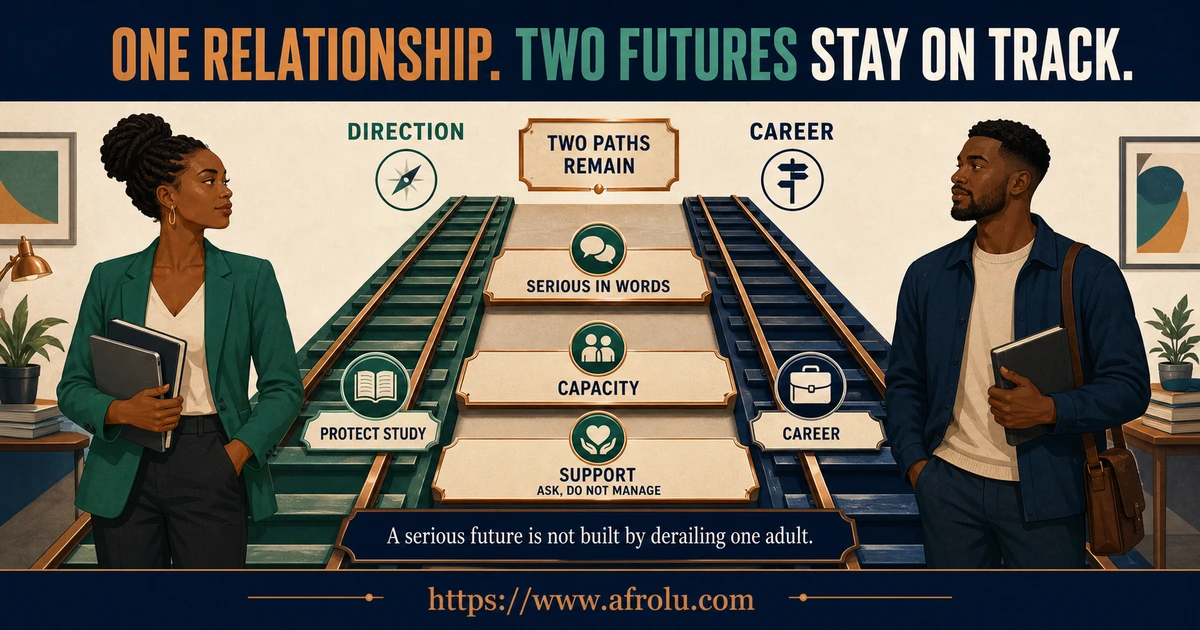
Build one relationship beside two independent futures.
Written and edited by Grace Mutiso · Kenya Guides Editor
Treat every student on this page as an adult and keep one relationship beside two education-to-career tracks. Define serious direction and present exclusivity separately. Protect study, sleep, paid work and a small complete relationship offer during demanding blocks. Let support be requested, scoped and reversible; keep grades, portals, applications, devices, money, mentors and placement decisions under their owner's control. Discuss how an opportunity affects the relationship without giving either partner a career veto. Check institutional policy when romantic interest overlaps assessment or employment power. At each block's end, review agreement, capacity, agency and repair; continue, rebalance or close without making sacrifice the proof of love.
Relationship intent · Students
Does serious intent appear as support for two viable futures, or as demands for grades, access, money, time and career sacrifice?
Serious adult-student dating is a long-term relationship direction built while one or both adults study, train or retrain. The two-track capstone protects each education-to-career path and joins only explicit shared decisions, distinguishing supportive partnership from academic monitoring, financial control, career vetoes and sacrifice demands.
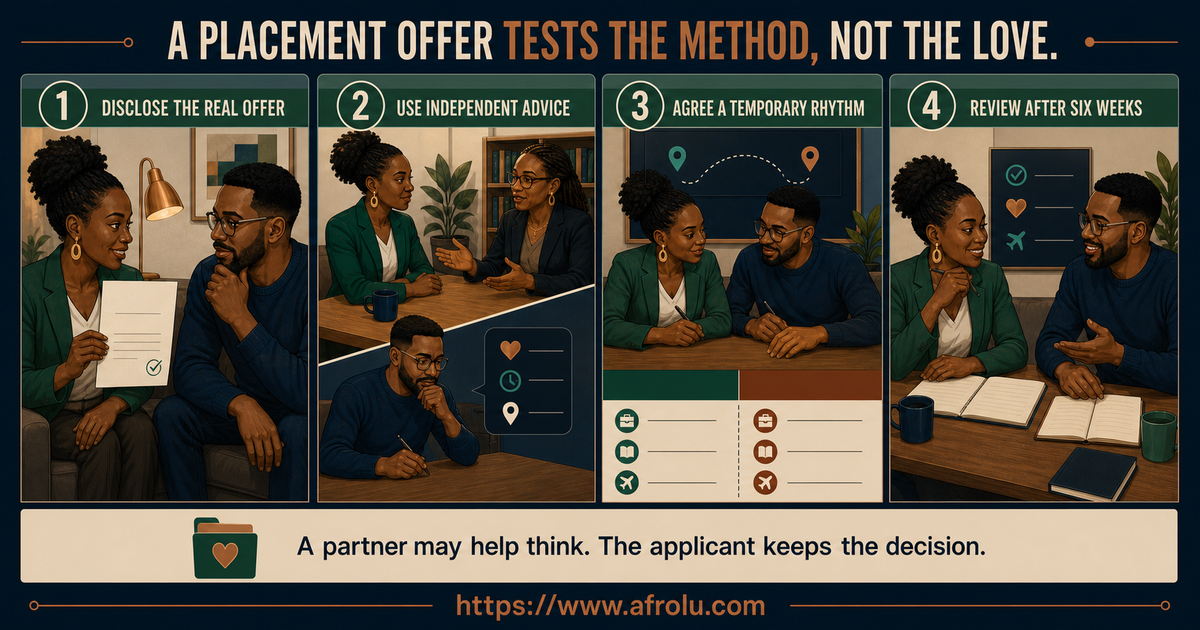
Njeri and Malik are fictional adult students, 27 and 30. When Njeri receives a six-month placement in another city, Malik names the relationship effects without claiming the decision. Njeri also seeks independent career advice. They create a temporary call-and-visit rhythm and review it after six weeks. Travel changes, but neither career becomes proof of who loves more.
The adult-student two-track capstone
Let serious partnership support the learners without becoming their examiner
Grace centres adult agency through exams, placements, money pressure and the first unstable years of a career path.
The capstone follows two individual tracks through shared clarity, support and review platforms, then tests every request by the agency it leaves behind.
Relationship clarity
Name serious direction and present exclusivity without implying access or sacrifice.
Protected capacity
Keep required study, sleep, health and a realistic connection offer visible.
Career authorship
Discuss effects while applications, placements and roles remain owned by the applicant.
Agency review
Check whether support, money and repair leave both adults able to choose.
Begin with two adult authors
Serious student dating should enlarge two futures, not appoint one manager
Student does not mean teenager. This guide is for adults in university, postgraduate study, vocational programmes, professional exams, apprenticeships or career retraining. Their age, income and previous experience may differ widely. What they share is a period in which time, money and location can change quickly. Serious dating can be meaningful here, but a long-term direction does not turn either partner into a parent, supervisor, sponsor or owner of the other's future.
Define serious in current language. Each adult may be dating toward lasting partnership while the present relationship is still non-exclusive. Or they may agree to exclusivity without deciding marriage, co-residence or location. Write intention and structure separately. Study stress, frequent calls, shared notes, sex, gifts or introductions to classmates cannot create an agreement by implication.
Education and early career require protected agency. A partner can listen, celebrate, proofread when invited, share a meal or adjust a date around exams. They do not need grade portals, learning accounts, application passwords, tutor contact, placement documents or control of attendance. Help stays supportive when the learner requests it, the scope is clear and the learner remains able to change the answer.
Avoid the sacrifice myth. Turning down a placement, missing an exam, taking debt, abandoning sleep or shrinking a goal may be framed as proof that the relationship is serious. A consequential choice can sometimes be made jointly, but it needs accurate information, time, independent advice and a genuine right to disagree. Love is not measured by which future disappears first.
The two-track capstone
Keep education-to-career routes parallel and join only deliberate relationship decisions
Track one belongs to the first adult: required study, finances, health, applications, placement choices and a plausible next career step. Track two belongs to the second. Put both on paper without ranking salary, prestige or speed. One person may be retraining at forty while the other completes a first degree at twenty-five. Neither path becomes less adult because it is slower, informal or currently unpaid.
The clarity platform is where the relationship direction and structure are spoken. The support platform asks what help is wanted this block: protected evenings, a shared meal, practice questions, transport after a late class or simply no academic discussion. The review platform is scheduled near a natural transition such as the end of exams, placement confirmation or the next timetable. Shared platforms require two yeses and can be redesigned.
Capacity is not affection. During exams, clinical rotations or project deadlines, contact may contract. Name the period, the smallest sustainable offer and the point for review. A serious partner does not demand sleep loss to prove priority. Nor should a student use every deadline to avoid relationship repair. The evidence is whether each adult gives honest notice, protects essentials and returns to the agreed conversation.
Career joining happens later and only where consequences are genuinely shared. Relocation, household budgets, caregiving and co-residence can affect both adults, but even then a specific job application remains the applicant's. Discuss effects openly, obtain independent career or financial advice where useful and preserve an option that does not depend on romantic approval. A joint plan is strongest when each route remains intelligible on its own.
Njeri and Malik meet a real career turn
A placement offer reveals whether partnership means support or veto
Njeri and Malik are fictional adults, 27 and 30. Njeri is completing a postgraduate programme while Malik undertakes professional certification alongside work. They have dated for eight months, agreed exclusivity and say they are exploring a lasting partnership. Their serious direction is real, but neither has promised a city, wedding date or shared account.
Njeri receives an offer for a six-month placement in another city. She tells Malik before accepting and asks what effects he sees. He names travel cost, reduced weekends and his fear of drifting apart. He does not say that accepting would prove she values work more than him. Njeri also speaks with her programme adviser and a former participant so the career decision is not judged only inside the relationship.
They build a temporary plan: one scheduled call, flexible lighter contact during demanding weeks, alternating affordable visits where possible and a six-week review. Neither shares academic or work passwords. Malik will not manage her deadlines; Njeri will not expect him to fund travel he cannot afford. They discuss sexual-health expectations relevant to the distance without assuming that exclusivity removes the need for conversation.
At six weeks, the communication rhythm works but travel is too expensive. They reduce visits and keep the placement plan. The relationship has not failed because the original schedule changed. It has produced better information. If Malik had threatened to end the relationship unless Njeri declined, contacted her supervisor or sabotaged the offer, the issue would not be ordinary disappointment; it would be interference with her agency and require stronger boundaries and support.
Test the requested action
Support increases capacity; control replaces the student's decision
Care asks: ‘What would help?’ It may be a quiet evening, a meal, encouragement, listening or no intervention. Coordination handles the relationship impact: choosing a date after an exam, agreeing on travel cost or moving a call. Neither requires access to the learning system. The student defines the task, and the helper can say what they can realistically offer.
Overreach enters private systems or authority. A partner checks grades without permission, writes an application in the learner's name, demands attendance proof, contacts a tutor, chooses subjects, controls study friendships or uses money to direct placement. Even apparently helpful acts can reduce agency when consent is missing. Close the access, change credentials where needed and name the boundary at the level of the action.
Stop-and-support conduct includes threats, coercion, stalking, impersonation, sexual pressure, withholding essential money to force a choice, destroying work or study materials, or contacting a school or employer after a no. Preserve useful evidence without investigating at personal risk. Use campus or workplace support, trusted people, financial providers, legal or advocacy help and emergency services according to the conduct and local options.
Do not diagnose a partner from study conflict. Stress, fatigue and anxiety can affect attention, but only qualified professionals can assess health concerns. A relationship can adjust around a difficult period without making one person clinician or compliance officer. If distress persistently affects daily life, seek appropriate support; if the behaviour is coercive, choose safety support rather than trying to treat it as poor time management.

Measure the permission requested, not the romance used to request it.
Two-author language
Name commitment and preserve the individual decision in the same sentence
For seriousness, say: ‘I am building toward a lasting partnership with you, and neither of us controls the other's education or career choices.’ This does not ban consultation. It defines the authors. If marriage, co-residence or relocation becomes a live question, create a separate discussion with the information and advice that decision requires.
For exams, say: ‘From Monday through Friday I need protected study and sleep. I can offer a short Wednesday call and Saturday afternoon after the paper.’ A partner can decide whether that temporary offer works. Do not share a timetable as a monitoring tool or promise constant replies during a study block. Protecting capacity is part of making later relationship attention real.
For a placement, say: ‘I want to hear how this affects us, and the application decision remains mine. Let us design the relationship plan if I accept.’ For grades, say: ‘My results and portal are private. I will share what I choose when I am ready.’ These sentences keep intimacy possible without making academic data the price of trust.
For money and consent, say: ‘I will not take debt or surrender account access to prove commitment,’ and ‘Serious, exclusive and supportive do not answer physical contact; ask for the present choice.’ If financial help is freely offered, define amount, purpose, repayment or gift status in writing where appropriate. Never let tuition, rent, transport or gifts become leverage over sex, study or career.

Name the shared relationship and the individual decision in one sentence.
Cross into work with guardrails
Placements, mentors and early jobs create third-party duties beyond the relationship
A placement or internship can create asymmetry. If a partner, relative or close colleague can affect assessment, hiring, pay or opportunities, identify the influence and consult current policy. The weaker party's private yes may not remove a conflict. Keep personal communication off work systems where appropriate and use an independent contact if harassment, retaliation or interference occurs.
Referrals spend credibility and affect third parties. A student may ask once, and a partner may decline. Directing someone to a public opportunity differs from promising selection or contacting a hiring manager through romantic leverage. Never use a referral as reward for intimacy or threaten to withdraw professional support after a relationship boundary.
Devices often blend study, personal and work material. Keep passcodes private, enable appropriate security and follow school or employer rules. A partner does not need access to verify attendance or loyalty. If credentials were shared, change them and review connected sessions. Do not open the other person's accounts to check whether they opened yours; preserve facts without escalating into mutual surveillance.
Career clarity includes practical money. Compare tuition, debt, transport and expected income without shaming either path. A serious relationship may eventually share budgets, but early scarcity should not be solved through secret borrowing, rushed investment or dependence on a remote promise. Qualified financial, career or legal advice can protect both adults when the decision exceeds ordinary dating guidance.
The end-of-block review
Check agreement, capacity, agency and repair before the next timetable begins
Agreement asks whether both adults can describe serious direction, current exclusivity and the support offered this block. If one believed that exclusive meant shared passwords or that serious meant declining relocation, correct the assumption before it becomes a demand. Put future questions in a separate list rather than pretending they are settled.
Capacity asks whether study, sleep, health, paid work and essential finances remained protected. A relationship can require effort without consuming every margin. Notice whose deadlines were believed and whose were repeatedly treated as negotiable. Rebalance the schedule when goodwill exists but the load is one-sided.
Agency asks whether each person still owns grades, applications, placements, mentors, money and consent. Repair asks what happened after a boundary or mistake. Did the other adult stop, acknowledge impact and restore access or opportunity where possible? Promises count less than a changed account setting, corrected contact, completed alternative or respected no.
Continue when seriousness appears as reliable care beside two intact futures. Rebalance when a temporary block, cost or distance needs a smaller plan. Close when the desired directions cannot fit or when control, sabotage, coercion, financial exploitation, threats or retaliation persists. The capstone is not staying together at any cost; it is making an adult relationship decision without erasing either author.

Continue, rebalance or close from two-track evidence.
Eight adult-student moments where support can cross into control
Temporary capacity needs a complete smaller offer
A learner asks for five quiet days and offers one short call, while their partner wants all-night study company.
Protect sleep and study, keep the offered call voluntary and review after the stated block.Celebration does not require portal access
A serious partner asks for login details so they can track every result and encourage improvement.
Keep credentials private and share results only at the depth the student freely chooses.Discuss impact without claiming the decision
A six-month placement would reduce visits and affect cost.
Use independent career advice, compare relationship effects and let the applicant retain final authorship.A partner's contact is not relationship property
One adult asks for an introduction and treats hesitation as lack of belief.
Decline or use a normal public process; never spend third-party trust as romantic proof.Financial help can become hidden control
A partner offers fees but expects subject choice and continuous location access in return.
Do not accept coercive terms; seek independent financial or student-support options.Peer contact is treated as disloyalty
A partner demands that a student leave a mixed-gender project group despite academic consequences.
Protect the legitimate study relationship and address jealousy without surrendering education or peer contact.Romance overlaps evaluation power
A placement supervisor expresses interest in an adult trainee whose assessment they influence.
Pause personal pursuit and use current institutional policy and independent support.Two job offers point to different cities
Both partners want commitment but neither can promise to move immediately.
Compare real offers and a bounded distance plan; do not make one declined career the proof of seriousness.Evidence that serious dating can protect two education-to-career tracks
Both adults can name serious direction and present exclusivity as different answers.
Study blocks include protected sleep, coursework and a realistic smaller relationship offer.
Grades, portals, applications and credentials remain controlled by the learner.
Help is requested, scoped and reversible rather than imposed as supervision.
Each adult's education-to-career path is described without prestige or income ranking.
Placement and job effects are discussed while the applicant retains final authorship.
Neither person treats missed study, debt or a declined opportunity as proof of love.
Peer, mentor and professional relationships can continue without isolation demands.
Referrals and employer access remain separate from romance and intimacy.
Sexual-health and consent choices are discussed directly despite serious or exclusive labels.
A mistake leads to restored access, corrected contact and changed behaviour where possible.
Both adults can continue, rebalance or leave without losing education, livelihood or essential money.
Test the requested action before granting the permission
| Situation | What it may mean | What to do next |
|---|---|---|
| An exam week reduces contact | A temporary capacity boundary | Protect essentials, offer a small complete connection and review afterward. |
| A partner asks for grades | Curiosity crossing toward academic monitoring | Share by choice and keep portal credentials private. |
| Study help is offered | Potential care with scope questions | Let the student define the task and retain the right to stop. |
| A placement changes distance | A career opportunity with relationship effects | Use independent advice and design a temporary plan without a romantic veto. |
| Tuition help has hidden conditions | Financial leverage over education or consent | Decline coercive terms and seek independent support. |
| A referral is requested | Professional credibility is being asked for | Use ordinary selection routes and keep affection out of the decision. |
| A project partner triggers jealousy | Relationship insecurity affecting legitimate study | Discuss the fear without isolating the learner or harming coursework. |
| One adult writes the other's application | Help has crossed into authorship | Restore control and keep advice clearly invited and attributed. |
| A supervisor expresses interest | Evaluation power enters personal consent | Pause and use current institutional policy and independent help. |
| Exclusivity is used to demand passwords | Relationship structure is being expanded into surveillance | Keep credentials closed and restate what exclusivity means. |
| Two job locations differ | A practical closing-distance question | Compare current offers and reversible options before sacrifice. |
| Materials are destroyed or access blocked | Sabotage with safety and livelihood effects | Preserve evidence, secure accounts and use campus, workplace or local support. |
Scripts for exams, grades, placements, money, peers and consent
“I am building toward a lasting partnership, and our education and career decisions remain individually owned.”
“From Monday through Friday I need protected study and sleep; I can call Wednesday evening.”
“My results and learning portal are private. I will share what I choose.”
“Listening would help tonight; I do not want advice or timetable management.”
“I want to hear the impact on us, and the application decision remains mine.”
“I will not decline this opportunity as a test of commitment.”
“My project group is part of legitimate study; jealousy does not decide my participation.”
“I will not share passwords, attendance or location to prove seriousness.”
“I will not accept tuition help tied to control over study, contact or intimacy.”
“Please use the public application route; our relationship does not decide selection.”
“Serious and exclusive do not answer this physical choice. Ask me now.”
“This block has become one-sided. Let us change the plan or close it honestly.”
Know the difference
Serious direction and supportive partnership do not require educational sacrifice
Invited, bounded help that leaves the student more informed, capable and free to choose.
Access, money, guilt or threats used to take over study, placement, career, peer or consent decisions.
Ask whether the action preserves two adult authors and two viable futures.

Do not turn one adult's sacrifice into evidence of both adults' commitment.
Compare serious direction, support, coordination, control and sacrifice
| Type or dimension | What it describes | Best next question |
|---|---|---|
| Serious dating | A direction toward lasting partnership | What current choices express the direction? |
| Exclusive dating | A present mutual relationship structure | What exactly has been agreed? |
| Support | Help requested and scoped by the learner | Does the student remain able to stop or change it? |
| Coordination | Shared planning around relationship effects | Which decision is actually joint? |
| Advice | Information offered without taking authorship | Was advice requested and independently checkable? |
| Academic monitoring | Access to grades, attendance or learning systems | Why would this permission be necessary? |
| Career veto | A partner claims authority over an application or role | Restore applicant control and seek independent advice. |
| Sacrifice demand | Loss is required as proof of love | Decline the test and protect the affected future. |
| Shared household choice | A decision with effects on both adults | Which parts are joint and which remain individual? |
| Workplace power | Influence over assessment, hiring or livelihood | Which policy and independent support apply? |
Build the two-track capstone in six moves
Write two tracks
List each adult's education, paid work, health, finances and next career decision without ranking them.
Name shared platforms
Define relationship clarity, invited support and the next review while keeping individual decisions individual.
Protect the study block
Keep sleep, required work and a small complete relationship offer visible during peak periods.
Close private systems
Keep grades, portals, applications, devices, accounts and mentor contact behind separate permission.
Test support by agency
Useful help should leave the learner more able to understand and choose.
Review the capstone
Check agreement, capacity, agency and repair, then continue, rebalance or close.
Questions organised by relationship, study, career and review
Choose a few prompts that fit the moment. This is a reference library, not a list to complete.
Relationship platform
Name direction and structure before discussing sacrifice.
- What does serious mean now?
- Are we exclusive?
- What support is wanted?
- Which decisions remain individual?
- When will we review?
Study track
Protect capacity while keeping connection usable.
- Which deadlines are fixed?
- What sleep must stay protected?
- What small offer is sustainable?
- Which data remains private?
- What happens after the block?
Career track
Separate discussion from authority.
- Who owns the application?
- What relationship effect is real?
- Which advice is independent?
- Does power affect consent?
- What choice remains reversible?
Capstone review
Choose from agreement, capacity, agency and repair.
- Can both name the agreement?
- Were essentials protected?
- Do two futures remain?
- Did repair change behaviour?
- Do we continue, rebalance or close?
What student, relationship, workplace and public-health evidence can support
Academic stress and sleep deserve protection without simple predictions
University research has examined links among academic stress, sleep, wellbeing and performance. Results vary by design and population, so Afrolu uses the evidence only to protect essentials and reject romantic pressure for avoidable sleep loss.
Evidence limit: Observational student studies cannot diagnose an individual or promise that a particular schedule will change grades or health.
Current relationship-specific experience matters more than a perfect-partner profile
A large project across longitudinal couple datasets found that relationship-specific reports such as perceived commitment, appreciation and conflict were important predictors of current quality. Afrolu translates this into observing conduct, not scoring a student partner.
Evidence limit: Prediction was limited, especially for change over time, and the data cannot evaluate an individual relationship or every culture.
Employment power can make sexual pressure consequential
Kenya's Employment Act addresses unwelcome sexual conduct and employment-related promises or threats. Placements and early jobs may require current policy and independent support when a romantic interest holds influence.
Evidence limit: Legal duties, coverage and remedies depend on the specific facts; obtain qualified current advice.
Study phones may also carry work or institutional access
NIST BYOD guidance describes security and privacy challenges where personal devices access organisational resources. Keep credentials private and follow the responsible institution's rules.
Evidence limit: NIST is U.S. organisational technical guidance, not a personal legal rule or a guarantee of security.
Serious intent, exclusivity and financial support do not supply consent
NHS guidance explains active, specific and withdrawable consent. Tuition help, a placement introduction or a long relationship cannot answer a present intimate choice.
Evidence limit: The source explains UK context; laws and support pathways vary, and individual incidents require local qualified help.
Conversation belongs before sex, not after an assumption
Current CDC guidance encourages partners to talk before sex so adults can make informed decisions about testing and prevention. A serious label does not replace relevant discussion.
Evidence limit: CDC guidance is U.S. public-health information; use locally appropriate clinical care for personal testing, vaccination or treatment.
Six shortcuts that turn support into authorship
Treating an adult student like a child
Care becomes control when one partner claims parental authority over choices and results.
Using grades as relationship evidence
Academic performance cannot measure honesty, commitment or consent.
Making sacrifice the serious test
A lost placement or damaged health proves loss, not mutual commitment.
Sharing accounts for convenience
Portals and devices can expose academic, employer and third-party information.
Turning money into authority
Financial help cannot purchase subject choice, location, contact or intimacy.
Letting one career become the default
Prestige, current income or age should not silently decide whose future moves.
Use a reviewed resource that matches the decision
This guide focuses on the relationship decision, so it does not rank dating apps. Check current prices, safety tools, and local availability before choosing a service.
Explore the guide library
Show more related guides
Continue with Afrolu
Show more Afrolu guides
Research, primary law and public guidance reviewed for this capstone
Afrolu reviewed these health, research, safety, or public guidance resources while editing this page. They support the behaviour and safety guidance; they do not diagnose any individual described by a reader.
Serious adult-student dating and career-clarity questions
Can adult students build a serious relationship while studying?
Yes, when both adults define serious direction, protect essential study and retain authority over their own education and career. Use a realistic relationship rhythm and review it at natural transitions. Serious does not require immediate co-residence, shared accounts, grade access or sacrificing a placement.
Should my partner know all my grades?
Only if you freely choose to share them. Grades are private information and do not measure commitment, honesty or relationship worth. Keep portal credentials under your control. A caring partner can celebrate, listen or help when invited without monitoring every result.
How much contact is fair during exams?
There is no universal amount. Protect required study, sleep and health, then offer the smallest complete connection you can sustain—a short call, planned meal or post-exam date. Name the block's end and review afterward. Neither adult should demand avoidable exhaustion as proof of priority.
Can a serious partner help choose my career?
They can discuss relationship effects and share observations when invited. The applicant should also use independent career information and retain final authorship of applications, placements and roles. Truly joint decisions such as a shared household still contain individual professional choices.
What if a placement means long distance?
Compare actual duration, cost, visit capacity, communication and what happens afterward. Create a bounded trial and review point if both want it. Do not ask the applicant to decline as proof of love or promise that distance will work. The relationship and placement can each be evaluated on their own evidence.
Is paying tuition a sign of commitment?
It may be a freely chosen gift or agreement, but payment cannot prove relationship quality or buy control. Clarify amount, purpose and whether repayment exists. Decline money tied to grades, subject choice, location, passwords, isolation or sex, and seek independent support where possible.
Should couples share learning or work passwords?
No. Convenience does not justify exposing academic, employer or third-party information. Keep credentials private, use appropriate device security and follow institutional rules. If access was shared, change passwords and review connected sessions without entering the other person's accounts.
What if my partner is jealous of classmates or mentors?
Listen to the feeling without allowing it to control legitimate study or professional relationships. Agree on relationship boundaries that apply fairly, but do not leave a project, avoid a mentor or expose private messages simply to relieve monitoring demands. Repeated isolation or sabotage needs stronger support.
Is it selfish to choose a career opportunity over the relationship plan?
Not automatically. Compare what was agreed, the opportunity's value, the relationship effect and reversible alternatives. A partner may be genuinely hurt without owning the decision. Sometimes two valid futures do not fit; a respectful close is more honest than making sacrifice the test of love.
What if a supervisor or tutor wants to date me?
If they can affect assessment, placement, funding, references or opportunity, pause. Check current institutional and legal guidance through an independent contact. Preserve relevant communication and seek support if pressure, promises, threats or retaliation appears. Private mutual interest may not resolve the power or policy issue.
One thing to do now
Build commitment without making either future disappear
Write both education-to-career tracks, then identify only the relationship platforms that are truly shared: clarity, requested support and review. Protect essential capacity and private systems. When a placement or role changes the plan, use independent evidence and preserve applicant authorship. Review agreement, capacity, agency and repair before the next block.