Four stations for belief, conduct, distance and freedom
Build Serious Faith-Led Love Across Distance With Clarity
A four-station guide to faith-led serious long-distance dating through shared values, conduct, visits, money, consent and free choice.
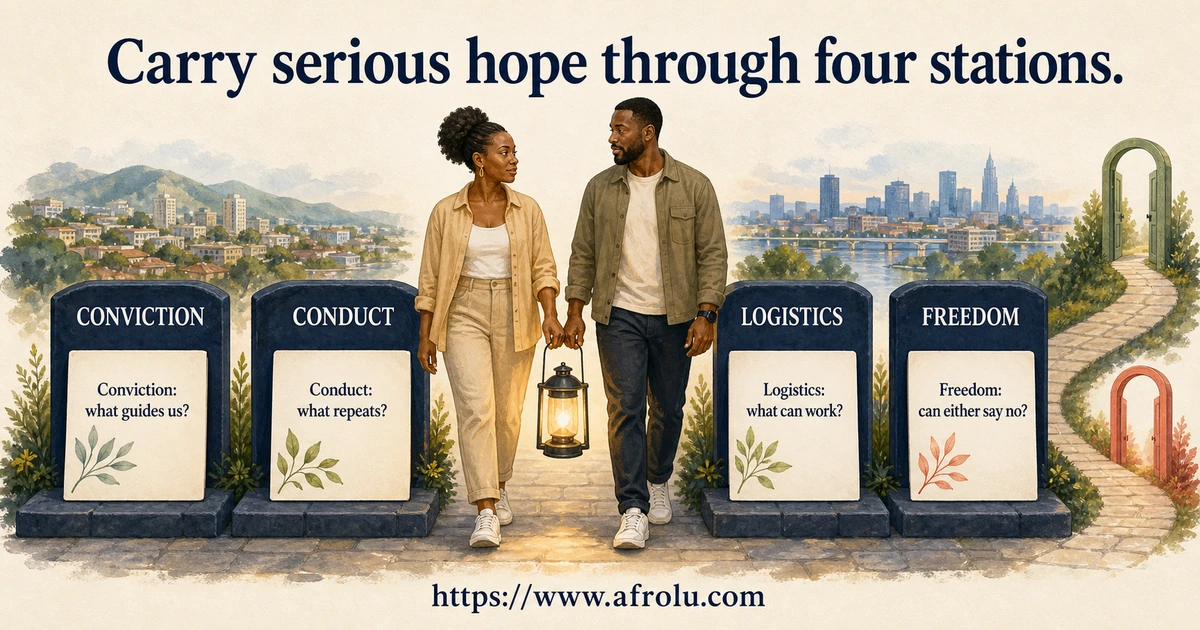
Shared faith can guide the process; conviction, conduct, logistics and freedom must each remain visible.
Written and edited by Clarisse Uwimana · Dating Culture Editor
Separate the three descriptors: faith-led names a values-guided process, serious names a hoped-for lasting direction and long-distance names a geographic constraint. Then use four stations. Conviction asks which beliefs materially shape daily life. Conduct pairs value words with consistent facts, reciprocal care and repair. Logistics builds sustainable calls and independently funded public visits while keeping documents, accounts and returns separate. Freedom checks whether either adult can disagree, seek outside advice, change consent, decline public disclosure or leave without shame or punishment. Define exclusivity rather than inferring it from prayer, community introduction or message intensity. Continue only when all four stations support one another; redesign or end without treating the outcome as a verdict on anyone's faith.
Relationship intent · Faith-Led Daters
Can our convictions, ordinary conduct, distance logistics and freedom support the same serious relationship rather than four different private stories?
Faith-led serious long-distance dating is a relationship process in which adults want religious or spiritual values to guide conduct, seek a lasting committed direction and live far enough apart that remote communication and planned visits are central. The four-station discernment relay tests conviction, conduct, logistics and freedom so belief supports rather than replaces evidence and choice.
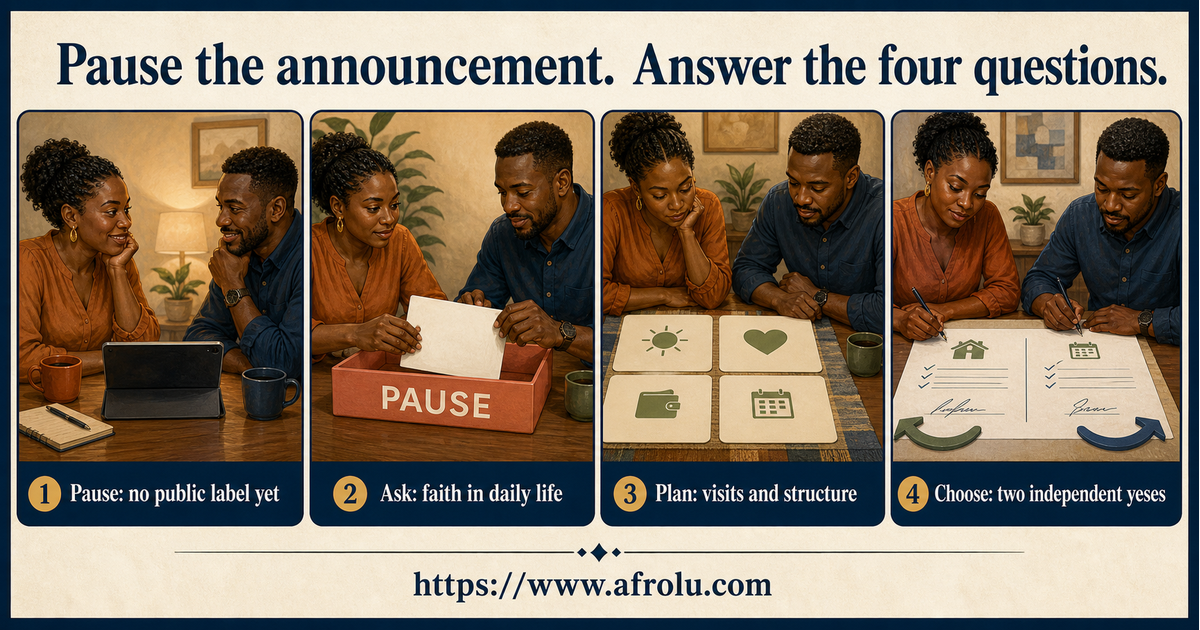
Esther and Malik are fictional adults, 33 and 36, introduced across countries by a mutual friend. After warm calls, Malik proposes a community announcement before they have defined exclusivity or travel. Esther pauses it. Malik respects the boundary, and together they examine faith practice, ordinary conduct, visit logistics and personal freedom. They choose ninety days of exclusivity and one independently funded public visit, with no engagement or public label promised.
The four-station discernment relay
Let shared values travel with conduct, logistics and freedom
Clarisse treats faith as a lived source of meaning while refusing to let identity, leadership or certainty language replace adult evidence.
The relay carries one serious question through conviction, conduct, logistics and freedom before any larger promise is made.
Conviction
Translate faith identity into the practices and choices that shape an ordinary week.
Conduct
Pair honesty, care, accountability and humility with repeated observable behaviour.
Logistics
Give contact, visits, money, documents and possible relocation a realistic plan.
Freedom
Keep disagreement, advice, disclosure, consent and exit personally authored.
Begin with the three words
Faith-led, serious and long-distance describe three different parts of the relationship
Faith-led dating means one or both adults want religious or spiritual convictions to shape how they date. The phrase does not identify one religion, level of observance or set of rules. Serious dating means the stated direction is a committed long-term partnership or marriage. Long-distance means geography materially limits ordinary in-person contact. These descriptions can coexist, but each needs its own conversation and evidence.
A shared faith label may be meaningful without creating complete compatibility. Two adults can share an affiliation yet differ on worship, interpretation, gender expectations, money, family authority, sex, children, community involvement, migration, interfaith relatives or what marriage means. Adults from different faiths may share important ethical commitments while facing other incompatibilities. Ask about lived practice and consequences rather than sorting people by a label alone.
Serious intention is direction, not instant exclusivity, engagement or family permission. Define the present structure: are either adult's dates with others within the agreement, what disclosure matters and how would exclusivity begin? Define pace separately: how often will calls happen, when will visits become realistic and which community or family disclosures are not yet part of the relationship? A clear early answer may still be exploratory.
Faith can support patience, honesty, care, accountability and hope. It must not replace identity checks, consent, financial independence or a realistic distance plan. Prayer, discernment, a leader's opinion, community enthusiasm or a claimed revelation cannot decide another adult's body, money, documents, travel, relationship status or public disclosure. A faith-led process remains worthy only while both adults retain freedom.
The four-station discernment relay
Carry the relationship through conviction, conduct, logistics and freedom
The conviction station asks what faith means in daily choices. Which practices shape the week? How are doubt, disagreement and learning handled? What expectations concern sex, marriage, household roles, giving, dress, food, holidays, children or community life? The purpose is not to complete a theological interview. It is to discover which beliefs would materially shape a shared relationship and whether each adult can explain them in their own voice.
The conduct station watches whether stated values appear under ordinary strain. Does honesty produce consistent facts? Does care include reciprocal time across time zones? Does humility allow correction? Does accountability lead to changed behaviour after harm? A person can speak fluently about values while evading plans or pressuring boundaries. Equally, one awkward conversation does not prove hypocrisy if acknowledgment and repair follow.
The logistics station asks whether the distant relationship can exist outside imagination. Name contact rhythm, time zones, internet limitations, affordability, travel documents, public visits, separate lodging and possible relocation without promising what has not been researched. Each adult should control money, documents and return. Immigration, marriage and family law are jurisdiction-specific; use current official sources and qualified advice before consequential decisions.
The freedom station is non-negotiable. Can Esther ask a hard question, decline a visit, change consent, disagree with an interpretation, seek advice outside Malik's preferred circle or end the relationship without shame, threats or spiritual punishment? Shared conviction can inspire a choice, but it cannot remove authorship from either adult. When belief is used to control, the problem is conduct—not insufficient faith by the person being pressured.
Esther and Malik replace an announcement with four answers
A public step waits until the adults know what they are publicly naming
Esther and Malik are fictional adults, 33 and 36, introduced by a mutual friend across countries. They enjoy six weeks of calls about faith, family and work. Malik says he is dating seriously. Esther agrees with the direction but notices they have not discussed exclusivity, visit finances or how different community practices would affect daily life. Warm language has created importance before an agreement has created structure.
After a hopeful conversation, Malik suggests that his community announce they are courting. Esther feels honoured and uneasy. She says: ‘Please do not announce us yet. Serious is our direction, but we have not agreed on a public label.’ Malik is disappointed. He pauses the plan, tells the friend there will be no announcement and returns to Esther without asking a leader to change her mind. That response protects the next conversation.
They use the four stations. Conviction reveals that both value service and family care but differ on how often a partner should attend community events. Conduct reveals reciprocal calls and one repaired misunderstanding. Logistics reveals that neither can relocate soon and each can afford only occasional travel. Freedom reveals that Esther wants private counsel from someone outside Malik's community and Malik can accept that without monitoring the advice.
Their next step becomes smaller and more honest: exclusive dating for ninety days, one independently funded public visit and no family or community announcement until the review. They are not engaged. They have not solved relocation. The serious relationship becomes more credible because it now has a present structure, an evidence plan and two adults who can still change their answers.
From value claim to behaviour
Place each belief statement beside what happens in ordinary life
If honesty is named, observe whether identity, relationship status, money stories and travel facts remain consistent. Verification can include ordinary video calls and independently located public information, not demands for passwords or sacred tests. A mismatch in a minor detail can be corrected. A pattern of fabricated identity, secret partners, forged documents or contradictory emergencies changes the safety decision.
If care is named, observe whether contact respects both time zones, work, sleep, worship and family duties. Serious distance cannot be maintained by one adult remaining continuously available. Care can sound like notice before an absence, an alternative call, a budget-conscious visit and curiosity about the other person's real day. Constant messaging may feel devoted while still becoming monitoring or interruption.
If accountability is named, look for repair. A person who shared the relationship publicly without consent can remove the post, correct the audience and ask what disclosure agreement should replace it. An apology that leaves the public claim standing is incomplete. A leader's approval of the original action does not answer the affected adult's boundary.
If humility is named, observe whether disagreement remains safe. Different interpretations, levels of observance or timelines may create incompatibility. They become coercive when one person uses shame, isolation, threats, forced practices, control of community access or belief-based justification for emotional, financial, physical or sexual harm. Seek support that respects both safety and the person's spiritual identity rather than demanding they abandon either.

Listen to the value, then observe the behaviour it is meant to shape.
Faith-honouring clarity
Ask serious questions in language that preserves personal authority
For lived faith, ask: ‘Which convictions shape an ordinary week for you, and where do you leave room for a partner to differ?’ This invites examples rather than a performance of correct language. Listen for practices, consequences and room for change. The answer may reveal fit, a manageable difference or a core incompatibility. None of those outcomes makes either adult morally inferior.
For seriousness, say: ‘I am dating toward a lasting partnership. Today I am choosing to know you; I am not announcing an engagement or assuming exclusivity.’ Then discuss structure explicitly. If exclusivity is chosen, define when it begins and what disclosure matters. Shared prayer or a leader's introduction does not create the agreement in place of both adults.
For distance, say: ‘We each arrange and pay for our own transport, lodging and return. We meet publicly and keep documents private.’ If that makes a visit impossible, postpone it. Do not send fare, visa fees, investment money or an emergency transfer to prove faith in the relationship. Verify official requirements through sources found independently.
For freedom, say: ‘My beliefs guide my choices, but no prayer, text, leader or relationship label decides consent for me.’ The same principle covers public announcements, family disclosure, money and touch. When someone continues after a no, preserve useful evidence and seek support from trusted people, faith-sensitive advocates, platforms, legal services or emergency responders according to the risk.

Ask what belief means in daily conduct, then name the agreement and the free choice separately.
A practical distance plan
Let budgets, calendars and visits answer questions that certainty language cannot
Choose a contact rhythm that can survive ordinary weeks. Some couples prefer scheduled calls and lighter asynchronous messages; others need fewer, longer conversations. Research on remote communication can describe associations within particular samples, but it cannot prescribe a universal amount. Ask whether messages feel responsive, whether both adults can be offline and whether difficult topics receive enough time and privacy.
Build visits as evidence rather than ceremonies. Confirm a staffed public location, realistic duration, separate lodging and independent return. Tell a trusted person the itinerary. Keep passports, immigration records, banking information and account credentials private. A community member may provide local knowledge, but they should not control transport, lodging or the adult's ability to leave.
Discuss relocation as a sequence of research questions: whose work, legal status, healthcare, family care, faith community and financial stability would change? What happens if the relationship ends? Which official information and qualified advice are needed? A person can be serious without promising migration before those facts exist. Repeated pressure to submit documents or transfer money is not made safe by a marriage plan.
Keep sexual and health choices explicit across belief differences. Adults may choose abstinence, particular boundaries or sexual activity. Discuss consent, exclusivity, relevant sexual-health information and healthcare needs without shame. A general article cannot determine personal testing, contraception or treatment. Use qualified local healthcare, and never let a shared faith label substitute for a health conversation.
The ninety-day relay review
Continue only when conviction, conduct, logistics and freedom can travel together
At the conviction station, ask whether each adult now understands the beliefs that materially affect partnership. Do not score agreement by vocabulary. Identify where practices align, where respectful difference is workable and where a core life decision conflicts. A serious relationship needs enough specificity to prevent one adult discovering later that ‘shared faith’ carried very different household expectations.
At the conduct station, review facts, reciprocity and repair. Did promises become complete actions? Did changes receive notice? Were boundaries accepted? Did an apology remove the effect and alter the pattern? Include ordinary, inconvenient moments rather than relying only on devotional or romantic conversations. Character claims gain meaning through repeated choices under manageable pressure.
At the logistics station, review whether calls and visits protect work, rest, money and documents. Is another visit genuinely affordable? Has relocation research begun through official routes rather than romantic claims? If no workable path exists, name that incompatibility before asking faith to carry indefinite waiting. Serious intention cannot make an impossible plan possible by itself.
At the freedom station, ask whether both adults can disagree, seek outside support, change consent and leave. Continue when the four stations support one another. Redesign when the relationship is respectful but the structure or logistics need a smaller promise. End when core incompatibility remains or when deception, coercion, spiritual shame, financial pressure, threats or retaliation removes safe choice. The most faith-honouring answer may be a truthful no.

Continue, redesign or end from four stations; no community audience needs to receive the relationship first.
Eight faith-and-distance moments where clarity protects freedom
The same affiliation leaves daily questions open
Two adults assume that naming the same faith settles worship, money, family roles and marriage expectations.
Ask which practices shape an ordinary week and where respectful difference is possible.Direction is not today's structure
Both want marriage eventually, and one begins calling the relationship exclusive without a conversation.
State the present structure directly and make exclusivity only through two free answers.Belonging does not cancel disclosure consent
A match wants to announce the relationship to a faith community after several strong calls.
Pause the announcement and agree on what label, audience and timing both adults choose.A respected introduction verifies neither identity nor conduct
A community leader knows one adult and is cited as proof that travel, money and trust checks are unnecessary.
Value the introduction while retaining ordinary independent verification and logistics.Incompatibility can remain respectful
Esther expects weekly shared attendance while Malik values private practice and occasional community events.
Discuss the practical household effect and decline if the difference is core; do not label it danger.Faith in a person is not a transfer method
A distant match asks for fare and says hesitation shows lack of trust in the relationship's purpose.
Send nothing, keep accounts and documents private and plan only independent affordable travel.Belief cannot authorise touch
A partner says prayer, commitment or a leader's blessing means physical boundaries should change on the visit.
Restate present consent, leave if pressure continues and use appropriate support.Control is conduct, not discernment
One adult is told that asking questions, seeking outside advice or ending the relationship proves weak faith.
Protect private support routes, preserve evidence and prioritise freedom and safety over another debate.Evidence that shared values are becoming voluntary serious conduct
Both adults describe what faith-led means in daily conduct rather than relying on an identity label.
Serious intention is stated alongside the current structure, pace and unanswered questions.
Different practices can be discussed without ridicule, conversion pressure or moral ranking.
Community disclosure happens only after both adults agree on the label, audience and timing.
Ordinary identity, relationship-status, travel and money facts remain consistent across time.
Contact respects two schedules, offline time, worship, work, sleep and family obligations.
Each adult controls travel, lodging, documents, accounts and the way home from a visit.
A leader, family member or friend can advise without becoming the author of the relationship.
Consent and sexual-health choices are discussed directly rather than inferred from faith or seriousness.
A correction produces acknowledgment, practical repair and changed behaviour.
Either adult can seek support outside the other person's preferred community without surveillance.
Shame, isolation, threats, money pressure or belief-based justification for harm triggers protection rather than deeper compliance.
Sort belief, compatibility, logistics, repair and control
| Situation | What it may mean | What to do next |
|---|---|---|
| A profile says faith-led | A value orientation with many possible meanings | Ask which beliefs shape daily dating conduct and partnership choices. |
| Both adults want marriage | Aligned future direction | Define today's structure and pace separately. |
| Worship practices differ | A possible compatibility question | Discuss practical effects without declaring either adult unsafe. |
| A community introduction feels important | Social context and potential support | Keep identity, money, travel and consent checks independent. |
| The relationship is announced without agreement | A disclosure boundary has been crossed | Request removal or correction and create a future disclosure rule. |
| Calls become constant | Remote intensity may be replacing a sustainable rhythm | Protect offline time and agree on complete contact windows. |
| Travel needs a romantic transfer | The reality test depends on financial exposure | Send nothing and postpone until logistics are independently affordable. |
| A leader recommends quick commitment | Advice is being given from limited relationship evidence | Listen if desired, then return the decision to both adults and observable facts. |
| Prayer is used to settle consent | Belief is being used to override personal authority | Stop the activity and leave or seek support if pressure continues. |
| An apology removes a public post | A concrete repair may be underway | Observe whether later disclosure follows the new agreement. |
| Outside advice is forbidden | Isolation or spiritual control | Protect independent support and do not surrender private communication. |
| Four stations remain workable | Serious direction has supporting present evidence | Choose the next modest promise without skipping future review. |
Scripts for faith meaning, structure, disclosure, travel and consent
“Which convictions shape an ordinary week for you, and where can a partner differ?”
“I am dating toward lasting partnership. Today I am choosing to know you, not promising an engagement.”
“Are we exclusive now, and what exactly would that agreement include?”
“Please do not announce or share our relationship until we agree on the label, audience and timing.”
“I will seek advice from people I trust, including people outside your community.”
“Let us choose calls that protect both time zones, work, worship, sleep and family duties.”
“We each arrange our own transport, lodging, documents, money and return.”
“I do not send fare, fees, investments or emergency money through a dating connection.”
“My beliefs guide my choice, but no prayer, leader or relationship label gives consent for me.”
“This practice is central to each of us in different ways, and I do not think our plans fit.”
“Please remove the announcement and tell the audience we had not agreed on that label.”
“Using faith to shame my boundary is not acceptable, so I am ending contact and protecting my support routes.”
Know the difference
Faith-led process, shared faith and serious intention answer different questions
A values-guided process with a stated direction toward lasting partnership. It still needs a present structure, conduct evidence and free consent.
Similarity in religious identity or affiliation. It may matter to compatibility but does not prove shared practice, character or relationship direction.
Ask how values appear in ordinary behaviour, how distance will work and whether either adult can disagree. Spiritual control is harmful conduct, not evidence of stronger faith.

Shared labels do not prove shared practice, and belief never authorises coercion.
Compare faith-led process, shared identity, seriousness and control
| Type or dimension | What it describes | Best next question |
|---|---|---|
| Faith-led dating | A process intended to align dating conduct with spiritual or religious values | Which values materially shape the relationship? |
| Same-faith dating | Partners share an identity or affiliation | Do daily practices and expectations also fit? |
| Interfaith dating | Partners identify with different faiths or belief traditions | Which differences affect shared life and freedom? |
| Serious dating | A direction toward committed long-term partnership | What present agreement supports that direction? |
| Exclusive dating | A current mutual structure concerning other dates | When does it begin and what does it cover? |
| Long-distance dating | A relationship maintained across material geography | Are contact, visits, cost and return workable? |
| Community courtship | A relationship receives social or communal involvement | Who chooses disclosure and what authority remains personal? |
| Discernment | A reflective process of evaluating fit and direction | Which facts, values and freedoms are being considered? |
| Spiritual support | Advice or care that respects personal agency | Can each adult accept, question or decline it? |
| Spiritual control | Belief is used to shame, isolate, coerce or justify harm | Which safe independent support can be protected now? |
Carry serious hope through four discernment stations
Define the three descriptors
Write what faith-led changes, what serious points toward and what distance requires without assuming a present commitment.
Visit conviction
Discuss the beliefs and practices that would materially shape an ordinary shared life.
Observe conduct
Pair honesty, care, accountability and humility with facts, reciprocal effort, repair and a respected no.
Build the logistics
Choose sustainable contact and independent public visits before discussing relocation promises.
Protect freedom
Keep consent, advice, money, documents, disclosure and exit personally answerable.
Review four stations
Continue, redesign or end from conviction, conduct, logistics and freedom rather than public expectation.
Questions organised by conviction, conduct, logistics and freedom
Choose a few prompts that fit the moment. This is a reference library, not a list to complete.
Conviction
Translate belief identity into the daily choices that affect partnership.
- Which practices shape an ordinary week?
- Where can a partner differ?
- What does commitment mean?
- How are doubt and change handled?
- Which family expectations matter?
Conduct
Pair value language with repeated observable behaviour.
- Do facts stay consistent?
- Is effort reciprocal?
- How is a mistake repaired?
- Can disagreement stay respectful?
- Does an apology change the pattern?
Logistics
Give distance a plan that survives ordinary constraints.
- Which calls fit both lives?
- Can each adult fund a visit?
- Where is separate lodging?
- What relocation facts are unknown?
- When will the plan be reviewed?
Freedom
Check whether every important choice remains personally authored.
- Can either adult say no?
- Who chooses public disclosure?
- Can each seek outside advice?
- Are money and documents independent?
- Can the relationship end safely?
What relationship research and public guidance can support
Religion can help and harm relationships through different pathways
A scholarly review of relational spirituality describes research in which religion may support relationships while also interacting with conflict or harmful dynamics. Afrolu uses the framework to ask about specific processes instead of assuming religion is uniformly protective or risky.
Evidence limit: The review covers selected mostly U.S. marriage and family studies from 1999–2009 and cannot predict one current dating relationship.
Responsiveness matters more than simply counting remote contact
A survey study of 647 emerging adults found long-distance participants used more remote communication and that responsive texting was associated with relationship satisfaction in that group. Use the finding to discuss quality and fit, not to prescribe constant messaging.
Evidence limit: This cross-sectional study does not establish causation and was not designed around faith, African populations or serious safety decisions.
Belief can be used to manipulate or justify harm
The National Domestic Violence Hotline describes spiritual abuse in intimate relationships, including ridicule, restriction, shame, manipulation and using beliefs to rationalise other abuse. The behaviour deserves a safety response without condemning a person's faith.
Evidence limit: This U.S. specialist resource cannot assess an individual incident or replace local advocacy, legal or emergency support.
Shared faith does not replace identity and meeting precautions
Police Scotland advises online daters to protect personal information, recognise fake profiles and use care with in-person meetings. Independent public visits remain appropriate even when a trusted community facilitated the introduction.
Evidence limit: The source is UK police guidance and does not guarantee safety or define all relevant cross-border reporting options.
Distance and urgent travel stories appear in romance scams
The U.S. FTC describes online interests who build trust, claim to live far away and later request money for visits, medical needs or other emergencies. Keep transfers outside romantic proof and verify through independently found routes.
Evidence limit: The examples and reporting system are U.S.-specific; remedies depend on the payment method and relevant jurisdiction.
Relationships, past agreement and silence are not active consent
NHS guidance explains that active consent is required, can be withdrawn and is not supplied by a relationship or earlier yes. Prayer, commitment language, travel and community approval likewise cannot answer for another adult.
Evidence limit: This is UK public-health and legal context; obtain qualified local support for an individual situation.
Six shortcuts that turn faith language into missing evidence
Using a shared label as the compatibility test
Affiliation cannot answer daily practice, household expectations or respect for difference.
Turning serious into already promised
A future direction does not silently create exclusivity, engagement or public status.
Borrowing community authority
A trusted introduction may add context but cannot verify consent, money stories or conduct.
Making distance a spiritual test
Unworkable logistics do not become virtuous because one adult sacrifices more.
Treating money as faith
Transfers, documents and investments require independent evidence, not romantic certainty.
Calling coercion discernment
Shame, isolation, threats and belief-based control remove the freedom that a real choice needs.
Use a reviewed resource that matches the decision
This guide focuses on the relationship decision, so it does not rank dating apps. Check current prices, safety tools, and local availability before choosing a service.
Explore the guide library
Show more related guides
Continue with Afrolu
Show more Afrolu guides
Research and public guidance reviewed for this discernment relay
Afrolu reviewed these health, research, safety, or public guidance resources while editing this page. They support the behaviour and safety guidance; they do not diagnose any individual described by a reader.
Faith-led serious long-distance dating questions
What is faith-led serious dating?
It is dating in which religious or spiritual convictions intentionally shape the process and the stated direction is a lasting committed partnership or marriage. It is not one universal rulebook. Ask how values affect ordinary conduct, what structure exists now, how distance will work and whether each adult keeps free consent and independent support.
Does sharing a faith mean we are compatible?
No. A shared identity can be meaningful but leaves practical questions about observance, interpretation, money, sex, household roles, children, family authority, community involvement and difference. Discuss the beliefs that would materially shape shared life. Honest incompatibility is possible without either person's faith being wrong or dangerous.
Does serious faith-led dating mean immediate exclusivity?
Not automatically. Serious describes direction; exclusive describes a current mutual structure. State whether either adult dates others, what disclosure matters and how exclusivity would begin. A prayer, introduction, daily call or leader's expectation cannot make the agreement instead of the two adults.
Should our faith community know about the relationship?
Only at the label, audience and time both adults choose. Community support can be valuable, but public disclosure creates social consequences and should not be used to force commitment. If something is shared without agreement, request removal or correction and decide what boundary will govern future disclosure.
Can a faith leader tell us whether to marry?
A leader may offer counsel if you choose, but the adults retain the decision and should consider conduct, compatibility, logistics, law, health and freedom. No adviser can supply consent, verify every private fact or make an unsafe dynamic safe. Keep access to independent advice and relevant qualified professionals.
How often should a serious long-distance couple communicate?
Choose a rhythm that protects both time zones, work, worship, sleep, family and offline life. Responsiveness and repair matter more than a universal message count. Constant access can become monitoring; very sparse contact can become vagueness. Agree on complete windows and how changes will be communicated.
Should I send travel or visa money to a serious match?
Do not use romantic confidence as financial verification. Keep documents, accounts and essential money private. Plan only travel each adult can independently arrange and afford. Verify any official requirement through a source you locate yourself. If suspected deception led to payment, contact the provider promptly and use appropriate local reporting support.
Does religious commitment decide physical boundaries?
A person may freely choose faith-informed boundaries, including abstinence. But belief, a leader, prayer, travel, marriage plans or a past yes cannot give present consent for another adult. Ask for each activity and accept a changed answer. Use qualified healthcare for individual sexual-health needs without shame.
What is the difference between faith guidance and spiritual control?
Support offers ideas while preserving the adult's right to question, decline, seek other counsel and leave. Control uses belief to shame, isolate, monitor, threaten, force practice or justify emotional, financial, physical or sexual harm. Protect independent support and prioritise safety if freedom is being removed.
When should we discuss relocation or marriage?
Discuss direction early enough for compatibility, but make consequential decisions only after ordinary conduct and logistics are known. Research work, immigration, healthcare, finances, family care and legal effects through current official and qualified sources. Seriousness does not require a premature promise, and an unworkable path may be an honest incompatibility.
One thing to do now
Choose a serious promise that all four stations can carry
Define faith-led, serious, structure and distance in separate sentences. Pair every value claim with observable conduct, make calls and visits independently survivable and protect advice, money, documents, disclosure and consent. At the chosen review, inspect conviction, conduct, logistics and freedom. Continue, redesign or end from all four—not from community expectation or certainty language.