Four phases for serious cross-city evidence
Test Serious Diaspora Dating Through a Nairobi Visit and Return
A low-pressure Nairobi visit-and-return loop for serious diaspora dating: verify, meet publicly, protect travel and review ordinary evidence.

A warm visit is one evidence window; serious direction must remain usable when ordinary distance returns.
Written and edited by Tariro Ncube · Diaspora Dating Editor
Separate serious direction from exclusivity, visit intensity and relocation. Before booking, verify ordinary identity in stages and confirm dates, a public first meeting, finish, cost, separate or independently controlled lodging, transport and return. Share only the information the plan needs; keep passports, booking accounts, employer systems, money and devices controlled. During Nairobi time, include ordinary modest plans and protect every no. Travel and hospitality do not buy sex, hosting, extra days or certainty. Keep the return even after a good visit, then complete a scheduled post-return review. Compare care, clarity, reciprocity, practical fit and independence across Nairobi and weekday distance. Continue, redesign or end from the cross-city pattern; treat relocation, sponsorship and financial integration as later high-consequence projects requiring far more evidence and independent advice.
Relationship intent · Diaspora Daters
Does our serious direction remain clear, reciprocal and independently survivable before the Nairobi visit, during it, through return and after ordinary distance resumes?
Low-pressure serious diaspora dating connected to Nairobi is the mutual evaluation of a possible lasting partnership across established lives in different places, using bounded visits and ordinary post-return conduct as evidence. The visit-and-return loop separates before-arrival facts, Nairobi behaviour, independent travel and the later distance pattern so serious intention does not silently grant exclusivity, documents, money, lodging, consent or relocation.
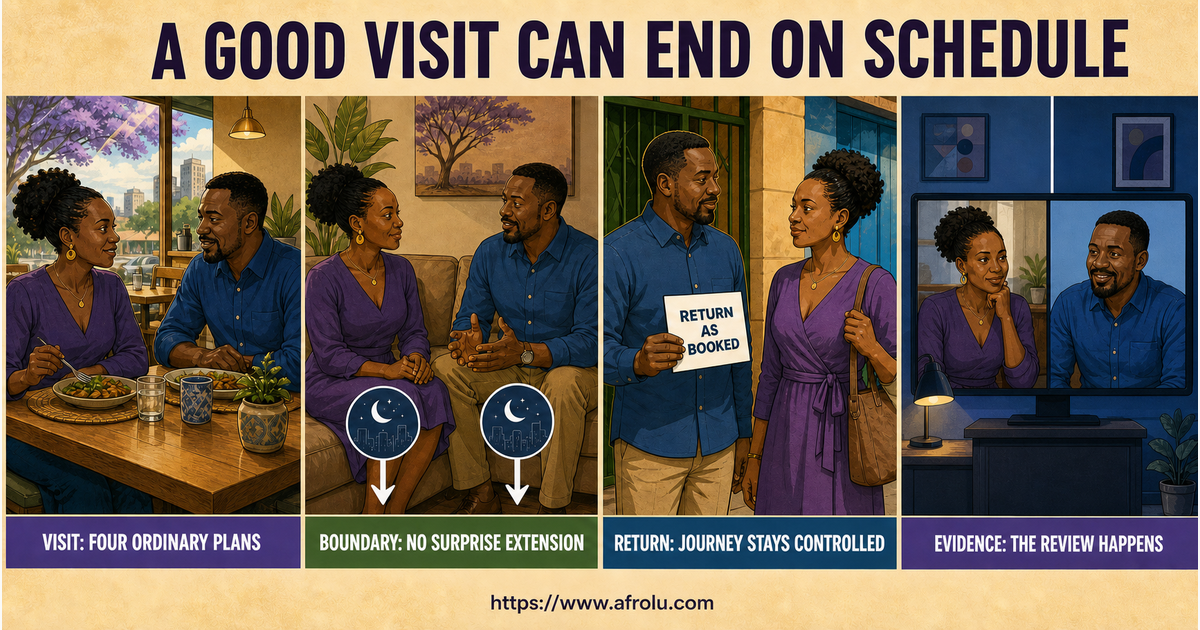
Makena and Elias are fictional adults aged 37 and 41. They state serious direction and plan six Nairobi days with separate lodging, independent transport and four public meetings. The visit includes ordinary repair and accepted limits. At departure, they keep Elias's return rather than extending under emotion. Their scheduled review happens a week later, when they decide to discuss exclusivity while leaving relocation outside the present plan.
The Nairobi visit-and-return evidence loop
Let serious intention travel through four phases without owning either adult's route
Diaspora relationships live in more than the anticipated visit. Tariro keeps the Nairobi days meaningful while giving ordinary post-return life equal authority.
The loop separates before-arrival facts, in-city conduct, independent return and the later distance pattern, then compares evidence across all four.
Before arrival
Verify in stages and confirm public meeting, lodging, transport, cost and return before booking.
Ordinary Nairobi
Use modest real plans to observe effort, adaptability, consent and respect for limits.
Independent return
Keep documents, ticket control, accommodation and enough money to leave.
After the visit
Review serious direction when weekday distance, work, sleep and community return.
Direction without manufactured certainty
Let serious name the future under evaluation—not a verdict produced by one Nairobi visit
Serious diaspora dating connected to Nairobi means two adults are evaluating a possible lasting partnership while at least one life is established elsewhere. Serious names direction; it does not guarantee compatibility, exclusivity, marriage, sponsorship, relocation or a successful visit. Diaspora does not prove wealth, mobility, homesickness or a duty to return. Nairobi residence does not make one adult the host, fixer or local representative. Begin with present facts: locations, adult identities, relationship structure, contact rhythm and the next review.
A visit is an unusual concentration of time, expense and anticipation. It can reveal punctuality, curiosity, adaptability, consent and how two adults share ordinary decisions. It can also amplify chemistry while hiding weekday workload, financial strain, family boundaries and distance fatigue. Do not dismiss the visit as unreal, but do not ask it to settle every future question. The best visit creates specific evidence and preserves enough independence for each adult to interpret that evidence after returning to ordinary life.
Low pressure does not mean low clarity. Confirm the dates, public first meeting, start and finish, affordable scope, accommodation, transport and independently controlled return before booking around the relationship. Decide what information the plan actually needs. A partner may know an arrival window without receiving a passport image, booking-account login, employer itinerary, home address or live location. Share a limited itinerary with trusted support chosen by the traveller, not as surveillance by the date.
Use a four-phase visit-and-return loop: before arrival, ordinary Nairobi time, independent return and post-return life. At every phase, ask what fact is known, what remains open, what access is required and who bears the cost of change. Serious direction becomes more credible when small agreements survive all four phases. If money urgency, document pressure, coercion, tracking, threats or blocked exits appear, leave the relationship interpretation task and use appropriate practical or local safety support.
The four-phase evidence loop
Test intention before arrival, in ordinary Nairobi moments, through return and after
Before arrival, verify in stages and turn the proposed visit into a complete plan. Use ordinary live conversation, consistent context and platform controls without demanding identity documents from a match. Confirm who travels, who books, where each adult stays, which public meeting begins the visit, how changes are communicated and what happens if either cancels. Do not send fare, visa, customs, medical, device or emergency money to make the visit possible. A serious claim can wait for independently controlled logistics.
During the Nairobi phase, include ordinary evidence rather than packing every hour with romance or performance. A staffed cafe, daytime walk, shared errand or modest meal can show how plans, cost, accessibility, waiting, disagreement and rest are handled. Neither adult owes an address, private venue, family introduction, sex, entire weekend or chauffeur role because distance made the meeting scarce. Keep personal devices, work systems, documents, money, accommodation and transport controlled by their owners.
The return phase protects the journey already chosen. Each traveller keeps their documents, account access, ticket changes, safe transport and enough money to leave. A good visit need not be extended to prove affection. If a change is genuinely desired, assess it through the same independence test rather than in the emotional minutes before departure. Nobody should miss a flight, surrender a passport, abandon lodging or accept a private ride because the relationship is called serious.
After return, let ordinary weekdays back into the evidence. Does the promised call occur? Can both adults discuss one disappointment without rewriting the whole visit? Does contact fit work, sleep, care and community? Are future questions answered more precisely, or does every practical conversation return to grand promises? Schedule a review after enough ordinary time to settle. Then continue the loop, redesign the rhythm, pause without demanding a wait or end because the available lives do not fit.
Makena and Elias let goodbye stay informative
An independent return gives a warm Nairobi visit room to become real evidence
Makena is 37, lives in Nairobi and manages a cooperative training programme. Elias is 41, grew up in Kenya and now works in Toronto. They meet online, hold several ordinary video conversations and say they are dating toward a possible committed partnership. They are not exclusive yet. Before Elias travels, they choose separate accommodation, four public plans over six days, independent daily transport and one conversation a week after his return.
The visit is enjoyable without being cinematic. They have lunch, visit a public exhibition, take a daytime walk and spend an afternoon buying supplies for Makena's work event. Elias is late once and messages early enough for Makena to choose whether to wait. Makena changes one venue when it becomes too crowded and suggests a nearby staffed alternative. Both accept the other's finish times. Neither treats local knowledge or travel cost as authority over the itinerary.
On the final evening, Elias considers extending his trip. Makena likes the idea but notices they would be changing lodging, work and ticket arrangements under departure emotion. She says she would rather keep the planned return and see whether their promised ordinary rhythm still works. Elias is disappointed, keeps his ticket and does not turn the cost of travel into a demand for certainty, sex or a relocation pledge. They leave separately after dinner.
Seven days later, their review occurs as planned. Makena says the late arrival was repaired and the visit felt reciprocal, but she needs clearer discussion of exclusivity before another trip. Elias says he wants to explore exclusivity and is not ready to discuss moving. They schedule that separate conversation and retain the current rhythm for one month. The visit supports serious direction because the return boundary and later review survived, not because either adult performed a perfect goodbye.
The cross-phase dashboard
Read what completes before, during and after the visit while unknowns remain visible
Green evidence includes consistent ordinary identity, a confirmed plan, independent bookings, punctual news, reciprocal organising, limits that remain complete and a post-return conversation that occurs. Notice modest details: both adults can name current structure; neither disappears when the visit becomes practical; a changed venue receives a complete alternative; the person affected may decline. These facts do not guarantee a partnership, but they make the next decision less dependent on imagination.
Amber unknowns belong on the board rather than being treated as failures. The adults may not yet know where they could live, how families will be involved, whether careers can move, what exclusivity would require or when another visit is affordable. Name the question, who needs information and when it will be revisited. Avoid forced certainty at arrival or departure. A serious relationship can contain important unknowns when neither adult uses them to extract present access.
Red pressure includes demands for passport or visa files, employer or residential access, urgent travel money, ticket control, surprise private lodging, live-location monitoring, sexual entitlement after spending, or anger when a return is retained. Do not travel or pay to test whether a story is true. Protect documents, accounts, devices and the exit. Contact named institutions through independently found details and use appropriate financial or reporting routes if deception is suspected.
Privacy is not deception. Kenya's Office of the Data Protection Commissioner describes rights and principles for personal-data processing; a dating relationship is not a substitute legal process, but the source reinforces a narrow practical habit: collect and share only what a present legitimate purpose requires. A match needs a time and meeting place, not a complete identity archive. Platform reporting, venue staff, trusted support and local services remain available when conduct moves beyond ordinary uncertainty.

Sort observable facts by phase; chemistry during exceptional days cannot answer every ordinary-life question.
Words for each phase
State serious direction alongside the booking, lodging, return and review boundaries
Before booking, say what is confirmed and what is not: ‘I want to explore this seriously. I will book only after we confirm dates, the first public meeting and my independent accommodation.’ This does not accuse the other adult. It stops a hopeful conversation from becoming a non-refundable obligation. If the plan stays vague, do not travel to force clarity. A serious connection can tolerate a later booking or the discovery that the proposed visit does not fit.
For privacy and lodging, keep the answer purpose-specific: ‘You can have my arrival window and our meeting place; my document copies and booking login stay private.’ ‘I am keeping separate accommodation and return transport.’ If a trusted person receives itinerary details, say what will be shared and why. Do not give a date constant live location as romantic reassurance or use third-party contact to monitor either adult.
During the visit, use present consent and finish language: ‘I want dinner and I am going back to my lodging at nine.’ ‘I am comfortable with this touch, not an overnight.’ Travel, hospitality, gifts and serious intention do not buy another activity. Consent can be withdrawn. Discuss relevant sexual-health information and testing before sex, and use qualified healthcare for individual prevention, symptoms, testing or treatment.
At return, name the next review instead of promising the entire future: ‘I am keeping my booked journey. I want to talk next Tuesday about what we learned and whether exclusivity fits.’ If the visit reveals incompatibility, say so without inventing distance excuses. If it reveals pressure or fear, prioritise a safe exit and support. A post-return conversation is useful only while both adults remain free to choose its outcome.

Say the serious direction and the practical boundary in the same conversation without treating one as payment for the other.
Ninety days across two realities
Review care, clarity, reciprocity, practical fit and independence on both sides of the visit
Review care through conduct. Could either adult be tired, disappointed, private or unavailable without punishment? Did consent remain present and specific? Did accessibility, food, faith practice, medication, sleep and safe return receive ordinary respect where relevant? Care does not require mind-reading or constant contact. It appears when practical information changes the plan without becoming a route into control.
Review clarity and reciprocity. Can both adults state serious direction, current exclusivity, contact rhythm, next-visit status and the important unknowns? Who verified, organised, paid their agreed costs, changed plans and repaired disappointment? Equal does not mean identical spending or task counts. It means the relationship is not powered by one adult's travel, local labour, emotional explanation or financial rescue.
Review practical fit across both realities. Nairobi visit days and post-return weekdays both count. Did the relationship protect work, care, sleep, friendships, community and essential spending? What would another visit realistically cost? Keep relocation, immigration, sponsorship, property, marriage and merged finance outside a dating-review shortcut. Those consequential decisions require much more evidence and appropriate independent advice in all relevant places.
Choose the next pattern: continue the same loop, make one modest structural agreement, redesign contact or visit frequency, pause without reserving someone, or end. Do not make a second trip to rescue a first trip's ambiguity. The review succeeds when the next choice is accurate and independently survivable for both adults, even if serious intention leads to a respectful conclusion rather than a permanent partnership.

Continue, redesign or end from the cross-city pattern; do not use one intense visit to settle every future choice.
Four parallel relationship lanes
Keep serious direction, visit intensity, current structure and relocation planning separate
Serious direction means the adults are evaluating a possible lasting partnership. It is a stated intention tested through present conduct. Visit intensity describes concentrated emotion, novelty and time. An intense visit can occur in casual dating; a modest visit can support serious dating. Feeling close is real information, but it cannot alone determine exclusivity, consent, financial trust or where either adult should live.
Current structure describes whether either adult dates or seeks others and what disclosure has been agreed. Frequent calls, deleted apps, travel or introductions do not create exclusivity by implication. Ask directly and define how change is requested. Exclusivity can coexist with distance and serious direction, but it does not supply sexual consent, device access, a right to travel or a guarantee that the relationship will last.
Relocation planning is a high-consequence practical project involving careers, housing, immigration status, money, law, health, care and community. It is not the natural fourth step after a good Nairobi visit. If considered later, separate the relationship choice from legal eligibility and independent professional advice. Protect both adults from urgency, sunk travel costs and the idea that the diaspora adult must return or the Nairobi adult must leave.
Keep each lane answerable: What future are we evaluating? What did this visit reveal and distort? What structure exists now? Is relocation even an active project, and which evidence or advice would it require? A relationship may be serious, emotionally warm, non-exclusive and not considering relocation. That combination is not contradictory when all four answers are spoken and freely chosen.
Eight diaspora visit moments where seriousness and access need separate answers
Amina waits for a complete plan
Amina is 35 and interested in a Nairobi visit, but the first public meeting and dates remain vague. She does not buy a ticket to make the conversation serious.
Confirm the usable plan before paying or travelling.Brian shares rather than outsources Nairobi
Brian lives abroad and asks his date to organise every venue and ride. When she names the imbalance, he researches two accessible public options and books his own transport.
Make local knowledge helpful without appointing one adult as trip manager.Wanjiru keeps the passport image closed
Wanjiru's match asks for her passport image as identity proof before his visit. She declines and offers an ordinary live verification conversation instead.
Use staged verification without building a private document archive.Kato keeps a room he controls
Kato's Nairobi date offers a family guest room. He appreciates the offer and keeps his existing accommodation so leaving and resting remain uncomplicated.
Choose lodging from independence, accessibility and budget rather than romantic symbolism.Zawadi declines a surprise introduction
Zawadi learns that a casual lunch has become a large family gathering. She asks for their original public plan and saves any introduction for a separate choice.
Let community access require notice and consent.Elias keeps the booked flight
Elias enjoys the visit and is asked to extend at departure. He keeps his return and offers a review call after a week of ordinary life.
Protect the return while making continued interest specific.Njeri asks once for the missing rhythm
After a warm visit, contact becomes irregular. Njeri asks what rhythm is actually available and sets a date to decide rather than filling every silence.
Request one usable answer and choose from the response.David separates affection from a transfer
David is told a ticket problem will cancel the visit unless he sends money immediately. He sends nothing and checks the booking issue only through independently located official channels.
Never use a payment to test a romantic story.Evidence that survives arrival, ordinary Nairobi time, return and distance
Both adults can state serious direction without promising exclusivity, marriage or relocation by implication.
Identity verification grows in stages without demanding passports, employer files or account access.
A visit has confirmed dates, public first meeting, affordable scope, lodging and independent return.
The Nairobi resident is not expected to provide every venue, ride, family bridge or emergency solution.
The travelling adult does not use airfare or scarcity to purchase time, touch, hosting or certainty.
Each adult controls personal devices, documents, money, accommodation, transport and work systems.
Changed plans receive timely news, a complete alternative and genuine room to decline.
Unknowns about exclusivity, another visit or future location remain named rather than hidden by romance.
The planned return can occur without punishment, dramatic tests or forced promises.
Post-return contact fits ordinary work, sleep, care, community and time-zone constraints.
Both adults contribute planning, questions, repair and the relationship review across locations.
Continue, redesign and end remain possible without money, family, migration or time invested becoming leverage.
Route each booking, boundary, change or request to the right phase
| Situation | What it may mean | What to do next |
|---|---|---|
| The trip is discussed but dates stay vague. | Hope has outrun a complete travel plan. | Do not book; request dates, first meeting, lodging and return details. |
| A passport image is requested as proof. | Verification is demanding disproportionate document access. | Decline and use limited staged identity checks without sending the file. |
| One adult must organise every Nairobi detail. | Local knowledge has become unpaid relationship labour. | Divide research, booking, transport and communication explicitly. |
| Separate lodging is called distrustful. | Accommodation is being treated as a loyalty test. | Keep independently controlled lodging or postpone the visit. |
| A public plan becomes a surprise home visit. | The plan has added private access and a narrower exit. | Return to the agreed public plan or leave using independent transport. |
| Travel cost is linked to sex or extra time. | Spending is being converted into entitlement. | Restate the boundary and prioritise a safe independent exit. |
| A delay receives a timely alternative. | One piece of accountable repair is present. | Use the revised plan if it still fits; retain the larger pattern review. |
| Departure triggers a relocation promise. | Separation emotion is replacing high-consequence assessment. | Keep the return and revisit the future after ordinary time. |
| Post-return contact changes without explanation. | Capacity, interest or expectations may differ from the visit. | Ask once for the actual rhythm and decide from the answer and action. |
| Another visit requires urgent fare money. | Romance is being recruited for a financial decision. | Send nothing and verify institutions through independently found details. |
| Both want seriousness but cannot afford the rhythm. | A practical incompatibility may exist without wrongdoing. | Design a smaller honest pattern or end rather than borrowing a future. |
| Tracking, threats or blocked return appear. | The task has shifted from relationship interpretation to safety. | Use the exit and appropriate venue, trusted, platform or local support. |
Scripts for booking, privacy, lodging, consent, return and review
“I am exploring a possible committed partnership; I am not promising its outcome.”
“I will book after we confirm the dates, first public meeting, lodging and return.”
“I will not send passport, visa, employer or account copies as dating proof.”
“I can offer two Nairobi options; please choose and manage your own transport.”
“I am keeping separate accommodation that I can enter and leave independently.”
“I want dinner from six to eight and will return separately afterward.”
“Travel and spending do not answer touch, sex, lodging or another date.”
“I do not send fare, visa, customs, medical or emergency money to a match.”
“I enjoyed the visit and I am keeping the journey I booked.”
“Let us talk next Tuesday after ordinary life returns.”
“Are we exclusive now, or is exclusivity still a separate decision?”
“The cross-city relationship available now does not fit me, so I am ending it.”
Know the difference
Serious direction versus visit intensity
Both adults are evaluating a possible lasting partnership through present agreements and repeated conduct.
A concentrated period of anticipation, novelty, emotion, time and expense that may amplify closeness.
Either can exist without the other, and neither automatically creates exclusivity, relocation, consent or financial integration.

Keep direction, intensity, structure and relocation in parallel lanes because each needs its own evidence and agreement.
Compare serious direction with intensity, structure and relocation
| Type or dimension | What it describes | Best next question |
|---|---|---|
| Serious direction | A possible lasting partnership is under mutual evaluation. | Which present actions make that direction credible? |
| Visit intensity | Emotion and time are concentrated into exceptional days. | Which impressions need ordinary-life confirmation? |
| Exclusive structure | A current spoken agreement governs dating or seeking others. | What exactly is agreed, and how can it change? |
| Non-exclusive structure | Other dating or seeking remains within the current agreement. | Which disclosure and health choices are relevant? |
| Long-distance rhythm | Contact, time zones and reviews form the ordinary relationship pattern. | Can both lives sustain it after the visit? |
| Another visit | A bounded new journey with its own cost, plan and exit. | What new evidence justifies repeating the loop? |
| Relocation project | A high-consequence career, housing, immigration and community decision. | Which independent evidence and qualified advice are required? |
| Sponsorship or legal process | A jurisdiction-specific formal process outside romantic proof. | Keep it separate and obtain independent qualified advice. |
| Financial integration | Shared obligations, accounts, property or debt create lasting consequences. | What protects each adult before any commitment? |
| Consent | A free present answer to one specific activity. | What does each adult choose now, regardless of distance or cost? |
Build one Nairobi visit-and-return loop in six moves
State the present direction
Name serious intention, current structure and the questions still under evaluation.
Complete the visit
Confirm public start, finish, affordable scope, lodging, transport and return before booking.
Protect both routes
Keep documents, money, devices, accommodation and travel controlled by their owners.
Collect ordinary evidence
Include modest plans, limits, change and rest rather than performing a perfect holiday.
Let the return happen
Do not convert departure emotion into extension, exclusivity or relocation pressure.
Review across two realities
Choose the next loop from Nairobi and post-return conduct together.
Questions organised by arrival, visit, return and after
Choose a few prompts that fit the moment. This is a reference library, not a list to complete.
Before arrival
Turn serious hope into a complete, independently survivable proposal.
- What identity facts are reasonably verified?
- Which dates and first meeting are confirmed?
- Who controls lodging and transport?
- What will not be shared?
- What cancels the visit?
Nairobi evidence
Include ordinary behaviour rather than a compressed romantic performance.
- Do plans become complete?
- How do we share local labour?
- Can either adult rest and leave?
- What happens after a no?
- Which unknown remains open?
Return
Protect the chosen journey while making continued interest specific.
- Are documents and tickets controlled?
- Is an extension truly optional?
- What promise should wait?
- When is the later review?
- Can goodbye remain safe?
Post-return review
Judge two realities and choose the next loop from the whole pattern.
- Did the promised contact happen?
- What repaired across distance?
- Is effort reciprocal?
- What can both lives afford?
- Do we continue, redesign or end?
What distance, privacy, safety and health sources can support
Long-distance relationships are not defined by inevitable low quality
A study comparing geographically close and long-distance dating relationships reported intimacy and communication findings that challenge a simple deficit view. Afrolu uses it only to avoid treating distance itself as failure and to focus on the actual pattern.
Evidence limit: The study's samples, measures and era cannot predict one relationship, Nairobi context or visit outcome.
Kenya data-protection principles support purpose-limited sharing
Kenya's Office of the Data Protection Commissioner lists rights and principles including information, access, objection, correction and limits tied to specified purposes. The practical dating lesson is to share only what a present plan requires and retain control of sensitive files.
Evidence limit: The official page concerns legal data processing; this guide does not determine whether a private interaction falls within the Act or provide legal advice.
Online dating safety can include limited sharing and public meetings
Police Scotland advises avoiding personal information, using trusted services, meeting publicly during the day and bringing a friend. Afrolu applies those general practices to the first Nairobi meeting while keeping local response routes distinct.
Evidence limit: The policing and reporting context is Scottish; platform features and appropriate local services vary.
Romance stories may shift into travel or emergency money requests
FTC consumer guidance describes false profiles, trust-building and urgent requests involving tickets, visas, health or other needs. The relevant action is not to use a transfer as a relationship test and to verify institutions independently.
Evidence limit: The source is U.S.-specific, and warning patterns cannot establish one person's intent or replace local recovery advice.
Consent remains active and withdrawable during a visit
NHS guidance explains that sexual activity requires active consent, that a relationship or prior yes does not provide it and that consent can be withdrawn. Travel cost, hosting, scarcity and serious language do not change that principle.
Evidence limit: Public-health information is not jurisdiction-specific legal advice or an assessment of an individual incident.
Sexual-health conversations belong before relevant choices
CDC guidance encourages partner conversations before sex about relevant STI information and testing. Location, exclusivity assumptions, appearance and visit intensity do not establish status.
Evidence limit: General public-health guidance cannot provide individual diagnosis, testing, prevention or treatment.
Six shortcuts that make one visit carry too much
Booking to force clarity
A purchased ticket turns a vague conversation into pressure rather than a complete agreement.
Making Nairobi one adult's job
Local residence does not assign all planning, transport, hosting or family labour.
Treating cost as entitlement
Airfare and hospitality do not purchase time, touch, lodging, certainty or another visit.
Trading documents for trust
Sensitive files create privacy risk and are not reliable relationship evidence.
Deciding the future at departure
Intensity and scarcity narrow reflection exactly when consequences can expand.
Ignoring the post-return pattern
A relationship must also fit ordinary work, sleep, care, community and distance.
Use a reviewed resource that matches the decision
This guide focuses on the relationship decision, so it does not rank dating apps. Check current prices, safety tools, and local availability before choosing a service.
Explore the guide library
Show more related guides
Continue with Afrolu
Show more Afrolu guides
Research and public guidance reviewed for this evidence loop
Afrolu reviewed these health, research, safety, or public guidance resources while editing this page. They support the behaviour and safety guidance; they do not diagnose any individual described by a reader.
Serious diaspora dating and Nairobi visit questions
Does a Nairobi visit prove a diaspora relationship is serious?
No single visit proves direction or fit. State serious intention separately, make the trip complete and observe ordinary conduct, limits, repair and post-return follow-through. A visit can supply valuable evidence without creating exclusivity, relocation, sponsorship, financial trust or a guaranteed future.
Who should pay for a diaspora dating visit?
There is no universal split. Agree a plan each adult can afford without sacrificing essentials or creating romantic debt. Independently controlled bookings and enough exit money are protective. Do not send fare, visa, customs, device, medical or emergency money to prove trust, especially under urgency.
Should the Nairobi partner provide accommodation?
Not automatically. Local residence does not create a hosting duty. Separate accommodation may protect rest, privacy and an uncomplicated exit. If a home stay is freely considered later, it remains a distinct choice and does not create sex, key, family access or extended-stay consent.
What identity documents should diaspora daters exchange?
A dating match usually does not need passport, visa, national ID, employer, bank or booking-account copies. Verify ordinary identity in stages through platform tools, live conversation, consistent context and public meetings. Legitimate formal processes should use their own official channels and qualified advice rather than private romantic document swaps.
How can a Nairobi first meeting stay low pressure?
Choose a staffed public place, bounded start and finish, affordable scope and independent arrival and return. Keep separate lodging and devices. Tell trusted support the limited plan if useful. Either adult can end the meeting or decline another activity without travel or hosting becoming leverage.
Does paying for a flight create intimacy expectations?
No. Spending creates no right to time, touch, sex, private lodging, home access, exclusivity or another date. Consent remains specific, present and withdrawable. If a no triggers anger, threats, blocked transport or retaliation, prioritise an independent exit and appropriate support.
When should we discuss exclusivity?
Whenever the current ambiguity affects choices. Ask whether either adult dates or seeks others, what disclosure is expected and how change is requested. Do not infer exclusivity from daily calls, deleted apps, travel, sex or serious language. Discuss sexual health before relevant activities regardless of structure.
Should I extend a good visit?
Only if the change is freely wanted and independently workable. Check lodging, ticket control, work, money, medication, care and safe return outside departure pressure. Keeping the original return can protect reflection. Continued interest can be expressed through a specific post-return conversation instead of an improvised extension.
How long should we wait before planning relocation?
This guide cannot set a timetable. Relocation is a separate high-consequence project involving careers, housing, immigration, law, money, health, care and community. It needs substantial ordinary evidence and independent qualified advice in every relevant jurisdiction. A good visit does not make relocation the required next step.
What if contact drops after the visit?
Ask once for the rhythm and relationship answer actually available. Consider work, sleep, care and time-zone realities, but do not fill indefinite silence with the memory of the visit. Set a decision point. If words and completed actions no longer support the relationship you need, redesign or end without diagnosing the other adult.
One thing to do now
Let the visit end, then see what the relationship can carry
Complete the before-arrival plan, collect ordinary Nairobi evidence, protect the return and require post-return follow-through. Keep documents, accounts, lodging, transport, consent and money with their owners. Name unknowns instead of converting them into promises. Review ninety days across both realities, then continue, redesign or end without treating a visit as a relocation audition.