Dating again · later start · chosen pace
You do not need a calendar to prove you are ready to date
Starting to date after a long relationship? Separate curiosity from relief, keep weekend plans manageable and tell a new person what you can honestly offer now.

Time since a breakup cannot certify readiness; present capacity and mutual choice matter.
Written and edited by Nala Okafor · Africa Dating Platforms Editor
Do not decide by counting months since a breakup. Notice what the new connection is being asked to do: can you enjoy this person's company without asking them to erase the past, provide constant reassurance or accept promises you cannot keep? Choose a small date that leaves room for your existing friends, responsibilities and rest. Say plainly if you are still finding your footing. Some people date soon after a breakup and build worthwhile relationships; others need more time. Research on rebounds does not provide a universal waiting period, so use your current capacity and the other adult's informed choice.
Breakup recovery · Late Entrants
Am I dating because I want to know this person, or because an empty weekend feels unbearable?
A rebound relationship is commonly described as a new relationship soon after a breakup. The label describes timing, not whether the new connection is healthy, exploitative, meaningful or doomed.
Illustrative scenario: After the end of a long relationship, an adult accepts a Saturday museum invitation. They enjoy the new person's conversation, then notice an urge to fill every empty Sunday with them. Rather than promising the whole next weekend, they offer another short meeting and keep a planned visit with a friend. That smaller invitation gives the new connection room to become its own story.
The person in front of you
Look at the job you are giving a new connection
Timing can matter, but it cannot tell whether two adults are treating one another honestly. A more useful test is what happens when the new person has their own life and limits.
Notice the reason for this date, state what you can currently offer and leave space to revise after the experience.
Why this person?
Name something you want to learn beyond being less alone.
What can you offer?
Keep the invitation within a weekend you can enjoy freely.
What is unresolved?
Acknowledge grief without making a date its cure.
Can both say no?
Let the new adult accept, counteroffer or decline.
Drop the deadline
A breakup date cannot certify a new relationship
Friends may tell you to wait a year, or to get back out immediately. Neither instruction knows your former relationship, the way it ended or the life you have now. Brumbaugh and Fraley's rebound research found that people who began new relationships sooner were not uniformly worse off. Its small and cross-sectional samples were mostly college-aged, so it cannot speak directly for adults returning after a long relationship. It challenges a simple 'too soon means doomed' story, not the need for honesty with a new adult.
A 30-week breakup study of 87 women aged 18 to 34 found different trajectories of distress and recovery rather than one common schedule. That young, women-only sample is far from every adult returning after a long relationship, and the study cannot tell this reader when to date. If sleep, work or daily life remains heavily disrupted, seek support that fits your situation; a new date need not become the sole way to function. If you feel ready to meet someone, you do not need to wait for an arbitrary anniversary to be allowed curiosity.
Readiness is practical. Can you keep a modest plan, hear a different answer, and speak about your current limits without recruiting the other person to repair the old relationship? You may still feel sad or remember an ex. The question is whether the new person can be encountered as themselves rather than used as evidence that you have recovered.
An open Saturday
Do not hand every empty hour to a new date
A long relationship leaves habits behind: shared errands, regular calls, a known Sunday. When those spaces open, a new person can feel immediately central simply because they are present. Before filling the whole weekend with them, keep one plan with a friend, relative or yourself. Choose a date with a beginning and end that you would still value if it led nowhere. This is a way to notice your own wishes, not a rule that people must date slowly.
Tell the other adult what the invitation actually means. 'I would like to spend Saturday afternoon together' is different from 'I will be with you every weekend.' They may prefer a faster or more committed arrangement and say no. That does not make your smaller offer unkind. The choice belongs to both adults, and neither should have to interpret a weekend invitation as a promise of healing.

The reader may choose another date or a pause.
Four questions beyond the calendar
- Specific curiosity
- Interest names this new person's qualities.
- One true plan
- The next invitation fits an ordinary weekend.
- Friends stay present
- Friends and other support remain available.
- No rescue demand
- A new date is not asked to erase an old loss.
Keep in mind: Read what the new date is asked to carry rather than measuring months since the breakup.
When the past enters
Be honest without making a stranger your repair plan
It is reasonable to say you are newly single or still adjusting. It is less fair to ask the new person to reassure you after every memory of your ex, compare themselves with that ex, or promise never to leave before you know one another. If you find yourself doing that, pause and take the deeper conversation to a trusted friend or professional support. You can still be interested; you may need a smaller dating role for now.
The other adult also gets to state limits. They may enjoy your company but decline a role as your primary source of comfort. Hear that without treating it as abandonment. love is respect's readiness and emotional-boundary resources invite people to consider existing demands and support needs; they do not diagnose rebound dating. Their value here is the permission to discuss actual capacity rather than a label that shames one person.
If a new date presses you to prove you have moved on by sharing passwords, staying overnight or cutting off friends, that is not a fair readiness test. Decide the specific choice for yourself. RAINN suggests public early meetings and independent travel as ways to reduce risk, including when a date feels familiar quickly. The advice is practical, not a claim that grief makes an adult incapable of judgment.

The other adult remains free to decline.
A small honest invitation
An optional way to say it
I like meeting you, and I am still finding my pace after a long relationship. I can enjoy a Saturday afternoon together, but I am not ready to promise every weekend.
What the line does
- Express interest
- Name your pace
- Offer one date
- Allow their choice
Keep in mind: Say you are finding your pace and can offer a Saturday afternoon, not every weekend.
After the date
Decide whether you want another meeting with this person
When you get home, write two separate observations: what you learned about this new person, and what the outing changed about your own mood. The second can be positive without being a reason to promise a relationship. Did conversation make you curious about their values, humour or life? Did you feel able to say when you needed to leave? A second date should be an invitation to know them, not a prescription for the next lonely evening.
If you want to continue, offer one next plan that fits the life you have. If you realise you need a pause, say so while the connection is still clear: 'I enjoyed meeting, but I cannot keep dating right now.' Do not ask the other adult to wait indefinitely. They may care about you and still choose to move on, and you can take that choice seriously without turning it into a verdict on your recovery.

No one is placed on indefinite hold.
Choose after one real date
- Check the motiveNotice curiosity and the urge to fill silence.
- Choose a small dateOffer one afternoon without surrendering all support.
- Notice the roleAsk whether this person is being treated as themselves.
- Invite or pauseInvite again or pause without putting them on hold.
Keep in mind: drop the fixed recovery clock, choose one bounded weekend date, notice the role given to the new person and decide again
A new date with different possible jobs
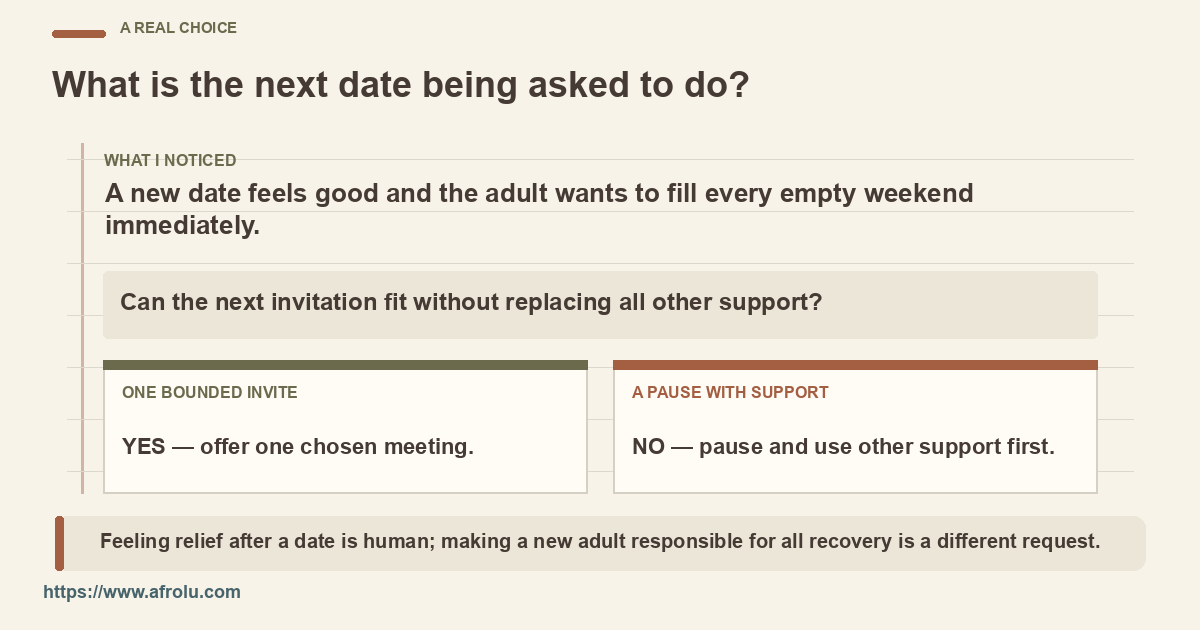
What is the next date being asked to do?
- What happened
- A new date feels good and the adult wants to fill every empty weekend immediately.
- Question to ask
- Can the next invitation fit without replacing all other support?
- YESoffer one chosen meeting.
- NOpause and use other support first.
Keep in mind: Feeling relief after a date is human; making a new adult responsible for all recovery is a different request.
A new person invites a short Saturday meeting
Interest can be tested without pledging the whole weekend.
Accept only the time you want to offer.The adult wants to send another invitation immediately
The urge may be about this person, the quiet, or both.
Keep a separate plan and decide after some space.A story about the former partner dominates dinner
The new adult may be asked to carry unresolved pain.
Acknowledge it and move deeper processing to other support.An enjoyable date becomes a promise of every weekend
The offer may outrun current capacity.
Reset to one next meeting or take a pause.Signs of a chosen, bounded invitation
The adult can name what interests them about this new person specifically.
A date fits alongside existing friends, family, work and rest.
The other adult can decline or ask for a different pace without being punished.
Breakup feelings can be held with support beyond this new connection.
An invitation describes one meeting rather than an unearned future.
When a weekend suddenly feels empty
| Situation | What it may mean | What to do next |
|---|---|---|
| Only a short time has passed | Timing alone does not decide the quality of a new connection. | Ask about present capacity and honesty. |
| You feel relief after the date | Relief is real but not a commitment agreement. | Notice what you learned about this person. |
| The new adult wants more | They may need a different pace. | State what you can offer without asking them to wait. |
| Memories disrupt daily life | A date need not be the only place to process them. | Use trusted or professional support appropriate to you. |
| You want to stop | You can pause without proving a rebound label. | Cancel the next plan clearly. |
Words that do not borrow a whole future
“I have enjoyed meeting you. I am finding my pace after a long relationship and can offer Saturday afternoon, not every weekend.”
“I liked our conversation, but I am not able to keep dating right now. I am cancelling our plan for Friday.”
“I hear that you want a steadier rhythm. I cannot promise that now, and I understand if you would rather stop.”
Know the difference
Curiosity about a new person versus relief from an empty calendar
I want to learn how this person sees the world and whether another date is mutual.
I need this person to make every lonely weekend and old hurt disappear.
Feeling relief after a date is human; making a new adult responsible for all recovery is a different request.

Loneliness alone is not wrongdoing.
Curiosity or repair assignment?
Their own story
I want to learn how this person sees the world and whether another date is mutual.
A repair assignment
I need this person to make every lonely weekend and old hurt disappear.
Questions that clarify the difference
- Curious about them?
- Can they say no?
- Other support kept?
- Offer is honest?
Keep in mind: Feeling relief after a date is human; making a new adult responsible for all recovery is a different request.
Curiosity or a repair assignment
| Type or dimension | What it describes | Best next question |
|---|---|---|
| Fast new date | A new meeting soon after a breakup. | Judge its actual terms and conduct. |
| Curiosity | Interest in this person's views and life. | Offer a modest next date if mutual. |
| Relief | The outing softens a lonely day. | Enjoy that without making a future promise. |
| Repair assignment | The new adult is expected to remove all prior pain. | Seek other support and reduce the dating burden. |
Meet one person, once
There is no date stamp
Research does not certify the exact month a person becomes ready.
Relief is not a fault
Feeling better after company does not make the connection false.
Two adults decide
The new person can welcome or decline the smaller invitation.
Questions after you get home
Choose a few prompts that fit the moment. This is a reference library, not a list to complete.
Before accepting
Keep the invitation attached to this person, not the empty calendar.
- What do I want to learn?
- What else supports me?
- What time can I freely offer?
After returning home
Write two separate observations.
- What did I learn about them?
- What changed in my mood?
- Do I want another meeting?
What rebound studies cannot decide for you
Rebounds
Brumbaugh and Fraley found faster new relationships were not uniformly linked to worse outcomes in two limited studies.
Evidence limit: Mostly college-aged, small and partly cross-sectional samples; not a test for later entrants or a causal guarantee.
Variation
A 30-week breakup study found different distress trajectories among 87 women aged 18 to 34.
Evidence limit: This young women-only sample cannot set a waiting period or diagnose an older adult.
Capacity
love is respect asks readers to consider current commitments and reasons for dating.
Evidence limit: Reflection guidance, not clinical clearance.
Emotional limits
love is respect discusses emotional boundaries and support needs.
Evidence limit: A new partner should not be designated sole recovery support by a web guide.
Meeting safety
RAINN suggests public early meetings and independent travel.
Evidence limit: General risk-reduction options, not a claim that recent breakup creates incapacity.
When a stranger becomes the whole support system
Using a fixed healing clock
Months elapsed cannot tell what a new adult is being asked to carry.
Making a stranger the only support
It can turn a date into a recovery assignment they did not choose.
Offering forever after one Saturday
An exciting afternoon does not establish next month's capacity.
Offer just the next afternoon
A new person can be enjoyed without being asked to replace a lost relationship or fill every empty weekend.
Explore the guide library
Continue with Afrolu
Rebound, breakup trajectory and readiness sources
Afrolu reviewed these health, research, safety, or public guidance resources while editing this page. They support the behaviour and safety guidance; they do not diagnose any individual described by a reader.
Questions about dating soon after a long relationship
How soon is too soon after a breakup?
No study provides a universal waiting period. Consider current capacity, honesty and whether the new person can choose the arrangement you offer.
Does feeling lonely mean my interest is fake?
No. Loneliness and genuine curiosity can coexist. Notice whether you can relate to the new person beyond relief from an empty day.
Must I tell a date every detail about my ex?
No. State relevant current limits honestly; deeper processing can happen with other trusted support.
What if they want commitment now?
Tell them what you can offer. They may choose to stop, and you need not promise a pace you cannot keep.
Can I pause after a good date?
Yes. Cancel any agreed next plan clearly and do not ask the other adult to wait indefinitely.
One thing to do now
Let the next invitation belong to this person
Ask what you can offer this actual person now, make one manageable plan and notice whether a no or a quiet weekend can still be tolerated.