Adult student life · digital boundaries · Nairobi
They watch your stories. Did they actually come back?
An old date may watch a student's posts without reconnecting. Separate that from a direct invitation, set a boundary and reclaim your Nairobi week today.

A like or view is observable; an intention to reconnect has not been spoken.
Written and edited by Miriam Otieno · Senior Kenya Editor
A view or like shows that an account interacted with a post; it does not tell you why or create a new agreement to date. If you want clarity, you may send one direct, answerable message, but you do not owe an invitation. If the old connection ended or they ignored an earlier invitation, let that history remain real until they communicate differently. Mute, hide or block where the platform offers those controls if repeated visibility keeps pulling you into a checking loop. If contact becomes harassing or threatening, save evidence and seek support rather than treating it as ordinary orbiting.
Modern dating terms · Students
If an old date keeps viewing my stories or liking posts but never messages, should I treat that as renewed interest?
Orbiting is the informal name for a former dating contact's passive online presence—such as story views or likes—without a direct attempt to resume the relationship. The label describes the visible pattern, not the viewer's motive.
Illustrative scenario: A Nairobi university student invited a former date to a weekend event and never got an answer. Weeks later the same account often views the student's stories. Before a basketball game, the student notices the view and wonders whether to send another invitation. Instead, they separate the old unanswered message from the new view, choose whether one direct question is worth sending, and change visibility settings if checking is consuming the afternoon.
The visibility gap
A platform signal is smaller than a conversation
A story viewer can occupy more attention than the small action warrants, especially when an earlier invitation went unanswered.
Write down what was actually agreed, what appeared on the platform and what you now want. Make a choice from those facts, not an imagined explanation.
Recall the last exchange
An unanswered invitation is still unanswered.
Name what appeared
A view is a view, not a date request.
Choose if you want it
One direct question is optional; chasing is not required.
Set visibility
Your afternoon does not belong to a viewer.
Separate the facts
The screen cannot tell you why they are there
An old date viewing a story can feel intimate because it places their name beside something personal. The visible fact is narrower: their account registered an interaction. They may have sought you out, tapped through many posts or had another reason you cannot see. None of those explanations is established by the view count, and none cancels an earlier direct conversation.
If you invited them to meet and they did not respond, that unanswered request is more relevant to a dating decision than today's like. If they explicitly ended contact, the prior ending remains the clearest term until both choose a new one. You do not need to decode the platform to honour what was already said—or not said.
The word 'orbiting' can be useful shorthand for passive presence, but it can also invite a theory about why someone is watching. Keep the useful part: what action has happened, and what action has not? If there is no direct request to speak or meet, you are free to leave the dating decision closed.
Count the attention
Checking their views can become a second unpaid course
You may find yourself posting to see whether they will watch, refreshing the viewer list between classes or discussing each small like with friends. That does not mean you are foolish; uncertain social signals invite repeated checking. It does mean the old connection is taking time from present commitments without offering a new conversation in return.
Ask what changes after each check. If the answer is only a short spike of hope or frustration, choose a practical limit: stop opening the viewer list, post to the audience you actually want, or use a platform control to reduce that account's visibility. You do not need to announce the change or prove that their behaviour was malicious.
Nairobi student life has real dates, commutes, fare costs and class deadlines. A passive account need not set your schedule for basketball, study or another person you might want to meet. Treat attention as a resource that belongs to your chosen week, not as a vote the old date can keep casting on it.

A safety concern requires a different path from ordinary uncertainty.
Choose direct contact
One clear question is optional; another chase is not required
If you genuinely want to reconnect and the previous exchange left room for it, you may send one message: 'Would you like to talk this week, or should we leave things where they are?' That gives the other adult an answerable choice. Do not send it only to prove they were secretly interested; the view does not establish that premise.
You may instead send nothing. An earlier unanswered invitation already gave them a chance to speak. If they eventually write directly, assess that message on its own: does it say what they want, acknowledge any broken plan that matters, and leave you free to decline? A vague emoji can remain a vague emoji.
A request for directness is a boundary for your participation, not control over their account. You cannot make a former date stop viewing by constructing a perfect message. You can decide which messages you will answer and whether repeated ambiguity is worth any place in your life this week.

Readers may skip the message entirely.
Use the controls
Visibility is a choice, not a verdict
love is respect recommends thinking through social-media and communication boundaries. Australia's eSafety Commissioner describes in-app options such as hiding, muting and blocking in online-dating safety guidance. The exact controls differ by service and may change, so check your own platform's current privacy settings instead of relying on a universal button sequence.
You might hide stories from the account, mute their posts, remove a follower or block contact. Each choice has a different social effect, and you can select the least disruptive one that protects your attention. None requires a courtroom case about the other person's motive. You may also keep access unchanged if the views are genuinely unimportant to you.
If the person moves from passive views to repeated unwanted messages, monitoring, threats or attempts to reach you offline, the situation is different. Preserve relevant evidence and ask a trusted person or appropriate local service for help. eSafety's advice on reporting and blocking abusive contact is a safety resource; ordinary ambiguous viewing alone should not be labelled abuse.
Return to your week
Your next move need not involve the old date
After setting a visibility boundary or deciding not to contact them, put an actual thing in the space the checking occupied. Meet a friend for a court game, finish an assignment, or go to a public event because you want to. This is not a trick to make the old date react. It is a way to let an uncertain signal have a proportionate place in your day.
If a clear new message arrives later, you can decide then. The previous view count does not require an answer, and the prior silence need not be forgotten. Ask whether this person is now offering the kind of direct, respectful connection you would choose. You can respond, decline or keep your current boundary.
The principle travels beyond any one platform. When a person wants a dating decision from you, they can make an actual request. Until then, you can manage what appears on your screen and continue a full life in Nairobi without waiting for a notification to become a plan.

If harassment occurs, preserve evidence and seek support.
What a former date's view does and does not do
A former date appears in the viewer list
The account viewed a post; no new dating request was made.
Leave the prior terms unchanged.They viewed a post after ignoring a weekend question
The direct invitation remains unanswered.
Decide whether any further contact is wanted.They ask to meet again clearly
A new request can be considered on its own.
Accept, ask a question or decline freely.Online activity becomes intrusive or threatening
This is no longer just an ambiguous view.
Save evidence and seek appropriate support.Facts you can observe on and off screen
A story view is recorded without being translated into a motive.
The earlier unanswered invitation remains part of the history.
A direct new message, if any, is evaluated on its own words.
The student chooses visibility controls for their own comfort.
Study, friends and transport plans continue without checking the viewer list.
Choose whether any contact is wanted
| Situation | What it may mean | What to do next |
|---|---|---|
| An old date likes a post | The platform reports passive activity. | Do not book a date from it. |
| You want an explanation | The account signal cannot supply one. | Ask once directly if the answer would matter. |
| You do not want contact | Clarity is not a duty owed to a passive viewer. | Mute, hide or leave it alone by choice. |
| They message directly | A new choice is being offered. | Read the actual request and your own wish. |
| Contact becomes unsafe | Threats or repeated unwanted messages need support. | Preserve evidence and use local help. |
One optional clarity message
“We have not spoken since my last invitation. Are you actually interested in reconnecting, or shall we leave it there?”
“I do not want to resume dating. Please respect that.”
“Thanks for asking directly. I would need to talk about what changed before deciding whether to meet.”
Know the difference
Passive orbiting versus direct reconnection
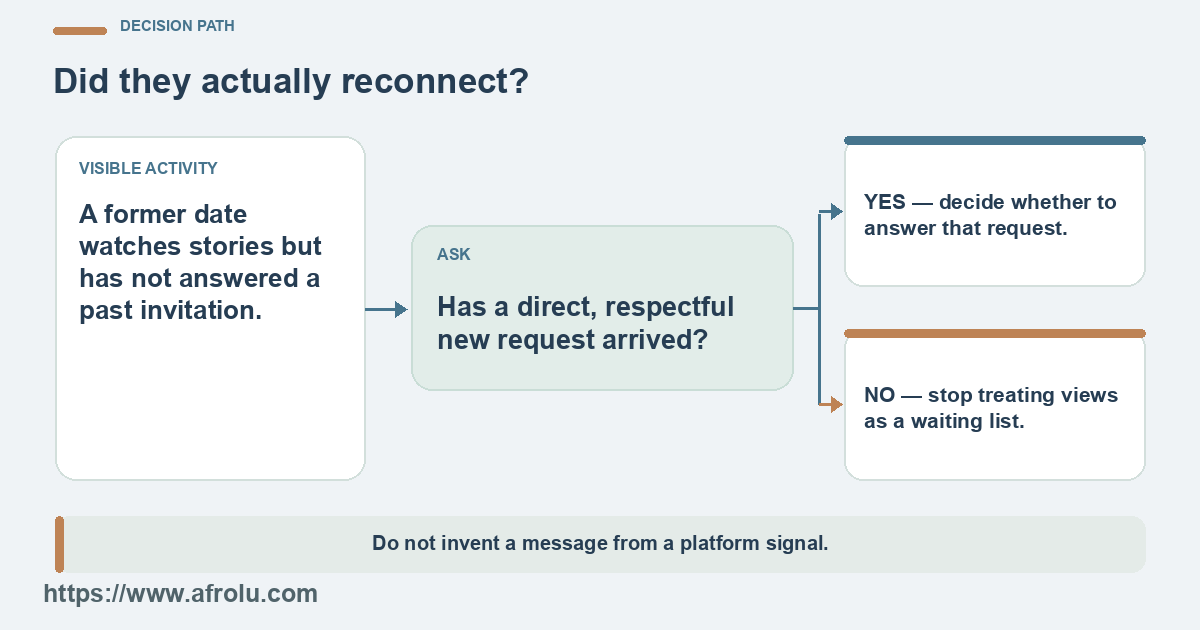
Story views or likes leave the old relationship terms unchanged.
A message names what the person wants and leaves the student free to accept or decline.
Do not invent a message from a platform signal.

Make the choice clear at phone and mobile sizes.
A view is smaller than an invitation
| Type or dimension | What it describes | Best next question |
|---|---|---|
| Story view | An account interacted with posted content. | Avoid inferring why. |
| A like | A small public or private signal. | Do not treat it as an invitation. |
| Direct message | Words addressed to the reader. | Decide whether to answer. |
| Specific invitation | A proposed meeting can be accepted or declined. | Check whether you actually want it. |
| Unwanted contact | Repeated intrusion after a clear no. | Use privacy tools and seek support if needed. |
Give the signal its actual size
A view is a small fact
It says little about intent and nothing about a chosen date.
An old invitation stays real
Passive activity does not answer the question that was left unanswered.
Visibility is yours to manage
A comfort boundary need not prove another person's wrongdoing.
Questions before checking again
Choose a few prompts that fit the moment. This is a reference library, not a list to complete.
Before sending anything
A message should serve your own choice.
- Was my last invitation answered?
- Would a direct answer change my next step?
- Could I accept no reply?
Before checking again
Protect attention as well as privacy.
- Am I posting for myself?
- Would muting help?
- What real plan matters today?
Where digital-boundary sources stop
Digital limits
love is respect asks people to decide their own social-media and contact boundaries.
Evidence limit: It does not interpret a viewer's romantic motive.
Visibility controls
eSafety describes hiding, muting and blocking tools in online-dating safety contexts.
Evidence limit: Features vary by platform; ordinary orbiting is not necessarily abuse.
Expectations
love is respect recommends discussing assumptions rather than treating them as agreements.
Evidence limit: A one-time clarity request is an option, not a duty to pursue an old date.
Respect
love is respect describes respect for another person's choices and separate activities.
Evidence limit: The student's offline life should not become contingent on a story viewer.
When a viewer starts directing your week
Inferring an apology from a view
The old unanswered invitation remains unresolved.
Posting to test them
The reader's day becomes organised around a tiny reaction.
Calling every view harassment
Ordinary ambiguity and repeated unwanted intrusion need different responses.
Return to the chosen afternoon
One direct message is optional; your privacy and offline plans are yours either way.
Explore the guide library
Continue with Afrolu
Digital privacy and respect sources
Afrolu reviewed these health, research, safety, or public guidance resources while editing this page. They support the behaviour and safety guidance; they do not diagnose any individual described by a reader.
Questions about orbiting
Does a story view mean they miss me?
The platform cannot establish that motive. It only shows account activity.
Should I message an old date who orbits?
Only if you want a direct conversation. One answerable message is an option, not a duty.
What if they ignored my last invitation?
That invitation is still unanswered. A new view does not replace a direct reply.
Is muting rude?
You may manage your feed for comfort without making a public accusation. Check your platform's current controls.
What if they finally ask to meet?
Read that request on its own terms and decide whether you want contact now.
When is this more than orbiting?
Repeated unwanted messages, monitoring or threats call for evidence preservation and trusted or local support.
One thing to do now
A viewer is not your calendar
Use direct contact to decide about direct contact; use your privacy settings to decide what you want to keep seeing.