App fatigue · work-heavy weeks
When dating apps feel like another work shift
If dating apps drain your limited time after work, audit what costs you energy, pause or narrow your use, and decide whether a calmer return is worth it.
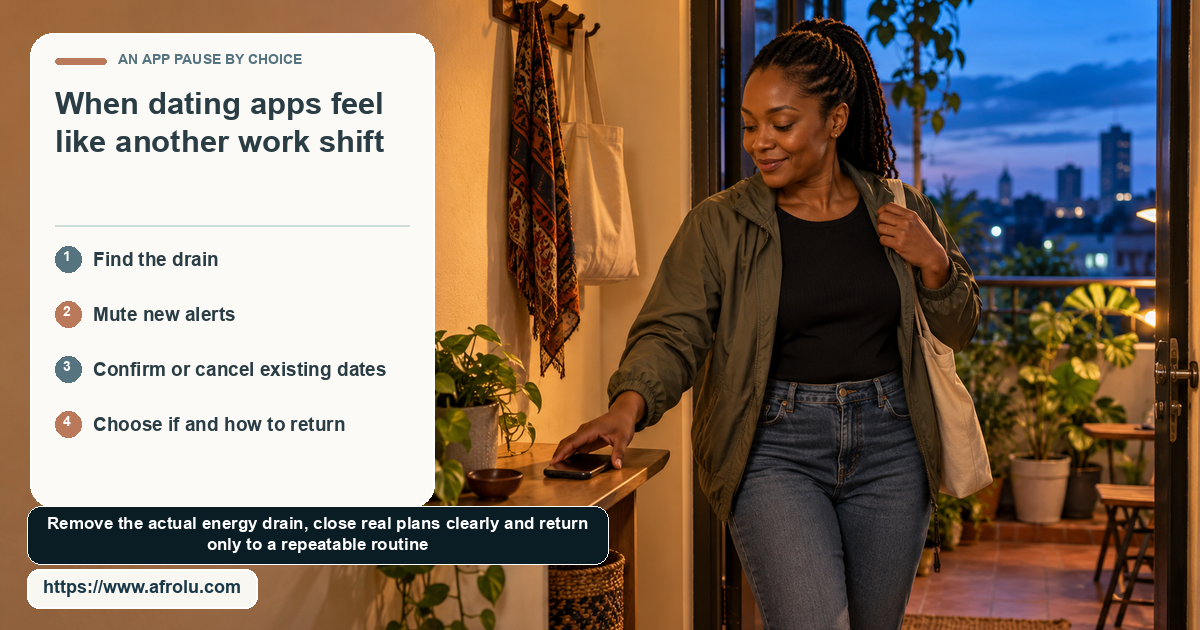
A smaller routine is worthwhile only if it leaves enough room for work, rest and curiosity.
Written and edited by Nala Okafor · Africa Dating Platforms Editor
Notice the actual drain before trying another optimization trick. Is it endless browsing, too many simultaneous chats, pressure to reply during work, disappointing dates, or simply no capacity this month? You may pause notifications and new matches, finish or close active conversations courteously, and protect work and rest. If you return, use one limited window and one meaningful question per conversation; if even that feels costly, a longer break or leaving the app is a complete choice.
Dating wellbeing · Professionals
Am I tired of the app routine, this work season, dating itself, or a specific interaction I should address?
App burnout is a reader's description of depleted interest or energy around an online dating routine, not a clinical diagnosis. A frustrating app week does not prove that dating or every possible match is hopeless.
Illustrative scenario: A Nairobi professional checks three apps between meetings and again late at night. They are talking to seven people but cannot remember which plans were proposed. They mute notifications for a week, send one clear update to a person with a real date pending, close chats they do not want to continue, and later decide whether one app and two short sessions a week fit their life.
Energy audit
Find the part that is costing you
'The apps' can mean swiping, messaging, paying, planning dates or managing rejection. Different drains need different decisions.
Look at a normal workweek, name the expensive activity and choose the smallest change that would restore genuine choice.
No end point
Cap browsing or remove the app for a while.
Too many open loops
Close conversations you cannot give attention to.
Logistics overload
Plan fewer meetings with an actual calendar window.
No space left
Pause dating without inventing a return deadline.
Name the drain
Separate app friction from lack of capacity
An app can feel exhausting for different reasons. Browsing may continue without a stopping point; several parallel conversations may require more recall than your workday leaves; a real date may require planning you cannot do this week. Before deleting everything or buying a new subscription, write down which activity you dread and which, if any, still feels interesting.
The American Psychological Association's interview with an online-dating researcher describes dating-app burnout as an area of study and notes that people have very different experiences. It does not establish a universal number of matches, minutes or dates that causes burnout. Your own capacity and preferences are better starting points than a viral rule about how hard you should try.
If work itself is consuming every available evening, app settings may not solve the problem. A pause can be a response to the season rather than a verdict on dating. If only notifications are intrusive, a smaller boundary may help. If a particular conversation feels coercive or unsafe, address or leave that interaction rather than treating it as a productivity issue.
Close open loops
Take a break without keeping people on standby
Start a pause by stopping new matches or silencing alerts. Then distinguish a conversation with a date and time from a thread that never became a plan. If someone is expecting you at a chosen meeting, cancel it directly. If you have been talking with interest but cannot continue, a short honest close respects their ability to move on.
A dormant match with no agreement does not need a formal resignation notice. Avoid using an open-ended 'I will be back soon' to soften discomfort if you do not know whether you will return. A sentence about your present capacity says enough; the other adult may be disappointed and still be entitled to make their own choices.
Choose what a break will protect: evening rest, a focused work project, time with friends or simply attention that is no longer being divided. A week can be a useful experiment, but there is no medically prescribed app holiday. The point is to notice whether your life feels more manageable when you are not treating every alert as a request.

A low match count alone does not diagnose burnout.
Try a smaller routine
A return should fit the calendar you actually have
If you choose to return, try one app and a predictable, modest time for browsing and replies. Do not open the app during a work meeting or the hour you need to sleep. Review what your profile reveals before making it visible again; Australia's eSafety Commissioner advises limiting identifying details. One thoughtful question about a person's actual profile can tell you more about fit than maintaining many identical threads.
Set a limit on how many conversations you can treat attentively, based on your own capacity rather than a magic number. Move toward an optional public date when both want one and you have a real opening; let a chat close if it never becomes a connection you wish to pursue. A paid upgrade cannot create time, curiosity or compatible expectations.
love is respect's digital-boundaries guidance suggests discussing expectations for texting and social media contact. That is U.S.-based relationship education, not a requirement to reply within any number of hours. A professional can say that they check messages after work, while the person they meet can decide whether that rhythm works for them.

Do not turn a pause into a request to wait.
Check the result
Notice whether the smaller routine gives anything back
Do not judge a return only by matches or dates. Ask whether you had room to be curious about anyone, whether you could keep the plans you made and whether the activity displaced sleep or other commitments you value. If you felt better with a smaller routine, keep the boundary even if the app encourages more engagement.
If conversations repeatedly turn into obligation, you can shorten the trial or leave. If one app suits you but another does not, that is useful information rather than proof about every service. You can also meet people in ordinary social spaces without constructing a new performance project; no channel is owed your time simply because other people use it.
A disappointing reply or cancelled date can sting without requiring an immediate overhaul. Look for the repeated cost of the routine rather than interpreting one person's choice as a measure of your worth. Rest, enjoyment and your actual work capacity are legitimate parts of deciding whether online dating currently fits.
Choose your channel
Leaving an app is allowed to be the answer
If you enjoy the smaller routine and can meet without stealing from work or recovery, continue. Tell a promising match what kind of communication and meeting pace you can offer. If the only workable version still feels like another unpaid shift, step away. You can remain open to connection without maintaining a profile or a queue of conversations.
A pause is not a promise to the people in old chats. If your preferences change, you can decide later whether to reopen the app, try another way of meeting or stay out. Before spending on a subscription or paying for a visibility boost, ask what concrete limitation money would change. If the limitation is attention or time, payment is unlikely to solve it.
If the fatigue extends far beyond dating and affects your daily functioning, support from a qualified professional may be useful. This page cannot diagnose burnout or prescribe treatment. Its narrower job is to help you decide what the dating routine is asking of you and whether you still choose that exchange.

Leaving the channel is a complete decision.
A workweek with the app still open
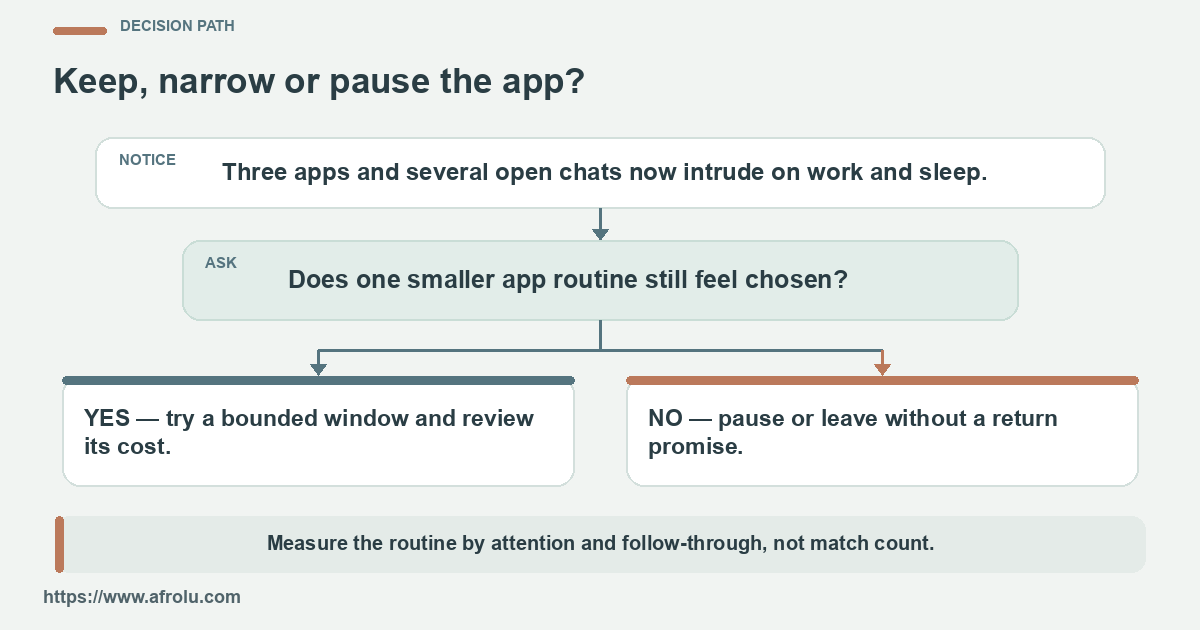
A quick check becomes half an hour
Browsing expands into a work break the reader needed for rest.
Set a stopping point or remove the app from work hours.Messages blur together
The professional cannot keep track of the people and plans they opened.
Close inactive chats and stop accepting new matches.A real date is pending
A pause would affect someone who has reserved time and travel.
Confirm or cancel directly before muting everything.A trial feels calmer or still costly
The useful measure is energy and follow-through, not match count.
Keep the limit, change channels or leave.Which part is draining you?
Browsing repeatedly exceeds the time the reader intended.
App checks interrupt work or sleep rather than chosen leisure.
Several chats remain open without enough attention for each.
A real date can no longer be planned or kept.
An existing plan is cancelled directly rather than abandoned.
Leaving an app remains an available choice, not a failure.
Match the change to the cost
| Situation | What it may mean | What to do next |
|---|---|---|
| Browsing runs long | The activity lacks a stopping point. | Set a short window or pause the app. |
| Chats pile up | The number exceeds real attention. | Close stale conversations before opening new ones. |
| A date is booked | Another person has reserved time. | Confirm or cancel before taking a break. |
| A pause feels good | The routine may have been the drain. | Decide whether any bounded return appeals. |
| The smaller trial drains too | The channel may not fit this season. | Leave without a promised return. |
Close chats and plans cleanly
“I check app messages after work, not during the day.”
“I enjoyed this exchange. Would a public coffee on Saturday suit you?”
“I am taking a break from this app and will not keep this chat open.”
“I cannot make Friday's date and wanted to tell you now.”
“I have enjoyed talking, but I am stepping away from dating apps.”
Know the difference
A chosen app window versus a permanent open tab
One deliberate session can lead to a conversation or a date you have room to keep.
Alerts, stale chats and paid boosts occupy time even when no connection is wanted.
Measure the routine by attention and follow-through, not match count.

Match counts are not a measure of personal worth.
A chosen window versus constant access
| Type or dimension | What it describes | Best next question |
|---|---|---|
| Swiping fatigue | Browsing itself consumes unchosen time. | Cap or pause browsing. |
| Chat overload | Too many open threads demand attention. | Close conversations deliberately. |
| Date logistics | A meeting requires calendar and travel capacity. | Book fewer real dates. |
| A bounded trial | Chosen sessions with an end point. | Review energy and follow-through. |
| Leaving the app | An option about a channel, not self-worth. | Choose another route or rest. |
A pause that protects rest
Name the exact cost
Browsing, chatting and meeting can drain different parts of an already full week.
A plan outranks an alert
A booked date affects someone else; a notification does not create the same obligation.
More is not always better
New matches cannot repair a calendar without free time.
The app is a channel
Leaving it says nothing final about a person's ability to connect.
Questions before opening the app again
Choose a few prompts that fit the moment. This is a reference library, not a list to complete.
Where it hurts
Locate the costly step.
- Is it the feed, the chats or dates?
- What period is being displaced?
- Is a single interaction the issue?
Before a return
Build a routine for this work season.
- Which app would I choose?
- What window is realistic?
- How many chats can I attend to?
What research can and cannot say about app fatigue
App experience
An APA interview describes dating-app burnout as an active research topic and notes varied outcomes.
Evidence limit: An expert interview is not a prevalence estimate or a clinical diagnosis.
Available capacity
love is respect asks whether work and other commitments leave room to date.
Evidence limit: Self-reflection questions, not a pass/fail readiness test.
Contact terms
love is respect recommends discussing text and social-media expectations.
Evidence limit: U.S. education; it sets no universal reply window.
Profile privacy
eSafety recommends limiting identifying details on a dating profile.
Evidence limit: Australian safety guidance, not evidence that a particular match is unsafe.
Fixes that add more work
Buying capacity
A paid boost cannot create time or desire.
Ghosting a booked date
Another adult may already have spent time and fare.
Treating a pause as a queue
Asking a match to wait preserves an obligation the reader is leaving.
Using matches as worth
The count does not measure connection or character.
Protect your rest, then decide whether to reopen the app
Use these guides to change the costly part of the app routine or leave it.
Explore the guide library
Research and digital-boundary sources
Afrolu reviewed these health, research, safety, or public guidance resources while editing this page. They support the behaviour and safety guidance; they do not diagnose any individual described by a reader.
Questions about pausing and returning
Is dating-app burnout a diagnosis?
No. Here it describes your experience of a draining routine, not a clinical condition.
Do I owe all matches an explanation?
No. Give a direct answer to booked plans and to active conversations you wish to close kindly.
Can I reply only after work?
Yes. State the rhythm so the other adult can decide whether it fits.
Will a paid boost fix the problem?
It may change visibility, but it cannot create time, rest or interest.
How long should my break be?
There is no universal duration. Return when you choose a workable routine, or do not return.
What if I cancel a date to pause?
Tell the person promptly and offer a replacement only if you truly want and can keep one.
One thing to do now
Keep the routine only if you choose it
Reduce the specific drain first; return only to a routine you can repeat without stealing needed rest.