Five-stop reset station · late-entry clarity
Start Online Dating Later Without Turning It Into a Race
A sourced Nairobi guide for adults new or returning to dating apps: reduce swipe fatigue, clarify intent, protect privacy, meet publicly and pause safely.
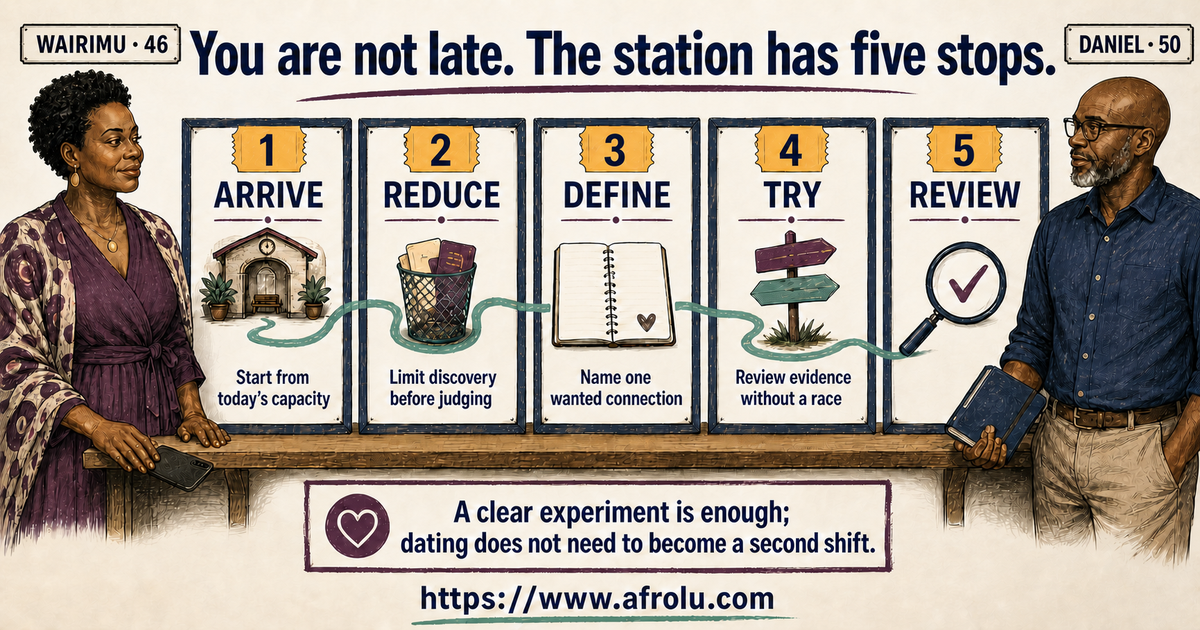
Arrive at your own time; leave with one clear next action.
Written and edited by Nia Kato · Profile Advice Editor
Begin at ARRIVE by identifying the exact unfamiliar job; at REDUCE, cap discovery and excess threads; at DEFINE, name one present aim; at TRY, attempt a bounded exchange or public Nairobi meeting; at REVIEW, compare capacity, boundary response and direct risk. That review can justify keeping one thread, adjusting a filter or rhythm, pausing the apps, closing contact, consulting care, locking down systems or obtaining protection.
Dating wellbeing · Late Entrants
How can a late-comer reduce unwanted online-dating work, state enough present intent and make one safe Nairobi choice without performing expertise or racing another person's timeline?
Late-comer means an adult for whom app-based dating is new or newly resumed, not someone behind in romance. Online-dating burnout is non-diagnostic shorthand for unwanted discovery, comparison, messaging, verification and planning work. Clarity is an answerable present intention, boundary or next move—not certainty about another person.
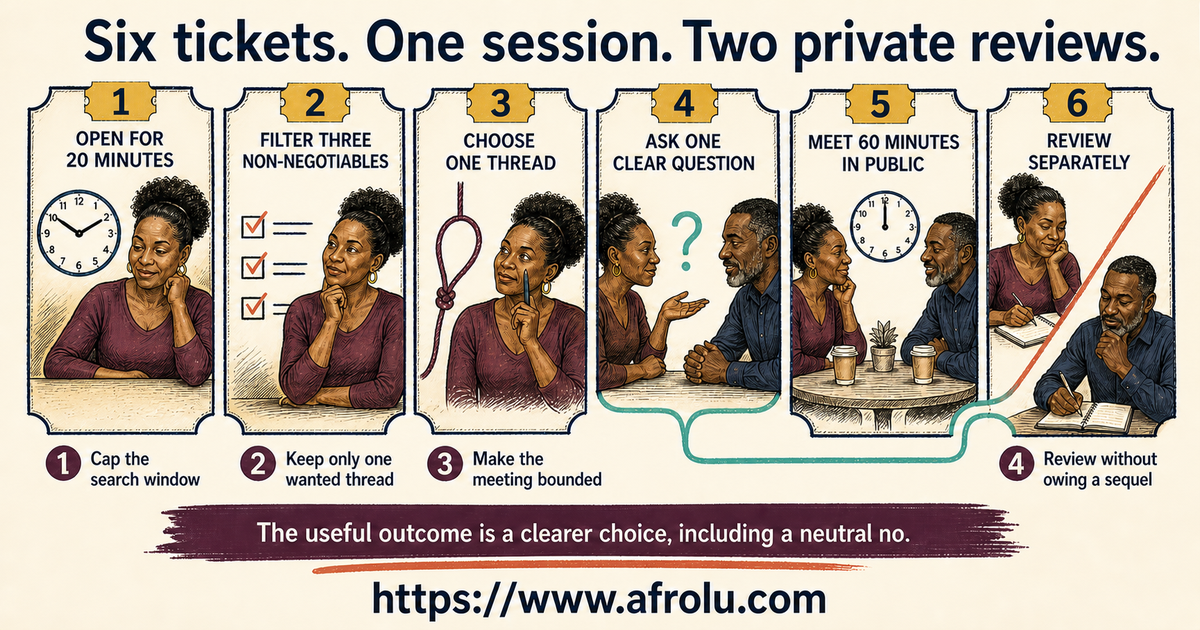
Wairimu, 46, and Daniel, 50, are fictional Black African adults in Nairobi. Six finite tickets take them from a twenty-minute search through one public hour and two private reviews. Neither owes another date, home access, money, exclusivity or a biography that proves why they arrived now.
The late-entry Nairobi reset station
Turn an endless feed into five finite adult stops
Nia treats late entry as timing, app fatigue as a task problem and clarity as one answerable present choice rather than a promise about the future.
Locate the unfamiliar task, cap optional volume, name one aim, run one bounded experiment and choose the next route from evidence.
Arrive
Name the exact setting, convention or concern that is genuinely unfamiliar.
Reduce
Close discovery and excess threads before they become permanent work.
Define
State one present aim and every issue that changes consent now.
Try
Use one bounded message, call or public Nairobi meeting.
Review
Choose continuation, redesign, pause, closure, care or protection.
Arrive without a timetable
Use five stops to make online dating finite, clear and voluntary
An adult can arrive at online dating at 26, 46 or 76 and still be a late-comer in the only sense that matters here: app-based dating is newer than expected, or newly resumed after a long absence. That timing says nothing reliable about confidence, desirability, digital skill, relationship intent or future success. Nairobi is the setting for practical choices, not a personality assigned to every resident.
Here, online-dating burnout is plain editorial shorthand for platform chores—browsing, weighing profiles, matching, messaging, checking identity and arranging dates—that have stopped feeling voluntary. It names no disorder. WHO reserves formal burn-out for work, and app studies adapt measures whose reach is limited. If disrupted sleep, mood, attention or day-to-day functioning lasts beyond app use, ask a qualified Nairobi health professional to evaluate the broader change.
The five stops are ARRIVE, REDUCE, DEFINE, TRY and REVIEW. ARRIVE identifies what is genuinely unfamiliar. REDUCE removes optional volume. DEFINE states one current purpose without promising the final relationship form. TRY creates one bounded experiment. REVIEW compares what happened with the adult's capacity, boundary and safety facts. Any stop can end in a pause or exit; the sequence is not a funnel toward partnership.
Start by naming the smallest friction. It may be settings, too many profiles, several simultaneous threads, unclear intent, pressure to reply, verification anxiety or the logistics of meeting in Nairobi. Change one variable before judging the whole medium or yourself. Threats, tracking, image abuse, impersonation, fraud or contact after closure skip the ordinary reset and move directly to system security or locally appropriate protection.
Separate biography from app skill
Learn the tool without turning a different timeline into a personal shortage
Late-comers often face two tasks at once: learning a commercial interface and deciding what kind of connection is wanted now. Keep those tasks separate. A confusing privacy control does not prove poor judgment, and uncertainty about casual or serious dating does not prove technical incompetence. Write down the setting that needs learning, then use help material reached independently rather than instructions sent by a new match.
A 2026 cross-sectional study surveyed 301 dating-app users aged 18 to 86 and found age differences in reported motivations, but cross-sectional self-report cannot show what age causes or prescribe an individual goal. Older-adult research also repeatedly warns against treating later-life daters as one group. This route therefore asks about today's aim—conversation, dates, companionship, exploration or a relationship—without treating birth year as the answer.
Clarity does not require a perfect relationship specification before the first message. A useful intent can be provisional: ‘I want to meet adults for unhurried public dates and see whether mutual interest grows.’ It becomes misleading only when the words are used to avoid relevant answers. If exclusivity, sex, money, location or relationship form would change another adult's decision, discuss that issue before relying on assumptions.
Protect dignity in both directions. A person who has used apps for years is not automatically careless; a person using one for the first time is not automatically naïve. Ask observable questions about settings, choices and conduct. Keep documents, passwords, one-time codes, precise routines and intimate material under individual control. Learning can happen slowly, and unresolved uncertainty can justify waiting or leaving without shame.
Follow one fictional session
Wairimu and Daniel turn six bounded tickets into evidence, not destiny
Wairimu is 46 and trying online dating for the first time after friends described it as unavoidable. Daniel, 50, has returned after several years away. Both live in Nairobi, but neither shares a home address, workplace schedule or daily route. Wairimu chooses a twenty-minute discovery session and three filters that concern present fit: adult relationship intent, a manageable contact pace and willingness to meet publicly.
At the end of the timer she closes discovery, even though more profiles remain. One exchange with Daniel is wanted, so she asks whether he is looking for conversation only or open to public dates. Daniel says he is open to dates but does not assume exclusivity. He asks whether one or two messages between meetings feels workable. The exchange answers two questions without turning message volume into proof of affection.
They choose a sixty-minute daytime meeting in a busy public place that each reaches independently. They confirm on the day, keep ordinary costs separate and share no identity document, live location or financial proof. The plan includes an ending; extending it would require a new yes. A friendly meeting is not consent to another date, private transport, home access, sex, exclusivity or continuous messaging.
Afterward, each writes a private review. Wairimu enjoyed the conversation but wants less app discovery. Daniel liked the meeting and can accept her message pace. Either could still close. The session is useful because six finite tasks replaced a vague demand to ‘catch up’: open, filter, choose, ask, meet and review. Nothing in the story makes a second meeting the successful answer.
Read sixteen signals in four groups
Distinguish load, intent, conduct and safety before changing the whole route
LOAD asks whether search windows end, active threads remain few, rest returns and essential settings are understood. A platform is optional, so an adult can remove discovery, silence prompts or delete an account without failing at dating. If a smaller task restores interest, the problem was at least partly administrative. If no app task is wanted, leaving the platform is a complete current choice.
INTENT asks whether purpose is stated, pace can be revised, exclusivity remains unassumed and a no is complete. Clear intent is not maximum seriousness. Casual, exploratory and relationship-seeking adults can all be honest. The important evidence is whether relevant choices are named early enough for consent and whether someone can counter or decline without being punished, mocked or subjected to a sales pitch.
CONDUCT asks whether questions travel both ways, plans are specific, ordinary mistakes receive proportionate repair and privacy remains respected. One enthusiastic message cannot prove character; one delayed answer cannot prove deception. Look for a pattern across small boundaries: what happens after a declined channel, a changed time, a request to slow down or a decision not to share precise personal information.
SAFETY asks whether location stays broad, money stays separate, devices remain personal and exit works. Threats, tracking, non-consensual image sharing, impersonation, fraud and blocked exit do not wait for a four-column review. When safe, preserve useful evidence and secure channels under your control. Use the platform, provider, specialist, legal or urgent route that matches the conduct and current Kenyan context.

A promising profile never cancels pressure, access requests or a defeated no.
Separate nine explanations around late-entry fatigue
Keep late entry, tool friction, low interest, mismatch, distress, fraud and control distinct
LATE ENTRY means app-based dating is new or newly resumed; start small without assigning a deficit. TASK FATIGUE means optional discovery, comparison or messaging is unwanted; remove that task and observe what returns. INTERFACE UNFAMILIARITY concerns a setting or convention; learn it through an independent help route. One adult can experience any combination, so a single difficult session should not become an age verdict.
INTENT UNCERTAINTY means the current connection aim remains unnamed, while LOW INTEREST means this person or route is not wanted even when capacity exists. FIT MISMATCH means two honest offers about pace, purpose, location or availability do not align. The next moves differ: define one provisional aim, decline, or release the mismatch. None requires a burnout label or criticism of the other adult.
WIDER IMPAIRMENT describes serious or persistent changes across sleep, mood, concentration or ordinary life beyond the app task. A page cannot diagnose the cause, so qualified local care is the appropriate route. Care is not the same as platform optimisation. It can coexist with pausing every dating task, and seeking it says nothing about whether the reader arrived at online dating at the correct time.
ROMANCE FRAUD uses a deceptive connection to obtain funds, codes, documents or account access; COERCIVE CONTROL narrows autonomy through monitoring, isolation, threats or defeated exit. Both bypass a compatibility score. In Nairobi, keep location broad, verify public meeting details independently, control transport and disclose less than a platform permits. Lock down exposed accounts, contact the relevant service or use current Kenyan protection according to the actual conduct.
Use twelve complete lines instead of performing expertise
State intent, limits, logistics, consent and closure in answerable language
ENTRY can say, ‘I am new to app dating, and I make decisions one step at a time.’ INTENT can name the current aim without forecasting a partner. SEARCH can cap discovery, and THREADS can limit simultaneous conversations. None of these statements asks the other adult to teach the platform, wait indefinitely or lower a boundary. They simply make the operating conditions visible.
REPLY and CALL scripts should define what silence and availability mean. ‘I usually reply within two days; an urgent answer is not available here’ is more usable than apologising for every delay. A call invitation names the day, channel and ending. A missed plan can receive one new offer. Repeated accusations, tests or alternate-channel pursuit after a stated delay are conduct facts, not communication-style trivia.
MEETING, LOCATION and MONEY protect the move offline. Offer one public hour, independent transport and a broad meeting area until a specific venue is confirmed. Say that ordinary costs remain separate and that no transfer, identity document or account code is part of verification. CONSENT remains specific to each image, conversation and physical step; age, enthusiasm, payment or a prior yes never supplies the current answer.
PAUSE can be open-ended: no comeback date is owed. CLOSE should name the route and channels that must remain closed. A person may dislike the decision without gaining a right to debate it. If a clear ending is defeated through new numbers, work routes, impersonation, threats or offline pursuit, stop refining the wording and move to account security, evidence preservation when safe and current local support.

A clear sentence states the offer and leaves the answer free.
Leave the review with one proportionate route
Choose among eight equal actions instead of forcing every session toward connection
KEEP ONE THREAD when the conversation remains wanted, the stated intent is compatible and ordinary boundaries hold. CHANGE FILTER when discovery is producing predictable mismatches and one profile criterion can be made more relevant. CHANGE RHYTHM when contact is wanted but the channel or frequency does not fit. Test one revision for a finite period instead of adding several rules at once.
PAUSE APPS when discovery or messaging is unwanted, whether for a day, a month or indefinitely. CLOSE CONTACT when the person, offer or route does not fit. A clear no needs no age explanation, clinical label or promise of friendship. The purpose of clarity is not to make every answer positive; it is to ensure that an adult can act on the answer that is actually present.
Choose SEEK CARE when sleep, mood, concentration or daily functioning remain seriously changed outside swiping, matching or messaging. A qualified Nairobi practitioner can investigate context that this article cannot evaluate. Choose SECURE SYSTEMS if a dating contact may have reached an account, device, document, exact whereabouts, intimate file or money. Using independently located support, revoke access you control; where credentials or payments were exposed, notify the responsible service without delay.
Choose SEEK PROTECTION when a threat, stalking, non-consensual image use, impersonation, fraud or repeated circumvention of closure is present. Before confronting or blocking, consider how either step could affect near-term safety. When it is safe to do so, retain relevant records and find Kenyan specialist, legal or emergency assistance suited to the event. Close the station log afterward: Wairimu, Daniel and every reader should leave a reset with reclaimed time and choice, not mandatory app labour.

Clarity may send you forward, sideways, home or directly to help.
Eight moments when late entry is mistaken for unlimited access or effort
The expert-performance trap
A new user pretends to understand privacy settings because asking feels like admitting they arrived late.
Stop, use independent help material and change only the setting understood.The endless platform
Profiles continue long after the chosen search window and no additional conversation is wanted.
Close discovery at the boundary; unfinished supply is not unfinished work.The final-answer demand
A match asks for a complete relationship future before either adult has gathered ordinary evidence.
State one current aim and leave later decisions genuinely open.The reply-speed test
A delayed answer is treated as proof that a late entrant is unserious or technically incapable.
Name the offered rhythm once and accept mismatch without an age verdict.The convenient private shortcut
Long messaging is used to replace a public first meeting with a home or vehicle pickup.
Keep the meeting public, bounded and independently reached.The identity-document lesson
A contact offers to teach verification if the reader sends an identity image or account code.
Share neither; learn and verify through an independently reached route.The rare-connection transfer
Urgency and scarcity frame a fare, emergency or investment payment as the price of keeping contact.
Send nothing and contact providers promptly if funds or credentials moved.The new-channel return
After closure, contact resumes through another number, social account or workplace route.
Close the reopened route, harden reachable accounts and, where safe, retain records for appropriate help.Sixteen markers across load, intent, conduct and safety
Search ends — the chosen discovery window closes even while more profiles remain.
Threads stay few — only wanted conversations remain open; possibility creates no duty.
Rest returns — unscheduled adult time is not automatically assigned to the app.
Settings are understood — privacy and visibility choices are changed through independent help.
Purpose is stated — today's connection aim is clear without promising the final form.
Pace can change — either adult may counter the channel, frequency or next step.
Exclusivity is unassumed — profile warmth or one date does not close other routes.
A no is complete — declining requires no age defence, diagnosis or continuing friendship.
Questions are mutual — curiosity travels both ways without an interview or sales pitch.
Plans are specific — a public place, time, duration and independent departure are usable.
Repair is proportionate — one miss receives one honest update rather than a loyalty test.
Privacy is respected — home, work, documents, routines and precise location remain controlled.
Location stays broad — feasibility is discussed without publishing an adult's daily map.
Money stays separate — fares, emergencies, investments, fees and codes prove no affection.
Wider impairment persists — serious daily change continues beyond app use; seek qualified care.
Exit is defeated — threats, tracking, image abuse, impersonation or fraud need direct protection.
Ten questions for one proportionate station decision
| Situation | What it may mean | What to do next |
|---|---|---|
| Can the search window end? | Fits: Discovery closes on time. Needs review: One setting needs checking. Stop: Supply keeps the session open indefinitely. | End discovery before judging fit. |
| Is only wanted contact open? | Fits: Each thread has a present purpose. Needs review: One conversation needs a decision. Stop: Possibility is maintained from guilt. | Close or archive the unchosen route. |
| Is current intent clear enough? | Fits: Both can answer the present aim. Needs review: One relevant term needs discussion. Stop: Fantasy replaces every concrete answer. | Define one aim without forecasting destiny. |
| Can the rhythm be countered? | Fits: A slower offer is respected. Needs review: Frequency needs one revision. Stop: Delay triggers accusation or pursuit. | Revise once or accept mismatch. |
| Are settings learned independently? | Fits: Help comes from a trusted route. Needs review: One control remains unfamiliar. Stop: A match requests documents or codes to help. | Decline access, then learn the setting through an independent help route. |
| Is the meeting bounded and public? | Fits: Place, duration and exits are clear. Needs review: One logistical detail is unfinished. Stop: Private access replaces the agreed plan. | Restore the safe plan or leave. |
| Do money and consent stay independent? | Fits: Each adult controls funds and each yes. Needs review: A money or consent term is still unnamed. Stop: Payment, images or touch prove interest. | Stop the request and reduce access. |
| Did reducing the task restore capacity? | Fits: Interest or rest returns. Needs review: Another bounded observation may help. Stop: Serious impairment continues across life. | Use qualified local assessment for persistent wider change. |
| Can a no end the route? | Fits: Closure remains closed. Needs review: A platform block is needed. Stop: New channels defeat the ending. | Secure systems and seek current support. |
| Has an immediate danger signal appeared? | Fits: Ordinary fit review remains available. Needs review: Account or provider action is needed. Stop: Threat, tracking, image abuse, fraud or impersonation appears. | Bypass scoring and use protection. |
Twelve lines for entry, pace, privacy, meeting and exit
“I am new to app dating, and I make decisions one step at a time.”
“I am learning one person at a time; no outcome is promised.”
“I search for twenty minutes, then I close discovery.”
“I keep only conversations I currently want to continue.”
“I may answer within two days; speed is not a hidden interest test.”
“I can call on Thursday for thirty minutes, and then I need to leave.”
“I can meet for one hour in public and leave independently.”
“I will confirm the venue, but I do not share live movement or home details.”
“I fund my own date costs; I send no fare, fee, investment or crisis payment.”
“This conversation, payment or earlier yes does not decide the next image, touch or sexual step.”
“I am pausing the apps and will not set a return date.”
“I am not continuing this connection; please leave this channel closed.”
Know the difference
Late entry, app fatigue and direct danger are different routes
The adult learns one setting, chooses a small search window and makes a present offer without an age apology.
Swipe, comparison, chat, verification and scheduling labour outlasts the reader's willingness to perform it.
New-interface friction, an unnamed aim, disinterest, incompatibility, life-wide difficulty, romantic deception and controlling conduct must be separated before selecting a response.

Name the narrow problem before choosing the route.
Do not confuse late entry, task fatigue, tool friction, mismatch, fraud and control
| Type or dimension | What it describes | Best next question |
|---|---|---|
| Late entry | App-based dating is new or newly resumed; no deficit is established. | Start with one finite task and learn only the needed setting. |
| Task fatigue | Optional discovery, comparison, messaging or planning feels unwanted. | Remove the narrow task and observe what returns. |
| Interface unfamiliarity | A platform control or convention is not understood. | Use independently reached help; share no credential or identity proof. |
| Intent uncertainty | The adult has not yet named what kind of connection is wanted now. | State one provisional aim and revisit it after evidence. |
| Low interest | This person or conversation is not wanted even when capacity exists. | Decline without turning the answer into an age or fatigue diagnosis. |
| Fit mismatch | Pace, intent, availability, meeting plan or other relevant offers do not align. | Accept incompatibility rather than negotiating away a boundary. |
| Wider impairment | Serious changes persist across ordinary life beyond the app task. | Seek qualified local assessment; a guide cannot diagnose the cause. |
| Romance fraud | A deceptive connection seeks funds, codes, documents or account access. | Stop transfers, lock affected accounts, contact the relevant service and use an appropriate reporting route. |
| Coercive control | Monitoring, threats, isolation or defeated exit narrows autonomy over time. | Use locally informed safety planning and urgent help for immediate danger. |
Move through five stops without turning timing into a race
Entry inventory
List the one app setting, convention or safety question that is actually unfamiliar today.
Volume cap
Set a closing time and maximum active threads before discovery begins, then honour the edge.
Provisional intent
Name what is wanted now without manufacturing certainty about relationship form or duration.
Boundary response
Observe what happens after a slower pace, broad location, declined channel or clear no.
Nairobi meeting card
Confirm a current public venue, bounded time and independent movement without publishing routines.
Proportionate route
Choose fit talk, pause, closure, care, account security, fraud action or protection from the present fact.
Questions for entry, volume, present intent and the next route
Choose a few prompts that fit the moment. This is a reference library, not a list to complete.
Locate entry friction
Name what is genuinely unfamiliar before judging yourself.
- Which setting is unclear?
- Which convention is optional?
- What can I learn independently?
- What personal data remains off the app?
Reduce the task
Give discovery and contact finite edges.
- When does search close?
- How many threads are wanted?
- What rest returns?
- Which prompt can be silenced?
Define present clarity
State only what another adult needs for today's choice.
- What connection is wanted now?
- What reply rhythm suits my capacity?
- Which terms have we not decided?
- What would change consent?
Select the station exit
Match the next move to the strongest current fact.
- Keep, revise, pause or close?
- Does wider change need care?
- Do any accounts need containment?
- Should this danger move straight to protection?
What current official guidance and limited app research can support
Formal ICD-11 burn-out belongs to the work setting
The ICD-11 explainer supports keeping this page's dating-burnout phrase non-diagnostic and focused on unwanted app tasks.
Evidence limit: WHO provides no dating-app measure, treatment plan or assessment of an individual reader.
Dating-app burnout was followed across four waves
Sharabi, Von Feldt and Ha began with 493 active single app users, collected four surveys over 12 weeks, and analysed exhaustion and inefficacy among the 190 participants retained in the final model.
Evidence limit: The sample, attrition, transferred burnout construct and observational predictors cannot establish a Nairobi prevalence or individual cause.
Three studies tested cumulative rejection in online dating
Pronk and Denissen used hypothetical and available partner options to examine acceptance, satisfaction and perceived success across repeated choices.
Evidence limit: Participants were heterosexual, single and aged 18 to 30; study designs and mixed sequence findings do not prescribe an ideal profile count for late entrants.
Pew records varied app experiences rather than one universal reaction
Pew's probability survey reached 6,034 adults in the United States between 5 and 17 July 2022, recording experiences that included excitement, disappointment and unequal volumes of incoming messages.
Evidence limit: Self-reported U.S. findings are not Nairobi estimates and cannot determine why one reader feels tired or uncertain.
A 2026 study spans adult ages while remaining cross-sectional
Liang and Bailey surveyed 301 dating-app users aged 18 to 86 about five motivations and several well-being measures.
Evidence limit: Cross-sectional self-report cannot establish direction or convert age-group associations into a goal, readiness score or African rule.
ODPC states data-subject rights and data-minimisation principles
The official Kenyan page covers access, objection, correction, deletion and limits around collecting personal and family information.
Evidence limit: Those duties attach to data controllers and processors. They neither provide case-specific legal advice nor guarantee privacy for information an adult voluntarily gives a dating contact.
FTC separates romantic storytelling from requests for money
FTC examples trace romance scams from migrated conversations and distant personal stories to urgent appeals involving journeys, crises or investments.
Evidence limit: It is U.S. guidance, not proof that warmth or distance equals fraud; Kenyan reporting and recovery routes differ.
Six ways a reset becomes another performance
Treating age as the problem
Timing replaces evidence. Repair: name the exact unfamiliar task, want or mismatch.
Learning from a match
Help becomes a route to documents or access. Repair: use independently reached materials.
Leaving discovery open
Endless supply becomes endless work. Repair: close the session at the chosen edge.
Demanding final intent
A provisional aim is mistaken for deception. Repair: ask only what changes today's decision.
Making private logistics efficient
Home access or live location replaces a public plan. Repair: retain independent movement.
Negotiating after direct risk
Threats, fraud or bypass become communication puzzles. Repair: secure access and use protection.
Reduce the app task, decide whether to leave it, or compare tools
These three practical routes answer different questions. Name the load, choose whether platform exit fits, or compare services only after privacy and intent requirements are clear.
Explore the guide library
Show more related guides
Continue with Afrolu
Show more Afrolu guides
Seven live sources with exact titles and explicit limits
Afrolu reviewed these health, research, safety, or public guidance resources while editing this page. They support the behaviour and safety guidance; they do not diagnose any individual described by a reader.
Late-entry questions about apps, pace, privacy and Nairobi meetings
Am I too late to start online dating?
No adult timeline establishes that. Late-comer here simply means app-based dating is new or newly resumed for you. Start with one bounded task, learn essential privacy controls and choose a provisional aim. You may continue, change method, pause or leave without turning age into a readiness verdict.
Is app-task burnout a clinical diagnosis?
No. This page uses it for unwanted discovery, comparison, messaging, verification and planning work. WHO limits formal burn-out to occupational context. Reduce the app task; if serious or persistent changes continue across sleep, mood, focus or ordinary life, seek qualified local assessment.
How many profiles should I review at once?
There is no universal evidence-based number. Choice studies use limited populations and designs. Choose a time or profile cap that preserves attention, close discovery at that edge and review whether decisions remain thoughtful. A commercial feed continuing is not a reason for your session to continue.
Do I need to know exactly what relationship I want?
You need enough current clarity for another adult to choose honestly, not a complete forecast. State whether you want conversation, dates, exploration or a relationship, plus any issue that changes consent now. Revise the aim openly when evidence or preference changes.
Should I tell a match that I am new to apps?
You may, but you do not owe that disclosure. If you share it, keep control: ask no match to manage your settings, verify you through documents or hold your codes. Learn technical steps from a help route reached independently and let conduct, not claimed expertise, guide trust.
How quickly should I reply?
Choose a response window that fits your real capacity; no universal speed demonstrates attraction. Explain the window once and let the match decide whether it works for them. If the proposal is declined, mismatch is enough reason to part. Punishment for delay, loyalty tests or pursuit through other channels are conduct to assess separately.
How should I plan a first Nairobi date?
Confirm a current public venue independently, set a start and end, control your own transport and avoid publishing home, work or live movement. A public plan reduces some risks but certifies no person. Either adult may leave or decline a changed private location.
Can a video call verify someone?
A video call can answer a narrow question—whether live conversation with the presented person is possible—but it cannot authenticate every identity detail, intention or future act. Never trade an ID photograph, password, one-time code, recording or intimate file for supposed verification. Use checks you reach independently, and pause or end contact when important uncertainty remains.
When should I delete or pause the apps?
Pause when the task is unwanted, capacity needs protection or you want to review one connection without discovery. Deleting may fit a privacy choice, a full exit or an exclusivity agreement, but those are distinct decisions. A pause can be indefinite and owes no return date.
When is this a safety issue instead of ordinary app fatigue?
Treat threats, stalking, location monitoring, non-consensual image use, impersonation, fraud, demands for credentials or repeated contact after closure as direct safety concerns. Protect exposed accounts and payment routes. If safe, retain relevant records, then choose up-to-date Kenyan provider, specialist, legal or emergency assistance that matches what occurred.
One thing to do now
Close the station with one clear adult choice
Continue only while the chosen task is finite, relevant intent can be discussed, a slower counteroffer is respected, settings are learned independently, meetings remain public and bounded, money and devices stay separate, consent is specific and closure works. Use qualified care for wider persistent impairment and direct protection for threats, tracking, image abuse, impersonation, fraud or defeated exit.