Four evidence lenses · one usable no
Spot Love-Bombing Pressure in a New Nairobi Connection
A non-diagnostic guide to early affection, pace, autonomy, gifts, access, money, boundary response, coercive-control signals and a safer Nairobi exit plan.
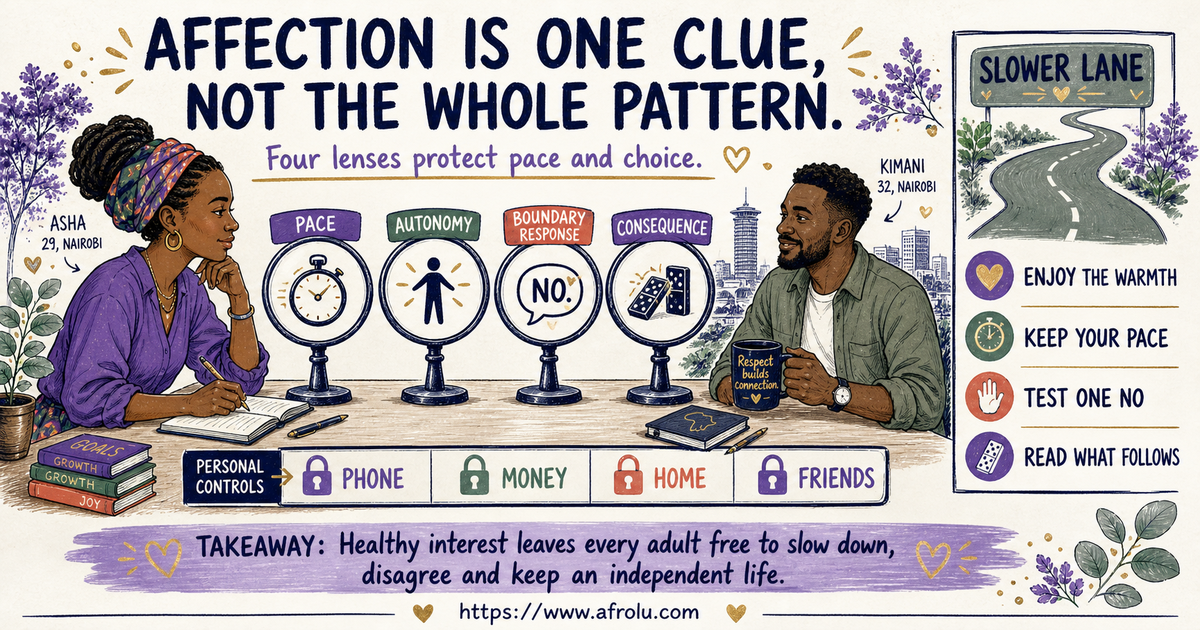
Warmth can be real; access still needs evidence and consent.
Written and edited by Adwoa Boateng · Dating Safety Editor
Do not diagnose someone from one gift, compliment or intense week. Use four lenses: PACE asks whether promises match shared knowledge; AUTONOMY checks friends, work, money, devices and private time; BOUNDARY RESPONSE records what follows one clear no; CONSEQUENCE asks whether ordinary choices narrow through guilt, monitoring, isolation, extraction or fear. Keep home, passwords, location, transport, money and consent separate. Reduce access and widen support when pressure repeats; use suitable local safety or emergency help for threats, stalking, coercion or violence.
Emotional safety · New Relationship Starters
How can a new dater enjoy warmth without letting gifts, promises or constant attention rush home, phone, money, exclusivity, sexual or social access before evidence and free agreement exist?
A love-bombing pattern is this guide's warning description for repeated intense affection, attention, promises or gifts that help rush access, obligation or dependence and are linked to pressure or punishment when the other adult chooses a slower pace. The phrase is not a diagnosis, motive detector or automatic legal conclusion.
Asha and Kimani are fictional Nairobi adults, 29 and 32. Warm public dates and a declined gift remain ordinary until future certainty, a requested key, isolation language, live-location pressure and an uninvited workplace appearance form a wider pattern. Asha secures access, tells trusted people and ends contact without seeking a private confession.
The four-lens affection journal
Read what the warmth asks you to surrender
Adwoa keeps strong early feeling visible while testing pace, autonomy, boundary response and practical consequence.
Separate each access decision, try one ordinary no when safe, observe the response and widen support before risk narrows the available routes.
Pace
Let promises remain hope until ordinary knowledge and time can support them.
Autonomy
Keep friends, work, faith, money, devices, transport and private time.
After no
Give more weight to accepted boundaries or repeated consequences than to praise.
Safety
Quiet planning and suitable support matter more than a perfect confrontation.
Begin with observable conduct
Love bombing is a warning phrase, not a diagnosis from one romantic gesture
Early affection can be sincere, awkward, exciting or mismatched. Compliments, frequent messages, flowers and future hopes do not by themselves prove manipulation. The useful question is what the intensity is attached to. Does it leave both adults free to slow down, keep ordinary relationships, protect accounts and say no without punishment?
The phrase becomes more useful when several elements repeat: disproportionate promises, urgency about exclusivity or access, gifts carrying an unspoken debt, pressure to isolate, requests for money or credentials, and a sharp change after a boundary. Record what was said, what access was requested and what happened next instead of trying to read a hidden personality.
Clinical and abuse resources often describe love bombing as excessive affection linked to influence or control. Legal standards differ by country, and the UK statutory guidance cited here addresses a particular legal framework. Afrolu uses those sources for pattern literacy—monitoring, isolation, economic control, intimidation and punishment—not as Kenyan legal advice or an automatic label for one date.
A reader does not need enough evidence to win an argument before protecting access. You may slow the pace because it does not fit, decline a gift, keep a key, refuse a password, see friends, control transport or end contact. If threats, stalking, coercion or violence appears, prioritise safety and appropriate help over explaining the term.
Use four lenses instead of a romance score
Pace, autonomy, boundary response and consequence reveal more than intensity
PACE asks whether closeness is growing in proportion to shared knowledge. A strong first week can still leave home access, exclusivity, sexual decisions, travel, money and future commitments undecided. 'Slow down' does not accuse the other adult. It tests whether affection can survive reality, time and separate judgment.
AUTONOMY asks whether each adult keeps friends, family, work, faith, hobbies, devices, accounts, transport and private time. Generosity that requires constant availability or separation from trusted people is not free. A partner may want more contact and still express that preference without monitoring, guilt, surprise visits or punishment.
BOUNDARY RESPONSE is the highest-value early observation. Decline a key, a private venue, a password, a money request or a faster label. A respectful response may include disappointment and a question, but the no remains effective. Repeated persuasion, ridicule, threats, silent punishment or attempts through another channel materially change the evidence.
CONSEQUENCE asks what the connection costs after disagreement. Are sleep, money, work, friendships, privacy or safety narrowing? Does affection disappear until compliance returns? One repaired mistake differs from a system where warmth and punishment alternate around access. Choose the smallest protective action that preserves options, then increase support if risk grows.
Follow the boundary, not the fantasy
Asha learns more from one declined key than from six weeks of praise
Asha, 29, is newly dating again in Nairobi. Kimani, 32, plans thoughtful public dates and messages daily. In week two he says he has never felt this certain and brings an expensive gift. Asha enjoys the attention but says she will not accept the item. Kimani takes it back politely, and that moment alone remains ordinary evidence of a respected choice.
By week four, he begins describing a shared home, asks for a spare key and calls her friends jealous when she keeps a planned evening with them. Asha says she wants a slower pace and will not share home access. Kimani sends repeated messages, arrives near her workplace without agreement and demands live location as proof that she is not wasting his time.
The concern is no longer one gift or enthusiastic language. Access pressure, isolation language, monitoring and an uninvited appearance now form a pattern. Asha tells two trusted people, changes account security, records useful messages and avoids a private confrontation. She states once that contact must end and uses platform and phone controls.
When Kimani creates another account, Asha does not answer to obtain a confession. She adds the contact to her record and seeks locally appropriate safety advice. The guide does not promise what will happen next. Its point is narrower: affection did not cancel autonomy, and a boundary did not need his agreement to become real.
Sort signals by what they do to choice
Continue, review and stop states should never become one love score
AFFECTION can continue when praise is specific, gifts are proportionate and neither person is asked to repay warmth with access. Review exaggerated certainty, constant contact or costly gifts when shared knowledge is still small. Stop treating affection as benign when it is used to erase consent, demand secrecy or create a financial obligation.
ACCESS can grow through freely discussed steps: another public date, ordinary identity context or a mutually chosen status conversation. Review requests for faster exclusivity, private venues, home access or constant replies. Stop when passwords, live location, money, documents, intimate images or unwanted physical access are demanded.
AUTONOMY remains visible when both adults keep work, friends, family, faith, rest and independent decisions. Review jokes that repeatedly undermine those connections. Stop isolation, monitoring, workplace interference, financial restriction, sabotage or rules enforced through fear. Those behaviours appear in coercive-control guidance because their cumulative effect matters.
CONSEQUENCE is clean when a no is accepted or one misunderstanding is repaired. Review sulking or persuasion that ends after a clear reminder. Stop threats, humiliation, stalking, repeated accounts, property damage, self-harm threats used to force contact, sexual pressure or violence. Use suitable support and do not meet privately to resolve a safety pattern.

Look for a pattern across pace, access, isolation and consequence.
Make pace and access discussable
Ten sentences test whether affection can coexist with an independent no
For PACE: 'I like this, and I am not making future promises yet.' 'I keep my existing plans.' 'I am not exclusive until we discuss and agree.' These statements preserve warmth while carefully separating present enjoyment from commitment, calendar control and assumptions about other dating.
For ACCESS: 'I do not share keys, passwords or live location.' 'I choose public dates and my own transport.' 'I do not send money or use match-sent investment links.' Those are personal rules. They do not accuse every admirer; they prevent affection from becoming an exception to ordinary privacy and scam safeguards.
For INDEPENDENCE: 'My friends and family remain part of my life.' 'Do not come to my home or work without agreement.' 'This gift is too much for me, so I will not accept it.' A respectful adult can hear those lines, feel disappointed and still allow the choice to stand without mockery or repayment.
For STOP: 'You repeated this after my no, so contact ends.' Send it once only if safe. Then use access controls, trusted support and appropriate platform, legal or emergency options. Do not keep replying because the other adult alternates apology, affection and pressure. The purpose is protection, not a perfect final explanation.

Say one clear line, then let the response supply evidence.
Widen options when the pattern concerns you
A safety plan can be quiet, staged and adapted to actual risk
TELL one or more trusted people what has happened and what contact is expected. SAVE only useful messages, dates, account names, payment information and unwanted visits when doing so is safe. Keep records somewhere the other person cannot access. Do not collect evidence by provoking contact or meeting privately.
SECURE email, phone, social accounts, devices and recovery methods. Remove unknown sessions and review location sharing. SEPARATE money, transport, home access and important documents. If the person had a key, account permission or repeated physical access, locally qualified safety advice can help plan changes without creating a predictable confrontation.
REPORT through the platform, payment provider or relevant local channel according to the conduct. PLAN the next few movements, public arrivals and who can be contacted. The plan may include no contact, limited practical contact or formal help. Do not publish the person's details online or ask strangers to investigate.
REVIEW after each material change rather than waiting for day seven. Threats, stalking, violence, sexual coercion, image abuse, financial extraction and repeated unwanted contact can require immediate action. If no urgent danger exists, the slower plan still matters: regain independent sleep, friends, work, money and decision time before considering any renewed contact.

Safety planning expands choice; it does not require one perfect confrontation.
Compare nearby patterns without moral shortcuts
Healthy enthusiasm, infatuation, love bombing, coercive control and scams overlap in appearance but not in function
HEALTHY ENTHUSIASM can be intense while remaining proportionate to knowledge and open to slower pace. INFATUATION may involve idealisation or excited future thoughts, but each adult can still keep autonomy and revise the view as reality arrives. Neither state guarantees compatibility or safety, yet neither should be called abuse from emotion alone.
A LOVE-BOMBING PATTERN becomes a useful warning description when intense affection repeatedly helps rush access, obligation or dependence and changes into punishment when choice appears. Focus on behaviour and effect rather than arguing about motive. A reader may leave because the pattern does not fit even without proving malicious intent.
COERCIVE CONTROL describes a broader repeated system that narrows autonomy through isolation, monitoring, economic abuse, intimidation, rules, sabotage or threats. The cited UK guidance is jurisdiction-specific, but the observable examples support safety literacy. ROMANCE SCAMS use trust and romantic narratives to extract money, investment or identifying data; financial safety action is central.
The actions differ. Enjoy healthy warmth while checking compatibility. Slow infatuation so evidence can arrive. Reduce access and widen support around a love-bombing pattern. Seek suitable safety and legal help for control, stalking or violence. Stop payments, secure accounts and report suspected scams through official channels. No single conversation resolves every category.
Eight early-connection moments where affection and pressure can look similar

An expensive present arrives on date two
The gift may be generous, mismatched or strategic; its meaning becomes clearer when Asha declines it.
Decline freely and observe whether warmth remains respectful.A shared home is described in week two
Imagining can be playful, but certainty exceeds the knowledge two adults currently share.
Name it as hope and defer commitments until evidence grows.Kimani calls Asha's friends jealous
One opinion becomes concerning when it pressures her to abandon existing support.
Keep the plan and reject isolation as proof of loyalty.A spare key is offered before trust exists
Access carries privacy and safety consequences independent of romantic intensity.
Say not yet and keep every home-access control personal.Live tracking is framed as reassurance
Constant location access is unnecessary for trust and can enable monitoring.
Refuse, review device settings and act on retaliation.An urgent investment appears after intense affection
Romantic trust is being connected to financial extraction and secrecy.
Send nothing, verify independently and use official reporting routes.A boundary is misunderstood and then accepted
A single accountable repair differs from repeated persuasion or punishment.
Keep observing over time without declaring permanent safety.Contact returns after blocking
The new account turns a relationship disagreement into an unwanted-access pattern.
Do not debate; preserve useful evidence and seek appropriate support.Ten signs across pace, access, autonomy and consequence
Certainty or soulmate language greatly exceeds shared knowledge
Gifts or help carry an unspoken expectation of access or loyalty
Exclusivity, sex, travel, home access or cohabitation is rushed
Constant replies or live location are treated as proof of care
Friends, family, faith or work are described as enemies of the bond
Money, investment, passwords, documents or intimate images are requested
A clear no produces repeated persuasion, ridicule or withdrawal of warmth
Uninvited home or workplace appearances are romanticised
Threats, stalking, property damage or coercion narrows ordinary choices
Independent boundaries and relationships remain intact without punishment
Review the connection through ten independent questions
| Situation | What it may mean | What to do next |
|---|---|---|
| Is affection proportionate to shared knowledge? | Fits: Warmth allows reality and uncertainty. Needs review: Certainty is running ahead of evidence. Stop: Promises are used to force access now. | Slow commitments and separate hope from present agreement. |
| Can a gift be declined? | Fits: The no changes nothing about respect. Needs review: Disappointment is discussed once. Stop: Debt, guilt or retaliation follows. | Return or refuse the gift and reduce access if obligation persists. |
| Can existing plans continue? | Fits: Friends, work and family remain normal. Needs review: More time is requested without control. Stop: Isolation or sabotage is demanded. | Keep support visible and seek safety help if control grows. |
| Are devices and accounts private? | Fits: Passwords and locations stay personal. Needs review: A request is withdrawn after no. Stop: Monitoring or account access continues. | Secure access and avoid announcing changes that increase risk. |
| Is home access freely timed? | Fits: Public dates continue while trust grows. Needs review: A key or private visit is proposed and declined. Stop: Uninvited appearances or blocked exits occur. | Protect the location and use appropriate safety support. |
| Does money remain separate? | Fits: No romantic proof requires payment. Needs review: A costly gesture is declined. Stop: Urgency, investment or secret transfer is demanded. | Send nothing, secure accounts and report through official channels. |
| Can consent change? | Fits: Each answer remains specific and reversible. Needs review: A mismatch ends respectfully. Stop: Affection, gifts or commitment are used to demand sex. | Leave or seek help; prior warmth never supplies present consent. |
| What follows a clear no? | Fits: The boundary is accepted. Needs review: One repair is completed. Stop: Punishment, threats or repeated accounts follow. | End access and widen support rather than explaining again. |
| Is the pattern narrowing daily life? | Fits: Autonomy and relationships remain intact. Needs review: One area needs deliberate repair. Stop: Fear, rules or monitoring changes ordinary behaviour. | Treat cumulative impact seriously and seek suitable help. |
| Is a private confrontation necessary? | Fits: A safe brief boundary is enough. Needs review: Advice is needed before contact. Stop: Meeting could increase danger or control. | Skip confrontation and use an individual safety plan. |
Ten lines for pace, gifts, access, money, consent and exit
“I like this, and I am not promising a future yet.”
“I keep my existing plans with friends and family.”
“I am not exclusive until we discuss and agree.”
“This is too much for me, so I will not accept it.”
“I do not share keys, passwords or live location.”
“I choose public dates and my own transport.”
“I do not send money or join match-sent investments.”
“Do not come to my home or work without agreement.”
“This answer is no, even though I care about you.”
“You repeated this after my no, so contact ends.”
Know the difference
Early warmth can support freedom, uncertainty, pressure, control or extraction
Affection may be intense while both adults retain time, money, support, privacy, consent and the ability to revise plans.
Affection becomes part of a concerning system when access, isolation, obedience or extraction is expected and refusal has consequences.
The clearest early test is not how high the feeling rises, but whether a boundary remains usable afterward.

Do not judge warmth alone; compare what it asks you to surrender.
Compare warmth, intensity, control and extraction without shortcuts
| Type or dimension | What it describes | Best next question |
|---|---|---|
| Healthy enthusiasm | Warm attention remains proportionate, reality-based and open to slower pace. | Enjoy it while preserving independent choices. |
| Infatuation | Excitement and idealisation may run ahead of knowledge without necessarily creating control. | Slow decisions and let ordinary evidence arrive. |
| Pace mismatch | Two adults want different contact or commitment speeds and can say so without punishment. | Negotiate once or end respectfully. |
| Love-bombing pattern | Intense warmth repeatedly supports rushed access, obligation or dependence and changes after no. | Reduce access, widen support and assess risk. |
| Coercive control | Isolation, monitoring, economic control, intimidation or rules narrow everyday autonomy over time. | Use suitable individual safety and legal support. |
| Romance scam | Trust and romantic stories are used to obtain money, investments, credentials or identity information. | Stop payment, secure accounts and report officially. |
| One repaired mistake | A disproportionate act is acknowledged, changed and not repeated. | Keep observing without granting instant trust. |
| Chosen ending | The pattern may simply feel too intense or incompatible even without proof of abuse. | End because consent to continue is absent. |
Use four evidence lenses before increasing access
Name conduct, not character
Record promises, access requests, boundary responses and consequences without remote diagnosis.
Keep pace divisible
Discuss status, sex, travel, money, home and devices as separate choices.
Test one ordinary no
A free boundary supplies more evidence than another extravagant promise.
Protect independent life
Friends, work, faith, transport, accounts and private time remain available.
Widen support quietly
Trusted people and account security can be restored before a final message.
Match help to risk
Fraud, coercive control, violence and ordinary incompatibility require different responses.
Questions for pace, autonomy, boundaries and safety
Choose a few prompts that fit the moment. This is a reference library, not a list to complete.
Pace questions
Separate hope from agreement.
- What do we actually know?
- Which promise is only hope?
- Which decision is being rushed?
- Can I say not yet?
- What evidence needs time?
Autonomy questions
Check the independent life.
- Can I see friends freely?
- Are my devices private?
- Who controls transport?
- Is money separate?
- Can I rest without punishment?
Boundary questions
Read what follows no.
- Was the no accepted?
- Did persuasion repeat?
- Was warmth withdrawn?
- Did access return elsewhere?
- What support should know?
Safety questions
Widen options without proving motive.
- What evidence is useful?
- Which accounts need security?
- Where could contact occur?
- Which local help fits?
- Would confrontation increase risk?
What clinical, safety, legal and fraud sources can support
Cleveland Clinic describes intensity, rushing and boundary pressure
The psychologist-reviewed overview lists excessive compliments, gifts, constant communication, soulmate language, isolation and anger around boundaries as possible signs and encourages outside perspective and limits.
Evidence limit: A public article cannot diagnose a person or prove intent from one action.
The Hotline links love bombing to influence and control
The National Domestic Violence Hotline discusses excessive affection and attention as a tactic that may be used to gain influence, with examples such as exaggerated praise, gifts and pressure.
Evidence limit: The resource supports pattern awareness, not a universal definition or local legal conclusion.
UK statutory guidance emphasises cumulative control
The guidance describes repeated monitoring, isolation, economic abuse, intimidation, workplace interference and rules that narrow ordinary life, showing why apparently small acts must be read in wider context.
Evidence limit: The law and offence described are UK-specific and are not Kenyan legal advice.
CDC includes coercive control in intimate-partner violence surveillance
CDC material describes coercive control examples including limiting transport, money, friends or family and excessive monitoring, supporting this guide's distinction between warmth and a system that reduces autonomy.
Evidence limit: The source does not assess an individual relationship or immediate danger.
FTC guidance separates romance from payment requests
FTC consumer guidance explains that scammers build trust on dating and social platforms before asking for money and advises refusing cash, gift cards, wire transfers and cryptocurrency.
Evidence limit: The U.S. guidance cannot verify a specific profile and should be paired with local reporting options.
The FBI warns about match-sent verification schemes
The IC3 alert describes quick movement off-platform and supposed free verification sites that collect financial and identity information or create recurring fees.
Evidence limit: Independent official navigation is safer, but no single signal proves every contact fraudulent.
Six ways intensity can distort evidence and safety planning
Calling every gift manipulation
One gesture is treated as proof. Repair: inspect access, autonomy and what follows no.
Waiting for motive certainty
Protection is delayed until intent is confessed. Repair: act on observable pattern and effect.
Repaying warmth with access
Affection becomes debt. Repair: separate gifts, sex, status, money and privacy decisions.
Arguing the label
The term replaces the boundary. Repair: state the action and reduce access.
Confronting privately for proof
Danger may increase. Repair: widen support and use a risk-aware plan.
Treating departure as failure
Intensity is confused with potential. Repair: let consent to continue be enough.
Use a reviewed resource that matches the decision
This guide focuses on the relationship decision, so it does not rank dating apps. Check current prices, safety tools, and local availability before choosing a service.
Explore the guide library
Show more related guides
Continue with Afrolu
Show more Afrolu guides
Love-bombing, coercive-control, violence and scam guidance
Afrolu reviewed these health, research, safety, or public guidance resources while editing this page. They support the behaviour and safety guidance; they do not diagnose any individual described by a reader.
Love-bombing questions for a new Nairobi dater
What is love bombing?
Love bombing is a popular warning phrase for excessive affection or attention that may help rush influence, access or dependence. It is not a diagnosis and has no single test. Look across pace, autonomy, requested access and the consequences of saying no. One gift, compliment or intense week does not by itself prove manipulation or abuse.
Can genuine excitement look intense?
Yes. Healthy enthusiasm and infatuation can involve frequent messages, strong attraction and hopeful future talk. The distinction is not how romantic it looks. Ask whether both adults can slow down, keep existing relationships, decline gifts, protect money and devices, change consent and end the connection without punishment or fear.
How soon is too soon for commitment?
There is no universal week number. Divide the decisions: exclusivity, sex, travel, home access, money, public visibility and long-term plans each need enough knowledge and free agreement. A pace is too fast for you when you cannot evaluate it independently or say not yet without consequences. Mismatch alone can justify slowing or ending.
Should I accept an expensive gift?
Only if you freely want it, understand any practical implications and can decline without debt. A gift does not purchase exclusivity, sex, access or forgiveness. If it feels disproportionate, say no or return it. Observe whether the person remains respectful. Financial pressure, repayment demands or guilt materially change the evidence.
Is asking for live location a red flag?
Continuous location access is unnecessary as proof of trust and can enable monitoring. You may share a bounded journey with a trusted person by choice, but a date does not need constant tracking. Refuse the request and review device permissions. Retaliation, repeated account access or uninvited appearances require a stronger safety response.
What should I do if affection turns into threats?
Prioritise immediate safety and locally appropriate emergency or specialist help. Tell trusted people, protect access, preserve useful evidence when safe and avoid a private confrontation. Do not keep replying to win agreement about the label. Threats, stalking, violence, sexual coercion and repeated unwanted contact are not solved by a better romantic explanation.
Can love bombing be part of a romance scam?
It can overlap when rapid affection and trust are used to obtain money, investment, gift cards, cryptocurrency, documents or verification details. Do not send funds or use match-sent financial links. Verify through official channels you navigate to independently, secure accounts and report suspected fraud to the relevant platform, payment provider and local authority.
How do I end contact safely?
Choose the method based on risk. A brief boundary may be enough when there is no danger. When retaliation, stalking or violence is possible, plan quietly with trusted and qualified support, secure accounts and locations, and skip a private final meeting. Blocking is one access tool, not a complete safety plan for every situation.
What if the person apologises?
An apology is one piece of evidence. Look for accountability, changed behaviour, no retaliation and respect for the boundary over time. You are not required to reopen access to test sincerity. Repeated apology-affection-pressure cycles carry different weight from one mistake that is owned and not repeated.
Am I overreacting if I simply dislike the intensity?
No proof of abuse is required to decline a pace or end a connection. Consent to continue must remain present. You can say that the intensity does not fit and leave. Safety language becomes important when access, isolation, monitoring, money, threats or coercion appears, but ordinary incompatibility is already enough for a respectful no.
One thing to do now
Let the next boundary reveal more than the next promise
Continue only while warmth remains proportionate and every adult can slow, decline, keep support and control money, devices, home, transport and consent. Review one mismatch or repair over time. Reduce access when pressure repeats. For threats, stalking, violence, sexual coercion, financial extraction or repeated unwanted contact, prioritise an individual safety plan and appropriate local help.