Four columns for light connection and protected study
Keep Casual Long-Distance Dating Clear During Adult Study
A semester-ledger guide for adult students balancing casual long-distance dating, study capacity, visits, money, privacy and consent.
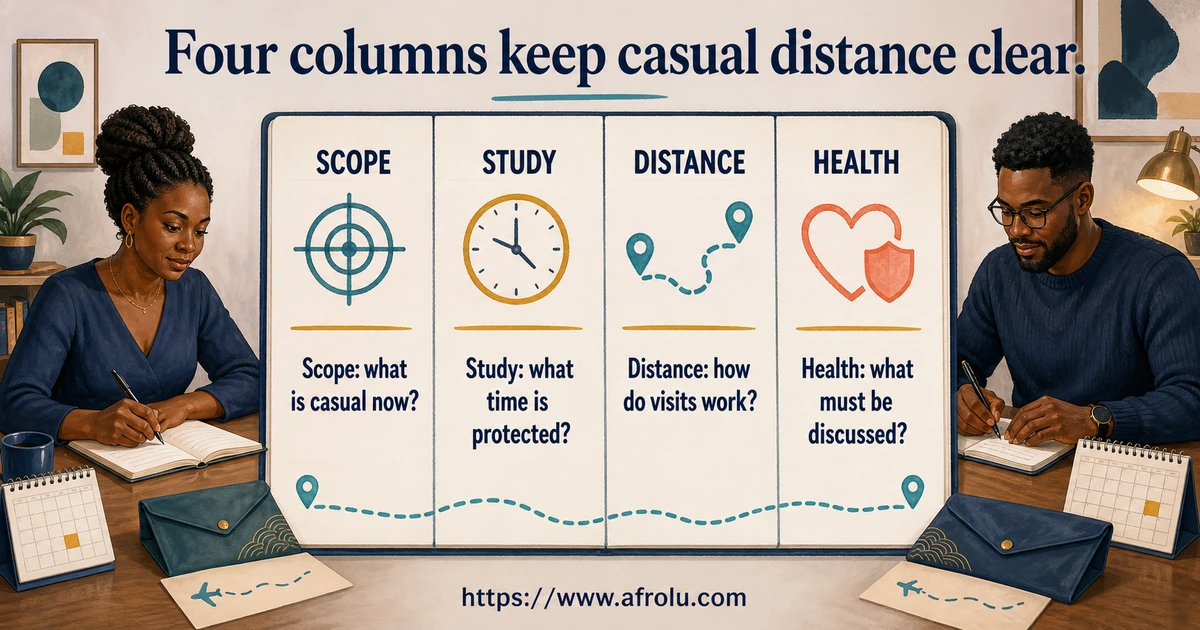
Write four agreements: scope, study capacity, distance and informed intimacy.
Written and edited by Grace Mutiso · Kenya Guides Editor
Use a four-column semester ledger. Scope defines what casual means, whether the relationship is exclusive and what future is not promised. Study capacity protects learning, work, sleep and healthcare through finite blocks, notice and workable alternatives. Distance defines sustainable remote contact plus visits each adult can afford, lodge and return from independently. Health and consent records the relevant other-partner, testing, barrier or contraception conversations needed before activity. Keep student accounts, coursework, grades, live location, images and essential money private. Daily contact does not create exclusivity; a visit does not create sex or commitment. At term end, review all four columns and choose to continue lightly, change the agreement, pause or close.
Distance and diaspora · Students
How can a casual connection stay honest across distance when academic capacity changes and neither adult wants constant access or an unspoken commitment?
Casual long-distance dating for adult students is a lighter stated relationship maintained across material geography while one or both adults study. The four-column semester ledger separates relationship scope, academic capacity, distance logistics and informed intimacy so a casual label does not become vagueness, permanent availability or reduced consent.
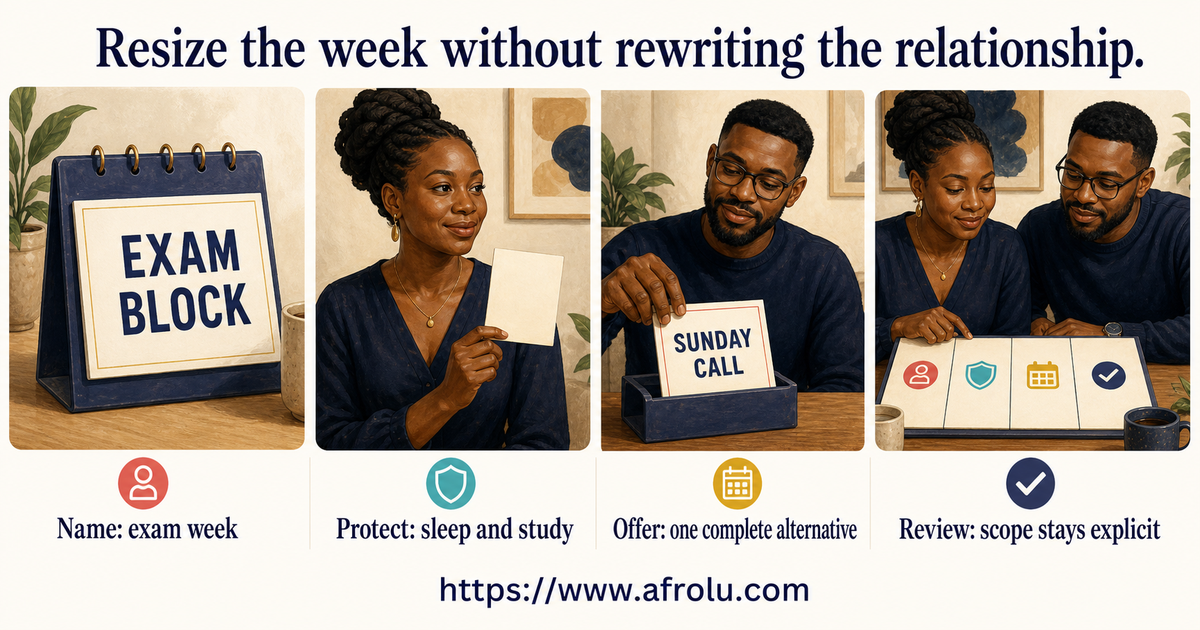
Amina and Daniel are fictional postgraduate adults, 27 and 29, in a casual non-exclusive connection across cities. Before Amina's exam, she closes evening calls until Friday and offers Sunday. Daniel respects the block without asking for grades, timetable or portal access. They review afterward: study capacity returns, casual scope remains explicit, travel stays independent and relevant other-partner or sexual-health changes must still be discussed before a visit.
The adult-student semester ledger
Keep a light relationship precise where time, distance and health affect another adult
Grace writes for adults aged 25 and older and treats study as real capacity, never as a cue for youth stereotypes or reduced agency.
The ledger separates scope, study, distance and health, then closes each term with a non-graded relationship decision.
Casual scope
Name the lighter offer, present structure and future that is not promised.
Study capacity
Protect finite blocks through notice, alternatives and reciprocal repair.
Distance logistics
Choose sustainable contact and independently affordable public visits.
Health and consent
Keep relevant information current and every activity freely answerable.
Separate the four facts
Casual, long-distance and student describe different pressures on an adult relationship
Casual dating is a lighter present relationship scope without an agreed serious commitment. It does not automatically mean non-exclusive, sexual, emotionally detached or careless. Long-distance describes geographic separation. Student describes an adult's current role and capacity, not age, maturity, income or relationship intention. A 27-year-old postgraduate and a 39-year-old part-time learner may face very different timetables, responsibilities and budgets.
Start with four agreements. Scope says what casual means now and what future is not promised. Study capacity says when learning, work, sleep and assessment time are protected. Distance says how remote contact and any visits will operate. Health and consent says what relevant partner information, barriers, testing, contraception or other choices need discussion before intimacy. Each column can change only through a new conversation.
Clarity does not make casual dating secretly serious. It prevents one adult from treating lightness as permission to be vague, demand constant attention or withhold information another adult needs for consent. A weekly call can be enough if both choose it. Daily flirting does not create exclusivity. A visit can remain casual. Sex does not upgrade the relationship, and a casual label does not supply consent.
Academic pressure deserves context rather than stereotypes. Deadlines, exams, placements, research, paid work and caregiving can reduce capacity. That does not prove disinterest. Look for notice, a finite change, a replacement offer and return to the agreement. Persistent disruption of study, sleep or essential money is not a sign that the connection matters more; it is a design problem or a boundary concern.
The four-column semester ledger
Write scope, study, distance and health in separate columns
The scope column records whether the relationship is light, exclusive or non-exclusive, how much emotional and practical involvement is offered and what is not promised. Do not use ‘casual’ alone because people hear different things. Say, for example: ‘I enjoy this, I am not building toward commitment this term and I am dating non-exclusively.’ The other adult can freely accept, ask for another structure or decline.
The study column records protected blocks and the communication available around them. It might say no calls during weekday study, a Sunday check-in and early notice if an exam changes the plan. It should also protect work, sleep, meals, exercise, healthcare and other responsibilities. Dating is not the only non-academic need; a timetable that makes all rest feel disloyal is unsustainable.
The distance column covers channels, time zones, visit timing, cost, lodging and return. A casual visit still needs a complete public plan and independent logistics. Neither adult should spend rent, tuition, food or essential transport money to prove light-heartedness. If a visit cannot be funded without transfer or debt, remote contact or postponement is a valid choice.
The health column covers the information and choices relevant before sex: present consent, other partners where disclosure affects the agreement or informed choice, STI conversations, testing, barriers, contraception and healthcare. Do not infer status from student identity, appearance, exclusivity or trust. Use qualified local healthcare for personal recommendations; a general relationship page cannot choose testing or treatment for an individual.
Amina and Daniel resize one exam week
Temporary low capacity does not have to become disappearance or relationship theatre
Amina and Daniel are fictional postgraduate students, 27 and 29, living in different cities. They have a casual, non-exclusive connection with a Sunday video date and lighter messages. Both work part time. They agree to disclose changes involving other sexual partners before relevant intimacy and to fund their own visits. Their relationship is intentionally light, not undefined.
Ten days before Amina's professional exam, she notices that evening calls are breaking her study blocks. She says: ‘I am offline after seven until Friday. I can do a short Sunday call after the exam.’ She does not send her timetable, grade target or portal screenshot. Daniel feels disappointed but does not interpret the smaller week as a demand for reassurance or proof that another partner has replaced him.
Daniel offers Sunday at six and sends one supportive message midweek without asking for a reply. He does not offer to complete coursework, request account access or turn help into intimacy. Amina accepts the call. On Sunday they review the ledger: the study column returns to normal; the scope remains casual and non-exclusive; the distance plan is unchanged; the health agreement still requires disclosure before their planned visit.
The story matters because nothing dramatic happened. A finite academic constraint received a finite adjustment. If Daniel had disappeared with no next step, Amina could call that vague. If he had demanded constant updates, grades or proof of study, the problem would be intrusion. Clear casual dating makes ordinary capacity visible without requiring either adult to perform commitment.
Capacity is not continuous availability
Read the shape of effort around exams, placements, shifts and research
A clear low-capacity period has a reason stated at an appropriate depth, a rough duration and an available alternative. ‘My placement runs late this week; Sunday is still good’ is enough. A student owes no timetable screenshot, lecturer name or live location. When plans change again, acknowledgment and another complete option preserve reciprocity.
Vagueness has a different shape: affectionate contact arrives when one person wants attention, every plan stays tentative and no review point survives. Ask once for the relationship that is actually available. The answer may reveal a casual rhythm that works, a lower level of interest or no usable agreement. Do not chase clarity by sending more intimate material, money or academic help.
Interference crosses another line. A match asks for portal access, copies assignments, pressures an adult to miss class, calls during declared exam blocks, tracks campus movement, threatens to reveal private images or withholds affection unless grades or opportunities are shared. Preserve relevant evidence, secure exposed accounts and use university, workplace, platform, legal, advocacy or emergency support appropriate to the behaviour.
Support remains possible without taking over. An adult can offer a meal after an exam, encourage sleep, listen to frustration or accept a smaller week. They should not become a clinician, supervisor or academic author. Persistent distress or anxiety that disrupts daily life deserves qualified health support; suspected academic misconduct or account compromise deserves the appropriate institution's current process.

Read capacity through notice, alternatives and repair—not through message count alone.
Light tone, exact agreement
Use one sentence for capacity, one for structure and one for informed choice
For academic capacity, say: ‘I am offline after seven until Friday for an exam. I can call Sunday at six.’ The closed period, end and alternative are visible. If Sunday no longer works, update it rather than vanishing. The other adult can accept or decide that the rhythm does not meet their needs without demanding access to the reason.
For scope, say: ‘I enjoy this and want to keep it casual and non-exclusive this term. I am not promising a committed future.’ If feelings change, begin a new discussion instead of acting exclusive or resentful. An adult who wants seriousness can decline the casual offer. That mismatch is not proof that either person used the other if the scope was honest and consent remained informed.
For sexual health, say: ‘Before sex, I want us to discuss other partners, testing, barriers and what each of us needs to choose freely.’ A non-exclusive agreement may make some information particularly relevant, but healthcare advice must fit the individual. Do not demand records through pressure or assume a negative result is a permanent guarantee. Consent remains specific and can change.
For visits, say: ‘We each arrange our own transport, lodging, money and return. The visit does not change our structure unless we both say so.’ Choose public early meetings and share a plan with a trusted adult. A visit never creates a debt of sex, time or exclusivity, and neither student should risk essential study or living funds to make it happen.

Say what the week can hold, what casual means and which information informed consent requires.
Protect the consequential choices
Keep accounts, coursework, money, images and consent outside casual entitlement
Student systems contain more than grades. Email, portals, identity records, financial aid, research data, placements and institution messages can expose the adult and other people. Keep credentials private, use strong authentication offered by the institution and follow current security rules. A romantic partner does not need to watch progress or submit work. If an account may be compromised, change access and report through the official route.
Intimate images are never owed in a casual or distant relationship. Do not pressure, trade or threaten. Consider that any digital file may be copied beyond the intended exchange. If someone threatens to share an image or uses one for coercion, preserve relevant evidence without redistributing it, secure accounts and use platform, institutional, advocacy, legal or emergency support appropriate to the situation. The person targeted is not to blame for another person's abuse.
Money boundaries protect study and daily life. Do not send fees, rent, emergency funds, fare, devices or investment money to verify a distant story. Avoid receiving or moving funds for a match. Choose date and visit costs that leave essentials intact. If suspected fraud occurred, contact the payment provider promptly and use appropriate reporting support. Shame only helps the person applying pressure.
Consent and health conversations remain direct. A casual or non-exclusive relationship can include care and informed disclosure. Discuss relevant partners and changes before sex, ask about testing at the depth needed for a decision and choose barriers or contraception with qualified healthcare where relevant. An earlier yes, a paid trip, images, flirting, exclusivity or a casual label cannot answer the next activity.
The end-of-term ledger review
Choose the next agreement without grading the relationship
Review scope: can both adults describe what casual means, whether they are exclusive and what future is not promised? Did either person's feelings or needs change? A new serious intention deserves a conversation, not a retroactive claim that the earlier casual agreement was false. If the desired structures differ now, a respectful ending may be the accurate result.
Review study capacity: did contact protect sleep, assessments, work and wellbeing? Did both adults communicate finite constraints and offer alternatives? If dating repeatedly consumed essential time or one person monitored performance, change the rhythm or close access. Do not use a poor grade to blame the relationship automatically; examine the actual time and conduct pattern.
Review distance: were calls, visits, costs and returns reciprocal and independently controlled? Did remote intimacy create assumptions that failed in person? A connection may remain remote, plan another modest visit or pause during a demanding term. Long-distance does not need to become relocation to count as real, and casual does not need to become committed to count as honest.
Review health and consent: was relevant information shared before choices, were boundaries accepted and could either adult change their mind? Continue only with a current agreement. Change structure through two explicit answers. Pause when capacity makes informed connection hard. Close for mismatch, repeated low effort, deception, coercion, image abuse, money pressure or academic intrusion. The ledger serves clarity, never a grade.

Review the four columns, then choose the smallest accurate next agreement.
Eight adult-student moments where light dating still needs clarity
A finite offline period can stay connected
Amina needs five evenings without calls and worries a casual partner will read the change as rejection.
Name the end date, offer one later window and return to the usual rhythm or review it afterward.Frequency does not create exclusivity
Daniel and Amina message every day, and Daniel assumes neither is seeing anyone else.
Ask about structure directly; maintain or change it only through mutual agreement.Casual does not mean permanently on call
A distant match contacts Leila only after midnight and says planning would make the relationship too serious.
Offer a sustainable planned rhythm or decline the access-only arrangement.Support must not become academic authorship
A match asks to log into a student portal to fix an assignment and frames access as practical care.
Keep credentials and authorship private; use legitimate academic support.A ticket buys travel, not sex or exclusivity
After arriving, one adult says the cost means the casual connection should become intimate and exclusive.
Restate the agreement, retain the independent exit and leave if pressure continues.Non-exclusive still needs relevant disclosure
A new sexual partner affects an earlier health agreement, but disclosure feels too serious for casual dating.
Share the information required for informed choice before relevant activity and revisit the agreement.Tuition urgency does not verify a romance
A match requests immediate school-fee help and promises a visit after payment.
Send nothing, protect essentials and verify any concern outside the romantic channel.Coercion changes the category
A former casual partner threatens to share an intimate image unless contact resumes.
Do not bargain privately; preserve evidence, secure accounts and use appropriate platform and local support.Evidence that casual distance protects study, privacy and informed choice
Both adults are explicitly 25 or older and speak for themselves about study and dating choices.
Casual scope is defined beyond the word, including present structure and what is not promised.
Exclusivity is discussed directly rather than inferred from daily messages, visits or sex.
Study, work, sleep, health and care blocks can be protected without punishment or surveillance.
A reduced-capacity week includes notice, a rough end and a workable alternative when possible.
Neither adult requests portal access, assignment authorship, grades, lecturer details or live campus location.
Remote contact is reciprocal without either person being permanently available.
Each adult controls the money, documents, lodging, transport and return for a visit.
Relevant other-partner and sexual-health information is discussed before informed choices.
Images, flirting, travel and past intimacy are never treated as standing consent.
A changed plan or boundary receives acknowledgment and changed conduct.
Account intrusion, image threats, academic pressure, money grooming or coercion triggers protection and support.
Sort capacity, structure, academic access, visits and consent
| Situation | What it may mean | What to do next |
|---|---|---|
| An adult student closes an exam week | A finite capacity boundary | Agree on an end and one later contact window without demanding proof. |
| Replies slow without explanation | Many possible causes, not evidence of betrayal | Ask once about the available rhythm and avoid surveillance. |
| Daily messages feel exclusive | Frequency is carrying an unspoken structure | Name exclusivity directly before acting as though it exists. |
| Casual is used to avoid planning | One adult may want access without reciprocity | Offer a complete light rhythm or decline the arrangement. |
| A match wants portal access | Care would expose academic and identity systems | Keep credentials private and use official academic support. |
| A visit requires essential money | The plan is not independently survivable | Postpone rather than spend rent, tuition, food or borrowed funds. |
| A new sexual partner affects the agreement | Relevant information has changed | Discuss it before the next activity so consent remains informed. |
| A visit is used to claim sex | Travel cost is being converted into entitlement | Stop, retain the exit and seek support if pressure continues. |
| A casual partner wants commitment | Needs or feelings have changed | Make a new mutual agreement or end respectfully; do not imply one. |
| A match asks for school fees | Financial urgency is entering remote trust | Send nothing and keep the relationship separate from payment. |
| An image is used as leverage | Digital abuse or coercion | Preserve evidence, secure accounts and use appropriate platform or local support. |
| The term ends with four clear columns | The light relationship has usable evidence | Continue, change, pause or close through a fresh explicit choice. |
Scripts for exams, casual scope, health, travel, money and change
“I enjoy this and want a casual, non-exclusive connection this term. I am not promising commitment.”
“I am offline after seven until Friday for an exam. I can call Sunday at six.”
“One planned call and lighter messages work for me; constant contact does not.”
“Daily messages feel close, but are we still non-exclusive? I do not want to assume.”
“My student email, portal, assignments and passwords stay private.”
“You can encourage me, but I will use my institution's support for the academic work.”
“Before sex, let us discuss other partners, testing, barriers and what each needs to choose freely.”
“We each arrange our own transport, lodging, money and return, and the visit does not change our structure.”
“I do not send tuition, fare, rent or emergency funds through a dating connection.”
“I do not owe intimate images because we are casual or far apart.”
“My feelings have changed. Do you want a committed structure, or should we end the casual one?”
“Using my image or studies to pressure contact is unacceptable. I am ending access and seeking support.”
Know the difference
Casual long-distance dating is not the same as a situationship or friends with benefits
A lighter stated relationship scope maintained across geography. It may be exclusive or non-exclusive and may or may not include sex.
A common label for a connection whose expectations or status remain unresolved. Distance can contribute to ambiguity but does not create the definition.
Friends with benefits adds an existing friendship plus an intimacy agreement; exclusivity adds a mutual present structure. State scope, structure and health needs instead of letting distance choose them.

Distance is geography; casual, FWB, situationship and exclusive answer relationship questions.
Compare distance, casual, non-exclusive, FWB and situationship structures
| Type or dimension | What it describes | Best next question |
|---|---|---|
| Long-distance dating | A geographic condition affecting contact and visits | What remote rhythm and visit plan are workable? |
| Casual dating | A lighter present relationship scope | What is offered and what is not promised? |
| Non-exclusive dating | A current structure allowing other dates as defined | Which changes need disclosure? |
| Exclusive dating | A mutual agreement concerning other dates | When does it begin and what does it cover? |
| Friends with benefits | A friendship that also includes consensual sexual activity | Are friendship, intimacy and disclosure expectations clear? |
| Situationship | A connection with materially unresolved expectations or status | Which unanswered question now affects a choice? |
| Slow dating | A deliberate pace with reason, rhythm, effort and review | Is the slower movement still mutual? |
| Study pause | A temporary capacity adjustment, not a relationship type | What changes, until when and what remains? |
| Sexual-health agreement | Information and prevention choices needed for informed activity | What must be discussed before the next choice? |
| Academic access | Permission involving portals, work, grades or identity data | Why would a dating partner need any of it? |
Build a four-column semester ledger in six moves
Write four columns
Define casual scope, academic capacity, distance logistics and health or consent without combining them.
Protect the study block
Give a rough end and a realistic alternative while keeping timetables, grades and portals private.
Name the structure
Say exclusive or non-exclusive directly; message frequency and visits do not decide it.
Make visits independent
Each adult controls affordable travel, lodging, money and return, with public early meetings.
Keep consent informed
Discuss relevant partners, health information and protection before activity; accept every changed answer.
Close the term
Review four columns and choose continue lightly, change, pause or close without assigning a grade.
Questions organised by scope, study, distance and health
Choose a few prompts that fit the moment. This is a reference library, not a list to complete.
Casual scope
State the light relationship that is actually available.
- What does casual mean here?
- Are we exclusive?
- What future is not promised?
- Which change needs a conversation?
- When will we review scope?
Study capacity
Protect learning and wellbeing without creating a surveillance timetable.
- Which blocks are protected?
- What contact remains available?
- When does the change end?
- How will a missed plan be repaired?
- Is effort reciprocal?
Distance plan
Make remote contact and visits affordable and reversible.
- Which channels fit both adults?
- Can each fund the visit?
- Where is separate lodging?
- How does each return?
- What would postpone the plan?
Health and review
Keep consent informed and choose a term-end outcome.
- What partner information matters?
- Which health discussion is due?
- Can either adult change consent?
- Did all four columns remain honest?
- Do we continue, change, pause or close?
What student, distance, health and safety sources can support
Academic stress includes deadlines, workload and lack of time
A study of university students describes exams, time distribution, deadlines and academic overload among common stressors and examines social support in relation to stress and health. Afrolu uses it to legitimise capacity conversations, not to diagnose a reader.
Evidence limit: The cross-sectional research came from a particular university population and cannot establish a universal schedule or treatment.
Romantic expectations can add to academic distress
A recent qualitative study of first-year female public-university students in South Africa reported relationship expectations, control and balancing academic responsibilities among sources of distress. The route uses the finding cautiously to foreground protected study time.
Evidence limit: The qualitative sample and gendered findings do not represent every adult student or establish prevalence and should not be generalised to all partners.
Remote responsiveness may matter more than raw message frequency
A survey of 647 emerging adults found frequent remote communication in long-distance relationships and an association between responsive texting and satisfaction within that group. This supports discussing fit and responsiveness rather than a mandatory count.
Evidence limit: The study was cross-sectional, not an African adult-student safety study, and cannot establish causation or ideal frequency.
Testing, treatment and partner notification are practical health steps
NHS guidance explains that sexual-health clinics offer confidential STI testing and treatment, that a person with a positive result should tell current and relevant former partners when possible, and that clinic-supported partner notification may be available. Individual testing and treatment decisions belong with qualified care.
Evidence limit: The service details and referral routes are UK-specific and cannot provide an individual testing, prevention or treatment plan; use qualified local healthcare.
Casual scope and earlier intimacy do not supply current consent
NHS guidance explains that active consent is required, a relationship or past yes does not provide it and consent can be withdrawn. The same principle applies after travel, flirting or image exchange.
Evidence limit: The legal and service context is UK-specific; use qualified local support for an individual incident.
Personal information, fake profiles and money requests remain relevant
Police Scotland's current online-dating guidance highlights fake profiles, personal-information risks, money or investment fraud and care with public meetings. Adult-student status does not reduce those risks.
Evidence limit: UK police guidance cannot guarantee safety or define Kenyan and other local reporting pathways.
Six shortcuts that make casual dating costly or unclear
Calling casual undefined
Light scope still needs a structure and enough health information for informed choices.
Counting replies as effort
A sustainable plan and repair reveal more than online presence during a demanding term.
Sharing academic access
Portals and coursework expose identity, other people and institutional obligations.
Spending essential money
A visit is not independently chosen if it consumes rent, tuition, food or borrowed funds.
Letting a visit upgrade the relationship
Geography and cost do not create exclusivity, commitment or sexual consent.
Grading the outcome
A truthful casual ending can be healthier than pressured permanence or an unworkable term.
Use a reviewed resource that matches the decision
This guide focuses on the relationship decision, so it does not rank dating apps. Check current prices, safety tools, and local availability before choosing a service.
Explore the guide library
Show more related guides
Continue with Afrolu
Show more Afrolu guides
Research and public guidance reviewed for this semester ledger
Afrolu reviewed these health, research, safety, or public guidance resources while editing this page. They support the behaviour and safety guidance; they do not diagnose any individual described by a reader.
Adult-student casual long-distance dating questions
Can adult students have a casual long-distance relationship?
Yes. Every person should be an adult choosing freely. Define what casual means, whether the structure is exclusive, what communication fits study capacity and how visits and sexual-health choices work. A light scope does not reduce privacy, consent, honesty or care. It also does not need to become serious to count as a valid relationship.
Does casual mean non-exclusive?
Not automatically. Casual describes a lighter scope; exclusive or non-exclusive describes the structure. Ask directly. If other partners affect an agreement or informed sexual-health decision, discuss the relevant change before activity. Daily messages, sex and visits do not create exclusivity without mutual words.
How often should long-distance students text?
There is no universal count. Choose contact that protects study, work, sleep, healthcare and other responsibilities. Notice whether both adults initiate and repair changes. A clear weekly call may fit better than constant messages. Online status does not prove availability, interest or another partner, so avoid monitoring.
How should I handle an exam period while dating?
Name the reduced-capacity period, give a rough end and offer one realistic later window when possible. You do not owe a timetable, grade or portal screenshot. Return to the prior rhythm or review it after the exam. If the other adult punishes protected study time, reconsider the relationship design and access.
Should I share my student portal or assignments with a partner?
No romantic proof requires credentials, grades, identity records or authorship. Use legitimate institutional support for academic work and follow current policies. If access may be compromised, change credentials, enable available security protections and contact the institution through an official route.
Who should pay for a casual long-distance visit?
Use a plan each adult can independently afford and control. Do not spend rent, tuition, food, healthcare or borrowed money to prove interest. Keep lodging, documents, transport and return separate for early visits. If the trip needs a romantic transfer to happen, postponing is a complete answer.
Does a casual visit imply sex?
No. Travel, cost, flirting, images, a casual label and past intimacy do not supply present consent. Ask for each activity and accept a changed answer. Retain an independent exit. If pressure or coercion appears, leave and seek appropriate local support rather than debating the value of the trip.
What sexual-health conversation belongs in casual dating?
Before sex, discuss information each adult needs for an informed choice, which may include other partners, STI testing, barriers and contraception. Do not infer health status from appearance, trust or student identity. Use qualified local healthcare for personal testing, prevention, symptoms or treatment.
What if a student match asks for fees or rent?
Do not send money because a distant story is urgent or a future visit is promised. Genuine hardship exists, but romance does not independently verify it. Protect essential funds, avoid receiving or forwarding money and contact the payment provider promptly if suspected deception led to a transfer.
What should I do about an intimate-image threat?
Do not blame yourself or bargain privately. Preserve relevant evidence without redistributing the material, secure accounts and use the platform's reporting controls. Seek institution, advocacy, legal or emergency support appropriate to the conduct and location. Immediate danger requires the relevant emergency route.
One thing to do now
Close the term with the smallest accurate agreement
Write scope, study capacity, distance and health in separate columns. Protect academic accounts and essential money, make capacity changes finite and visits independently survivable, and ask directly about structure and consent. At the end of the term or another chosen point, review all four and continue lightly, change, pause or close through a fresh explicit choice.