Two protected homes and six weekend windows
Build a Low-Pressure Weekend Distance Route as Parents
A parent-first weekend long-distance guide to contact, child privacy, video, repair, money, travel, sexual health, consent and route reviews.

Open one weekend window without exposing either household.
Written and edited by Tariro Ncube · Diaspora Dating Editor
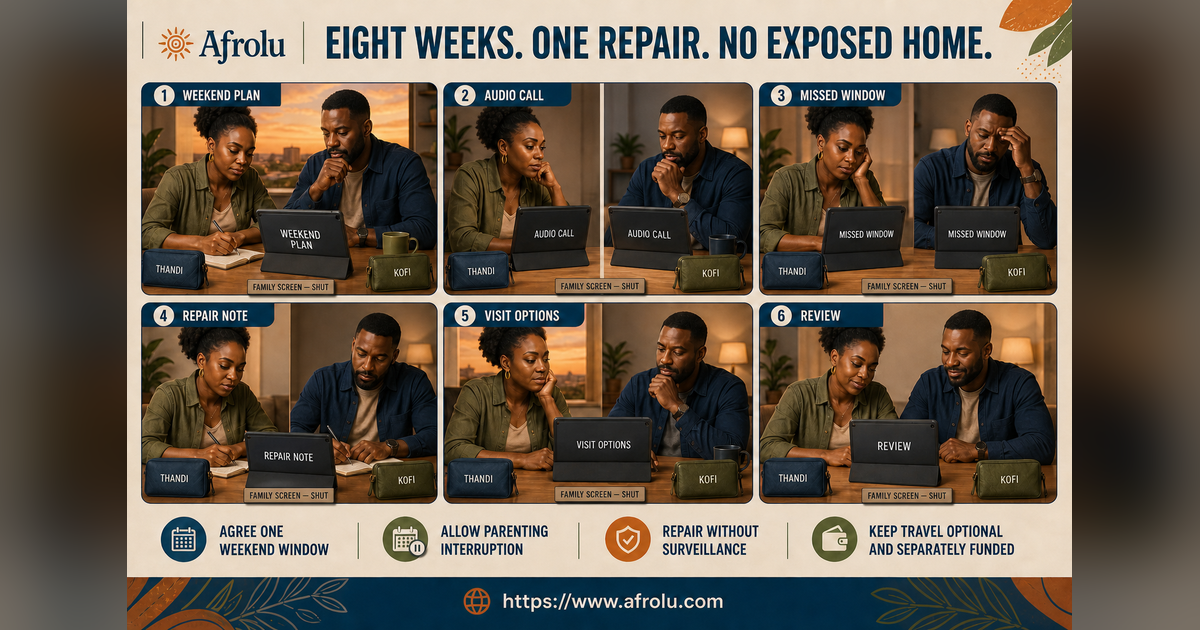
Protect TWO HOMES and open six bounded windows: PLAN shares adult availability, CONTACT chooses channels, CHILD-FREE TIME keeps family life off dating calls, VISIT preserves independent travel and lodging, REPAIR handles interruption without proof, and REVIEW chooses continue, redesign, pause or close. Low pressure still requires mutual status, timely health facts and current consent. No call volume, child appearance, transfer or ticket creates partnership or family access.
Distance and diaspora · Parents Returning To Dating
How can two parents build meaningful weekend contact across distance without exposing children, simulating a shared household or turning travel and money into relationship proof?
A low-pressure parent weekend distance route is a mutual adult arrangement with purpose-limited plan, contact, child-free time, visit, repair and review windows while each home, child, account, fund and physical decision remains independently protected.
Thandi and Kofi are fictional parents, 37 in Cape Town and 40 in Accra. Across eight weeks, an honestly repaired missed call, a protected family-video boundary and a separately priced visit left unbooked show how a remote route can become clearer without household exposure.
The two-home weekend switchboard
Open adult connection without broadcasting either family system
Tariro gives plan, contact, child-free time, visits, repair and review independent switches between two protected homes.
Each window opens only for a stated purpose, at a sustainable capacity and with a practical close control.
Plan and contact
Share adult availability, channels, normal delay and confirmation.
Child-free time
Use neutral adult space and protect every family identity and routine.
Visit
Separate tickets, lodging, movement, health, consent and cancellation.
Repair and review
Return after disruption and choose the next route from ordinary evidence.
Connect adults across two homes
A low-pressure weekend route should not turn family life into continuous remote access
Weekend long-distance dating may suit parents because a planned window is easier than constant messaging and because geography naturally slows in-person access. It may also create pressure to make every Saturday exceptional. Start smaller: name the adult relationship type, one sustainable contact window, normal interruption, money boundaries, visit conditions and a date for review.
Two homes means two family systems, not a single remote household. A new match does not need a child's name, face, voice, school, caregiver, co-parent contact, bedroom view, precise routine or live location. Even harmless-looking video calls can reveal walls, documents, uniforms, neighbourhood landmarks or other people who never agreed to join the dating interaction.
Low pressure does not mean no care. Confirm a planned window, communicate likely delays, acknowledge a miss and offer a realistic return. Neither parent should spend every weekend waiting beside a device. An asynchronous voice note, a shorter call or a skipped week can be valid when both adults understand the rhythm and the connection still supplies enough evidence.
Long distance adds travel and money decisions without reducing sexual-health or consent standards. A future visit should have a purpose, separately controlled funds, independent movement, accommodation options, relevant health discussion and cancellation. A ticket cannot purchase a family introduction, private lodging, an extended stay or any physical answer.
Open six windows by purpose
Plan, contact, child-free time, visit, repair and review each need their own control
PLAN covers which weekend, approximate duration, channel and who confirms. Give only adult availability. Avoid revealing when a home is empty or who is caring for a child. CONTACT covers voice, video and messages with normal delay. Choose neutral backgrounds, disable unnecessary location sharing and ask before recording, screenshotting or forwarding any adult image or story.
CHILD-FREE TIME means the relationship contact is arranged when the parent can participate without placing a child on camera or making the child perform approval. A brief interruption is ordinary. The adult can pause and return without explaining private circumstances. A match who competes with caregiving or asks for direct child contact is not simply asking for more romance.
VISIT covers identity context, purpose, budget, travel, lodging, public first plans, independent movement, health, consent and cancellation. Each adult keeps documents, essential money and return options. No one should travel primarily to prove love, rescue an emergency, deliver funds or force an unclear route to become serious. Remote warmth does not remove in-person uncertainty.
REPAIR covers what happens after missed or interrupted contact: acknowledgement, proportionate context and a realistic next option. REVIEW considers repeated connection, disruption, burden and pressure before continuing. A useful review may keep weekend contact exactly as it is. If capacity or need does not fit, a smaller rhythm, pause or closure remains an honest outcome.
Follow eight ordinary weekends
Thandi and Kofi learn more from a repaired miss than from a flawless call
Thandi, 37, lived in Cape Town; Kofi, 40, lived in Accra. Both were parents and wanted low-pressure open discovery. They chose an eight-week route with one adult-only weekend call when capacity allowed, unhurried messages, no live location and no family introductions. Either could date others, with material health facts discussed before intimacy or travel.
During week three, Kofi missed the planned window while responding to a private family need. He sent a brief message later, acknowledged that Thandi had waited and offered two future windows. He did not send photographs, names or a detailed account to prove the reason. Thandi chose one option and did not request access to a child or caregiver.
On a later video call, a young voice was audible outside Thandi's room. She paused the call and returned from a neutral space. Kofi did not ask who it was or request an introduction. They agreed that cameras would remain optional and that neither would record or share the call. The boundary protected the household without denying that family life existed.
At week eight, they considered a public Cape Town visit. Each priced independent travel and lodging, but Kofi's schedule was not ready. They left the visit unopened and continued their weekend route for four weeks. The choice did not weaken the connection; it prevented money and a rare free weekend from making a decision their ordinary evidence could not yet support.
Read three states in every window
Continue, review and stop signals keep affection from hiding pressure elsewhere
On PLAN, continue means a bounded time and confirmation; review means capacity changed; stop means the full household schedule is demanded. On CONTACT, continue means chosen channels and normal delay; review means frequency is unsustainable; stop means monitoring, recording, punishment or constant availability becomes a condition of affection.
On CHILD-FREE TIME, continue means interruptions are handled discreetly and children stay off camera. Review means the setting accidentally revealed more than intended and should be reset. Stop means repeated child questions, direct messages, screenshots, school interest or pressure for family performance. Close access before providing further explanation.
On VISIT, continue means a bounded plan with separately controlled travel, lodging, documents and money. Review means one dependency or fact remains unresolved. Stop means urgent transfers, controlled movement, private lodging pressure, document handling or an implied obligation to intimacy. Contact relevant banks, platforms or local support promptly when money or safety is affected.
On REPAIR and REVIEW, continue means disruption receives ownership and the review produces an answer. Review means burden is uneven or a short test is needed. Stop means disappearance alternates with access demands, or reviews are postponed while travel and family privileges grow. No volume of romantic messages can make an unusable exit safe.

Classify each weekend window alone; no attractive total score can cancel a stop.
Use twelve bounded lines
A weekend route can feel warm without becoming an always-on household broadcast
For planning: 'Saturday evening is possible; I will confirm Friday without sharing my family schedule.' For rhythm: 'One weekend call and unhurried messages is what I can sustain.' Those lines provide enough certainty for the date while protecting when a parent or child is at home, elsewhere or unavailable.
For video: 'I use a neutral background, and calls are not recorded or shared.' For child privacy: 'My child will not join our dating calls, and identifying details remain private.' For delay: 'Parenting may interrupt; I will return within our repair plan.' Distance curiosity does not create a right to watch family life.
For money: 'I do not send emergency, ticket or investment funds through dating.' For visits: 'We each control travel, lodging, documents and essential money.' For health: 'Before a visit where intimacy is possible, let's discuss current facts and qualified care.' Those decisions prevent a journey from becoming financial or physical obligation.
For consent: 'Arrival does not answer any private or physical question.' For review: 'After four weekends, let's choose continue, redesign, pause or close.' For ending: 'I am closing this dating route; do not move contact to new accounts.' Prepared language cannot guarantee respect, but the response provides useful evidence.

Give the date an adult window, not a live view into family life.
Review four evidence trays
Connection, disruption, burden and pressure show whether the windows still fit
CONNECTION asks whether the chosen rhythm supports genuine conversation and whether both adults initiate in ways they can sustain. Message volume is not a universal measure. A low-pressure route may have few contacts but clear attention. If one person needs more contact, test one workable change rather than opening constant video or tracking.
DISRUPTION asks how missed calls, parenting interruptions, travel, power, data or work changes are repaired. BURDEN asks who regularly accepts inconvenient time zones, plans, pays for data and waits. Share burden over time without demanding exact equality in every week. A route that repeatedly exhausts one parent may need redesign despite genuine affection.
PRESSURE includes child access, surveillance, sexual expectations, urgent money, ticket deadlines, private lodging, identity documents and future promises. Protect the affected window immediately. The FTC's romance-scam guidance and security sources offer useful patterns and controls, but no page can determine the intent or safety of an individual remote match.
CONTINUE when the six windows remain clear. REDESIGN frequency, channel or timing when evidence supports a test. PAUSE for capacity, missing facts, health or travel constraints. CLOSE when need differs or deception, financial manipulation, stalking, threats or coercion appears. Only after that decision should a separate optional visit question be opened.

Review the ordinary windows before opening a journey or household.
Compare eight routes between homes
Status, contact, visit access and future horizon should never collapse into one distance label
Conversation is early remote contact before recurring romance. Bounded discovery adds a purpose and review. Casual weekend dating adds recurring adult contact with limited integration. Slow weekend dating deliberately limits frequency or escalation. Each can be caring when status, other dating and relevant health facts remain honest.
One-person focus means one adult concentrates attention without mutual exclusivity. Exclusive distance dating means both stop defined outside dating or sexual contact. Neither status grants constant calls, live location, passwords, money, visits, home views or child contact. Distance requires more explicit logistics, not fewer personal boundaries.
Distance partnership adds chosen responsibilities and future coordination across homes. It may include travel or eventual location questions, but every step needs evidence, capacity, independent professional advice where relevant and a free decision. Partnership still does not make documents, family routines, finances, sexual health or physical consent universally accessible.
Closure ends the adult dating route and should close agreed channels, location shares and future visits. Preserve relevant evidence and seek suitable help if contact continues through new accounts or includes threats, fraud, stalking or image abuse. The best current route is accurate and revisable; it is not the one that promises the fastest reunion.
Eight parent-distance moments where a weekend window can expose too much
A full household calendar is requested
Adult coordination is expanding into private family movements.
Offer one bounded window and keep the schedule closed.A child-related need ends a call early
The contact changes without requiring family detail.
Pause, acknowledge later and offer a realistic return.A match asks a child to wave on camera
Remote warmth is being used to open family contact.
Decline and keep future calls adult-only.Weekend reassurance becomes continuous tracking
Logistics are shifting into surveillance.
Disable the share and use bounded journey updates if chosen.A ticket emergency creates a transfer deadline
Travel urgency is bypassing independent financial judgment.
Do not pay; verify through channels you find yourself.One home is proposed as the only lodging
The journey would control privacy, movement and cancellation.
Postpone or build independent alternatives.A visit is booked before an intimacy discussion
Travel cost may make a free decision harder.
Discuss relevant facts and choices before purchase.Four weekends support the same remote rhythm
A visit is unnecessary for the route to remain meaningful.
Continue the windows and set another review.Signals across plan, contact, child-free time, visit, repair and review
Both adults can state the present distance arrangement, other dating terms and weekend rhythm.
Adult availability is shared without exposing a child's routine, caregiver, co-parent or empty home.
Voice, video and messages use chosen channels, neutral settings and no unagreed recording or forwarding.
Parenting interruptions receive a practical repair rather than proof demands, jealousy or punishment.
No child is asked to perform approval, join a dating call or carry messages between adults.
Passwords, authentication codes, recovery channels, location and personal documents remain independent.
Emergency, investment, ticket and living costs never become evidence of affection or identity.
A visit has separate travel, lodging, movement, health, consent and cancellation controls.
Future partnership or relocation stays conditional on evidence, capacity and two free choices.
Continue, redesign, pause and close remain usable without crossing family or financial gates.
Choose the next weekend route through ten bounded questions
| Situation | What it may mean | What to do next |
|---|---|---|
| Is weekend availability bounded? | Fits: One adult window is enough to plan. Needs review: Duration or confirmation needs redesign. Stop: The household schedule or empty-home times are demanded. | Share less and protect family movements. |
| Does contact remain chosen? | Fits: Channels and normal delay are mutual. Needs review: Frequency is tiring one adult. Stop: Recording, monitoring or punishment controls contact. | Reduce access and reset the rhythm. |
| Are children outside dating calls? | Fits: Contact uses neutral adult-only space. Needs review: An accidental reveal needs containment. Stop: A child, school or caregiver is pursued. | Close the window and use suitable support. |
| Can interruption repair without proof? | Fits: A miss is owned and a return offered. Needs review: One disrupted weekend needs context. Stop: Private family evidence is demanded. | Keep the explanation proportionate. |
| Are accounts and location personal? | Fits: Controls remain with each adult. Needs review: A temporary share needs an end. Stop: Passwords, codes or continuous tracking are requested. | Stop sharing and harden affected accounts. |
| Does money stay independent? | Fits: Contact and future plans remain affordable. Needs review: One shared cost needs a cap. Stop: Urgency, tickets or investments pressure payment. | Do not transfer and verify independently. |
| Is a visit freely cancellable? | Fits: Travel, lodging and movement have alternatives. Needs review: One dependency needs redesign. Stop: Documents, lodging, funds or movement are controlled. | Postpone the journey or seek immediate help. |
| Are health and consent settled before travel? | Fits: Relevant facts and free choices precede booking. Needs review: A conversation or care step remains. Stop: Ticket cost is used to override no. | Pause the booking or physical action. |
| Is future integration conditional? | Fits: Location and family questions remain optional. Needs review: Capacity or horizons differ. Stop: Relocation or family access is declared unilaterally. | Return to the present route. |
| What do four weekends support? | Fits: All six windows remain accurate. Needs review: One bounded redesign deserves testing. Stop: Need, burden or safety cannot fit. | Continue, redesign, pause or close. |
Twelve lines for adult windows, private homes, visits and closure
“Saturday evening may work; I will confirm without sharing my family schedule.”
“One weekend call and unhurried messages is what I can sustain.”
“I use a neutral background, and our calls are not recorded or shared.”
“My child will not join dating calls, and identifying details stay private.”
“Parenting may interrupt; I will use our repair plan when I can return.”
“I do not use continuous tracking; journey updates are optional and temporary.”
“I do not send emergency, ticket or investment funds through dating.”
“We each control travel, lodging, documents, movement and cancellation.”
“Before a visit where intimacy is possible, let's discuss current relevant facts.”
“Arrival does not answer any private or physical question.”
“After four weekends, let's choose continue, redesign, pause or close.”
“I am closing this route; do not contact me through new accounts.”
Know the difference
Relationship status, weekend contact, visit access and family horizon stay separate
Names adult status, opens specific contact windows, protects households and makes every journey separately cancellable.
Uses constant video, tracking, child contact, money or future promises to imitate integration before evidence supports it.
Choose the smallest route that stays truthful after one disrupted weekend and one freely declined visit.

Choose the smallest route that remains accurate after an interrupted weekend.
Compare eight distance routes without making family access progress
| Type or dimension | What it describes | Best next question |
|---|---|---|
| Conversation | Initial remote adult contact before recurring romance or weekend expectation exists. | Enough consistent context for bounded discovery |
| Bounded discovery | A limited learning route with planned windows, private homes and a review. | Ordinary contact plus a repair |
| Casual weekend dating | Recurring low-pressure contact while outside dating may continue under clear terms. | Comfort with present scope and disclosure |
| Slow weekend dating | Frequency or escalation is deliberately limited without removing clarity or repair. | A sustainable rhythm across family duties |
| One-person focus | One adult concentrates attention without claiming reciprocal exclusivity. | A direct two-adult status conversation |
| Exclusive distance dating | Both stop defined outside dating or sexual contact; homes and money stay separate. | Reliable conduct before a visit question |
| Distance partnership | Chosen responsibilities and future geography are coordinated without blanket family access. | Purpose-specific integration and independent advice |
| Closure | Adult dating and agreed channels end because fit, capacity, desire or safety requires it. | A clear exit and appropriate support |
Build a protected two-home weekend route in six moves
Protect two homes
Keep children, backgrounds, routines, locations and household occupancy outside remote proof.
Plan one window
Share adult availability, channel, duration and confirmation rather than a family schedule.
Design child-free contact
Use neutral adult space and pause ordinary interruptions without explanation pressure.
Repair the miss
Acknowledge disruption, give proportionate context and offer a realistic return.
Gate every visit
Separate funds, lodging, movement, health, consent, documents and cancellation.
Review before repeating
Use connection, disruption, burden and pressure to choose the next route.
Questions for plans, remote contact, visits and review
Choose a few prompts that fit the moment. This is a reference library, not a list to complete.
Plan questions
Coordinate adult time without mapping homes.
- Which weekend window works?
- Who confirms and when?
- Which channel fits?
- What detail is unnecessary?
- When does the window close?
Contact questions
Keep warmth bounded and child-free.
- Which background is neutral?
- Are recordings excluded?
- What delay is normal?
- How do we handle interruption?
- Which family facts stay private?
Visit questions
Preserve independent travel and consent.
- What is the visit for?
- Who controls essential money?
- Where can each adult stay?
- Which health talk comes first?
- How can either cancel?
Review questions
Choose from ordinary window evidence.
- What connection repeated?
- How did disruption repair?
- Who carried burden?
- Where did pressure appear?
- What route fits next?
What distance, child, security, fraud, health and consent sources support
Remote intimacy can be meaningful and selectively presented
Peer-reviewed long-distance research examined communication media, intimacy and idealisation. It supports valuing remote connection while reading it beside disruption, boundaries and in-person logistics rather than treating frequency as complete evidence.
Evidence limit: One study cannot prescribe weekend contact or predict identity, compatibility and relationship outcomes.
Kenyan child-rights context illustrates why family screens stay closed
Kenya's Children Act protects a child's privacy, family, private affairs and correspondence and places best interests at the centre. Those principles support withholding identifying child information during remote adult dating.
Evidence limit: This Kenyan legal context is not universal law, custody advice or a timetable for family introduction.
Independent digital controls reduce remote exposure
CISA recommends strong passwords, multifactor authentication, phishing recognition and updates. Those measures support separate accounts and recovery without giving a long-distance match administrative access.
Evidence limit: Digital controls reduce some risks but cannot verify a match's identity, intentions or physical safety.
Distance and urgency can be paired with financial requests
The U.S. Federal Trade Commission describes remote romance-scam patterns involving trust, inability to meet and requests for money. Refusing transfers and checking independently is proportionate.
Evidence limit: The examples and reporting paths are U.S.-specific; use relevant local banks, platforms and authorities.
A journey should follow an informed adult conversation
CDC guidance recommends talking with partners before sex so both can make informed choices. Current partners, testing, prevention and qualified care may matter before a distance visit.
Evidence limit: This source is general public-health information, not individual diagnosis, treatment or travel advice.
Travel never supplies a physical answer
NSW Government guidance describes consent as voluntary, communicated, specific, ongoing and withdrawable. Tickets, lodging, gifts, time zones and relationship labels do not alter those qualities.
Evidence limit: Legal definitions and services differ; seek appropriate local health, legal or emergency support for actual events.
Six ways weekend distance dating can open the wrong window
Broadcasting family life
Video becomes an open home window. Repair: use neutral adult space and no recording.
Interrogating interruption
A missed call requires child proof. Repair: accept proportionate context and read repair.
Measuring love by weekends
Every free day is claimed. Repair: define a sustainable rhythm with protected rest.
Funding the reunion
Urgency opens ticket or emergency money. Repair: keep funds and booking control separate.
Letting travel decide intimacy
Cost creates expectation. Repair: discuss health and consent before purchase.
Promoting contact into partnership
Message volume becomes status. Repair: name the adult arrangement directly.
Use a reviewed resource that matches the decision
This guide focuses on the relationship decision, so it does not rank dating apps. Check current prices, safety tools, and local availability before choosing a service.
Explore the guide library
Show more related guides
Continue with Afrolu
Show more Afrolu guides
Peer-reviewed distance research plus official child, security, fraud, health and consent sources
Afrolu reviewed these health, research, safety, or public guidance resources while editing this page. They support the behaviour and safety guidance; they do not diagnose any individual described by a reader.
Low-pressure weekend distance questions for parents
How can parents make weekend long-distance dating low pressure?
Choose one sustainable adult contact window with a confirmation time, normal delay and repair. Keep children, care arrangements and household routines private. Allow skipped weeks when capacity requires them. Low pressure still needs honest status, relevant health disclosure, respect for no, independently controlled money and a review that can redesign or end the route.
Should my child join video calls with a long-distance date?
Not as proof, entertainment or an early relationship milestone. Use neutral adult-only space and avoid identifying backgrounds, uniforms, documents or voices. Any later introduction should be separately considered around the child's interests and family context. A match who repeats child-contact requests after refusal provides important evidence about boundary respect.
How do I explain a missed call caused by parenting?
Acknowledge that the plan changed, offer only the context needed and suggest a realistic return. You do not owe a child's story, caregiver identity, photograph or schedule as proof. The other adult may name the impact and decide whether the rhythm fits, but surveillance and interrogation are not necessary repair.
Is one weekend call enough for a relationship?
It may be enough for one pair and insufficient for another. Ask whether the rhythm supports meaningful learning, mutual initiation and repair without draining family, work and rest. Test a bounded adjustment if needs differ. Do not substitute always-on video, tracking or child access for an honest compatibility decision.
Should long-distance parents share live location?
Continuous tracking is not required by care or relationship status. A temporary journey share may be freely chosen with a clear purpose, audience and end. Keep account credentials and recovery private. Pressure, workarounds or punishment after refusal are reasons to close access and use suitable support for the actual risk.
Who should pay for a first visit?
Each adult should retain control of essential funds, booking, documents, movement and cancellation. If sharing one cost, set an affordable cap and refund rule without creating debt. Do not transfer emergency, investment or proof-of-love money. Verify providers through channels you locate independently, and postpone when the plan requires dependence.
Where should a visiting parent stay?
Choose options that preserve adult privacy, independent movement and cancellation. A family home should not be the only lodging merely because one person travelled. Agree a public first plan and keep children outside the visit unless a separate child-centred decision has been made. Arrival never creates permission to extend or enter private space.
When should we discuss sexual health and consent?
Before booking a visit where intimacy may be considered, discuss current partners, testing, prevention, boundaries and qualified care. Share information relevant to choice without demanding unrelated files. Every physical act needs a current voluntary answer. Distance, exclusivity, ticket cost, lodging and a previous yes cannot answer for the present.
What if a match asks for ticket or emergency money?
Do not pay because trust, urgency or a future visit is invoked. Verify claims through independent contact details and keep accounts, codes and documents secure. If funds have moved unexpectedly, contact the relevant bank or provider promptly and use appropriate local platform, financial, fraud or legal reporting and support routes.
How do we decide whether to keep the weekend route?
Review connection, disruption, burden and pressure across the six windows. Continue when the current route remains mutual; redesign one timing or channel; pause for capacity, health or missing travel facts; close for incompatible needs or unsafe conduct. A visit is a separate optional question, not proof that remote dating has progressed.
One thing to do now
Connect the adults while both family homes remain independent
Continue when six windows remain mutual and both homes are protected. Redesign timing, channel or burden through one bounded test. Pause for parenting capacity, health, travel or missing facts. Close when needs differ or deception, surveillance, child-access pursuit, financial manipulation, stalking, sexual pressure, threats or retaliation makes the route unsuitable.