Adult trust first; child and career access stay separate
Build Clear Long-Distance Dating Around Parenting and Work
A three-lock guide to long-distance dating for working parents, with adult clarity, child privacy, career boundaries, safe visits, money and consent.
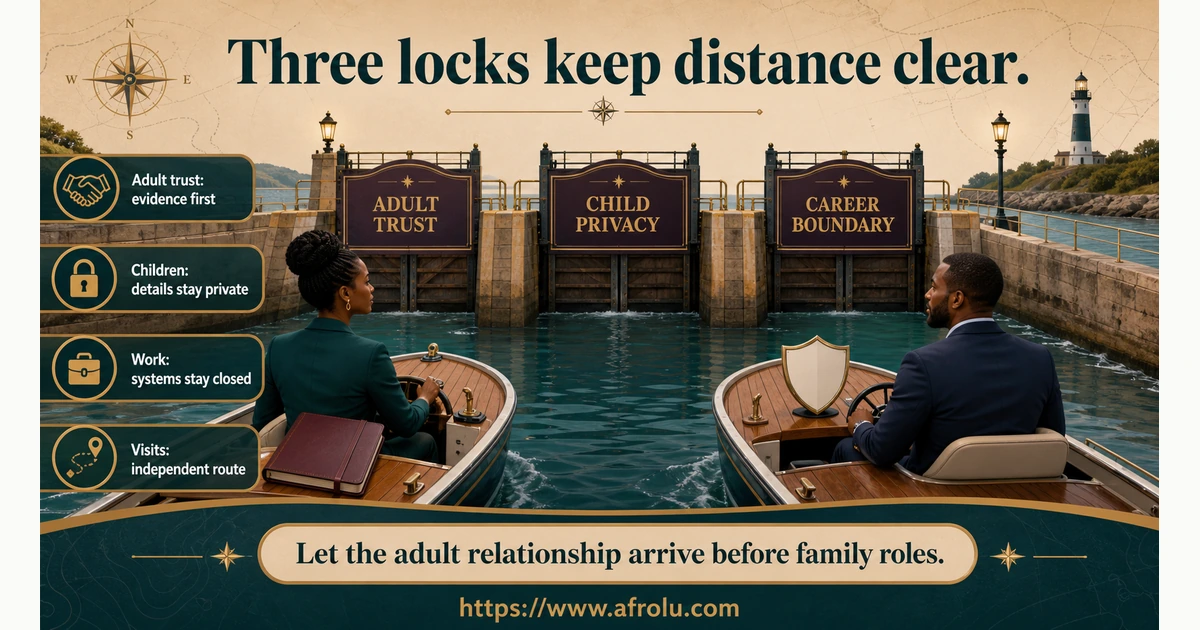
Let the adult relationship arrive before family roles.
Written and edited by Adwoa Boateng · Dating Safety Editor
Keep the first relationship channel adult. Separate long-distance geography, serious direction, present exclusivity, pace and any future family role. Use three locks: adult trust, child and home privacy, and career boundaries. Share broad availability but no child name, image, school, routine, health, location, custody material, employer system or detailed calendar. Meet as adults first in public with independent travel, lodging, money and return. Do not accept early care roles or send travel, device, family-emergency or investment money. After an eight-week adult cycle, review clarity, reliability, privacy, autonomy and repair; one strong pattern supports one adult next step, not automatic family access.
Distance and diaspora · Parents Returning To Dating
Can adult trust grow through clear intention, structure, rhythm and visits while every child, home, career and financial permission remains independently controlled?
Clear long-distance dating for working parents is an adult relationship maintained across geography while existing care and career responsibilities remain protected. A three-lock harbour separates adult trust, child and home privacy, and professional access so serious intention or exclusivity cannot silently create a family role, expose dependants or merge work and money.
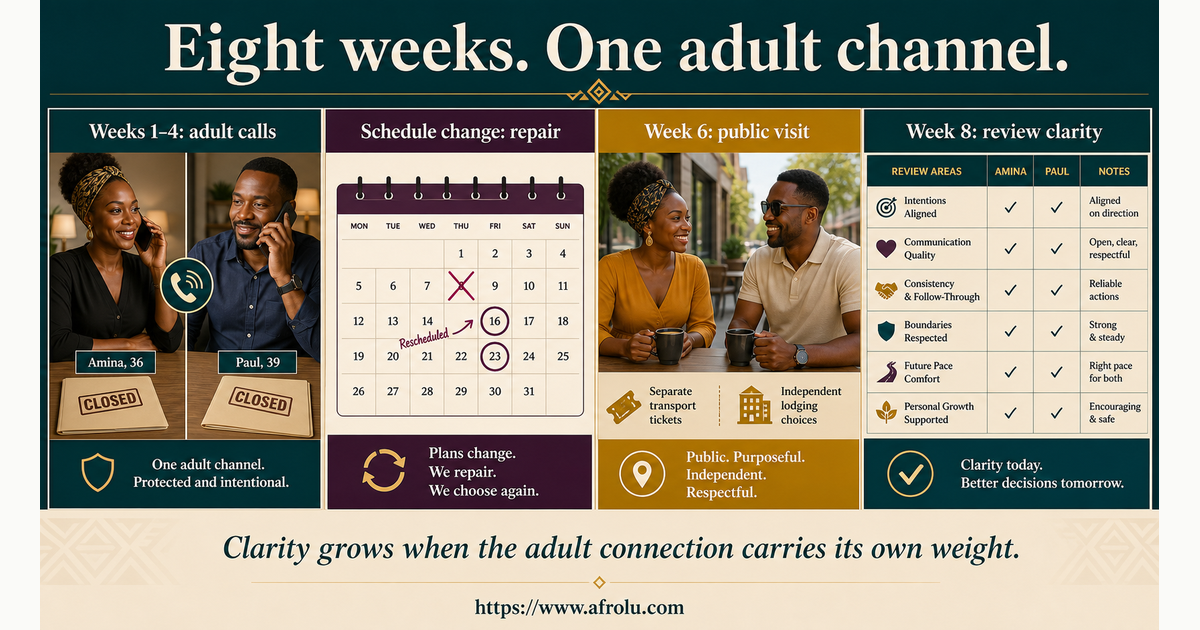
Amina and Paul are fictional working parents, 36 and 39, dating across cities. For eight weeks they use adult-only calls and share broad availability, not child or employer details. Amina repairs a family-related cancellation without disclosing private evidence. Paul funds his own adult-only public visit and lodging. They continue another cycle and discuss exclusivity while agreeing that family introduction and relocation remain separate future questions.
The three-lock distance harbour
Let adult trust cross cities without making dependants or careers carry it
Adwoa separates adult connection, child and home privacy, and professional systems before planning a visit or family future.
An eight-week adult channel builds evidence; five harbour buoys test clarity, reliability, privacy, autonomy and repair before another lock opens.
Adult trust
Define intention, structure, rhythm, consent and visits through direct adult conduct.
Child and home privacy
Keep names, images, routines, locations, contact and family roles closed.
Career boundary
Coordinate from broad capacity without employer, client or system access.
One adult next step
Continue, revise or close without making introduction the required outcome.
Keep the first channel adult
Parenting and career are responsibilities, not shortcuts to relationship structure
Long-distance dating for working parents connects two adult lives that already contain people and systems deserving care. School routines, custody or care arrangements, employment, housing, health, money and travel can all shape capacity. Those facts matter, but they do not decide what the adult relationship is. Distance describes geography. Serious describes a possible future direction. Exclusivity is a present agreement. Parent identifies an existing responsibility. A role in a child's life is a separate future decision.
Clarity begins by keeping the first channel adult. Learn through direct conversations and adult-only public meetings. Share broad availability rather than a child's name, image, school, routine, health, location or family conflict. Do not use children on calls to create intimacy or ask them to assess a match. A new adult relationship should be able to carry its own curiosity and evidence before it enters a child's world.
Career privacy deserves the same separation. Broad work windows may explain when calls and visits fit; employer systems, client details, income documents and exact routines are unnecessary. Parenting can make cancellations more likely, but it does not remove accountability. Give only the context needed, own the impact and offer a realistic alternative without exposing a child's private event as proof.
This page does not give custody, family-law, immigration, child-protection or employment advice. Family forms and legal responsibilities differ. Where an introduction, travel, relocation or care arrangement could affect a child, use the child's welfare, existing responsibilities and qualified local guidance rather than dating urgency. The early method here is deliberately smaller: make adult agreements clear, protect dependent people and systems, and expand one permission only after sustained adult evidence.
Navigate three protected locks
Move adult trust, child privacy and career access on separate controls
The adult-trust lock contains identity consistency, relationship intention, present structure, contact rhythm, public meetings, consent and repair. Ask what the two adults need to decide now. Video calls and ordinary public context can support a first meeting, but no single item proves a complete biography. Verification should remain proportionate and never require passwords, account access or a private dossier.
The child-and-home lock stays closed longer. It covers names, faces, voices, school, schedule, health, custody, care, address, photographs, digital contact and entry into the home. A parent may mention that care responsibilities shape availability without sharing identifying detail. An adult match has no entitlement to communicate with a child, provide gifts, collect them, photograph them or join a routine because the dating connection is serious.
The career lock includes employer and client information, internal calendars, credentials, devices, work locations, income records and professional contacts. Coordinate with broad windows. A remote partner can accept ‘I am unavailable during this block’ without receiving a screenshot. If work travel creates a meeting opportunity, keep the dating plan separate from confidential work and avoid using an employer booking or colleague as relationship verification.
Travel passes through all three locks only for the information it genuinely needs. An adult-only visit can proceed with public plans, suitable lodging, controlled money, documents, communication and return while family and work access remain closed. Nobody should rearrange a child's care, carry unexplained property, send urgent fare or rely on an unverified match for essential transport. A complete visit protects the adults and prevents a dependent person from carrying its risk.
Amina and Paul build adult evidence
An eight-week channel keeps children and workplaces out of early proof
Amina and Paul are fictional working parents, 36 and 39, living in different cities. They meet on an app and both say they are open to partnership. They have not agreed to exclusivity. For eight weeks they choose one scheduled adult video call, light messages and a review before any family introduction. They share only broad care windows and career fields. Children remain off calls and no school, custody, home or employer details are exchanged.
In week three, Amina needs to cancel a call because an unexpected family responsibility arises. She says she cannot talk, acknowledges the short notice and offers two adult times without sending medical or school evidence. Paul accepts Thursday. He does not ask which child, where they are or who else is involved. The next week, he takes responsibility for planning the call and keeps it.
They arrange an adult-only public visit in week six. Paul travels with funds and a return he controls and books his own accommodation. Amina chooses a staffed daytime venue and independent transport. Neither visits a home or workplace. A trusted person receives the useful itinerary at each adult's choice. The meeting can end early without affecting a child schedule or requiring either person to host.
At week eight, both want to continue and discuss exclusivity. They also agree that introductions are premature. Amina needs more evidence about conflict; Paul wants clarity about future geography. They choose another eight-week adult cycle. The relationship moves because its agreements grow more precise—not because children or careers are used to make the connection look established.
Read adult evidence and role pressure separately
A reliable dater is not automatically a safe family participant
Useful adult evidence is modest: identity details remain consistent, intentions can be discussed, public plans are completed, limits receive respect, money stays independent and repair changes conduct. This can support another date, a structure conversation or a second visit. It cannot answer how someone would behave around a child or within a household they have never responsibly known.
Role pressure may sound flattering. A match calls themselves a future parent, sends gifts for unnamed children, asks to join a school event or offers childcare before the adult relationship is established. Decline the role without debating their character. A caring adult can accept that family involvement follows a different timeline and that a child is not relationship evidence.
Career-role pressure can appear as rescue or convenience: an offer to manage a business, solve a relocation, contact an employer, share a device or combine money so visits become easier. Keep professional and financial decisions independent. A partner can support ambition through conversation while qualified advisers, official information and established workplace processes handle high-consequence choices.
Safety concerns are concrete conduct, not mere differences. Repeated identity contradictions, requests for child images or locations, secret contact, threats, surveillance, workplace intrusion, financial urgency or refusal to accept a no require stronger distance and appropriate support. Do not ask a child, colleague or family member to confront the person. Protect accounts and routes, preserve relevant evidence and use qualified local help.

Evidence of dating is not permission to enter a family system.
Use adult-only language
Coordinate intent, care windows, work, visits and money without exposing dependants
To name the adult relationship: ‘I am open to a lasting partnership, and I want us to define our present structure before discussing family roles.’ This separates future hope from current agreement. It allows a serious direction while the relationship remains non-exclusive or uncertain, and it prevents family language from manufacturing commitment.
To protect children and home: ‘My children are not part of early dating calls, photos, gifts or meetings. I will share only broad care availability for now.’ No apology is required. The boundary protects a child's privacy and prevents a new adult from becoming emotionally embedded before the adults have enough evidence to assess the relationship.
To protect work and scheduling: ‘I can offer Tuesday after eight or Saturday afternoon. My employer, detailed calendar and the family reason behind another block stay private.’ This gives two usable options and enough context to plan. If the other adult treats undisclosed detail as dishonesty, observe whether the relationship can respect purpose-limited information.
To plan travel and money: ‘Our first visit is adult-only, public and independently funded. We each control accommodation, documents, communication and return.’ A work trip does not provide automatic transport or lodging. Avoid loans, emergency transfers and unpaid care arrangements. Consent remains specific throughout, and either person can leave when the plan or facts change.

Name the adult plan and close the unrelated door.
Read five harbour buoys
Review clarity, reliability, privacy, autonomy and repair before widening the circle
Clarity asks whether geography, intention, structure and pace have compatible answers. Did either adult begin implying co-parenting, relocation or shared money without a conversation? Write what exists now and what remains unknown. A serious direction can be real while family involvement stays far away.
Reliability asks whether calls, visits and changes were handled with enough notice, ownership and reciprocity. Parenting will sometimes disrupt plans. The key is not perfect predictability; it is whether one adult always absorbs uncertainty and whether private child details are demanded as proof. Broad truthful context should be sufficient for ordinary repair.
Privacy and autonomy ask whether children, school, home, work, money, transport and consent remained controlled by the responsible adult. Did anyone use gifts, future-family language or travel spending to seek access? Could either person change an adult plan without exposing a dependent or risking employment? A warm relationship can pass this buoy while every family door remains closed.
Repair asks whether a missed agreement changed later conduct. Continue with one adult step when the pattern is sound. Revise a specific rhythm or travel imbalance when interest remains. Close when pressure targets dependants, systems, money or choice. Do not involve children in explaining the ending. Keep the boundary adult and use support suited to any safety concern.

Review the adult pattern before widening the circle.
Widen only after sustained adult evidence
A possible introduction is a separate family decision, not a dating milestone
If the adult relationship becomes sustained and a parent considers an introduction, first clarify the purpose. A brief hello, a recurring presence, a home visit and a caregiving role carry different consequences. Consider the child's circumstances, existing responsibilities, family guidance and the other relevant caregiver or legal arrangements where applicable. Use qualified local advice for questions with legal consequences.
Protect privacy before, during and after any contact. Decide what names, images, locations and relationship labels may be shared and whether photographs or online posts are prohibited. A child should not be asked to keep the dating relationship secret, report on another caregiver or provide reassurance to an adult. The parent remains responsible for observing adult conduct and managing boundaries.
Career and relocation decisions should also remain separate projects. A future move may involve employment, housing, education, care, health, support networks and law. Use current official information and qualified advice. Do not resign, transfer school information, combine money or change care arrangements because a rare visit created urgency.
If the relationship ends, close the adult channel without using a child as messenger or explanation. Revoke digital, home and workplace access that was explicitly granted, and protect private material. Where threats, stalking, child-focused contact or account compromise occurs, preserve evidence and seek platform, financial, workplace, child-protection, legal or emergency support appropriate to the facts and jurisdiction.
Eight parent-and-career distance moments where the adult channel matters
A parent offers availability without a child's schedule
Amina says Tuesday evening and Saturday afternoon work but does not explain school, care or custody details.
Use the adult options and leave the private family reason closed.A care disruption receives adult repair
A planned call is cancelled with short notice, an apology and two new times but no private evidence.
Judge ownership and follow-through rather than demanding family detail.A match asks to meet children on screen
After several warm calls, the adult says a quick introduction would prove that the connection is real.
Keep children off early dating calls and return to adult evidence.Generosity seeks a route into the family
A remote match requests a school address to send a surprise package.
Share no location and decline gifts or contact involving children.Professional travel is treated as a private visit
One adult assumes the other can use employer lodging and transport for a romantic weekend.
Separate the trip and build independently controlled dating plans.Early affection becomes unpaid family labour
A match proposes collecting a child or providing care so the adults can spend more time together.
Keep care roles closed and meet as adults only.Relocation hopes differ
Both adults want partnership but neither can move without major effects on children and careers.
Treat the difference as a project and compatibility question, not a demand for sacrifice.Adult evidence supports another cycle
Intent, calls, public travel, privacy and repair align while every child and work boundary remains intact.
Continue with one adult next step and keep family access separate.Evidence that adult trust can grow while dependants and work stay protected
{'label': 'Adult words', 'title': 'The relationship can be defined without family symbolism', 'detail': 'Intention and structure receive direct answers from the two adults.', 'reading': 'Clear adult channel'}
{'label': 'Privacy', 'title': 'Children remain outside early evidence', 'detail': 'No names, images, schools, routines or digital contact are requested.', 'reading': 'Protected dependants'}
{'label': 'Scheduling', 'title': 'Broad care windows are enough', 'detail': 'A match plans from available times without demanding the private reason behind them.', 'reading': 'Purpose-limited clarity'}
{'label': 'Work', 'title': 'Career systems stay closed', 'detail': 'Employer, clients, devices and detailed routines are not relationship proof.', 'reading': 'Professional autonomy'}
{'label': 'Meetings', 'title': 'Adults meet publicly first', 'detail': 'Home and family routines do not carry the first in-person evidence.', 'reading': 'Bounded access'}
{'label': 'Travel', 'title': 'Each adult controls essential logistics', 'detail': 'Money, documents, lodging, communication and return remain usable independently.', 'reading': 'Safe mobility'}
{'label': 'Roles', 'title': 'No partner or care title is assumed', 'detail': 'Future-family language does not appoint another adult inside a household.', 'reading': 'Accurate scope'}
{'label': 'Money', 'title': 'Affection does not fund dependency', 'detail': 'Visits, care, devices and emergencies do not produce urgent transfers.', 'reading': 'Financial protection'}
{'label': 'Repair', 'title': 'Family disruptions receive adult accountability', 'detail': 'Privacy remains intact while impact and alternatives are addressed.', 'reading': 'Reliable conduct'}
{'label': 'Pace', 'title': 'The circle widens through separate decisions', 'detail': 'Home, family, work and finances never open as one milestone.', 'reading': 'Proportionate growth'}
Move through each harbour lock without borrowing permission
| Situation | What it may mean | What to do next |
|---|---|---|
Scripts for adult intent, children, scheduling, work, visits and money
“I am open to partnership, and I want to define our adult relationship before any family role.”
“Have we agreed to exclusivity, or are either of us still dating others?”
“My children are not part of early calls, photos, gifts or meetings.”
“I can offer Tuesday evening or Saturday afternoon; the family details behind other times stay private.”
“I share my career field, not my employer systems, clients or detailed calendar.”
“Our first visit will be adult-only, public and independently funded.”
“I am not opening my home; we can choose a staffed public place.”
“I do not send travel, care, device or emergency money in a new connection.”
“Relocation and family roles are projects, not promises we can make on this visit.”
“The pressure for family access means I am ending adult contact.”
Know the difference
The five-lock working-parent distance map

Use one label for one fact and one permission for one consequence.
Compare distance, serious direction, exclusivity, parent identity and family role
| Type or dimension | What it describes | Best next question |
|---|---|---|
| Long-distance | ||
| Serious | ||
| Exclusive | ||
| Parent | ||
| Family introduction | ||
| Care role | ||
| Career move | ||
| Adult-only visit |
Build the three-lock distance harbour in six moves
Define the adult channel
Close family data
Close career systems
Plan an adult-only visit
Observe role pressure
Review before widening
Questions organised by adult channel, privacy, visits and harbour review
Choose a few prompts that fit the moment. This is a reference library, not a list to complete.
Adult-channel questions
Define the relationship without family symbolism.
- What is our intention?
- Are we exclusive?
- What rhythm fits care and work?
- Which future questions remain open?
- When will we review?
Privacy questions
Keep dependants, homes and systems outside early proof.
- Which child details stay closed?
- Is broad availability enough?
- Are homes private?
- Which work systems stay closed?
- Can photos remain unshared?
Visit questions
Make adult travel complete and independent.
- Is the plan public?
- Who controls lodging?
- Are funds independent?
- Does return work?
- Are children unaffected?
Harbour questions
Review before another lock opens.
- Is adult clarity growing?
- Are plans reliable?
- Did privacy hold?
- Could both adults choose?
- Do we continue, revise or close?
What relationship, child-privacy, work and consumer sources can support
Distance alone does not determine relationship quality
A nationally representative U.S. study compared long-distance and close-proximity relationships and found no simple distance verdict. Afrolu uses that limited lesson while asking parents to assess their own agreements and constraints.
Evidence limit: The 2013 findings cannot predict an individual couple or represent every working-parent and African context.
Children have a recognised right to privacy
Article 16 of the United Nations Convention on the Rights of the Child addresses privacy, family, home and correspondence. Keeping identifying details out of early dating is a cautious practical application.
Evidence limit: A treaty text does not decide a specific family, safeguarding or legal question; use qualified local guidance.
Children's data deserves strong safeguards
Kenya's Office of the Data Protection Commissioner guidance emphasises privacy, best interests, minimisation and protection for organisations processing children's data. Parents can still use the conservative principle of sharing less in dating.
Evidence limit: The guidance addresses regulated processing; this page does not determine its application to private household activity.
Schedules shape work-life balance
The International Labour Organization reviews working hours and arrangements globally. Parenting and work capacity should be planned from actual responsibilities, not a universal contact formula.
Evidence limit: The report cannot determine an individual's safe workload, parenting plan or relationship compatibility.
Remote trust may be followed by urgent payment stories
The U.S. Federal Trade Commission describes romance-scam requests involving emergencies, travel and investment. Do not route family or essential funds through an unverified connection.
Evidence limit: U.S. reporting routes and remedies vary elsewhere; contact the relevant provider and local authority.
Relationship and family language do not create consent
NHS public-health guidance describes active consent and the ability to withdraw it. Serious direction, exclusivity, parent identity and travel never replace a present personal answer.
Evidence limit: The source explains UK context; legal definitions and support routes differ by jurisdiction.
Six shortcuts that make dependants carry dating risk
Use a reviewed resource that matches the decision
This guide focuses on the relationship decision, so it does not rank dating apps. Check current prices, safety tools, and local availability before choosing a service.
Explore the guide library
Show more related guides
Continue with Afrolu
Show more Afrolu guides
Research and official guidance used for this three-lock harbour
Afrolu reviewed these health, research, safety, or public guidance resources while editing this page. They support the behaviour and safety guidance; they do not diagnose any individual described by a reader.
Working-parent long-distance clarity questions
When should a long-distance match meet my children?
There is no universal number of weeks. First establish sustained adult evidence and clarify the purpose and scope of any introduction. Consider privacy, welfare, existing care or legal responsibilities and how contact can end cleanly. A serious label, exclusivity or travel does not create a right to meet a child.
What may I say about my parenting schedule?
Share broad availability: for example, Tuesday evening or Saturday afternoon. You do not need to disclose a child's name, school, location, health, exact routine or custody material to explain another block. A respectful adult can coordinate from the options offered.
Should children join early video calls?
Keep the early evidence channel adult. Children should not be used to verify identity, seriousness or family fit. Avoid sharing their face, voice, name, school or location with a new match. Later contact, if considered, is a separate family decision with its own purpose and safeguards.
Can working parents maintain a clear long-distance rhythm?
Yes. Choose a modest cadence around actual work and care, include a method for changed plans and set a review point. Reliability means truthful updates, ownership, alternatives and reciprocal effort—not exposing the private family event behind every cancellation.
Does dating a parent mean accepting a future parenting role?
No. Parent describes one adult's existing responsibility. A role for another adult is a separate high-consequence decision. Dating, exclusivity, gifts and future-family language do not appoint a caregiver, co-parent, provider or household member.
How should work travel be handled in a distance relationship?
Keep employer travel and private dating plans distinct. Do not expose confidential itineraries, colleagues or work-funded lodging. If meeting is allowed and freely chosen, create public plans, personal communication, controlled money and a return that does not depend on the match.
Should I accept money or childcare help from a new match?
Early financial and care dependency can create leverage and family access before enough evidence exists. Keep essential costs and established care arrangements independent. Never send urgent travel, device, school, emergency or investment money to prove commitment.
What if we are serious but neither parent can relocate?
Treat geography as a project and compatibility question. Relocation can affect employment, housing, education, care, health, support networks and law. State present constraints honestly and use current official information and qualified advice. Love cannot guarantee that a move is feasible or right.
How do we discuss exclusivity without involving children?
Keep the conversation between adults. Define whether either dates others and what relevant sexual-health disclosure is expected. Exclusivity concerns present adult structure; it does not require a child introduction, public family label, home access or contact with another caregiver.
What should happen if a match contacts my child or school secretly?
Treat unauthorised child-focused contact as a serious change in the facts. Stop access, preserve relevant evidence and tell appropriate trusted or responsible adults without asking the child to confront the person. Seek platform, school, child-protection, legal or emergency support suited to the conduct and jurisdiction.
One thing to do now
Let sustained adult conduct—not a child or career system—carry the relationship
Keep adult relationship evidence, dependant privacy and career systems behind separate locks. Continue when intentions and structure are clear, adult plans are reliable and every protected boundary remains usable. Revise rhythm or travel one part at a time. Close when dating seeks child contact, home or work access, unpaid care, provider status, surveillance, money or pressure that reduces adult or dependant safety.