Three horizons for one truthful distance start
Start Long-Distance Dating Casually Without Hiding Serious Hopes
A new-journey long-distance guide separating casual present scope from serious future hopes, with privacy, money, visits, health and consent.

Name NOW, NEXT and POSSIBLE FUTURE as three different answers.
Written and edited by Tariro Ncube · Diaspora Dating Editor
Write three separate answers: NOW names the current open, bounded, focused or exclusive structure; NEXT names one ordinary question that conduct can answer; POSSIBLE FUTURE names partnership, location or another option with conditions. Agree contact, repair, privacy and material disclosure now. Keep accounts, money and travel independently controlled. Discuss current sexual-health facts before intimacy and ask for a specific present answer. Review accuracy, burden and pressure after four weeks, then stay, adjust, pause or close. Future seriousness never overrules the present.
Distance and diaspora · New Relationship Starters
How can both adults honour serious future hopes while keeping today's casual long-distance structure accurate, respectful and free from borrowed exclusivity or pressure?
Three-horizon long-distance dating is an arrangement in which a casual present structure, the next evidence-gathering step and serious future possibilities are separately named, independently controlled and changed only through fresh evidence and two free answers.
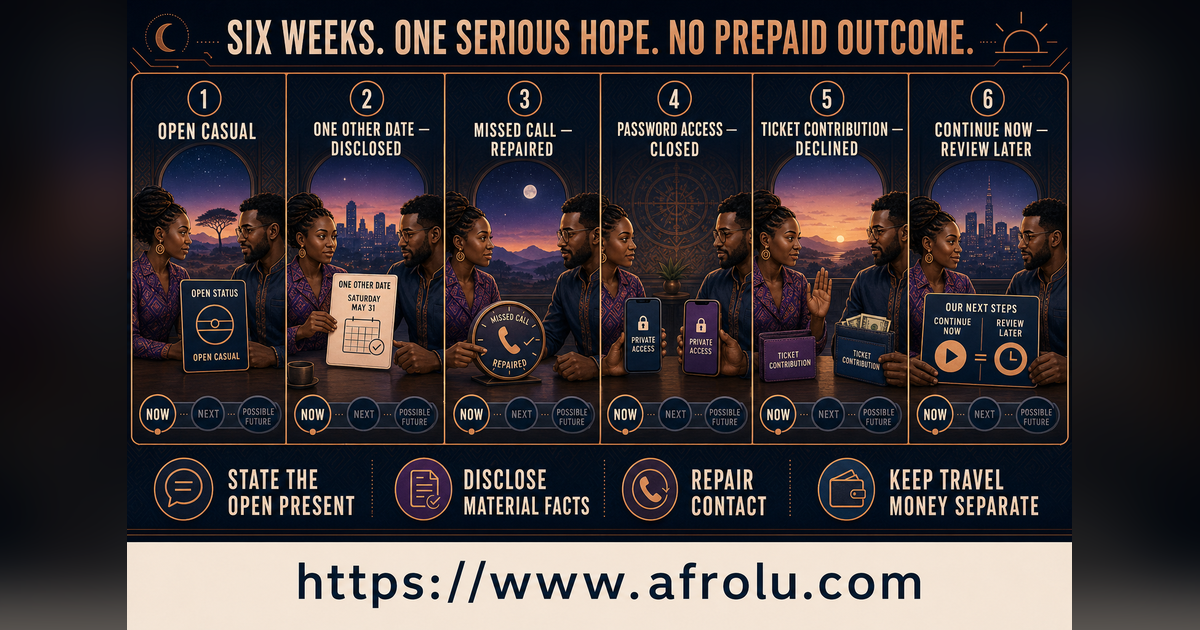
Lindiwe and Jabari are fictional adults, 30 and 33. Six weeks of open casual distance dating, timely other-date disclosure, one repaired call, a declined ticket contribution and an unchanged status show serious hope surviving because it does not borrow present commitment.
The three-horizon distance chart room
Give the casual present and serious future two different sentences
Tariro follows Lindiwe and Jabari through open status, another-date disclosure, repaired contact, a money boundary and an unbooked visit.
Three horizontal bands prevent future hope from silently purchasing exclusivity, financial support, travel or physical access now.
NOW
Name status, disclosure, contact, privacy and money boundaries.
NEXT
Choose one bounded question that ordinary conduct can answer.
POSSIBLE FUTURE
Keep exclusivity, partnership and location conditional.
Exit
Preserve stay, adjust, pause and close without moral ranking.
Separate three different questions
Geography, present structure and future intention are independent coordinates
A new journey can contain serious long-term hopes and a casual present without contradiction. The contradiction appears only when one adult hides, moralises or silently upgrades one line. Casual should describe a bounded current structure. It should not mean careless, dishonest, sexually available, emotionally disposable or exempt from health and consent conversations.
Serious hope should describe a future orientation, not a claim that this connection will become partnership. Lindiwe may want a committed relationship eventually while dating Jabari openly today. Jabari may share that goal while needing months of ordinary evidence. Their mutual hope matters, but it cannot perform an exclusivity conversation or create duties neither has accepted.
Geography adds communication and travel decisions. Remote contact can carry genuine intimacy while presenting selected moments. Keep accounts, location, images, money and daily functioning independently controlled. Define which channels fit logistics, reflection and complex conversation. Frequent calls may be enjoyable without becoming attendance monitoring or proof that another date is forbidden.
Write three sentences: 'Now we are choosing...', 'Next we need evidence about...', and 'A possible future could be... if...'. Include a review date and four outcomes. If relevant other dating or sexual contact could affect health or consent, discuss it before that choice. Warmth stays honest when the present is specific and the future remains conditional.
Use three horizontal horizons
NOW contains agreement, NEXT contains evidence and POSSIBLE FUTURE contains options—not promises
NOW records present status, outside dating, ordinary contact, privacy and money boundaries. If the arrangement is open casual distance dating, say what open means and when another connection becomes material. Clarify whether either person is personally focusing on one match without turning that private choice into a shared restriction.
NEXT records bounded questions that ordinary conduct can answer: Does contact repair after a missed plan? Does a privacy boundary remain safe? Can two adults plan a visit without financial dependence? Are current health facts discussed before intimacy? Each item needs an observation period, a consequence and an option not to advance.
POSSIBLE FUTURE contains exclusivity, partnership, more frequent visits, a shared city or another desired arrangement. State dependencies and advice needs. A future location decision may involve work, family, immigration, housing, money and law; this guide cannot settle those systems. Keep both adults able to postpone or choose a different destination.
Items can also move back. A capacity change may return exclusivity discussion to open dating. A travel problem may postpone a visit without ending the connection. A direction mismatch may close the relationship even when the casual present was enjoyable. A reversible chart is more serious about reality than a romantic timeline that treats every step as inevitable.
Watch three horizons survive a real week
Lindiwe and Jabari keep future hope intact by refusing to overstate the present
Lindiwe, 30, lived in Johannesburg and was starting to date again after a deliberate break. Jabari, 33, lived in Kampala. Both hoped eventually for partnership. They chose six weeks of open casual distance dating, one planned call most weeks, no instant-reply rule, no money transfers and a review before exclusivity or travel.
In week two, Lindiwe accepted another local date. Before it became relevant to health or their spoken arrangement, she told Jabari. He noticed disappointment without claiming betrayal. They confirmed that open meant both could date others and that either could request a status conversation later. Honest feeling did not create a retroactive rule.
Jabari missed a call in week four and repaired it the next evening. Later, he found a discounted ticket and asked whether Lindiwe could contribute immediately. She declined, saying they had not completed visit purpose, budget, accommodation, movement, health or cancellation. He let the price expire, retained his own travel plan and did not question her serious future intent.
At six weeks, both still wanted partnership someday but kept open casual status. They added one next-horizon task: design a possible public first visit without booking. The outcome was neither failure nor promotion. Their NOW became more accurate, NEXT became specific and POSSIBLE FUTURE remained worth discussing because it had not been forced.
Read four zones in three states
Present, contact, visit and future signals stop one horizon from hiding a risk in another
At present, continue means both name the same open, focused or exclusive structure and material facts arrive in time. Review means feelings or frequency are carrying an assumption. Stop means outside dating is concealed when relevant, exclusivity is imposed retroactively or casual language is used to dismiss dignity, health or consent.
At contact, continue means useful channels, normal delay and repair. Review means time zones or capacity need redesign. Stop means surveillance, password demands, punishment for offline time or chronic disappearance paired with claims on loyalty. Future seriousness does not require constant proof, and casual status does not excuse unowned disruption.
At visit, continue means purpose, independent funds, movement, accommodation, health and cancellation. Review means one dependency can be redesigned. Stop means urgency, debt, controlled documents, unsafe lodging, restricted movement or travel pressure tied to affection. The FTC's romance-scam examples reinforce refusing urgent money, but local providers and authorities must fit the actual situation.
At future, continue means options are mutual, conditional and supported by ordinary evidence. Review means timelines, cities or definitions differ. Stop means partnership, relocation or marriage is declared for one adult or used to override present boundaries. When threats, financial manipulation, stalking, coercion or immediate danger appears, protect safety and use suitable professional or emergency support.

Read the zone under strain and never use future hope to cancel a present stop.
Give each sentence a horizon
Twelve direct lines keep casual present scope and serious future hope from contaminating each other
NOW status: 'I hope for partnership eventually and am choosing open casual dating now.' NOW disclosure: 'Before another connection affects health or consent, I will tell you.' NOW privacy: 'My messages, accounts and location stay separately controlled.' NOW money: 'I do not send emergency, investment or travel funds through dating.'
NEXT contact: 'One planned call most weeks works, with normal delays.' NEXT repair: 'If a call changes, acknowledge it and offer a realistic return.' NEXT visit: 'We can design a visit without booking it.' NEXT health: 'Before relevant intimacy, let's discuss current partners, testing, prevention and care.'
POSSIBLE FUTURE exclusivity: 'I may want exclusivity later; it is not our status now.' Partnership: 'I am open to building partnership if ordinary evidence fits.' Location: 'I am not promising relocation; we can compare real options later.' Consent continuity: 'No future label changes the need for a current answer.'
If the other adult responds with a different but clear answer, decide fit rather than trying to out-argue it. If a boundary triggers shame, surveillance, payment pressure or threats, move the pressured action to stop. Prepared language is not a guarantee; it makes conduct after the sentence easier to observe.

Say which horizon each sentence belongs to before asking for an answer.
Review NOW before moving to NEXT
Accuracy, ordinary evidence, burden and pressure show whether the present arrangement deserves change
Accuracy asks whether both adults still describe the same status, outside dating, contact and privacy boundaries. Compare words with lived conduct without turning the review into device inspection. If one adult says open while punishing another date, or says casual while claiming partner access, the present requires correction before any later horizon is discussed.
Ordinary evidence includes planned calls, delay, repair, relevant disclosure and safe responses to no. Include humour and tenderness, but examine whether those qualities survive inconvenience. Long-distance communication research suggests mediated interaction and idealisation can shape intimacy; it cannot tell you whether this person is suitable or whether more contact is always better.
Burden includes inconvenient hours, data costs, planning labour, emotional uncertainty and prospective travel. Pressure includes jealousy, public status, sex, gifts, tickets, urgent money and fear of losing a serious future. Ask what each adult would choose if there were no sunk costs and no need to defend the casual label to anyone else.
Stay NOW when the present remains accurate and useful. Adjust NOW when one contact or disclosure feature needs testing. Pause for missing identity, health, travel, money or capacity facts. Close when goals, needs or safety cannot fit. Move one item to NEXT only when both explicitly choose it; do not promote the entire relationship as a reward for tolerating ambiguity.

Review NOW honestly before moving anything into NEXT.
Compare eight arrangements on one level
Casual and serious describe different dimensions, so neither belongs above the other
Conversation is exploratory contact before recurring dating exists. Open casual distance dating adds recurring romantic contact while both may date others. Bounded casual dating adds an agreed period, rhythm and review. Each can coexist with serious future hopes when those hopes are stated as personal direction rather than a promise about this pair.
Slow casual distance dating limits frequency or escalation while preserving clarity. One-person focus describes an individual attention choice without claiming mutual exclusivity. These arrangements may look similar from outside. The distinction comes from the agreement, material disclosure and whether an adult can request a change without the other rewriting history.
Exclusive distance dating means both stop the outside dating or sexual contact they define. Partnership planning adds shared future work but does not automatically merge money, location, home or accounts. A serious future label never removes current health conversations or consent. Each larger responsibility needs its own evidence and two answers.
Closure ends dating or contact because desire, direction, capacity, fit or safety does not support continuation. It need not prove that the casual beginning was dishonest. Compare every arrangement by whether NOW is accurate, disclosure is timely, visits are independently controlled and the future stays conditional. If those cannot coexist, use a smaller structure or leave.
Eight long-distance moments where serious hope and casual scope can silently trade places
Partnership hope is heard as present exclusivity
A possible destination silently rewrites NOW.
Restate the casual structure and ask directly about change.Jealousy appears inside an open agreement
A feeling is used to invent a retroactive rule.
Name the feeling and keep the existing status until two answers change it.Serious hope creates a demand for proof
Ordinary delay becomes location or account surveillance.
Ask for repair while keeping systems private.Casual is treated as permission to share
A personal image is circulated without chosen audience.
Close the share and state privacy directly.A price deadline replaces relationship review
One adult is asked to fund travel immediately.
Let the fare go and complete visit planning first.Casual is used to avoid a relevant conversation
Other partners or prevention would affect consent.
Discuss current facts before intimacy.One adult wants NEXT and the other wants NOW
The mismatch is real even when future goals are similar.
Choose a bounded review or close without pressure.A serious future becomes one adult's assignment
City choice is declared before practical evidence and advice.
Return it to a conditional future option.Signals across present, contact, visit and future zones
Both adults can state serious future hopes without calling the present more committed than it is.
The open, bounded, focused or exclusive status is directly shared rather than inferred from call intensity.
Other dating and relevant sexual-health facts arrive before they affect consent or the agreement.
Contact rhythm includes asynchronous options, normal delay and repair after a missed plan.
Messages, images, accounts and location remain privately controlled despite distance or jealousy.
Money, investments, emergencies and travel funds do not become tests of a serious future.
A possible visit retains independent budget, movement, accommodation, health and cancellation.
Every physical answer remains specific and current whether the present is casual or exclusive.
Future partnership, location and relocation are conditional options supported by ordinary evidence.
Stay, adjust, pause and close remain available without moralising either serious or casual language.
Choose the next horizon through ten bounded questions
| Situation | What it may mean | What to do next |
|---|---|---|
| Is NOW described the same way? | Fits: Present status and exclusions are shared. Needs review: Intensity or hope carries an assumption. Stop: Exclusivity or partner access is claimed retroactively. | Return to the smallest mutual present. |
| Are other connections disclosed in time? | Fits: Material facts precede health and consent choices. Needs review: The disclosure rule needs detail. Stop: Open status is used to conceal relevant facts. | Pause the affected action and clarify. |
| Does contact survive disruption? | Fits: Delay and repair are usable. Needs review: Capacity or time zones need redesign. Stop: Silence or surveillance controls one adult. | Adjust contact or reduce access. |
| Does privacy remain independent? | Fits: Images, accounts and location have chosen purposes. Needs review: One proposed share needs discussion. Stop: Passwords, tracking or exposure are demanded. | Close access and protect the system. |
| Is money outside future proof? | Fits: Funds and consequential claims stay separate. Needs review: One shared cost needs a cap. Stop: Urgency or investment pressures payment. | Do not transfer and verify independently. |
| Can the visit be cancelled? | Fits: Purpose, movement, lodging and funds have alternatives. Needs review: One dependency needs redesign. Stop: Documents, money, movement or lodging are controlled. | Postpone or seek immediate support. |
| Are health and consent current? | Fits: Relevant facts and each answer precede action. Needs review: Conversation or care remains incomplete. Stop: Casual, serious, tickets or gifts override no. | Pause or stop the pressured action. |
| Is NEXT a bounded question? | Fits: Evidence and consequence are named. Needs review: The test is vague or too large. Stop: Advancement is demanded to preserve affection. | Shrink the test or stay NOW. |
| Is the future conditional and mutual? | Fits: Options, constraints and reviews are explicit. Needs review: Timelines or places differ. Stop: Partnership or relocation is assigned to one adult. | Reset the future or close the mismatch. |
| What does twenty-eight days support? | Fits: NOW remains accurate and useful. Needs review: One bounded adjustment merits testing. Stop: Need, pressure or safety cannot fit. | Stay, adjust, pause or close. |
Twelve lines for NOW, NEXT and POSSIBLE FUTURE
“I hope for partnership eventually and am choosing open casual dating now.”
“Before another connection affects health or consent, I will tell you.”
“My messages, accounts and location stay separately controlled.”
“I do not send emergency, investment or travel funds through dating.”
“One planned call most weeks works, with normal delays.”
“If a call changes, acknowledge it and offer a realistic return.”
“We can design a visit without booking it.”
“Before relevant intimacy, let's discuss current partners, testing, prevention and care.”
“I may want exclusivity later; it is not our status now.”
“I am open to partnership if ordinary evidence fits.”
“I am not promising relocation; we can compare real options later.”
“No future label changes the need for a current answer.”
Know the difference
Present status, disclosure, visit access and future conditions remain independent
Names the casual present, shares material facts, tests ordinary remote conduct and keeps travel, exclusivity, partnership and location separately conditional.
Uses serious hope to claim loyalty, money or travel while using casual language to avoid repair, health information, dignity or current consent.
Choose the smallest arrangement that remains accurate after another date, a missed call, a money boundary and an optional visit.

Choose the smallest arrangement that both adults can describe without borrowing a future.
Compare eight arrangements without ranking serious over casual
| Type or dimension | What it describes | Best next question |
|---|---|---|
| Conversation | Exploratory contact before a recurring distance-dating arrangement exists. | Enough context for bounded dating |
| Open casual distance dating | Recurring romance while both may date others and share material facts in time. | Comfort with the spoken open structure |
| Bounded casual dating | A defined period, rhythm and review without automatic exclusivity. | Ordinary evidence across disruption |
| Slow casual distance dating | Contact or escalation is intentionally limited without removing clarity or repair. | Enough information at the chosen pace |
| One-person focus | One adult concentrates attention without claiming a mutual restriction. | A direct two-adult status conversation |
| Exclusive distance dating | Both define stopped outside dating; privacy, money, visits and consent stay separate. | Reliable agreement and repair |
| Partnership planning | Shared future work begins without promising location or merging systems. | Practical fit and qualified advice |
| Closure | Dating or contact ends when desire, direction, capacity, fit or safety cannot align. | A clear boundary and suitable support |
Build three-horizon long-distance clarity in six moves
Name three answers
Write NOW, NEXT and POSSIBLE FUTURE without letting one replace another.
Keep casual specific
Define status, disclosure, contact, privacy, money and review.
Keep serious conditional
State future direction without assigning this pair an outcome.
Test ordinary remote conduct
Read delay, repair, other-date disclosure and boundary responses.
Design before booking
Separate visit purpose and logistics from relationship promotion.
Protect four outcomes
Stay, adjust, pause or close at every horizon.
Questions for present scope, next evidence, future options and pressure
Choose a few prompts that fit the moment. This is a reference library, not a list to complete.
NOW questions
Make the casual present complete and accurate.
- What is our status now?
- May either person date others?
- What must be disclosed?
- Which access stays closed?
- When will we review?
NEXT questions
Turn uncertainty into bounded evidence.
- Which conduct needs observing?
- How will a missed call repair?
- Can we design without booking?
- Which health facts matter?
- What happens if the test fails?
FUTURE questions
State serious hope without assigning an outcome.
- Which partnership is desired?
- What could exclusivity mean?
- Which cities are possible?
- What advice would be needed?
- Can either answer remain no?
Pressure questions
Keep horizon movement free.
- Has money created urgency?
- Is jealousy inventing a rule?
- Is privacy being traded for proof?
- Does travel restrict exit?
- Which support fits the facts?
What commitment, distance, fraud, account, health and consent sources support
Dedication and constraints help separate intention from lock-in
Peer-reviewed commitment scholarship distinguishes desire to maintain and improve a relationship from forces that make leaving costly. It supports keeping serious future hope separate from money, travel or public constraints in a casual present.
Evidence limit: The theoretical work does not diagnose a relationship or prescribe one ideal progression.
Remote intimacy may involve adaptation and idealisation
Peer-reviewed research examined communication media, intimacy and idealisation in long-distance relationships. It supports treating mediated closeness as meaningful while still gathering ordinary evidence and planning in-person logistics carefully.
Evidence limit: The study cannot verify a match or set one correct contact rhythm.
Distance and future talk can accompany urgent requests
The U.S. Federal Trade Commission describes patterns in which a remote contact builds trust and requests money for travel, emergencies or investments. Refusing payment and checking independently are proportionate responses.
Evidence limit: Examples and reporting paths are U.S.-specific; use relevant local banks, platforms and authorities.
Private controls matter even inside an affectionate connection
CISA's Secure Our World guidance recommends strong passwords, multifactor authentication, phishing awareness and updates. Those practices keep remote dating from opening accounts or recovery channels.
Evidence limit: Security practices reduce digital risk but cannot guarantee identity or personal safety.
Casual and serious arrangements both require respectful wellbeing
The World Health Organization frames sexual health around physical, emotional, mental and social wellbeing, respect, safety and freedom from coercion. Present labels cannot replace relevant information or qualified care.
Evidence limit: The framework is not individual medical advice or a testing recommendation.
Every horizon preserves a current specific physical answer
NSW Government guidance describes consent as voluntary, communicated, ongoing, specific and withdrawable. Casual status, exclusivity, tickets and serious future plans do not change those properties.
Evidence limit: Legal definitions and services vary; use appropriate local professional or emergency support.
Six ways serious hope and casual scope become misleading
Borrowing exclusivity from hope
A serious goal silently changes NOW. Repair: name the present status directly.
Using casual to avoid duty
Repair, disclosure or consent is dismissed. Repair: make the bounded obligations explicit.
Treating jealousy as a rule
A feeling retroactively prohibits other dating. Repair: request a future status conversation.
Monitoring the distance
Accounts or location become proof. Repair: protect systems and evaluate ordinary repair.
Funding NEXT
A ticket deadline forces advancement. Repair: let the price go and design the visit first.
Promising location
A future city is assigned before practical evidence. Repair: restore conditions and advice needs.
Use a reviewed resource that matches the decision
This guide focuses on the relationship decision, so it does not rank dating apps. Check current prices, safety tools, and local availability before choosing a service.
Explore the guide library
Show more related guides
Continue with Afrolu
Show more Afrolu guides
Peer-reviewed commitment and distance research plus official fraud, security, health and consent sources
Afrolu reviewed these health, research, safety, or public guidance resources while editing this page. They support the behaviour and safety guidance; they do not diagnose any individual described by a reader.
Serious-hope casual long-distance dating questions
Can a long-distance connection be casual now and serious in intention?
Yes. Casual describes the present structure; serious intention describes a future an adult is open to. State both. Define whether dating is open, what disclosure is material, what contact is expected and when to review. Neither hope nor intensity creates exclusivity, travel duties, financial support or physical consent.
Does casual long-distance dating mean low responsibility?
No. It can be bounded and respectful. Keep status accurate, disclose other connections before they affect health or consent, repair missed plans, protect privacy and funds, and accept no. Casual does not mean secret, careless, sexually available or emotionally disposable. It means the present commitment scope is limited and explicitly described.
How should we handle jealousy in an open casual arrangement?
Name the feeling without rewriting the agreement. Ask whether either adult wants a future status conversation and what would change. Until two people agree, keep the existing structure. If jealousy leads to tracking, account demands, threats or punishment, protect private systems, reduce access and use suitable support for the actual safety facts.
How often should we communicate?
Choose a rhythm both adults can sustain across time zones, work, sleep and offline life. Include planned calls, asynchronous options, normal delay and repair. More contact is not automatically more serious or honest. If one adult needs more frequency, discuss fit instead of using future partnership hopes to impose an attendance rule.
Should we share passwords or live location because we are far apart?
No present or future label requires credentials or continuous tracking. Use strong unique passwords, multifactor authentication and private recovery. A temporary voluntary location share for one journey is different and can be declined or stopped. Pressure or retaliation after refusal is evidence to reduce access and seek appropriate support.
Can one person help pay for the first visit?
Cost sharing is a later choice, not proof of serious intent. Early travel is easier to cancel when each adult controls essential funds and has alternatives for movement and accommodation. Do not send urgent emergency, investment or ticket money through a new connection. Verify consequential claims independently and let a price expire rather than force timing.
When should we discuss sexual health?
Before relevant intimacy or a visit where intimacy may be considered. Discuss current partners, testing, prevention, boundaries and qualified care. Open casual status makes timely material disclosure especially important, but no label answers the health question. Share what the decision needs and seek a current specific answer for every physical act.
When should we consider exclusivity?
When both want a shared change in outside dating or sexual contact and enough ordinary evidence supports it. Define exactly what stops, when disclosure is needed and when to review. Do not infer exclusivity from future hope, jealousy, frequent calls, one-person focus or a booked visit. Other access remains separately controlled.
How do we talk about relocation without making a promise?
Place it in POSSIBLE FUTURE with conditions. Compare cities, careers, family needs, housing, money, legal advice and the ordinary evidence needed before another review. Neither adult should surrender work, documents or essential funds to prove intention. A future conversation may lead to another visit, a different arrangement or closure.
How do we decide after the first month?
Review whether the present status is accurate, material disclosure is timely, contact repairs, privacy and money stay controlled, and future talk remains conditional. Stay at NOW, adjust one bounded feature, pause for missing identity, health, travel or capacity facts, or close when goals, fit or safety cannot align. Promotion is not the only positive outcome.
One thing to do now
Keep NOW truthful and let evidence decide what moves to NEXT
Stay at the present horizon when status, disclosure, contact, privacy and money remain accurate. Adjust one feature when evidence supports a bounded test. Pause for missing identity, health, travel, financial or capacity facts. Close when goals or needs differ, or deception, surveillance, financial manipulation, restricted movement, coercion or retaliation appears. Move forward only through explicit mutual choice.