Six boundary docks for one leaveable remote bond
Keep Casual Long-Distance Dating Safe Later in Life
A later-life casual long-distance guide to scope, verification, contact, money, travel, lodging, documents, consent, family privacy and post-visit review.

Give each remote step its own purpose, evidence and route back.
Written and edited by Jean-Claude Mukendi · Relationship Guides Editor
Separate casual relationship scope from long-distance logistics, then use six docks: identity, contact, money, meeting, consent and exit. Verify material claims without trading documents, agree a sustainable contact rhythm, fund essential travel and lodging independently, protect home, family, accounts and records, ask again about every image and physical act after arrival and review only after both adults return to ordinary life. Repeat, revise, deepen or close from the record.
Distance and diaspora · Late Entrants
What can a casual long-distance connection include now, and how can every remote or travel step preserve independent systems and a route home?
Later-life casual long-distance dating is a mutually understood low-commitment romantic arrangement across locations, with contact, dating-others, visits, sexual-health expectations and every form of home, family, financial, digital, document and physical access explicitly separate.
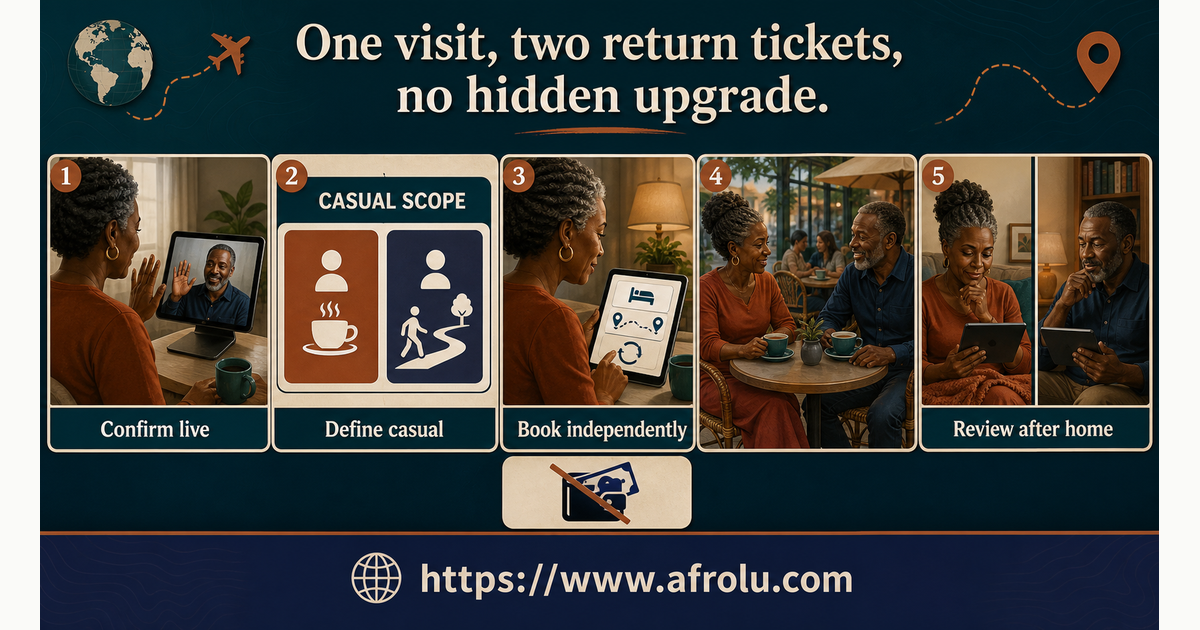
Rose and Kwesi are fictional adults, 51 and 56. They use remote verification, an explicit casual scope, independently booked travel and lodging, a declined money request and a post-visit review to decide on another visit without choosing exclusivity.
The six-dock later-life distance boundary port
Let remote warmth arrive without tying every established-life system to it
Jean-Claude separates identity, contact, money, meeting, consent and exit, then tests the port through one independently planned visit.
The harbour follows a casual-scope talk, five system firewalls and a post-return six-record review with four equal routes.
Identity
Verify only the claim material to the next decision.
Contact
Name a remote rhythm that leaves both established lives intact.
Money
Fund essential travel and return without romantic dependency.
Meeting
Use controlled lodging, documents and a practical exit.
Consent
Ask again about every image and act after arrival.
Exit
Keep the route home and the right to end the bond.
Separate structure from geography
Casual describes the agreement; long distance describes the load around it
Adults returning to dating later may want companionship, attraction and discovery without immediately seeking exclusivity or merged lives. A casual long-distance connection can fit that intention, but only if casual is translated. Does either adult date others? How often is contact expected? Is an in-person meeting desired? What emotional care, sexual-health information or physical intimacy is relevant? Which systems remain entirely separate? Distance does not answer those questions; it can make assumptions harder to notice.
Remote conversations may become deep quickly because both adults choose focused windows and avoid many ordinary interruptions. That intimacy is real as an experience, but it does not prove identity, exclusivity, household compatibility or future geography. A daily call can still belong to open casual dating. A first visit can remain a discovery event. A person can feel emotionally significant without receiving passwords, money, documents, home access or authority over family networks.
Later-life dating often sits beside established systems: a home, savings, adult or dependent family, health routines, work, community and preferred solitude. These are not evidence of emotional unavailability. They are parts of a life into which access should be relevant and chosen. Do not use age or loneliness to argue that caution wastes time. Do not use independence to avoid all vulnerability. Share enough for mutual choice while keeping essential systems controlled until actual evidence supports change.
Begin with two sentences: 'I am open to a casual long-distance connection with these boundaries,' and 'I do or do not want an eventual in-person meeting.' Ask the other adult to describe their version. If the answers differ, negotiate one bounded stage or close. Do not use more messages, intimate disclosure or travel spending to force alignment. Clarity protects casual warmth by preventing one person from carrying a hidden serious relationship while the other receives access without commitment.
Use the six-dock boundary port
Identity, contact, money, meeting, consent and exit each need their own berth
Identity verification should match the next decision. Live contact and consistent ordinary detail can support early conversation. A consequential claim about travel, employment, health, property or finance needs an appropriate independent source. Do not trade full identity documents. A photograph of a passport can expose more than it proves, and a convincing document can still be altered or unrelated. If verification continually fails while urgency or access demands grow, do not compensate with more disclosure.
Contact needs scope. Agree likely call windows, response expectations and whether either adult can pause without punishment. Avoid turning continuous messaging, device inspection or live location into proof of honesty. Digital security remains personal: use strong unique passwords, multifactor authentication and current software; never share login or verification codes. Ask before saving, forwarding or publishing private messages and images.
Money and meetings should stay independently controlled. Romance-scam guidance describes trust cultivated before urgent requests, but you need not decide whether the entire person is false before refusing money. Each adult should finance essential travel, lodging and return at a sustainable scale. Verify current transport, entry and venue details through authoritative channels. Early meetings can remain public with separate lodging and a trusted-contact plan chosen by the traveller.
Consent and exit remain active after arrival. A journey, hotel booking, meal, gift or months of intimate conversation cannot answer a physical request. Ask and accept the current response. Keep phone, documents, payment and the route home accessible. If plans become unsafe, prioritise leaving rather than preserving politeness. After the visit, either adult can return to the prior casual structure, propose change or close; effort creates no relationship debt.
Rose and Kwesi keep the first visit in scope
Two return tickets let their concentrated weekend remain an experiment rather than an invoice
Rose, 51, and Kwesi, 56, met online while living in different countries. Both had returned to dating after long relationships and wanted a casual connection with the possibility, but not promise, of visits. They used live video and kept personal accounts separate. They agreed they were free to date others and that neither would expect daily contact. Rose did not share her home address or family contacts; Kwesi did not ask for proof of her savings or travel eligibility.
After four months they discussed a visit. Rose wanted to travel for her own city break and meet Kwesi on two public dates. She booked lodging and a return she controlled. Kwesi offered his home, and she declined without accusing him. He accepted and helped compare public options without needing her hotel address. The plan made hospitality available while leaving Rose's sleep, belongings and departure outside the relationship.
A week before travel, Kwesi described a temporary shortfall and asked whether Rose could cover one booking, promising repayment. Rose said she did not send money in a casual connection and suggested a lower-cost date or postponement. Kwesi withdrew the request and chose a plan he could fund. She recorded the event rather than declaring him safe or fraudulent. During the visit, his conduct around spending and her other boundaries remained part of the evidence.
The dates were warm, and they chose some physical affection through specific conversations. Rose returned home as planned. They waited until ordinary routines resumed, then reviewed. Neither wanted exclusivity. Both wanted another visit eventually, with costs again independent and a clearer contact rhythm. The result was not a downgrade. Their casual structure had survived a real journey, a money boundary and the return to ordinary life without pretending to be a partnership.
Protect five established-life systems
A remote bond can grow beside home, family, money, digital and document independence
Home access includes an exact address, routines, keys, overnight lodging and information about who lives there. Remote dating can make a home tour feel intimate, yet video may reveal private documents, security details or other people who have not consented. Keep backgrounds intentional and first visits independently lodged where that is the safer workable choice. A later invitation can be limited to one occasion without becoming permanent access.
Family access includes names, contacts, photographs, health details, care responsibilities and introductions. Adults returning to dating may have children, elders, former partners or close friends whose privacy intersects with theirs. Share only what you are entitled to share. A family introduction does not verify a remote match or grant authority over the relationship. Mutual contacts can add context but should not become informal investigators without consent.
Money and digital systems can make leaving expensive. Do not send fare, emergency funds, investments, account details, authentication codes or remote device access. A genuine person may have a genuine need and still be the wrong person for you to finance. Keep essential funds and credentials controlled. If money or an account has been compromised, contact the relevant provider promptly, secure access and use appropriate reporting channels.
Documents include passports, visas, tickets, medical records, property records and legal papers. Share through legitimate services only the fields required for a specific process. Relationship curiosity is not a process. For consequential relocation, property, immigration, pension or estate choices, obtain qualified independent advice rather than letting a casual match interpret documents. A safe relationship can wait while facts are checked.

Access expands by relevant permission, not by call duration or travel effort.
Use eight harbour sentences
Direct language keeps a casual remote bond warmer than hidden terms do
For scope, say: 'I enjoy this and am treating it as casual; we are both free to date others.' For contact: 'I can talk twice a week and do not promise immediate replies.' These statements let the other adult decide whether the arrangement fits. If regular intimacy has created different expectations, acknowledge the impact and review rather than insisting that the original label permanently controls meaning.
For money: 'I do not send fare, emergency funds or investment money to a match.' For lodging: 'I will book a place I control and will not share the address.' For transport: 'I will keep my ticket, documents and route home.' A respectful person may prefer a different plan or decide the trip is not feasible. They do not need to approve your boundary, but they must not bypass it.
For intimacy: 'I want to decide physical contact in person and one act at a time.' Discuss relevant sexual-health information, testing and prevention with qualified care where needed. Casual does not mean automatic sex, and months of remote sexual conversation cannot create in-person consent. Images and recordings also need specific permission; do not capture, forward or threaten to share intimate material.
For family: 'I am not involving my children or relatives in this casual connection.' For review: 'After we are both home, I want to compare the visit with our ordinary contact and decide whether another visit fits.' The next answer may be repeat, revise, deepen or close. If closing creates threat or persistence, use the safest channel, protect accounts and seek appropriate local support rather than pursuing an ideal final conversation.

Name what the connection includes and what each journey still leaves separate.
Review after returning home
Six records prevent one intense visit from replacing the remote relationship that follows
Facts include what was personally confirmed and which claims remain open. Contact compares the in-person experience with the remote rhythm before and after travel. Was attention reliable only during anticipation? Did each adult return to a contact level consistent with the casual agreement? Avoid interpreting one slower week as a verdict; look for communication that makes the changed rhythm usable.
Travel asks whether costs, planning and inconvenience were independently controlled and fair enough. Exact symmetry is not required, but dependence and recurring one-way effort need attention. Boundary response covers lodging, money, images, touch, time and family. Notice not only whether a no was obeyed in the moment, but whether warmth or contact was withdrawn later as punishment.
Recovery asks how the visit affected work, home, health routines, finances, family and emotional steadiness. A connection can be enjoyable and too costly. A larger second visit may not be the correct response to a draining first one. Resize duration, location or frequency if both want another experiment. Keep essential money and return control independent each time.
Choose repeat when the same casual structure and visit size remain accurate. Revise one element when contact, cost or expectations need adjustment. Deepen only through explicit agreement, defining what new structure includes and still excludes. Close when interest or fit is absent, or when deception, coercion, financial urgency, stalking, image abuse or unsafe travel pressure makes another journey inappropriate. Time invested is not a reason to keep a route open.

Judge the visit beside the remote pattern, not in place of it.
Compare eight remote arrangements
A casual distance connection can change shape without following a universal commitment route
Occasional remote companionship may involve irregular conversation with no visit plan. Scheduled-call companionship adds a predictable rhythm while remaining non-exclusive. Open remote dating includes romantic or sexual interest and freedom to date others. Each arrangement should be named, especially when disclosure or emotional reliance grows. A person can decide that an online-only arrangement no longer fits without accusing the other adult.
A casual first-visit stage uses independent travel and bounded public meetings to add in-person evidence. Reciprocal casual visits test whether effort and logistics can move both ways without creating exclusivity. Exclusive long-distance dating changes the relationship structure, not unrelated access. Define dating or sexual partner expectations and discuss relevant health choices; keep passwords, money, home, family and movement separate.
Living-apart partnership may eventually suit some adults, but it is a serious mutual structure rather than a default destination for a casual connection. Adults can also decide that a good remote bond should remain occasional or close completely. The value of previous conversations does not require converting them into a partnership. Ending can protect both lives when geography, intent or capacity does not fit.
For each arrangement ask what contact is promised, whether either adult dates others, whether meeting is desired, who controls travel and which systems remain closed. Identify the next evidence rather than a fantasy milestone. If one adult continually seeks the privileges of a deeper structure while preserving the freedom of a lighter one, state the mismatch. The ethical arrangement is the one both adults can describe and leave.
Eight later-life casual distance moments where warmth can open access too quickly
Daily contact feels like partnership
Emotional depth has outgrown the casual label for one adult but not the spoken agreement.
Review scope before adding intimacy or travel.A document is exchanged as proof
Sensitive information is being traded without verifying the relevant claim.
Use the proper independent source and share less.A visit becomes your financial project
Urgency asks one adult to fund travel or an emergency.
Do not transfer; postpone and verify.A host expects a home stay
Convenience would remove privacy and independent recovery.
Keep lodging controlled or delay the visit.Children are used to verify the match
Private people are drawn into casual dating before permission or purpose exists.
Keep family information and contact separate.Remote intimacy is expected to continue
Past sexual messaging is treated as consent for new images or in-person acts.
Ask again and stop at the current answer.A good visit becomes exclusivity
Travel intensity is silently changing structure.
Return home and discuss the relationship directly.Time invested becomes a reason to stay
Months of contact are used to keep an arrangement that no longer fits.
End access and the romantic channel where safe.Signs that casual scope, travel, systems and consent remain independent
{'label': 'Scope', 'title': 'Casual has a shared definition', 'detail': 'Contact and dating-others expectations are usable.', 'reading': 'Clear'}
{'label': 'Identity', 'title': 'Verification matches the decision', 'detail': 'Sensitive data is not exchanged as performance.', 'reading': 'Proportionate'}
{'label': 'Contact', 'title': 'The remote rhythm leaves independent life', 'detail': 'Delayed replies do not trigger monitoring.', 'reading': 'Sustainable'}
{'label': 'Money', 'title': 'Visits do not create financial dependence', 'detail': 'Each adult controls essential costs and funds.', 'reading': 'Independent'}
{'label': 'Lodging', 'title': 'Hospitality remains optional', 'detail': 'Private space and rest can stay separate.', 'reading': 'Bounded'}
{'label': 'Documents', 'title': 'Personal records remain personal', 'detail': 'Legitimate services receive only what they require.', 'reading': 'Secure'}
{'label': 'Consent', 'title': 'Remote intimacy creates no invoice', 'detail': 'Every image and physical act has a current answer.', 'reading': 'Voluntary'}
{'label': 'Family', 'title': 'Established networks stay chosen', 'detail': 'Children and relatives are not evidence tools.', 'reading': 'Private'}
{'label': 'Return', 'title': 'Ordinary contact survives the visit', 'detail': 'The bond is readable after concentrated time ends.', 'reading': 'Observable'}
{'label': 'Exit', 'title': 'Either adult can end the arrangement', 'detail': 'Time and travel do not become relationship debt.', 'reading': 'Leaveable'}
Choose the next remote step through six boundary docks
| Situation | What it may mean | What to do next |
|---|---|---|
| Is casual scope mutual? | Fits: Both name contact, dating-others and visit expectations. Needs review: Emotional depth has created one assumption. Stop: Casual language preserves unilateral access and secrecy. | Rewrite the present agreement in two sentences. |
| Is identity evidence proportional? | Fits: Relevant claims are checked independently. Needs review: One travel-related fact remains open. Stop: Documents or codes are demanded as trust proof. | Verify the claim without trading sensitive records. |
| Does contact fit both lives? | Fits: Call and reply expectations remain sustainable. Needs review: One rhythm needs translation. Stop: Monitoring or constant access is required. | Set a contact window without surveillance. |
| Can each adult fund essentials? | Fits: Travel, lodging and return stay controlled. Needs review: The plan needs resizing. Stop: Urgency, secrecy or investment claims seek money. | Do not transfer; postpone and verify. |
| Is lodging independently chosen? | Fits: Private space and address remain controlled. Needs review: Convenience is opening a home early. Stop: A private stay is demanded or departure is obstructed. | Use separate lodging or cancel. |
| Are documents protected? | Fits: Only legitimate services receive needed fields. Needs review: One copy is being shared too widely. Stop: Passport, account or legal records are collected romantically. | Stop disclosure and secure exposed information. |
| Is consent current after travel? | Fits: Every act and image receives a specific yes. Needs review: Expectation needs a reset. Stop: Fare, time or remote intimacy is used to override a no. | Stop the act and prioritise safety. |
| Can family remain outside the connection? | Fits: Disclosure follows purpose and permission. Needs review: A relative is being used as informal verification. Stop: Family is contacted, exposed or pressured. | Narrow access and repair the disclosure. |
| Does ordinary contact support the visit? | Fits: Warmth and reliability continue after return. Needs review: Holiday intensity differs from routine. Stop: The visit repeatedly masks deception or coercion. | Review only after both lives resume. |
| What route does the record support? | Fits: Repeat or explicit deepening fits the evidence. Needs review: One variable needs revision. Stop: Fit is absent or agency has been reduced. | Repeat, revise, deepen or close. |
Scripts for scope, contact, money, lodging, transport, intimacy and review
“”
“”
“”
“”
“”
“”
“”
“”
“”
“”
Know the difference
Remote rhythm, casual structure and visit stage are separate variables
Names expectations, funds essential logistics independently, protects established systems and reviews visits after both adults return to ordinary life.
Uses intimacy, loneliness, travel expense or age urgency to secure money, documents, monitoring, home access or commitment without mutual agreement.
Choose the remote arrangement that remains accurate, sustainable and easy enough for either adult to revise or leave.

Choose the arrangement both adults can accurately describe before another visit.
Compare eight later-life casual long-distance arrangements
| Type or dimension | What it describes | Best next question |
|---|---|---|
| Occasional companionship | Does the light scope still fit? | |
| Scheduled-call companionship | Can the rhythm stay sustainable? | |
| Open remote dating | Is meeting wanted and feasible? | |
| Casual first visit | How were limits received? | |
| Reciprocal casual visits | Is effort fair enough? | |
| Exclusive distance dating | Does ordinary conduct support it? | |
| Living-apart partnership | Is the long-term load workable? | |
| Closure | Protect accounts and return items safely |
Build a safe casual distance connection in six moves
Define casual scope
Verify by decision
Protect five systems
Build independent travel
Ask after arrival
Review after return
Questions for scope, systems, visits and review
Choose a few prompts that fit the moment. This is a reference library, not a list to complete.
Scope prompts
Define the remote relationship operating today.
- Are we dating others?
- What contact is promised?
- Is a visit desired?
- What is casual here?
- When will we review?
System prompts
Keep established-life access separate.
- Which home detail stays private?
- Who may know?
- Which money stays controlled?
- Are accounts independent?
- Which documents are actually required?
Visit prompts
Build a journey with its own return.
- Who funds essentials?
- Where is separate lodging?
- How do I leave?
- Who knows the broad plan?
- Can the date remain public?
Review prompts
Compare the visit with ordinary distance life.
- What was confirmed?
- Did contact stay consistent?
- Was a no respected?
- What was the recovery cost?
- Repeat, revise, deepen or close?
What distance research and official safety guidance can support
Distance does not automatically predict lower relationship quality
Peer-reviewed Family Process research comparing long-distance and geographically close relationships reported a more complicated picture than a simple distance deficit. The useful lesson is to examine communication, commitment and context rather than using miles as a verdict.
Evidence limit: Population findings cannot score one couple, prove safety or make a distance arrangement feasible.
Intimacy and comfort remain individually defined later in life
Newcastle Sexual Health's NHS service explains that dating, intimacy and sexual wellbeing can continue after 50 while desire, comfort and circumstances may change. Readers should ask rather than infer from age or relationship history.
Evidence limit: This is general UK service guidance, not individual medical advice, and it cannot define a person's consent.
A private channel can reveal more before identity confidence improves
UK Government Stop! Think Fraud guidance recommends care with social-media information, reverse-image checking and considering staying on the dating platform until identity confidence improves. It also warns against urgent pressure to send money or information.
Evidence limit: The reporting route is UK-specific; local, platform and provider options vary.
Trust may be cultivated before money is requested
FTC guidance describes remote romantic narratives followed by requests for money. Refusing fare, emergencies and investments preserves an important exit without requiring a complete fraud diagnosis.
Evidence limit: Examples and reporting paths are U.S.-specific; use relevant local and provider channels.
Strong independent accounts reduce avoidable exposure
CISA recommends strong unique passwords, multifactor authentication, software updates and phishing awareness. Casual or exclusive labels do not justify passwords, codes or remote device access.
Evidence limit: Cybersecurity habits cannot verify identity or prevent every form of coercion.
A journey cannot supply current consent
NSW Government guidance emphasises consent that is free, communicated, ongoing, specific and withdrawable. Travel, payment, remote intimacy and a previous yes cannot answer for a new act.
Evidence limit: Legal definitions and services vary by location; seek appropriate local support.
Six ways contact or travel can blur a casual relationship
Use a reviewed resource that matches the decision
This guide focuses on the relationship decision, so it does not rank dating apps. Check current prices, safety tools, and local availability before choosing a service.
Explore the guide library
Show more related guides
Continue with Afrolu
Show more Afrolu guides
Distance research and official later-life, online-safety, scam, account and consent sources
Afrolu reviewed these health, research, safety, or public guidance resources while editing this page. They support the behaviour and safety guidance; they do not diagnose any individual described by a reader.
Later-life casual long-distance dating safety questions
Can a long-distance relationship be casual later in life?
Yes. Casual describes the present commitment structure, while long distance describes geography and logistics. Define whether either adult dates others, the contact rhythm, whether visits are desired and what emotional, sexual-health and access expectations apply. Keep home, family, money, accounts and documents separate. A casual bond can be warm and ethical when its scope is mutual and leaveable.
How much contact is reasonable in casual long-distance dating?
Use a rhythm both adults can sustain and understand rather than a universal frequency. You might schedule two calls and allow messages without immediate replies. Review if emotional reliance grows beyond the casual structure. Daily contact does not automatically create exclusivity, and delayed replies do not justify passwords, device inspection or live location.
How should adults over 50 verify a remote match?
Age does not change the principle: verify only what the next decision requires. Use live contact and consistent ordinary detail for early learning, then independent official or professional sources for consequential travel, work, property or financial claims. Do not trade passport copies, account records or verification codes. No single check proves every fact or guarantees safety.
Should I help pay for a first long-distance visit?
A strong early safety position is that each adult funds essential travel, lodging and return. If the trip is unaffordable, resize or postpone it. Do not send fare, emergency money or investments through a match. A genuine person can respect that you are not the funding source. Contact the relevant provider promptly if money has already been lost.
Is staying at the match's home appropriate for a first visit?
Adults can choose differently as evidence grows, but independent lodging provides privacy, recovery and a route out that does not depend on the host. Keep your ticket, documents, phone and payment controlled. If separate lodging is not feasible, postponing may be safer than making private dependence the price of meeting.
Does remote sexual conversation mean consent in person?
No. Consent is current, specific, communicated and changeable. Previous messages, images, phone sex, travel, gifts or a casual label cannot answer for an in-person act. Ask again and accept the response. Do not record or share intimate material without permission. Seek appropriate specialist support if images are threatened or distributed.
When should family know about a casual remote connection?
When the adult whose family system it is chooses and the purpose fits. A trusted person may know the broad travel plan without receiving the match's private history. Ask before sharing names, photographs or messages. Children, relatives and mutual contacts should not be used as verification tools or relationship audiences without permission.
Can a casual long-distance connection become exclusive?
Yes, through a direct conversation. Define whether exclusivity concerns dating, sexual partners or both, when it begins and what health conversations are relevant. State what it does not grant: passwords, tracking, home access, money, family contact or physical consent. If only one adult wants the change, the existing structure remains or either may leave.
How long should we wait after a visit before deciding?
No fixed interval applies. Wait long enough for ordinary work, home, family, health and contact patterns to resume. Then compare confirmed facts, remote rhythm, travel distribution, boundary response and recovery cost. A concise review can happen soon while still resisting decisions made inside travel intensity.
How do I end a casual long-distance relationship safely?
Where safe, state that the arrangement no longer fits and end romantic contact without debating every month invested. Cancel or separate bookings, remove unnecessary digital and financial access, secure exposed accounts and arrange belongings through a practical route. If contact becomes threatening or persistent, use the safest channel and appropriate local, platform or specialist support.
One thing to do now
Choose the remote route that leaves both established lives and return paths intact
Advance when scope is mutual, relevant claims are proportionately checked, contact is sustainable, travel remains independently controlled and every no works after arrival. Revise one variable when logistics or expectations do not fit. Deepen only through explicit agreement. Close when interest or geography fails, or deception, money pressure, coercion, image abuse, surveillance or unsafe travel reduces agency.