Two independent keys for one weekend
Plan a Faith-Led Long-Distance Weekend With Two Safety Keys
A dual-key guide for faith-led long-distance weekends: discuss values, bound community roles, verify travel, protect consent and return.

Faith alignment cannot unlock travel, and safe logistics cannot manufacture spiritual compatibility.
Written and edited by Samira Benali · Faith and North Africa Editor
Use a dual-key gate. The values key asks what faith means to each adult in daily practice, direction, family, money, physical boundaries and repair; a shared label is not a complete agreement. The travel key requires staged identity checks, a staffed public first meeting, bounded finish, affordable scope, independently controlled lodging, transport, documents, money and return. Community may introduce, host or counsel only at the level both adults choose; nobody else can consent or order continuation. Shared prayer, hospitality, cost and marriage hopes create no right to touch, private access or disclosure. Watch what happens after difference and no: respect is evidence, while shame, isolation, leader pressure, forced practice, money urgency or coercion shifts the task toward safety. Review four ordinary weekends or calls for meaning, completion, repair and freedom, then continue, redesign or end without ranking either adult's faith.
Distance and diaspora · Faith-Led Daters
Do our values and our practical weekend plan each work freely, with community roles bounded and every decision about travel, money, consent and return still owned by the adults?
Faith-led long-distance weekend dating is an adult relationship process in which sincerely held religious or spiritual values inform evaluation while practical travel safety remains an independent requirement. The dual-key gate prevents faith alignment from granting access and prevents a safe itinerary from standing in for values compatibility. Community context, relationship structure, consent and travel each retain their own adult answer.
Salma and Idris are fictional adults aged 34 and 37, introduced through a mutual community contact. They discuss their own faith meanings and notice different preferences about early family involvement. For a Mombasa weekend, Idris keeps separate lodging and Salma keeps the plans public. He accepts her physical boundary without invoking belief. After return, they continue four weekends of calls and schedule a specific values review rather than treating the introduction or visit as a marriage verdict.
The faith-and-travel dual-key gate
Keep spiritual alignment and practical weekend safety independently answerable
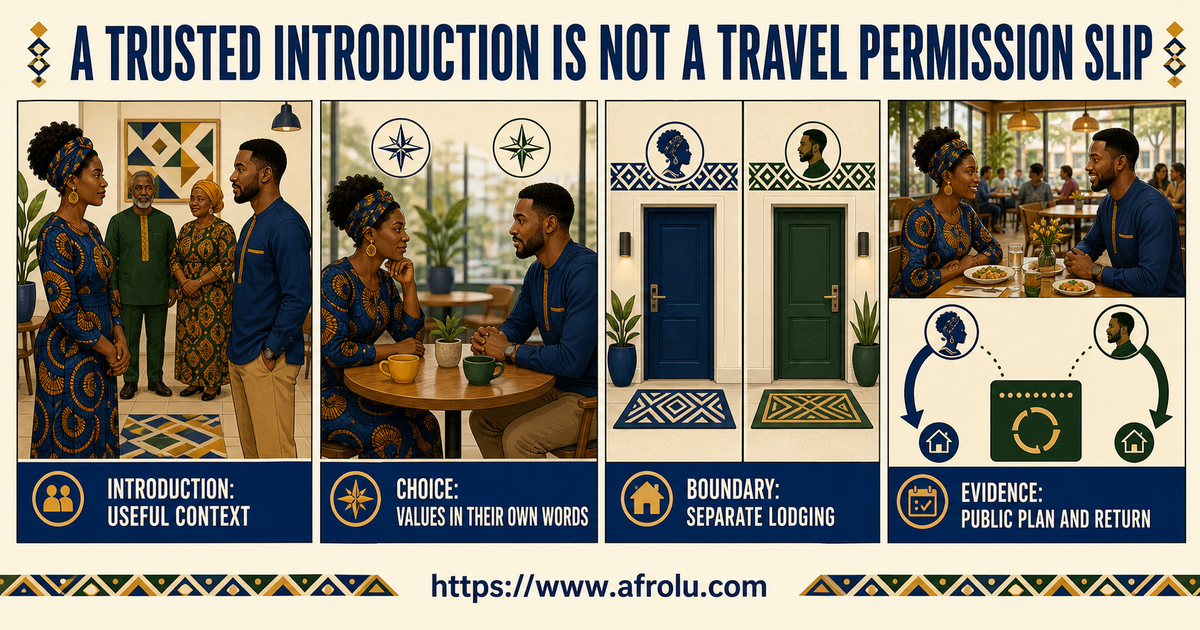
Faith can add purpose and community to dating without becoming borrowed authority. Samira gives both values and travel their own adult key.
The gate tests personal values, bounds community roles, completes the public visit and preserves consent and return before review.
Personal values
Translate belief into daily practice, relationship direction, family, money and boundaries.
Practical safety
Verify, meet publicly and control lodging, transport, documents, money and return.
Community has a bounded role
Introductions and counsel may inform; they cannot consent, disclose or enforce.
Observe difference and repair
Choose the next step only after both keys survive an honest no or mismatch.
Shared meaning with adult choice
Let faith guide the questions without claiming it has already answered the relationship
Faith-led long-distance dating means adults intentionally include religious or spiritual values in how they evaluate a relationship. It does not mean that shared identity, prayer, community introduction, a leader's opinion or a hoped-for marriage has already established compatibility. Faith can shape purpose, time, intimacy, service, family hopes and daily practice. Each adult still needs to explain what those words mean in their own life rather than treating a label as a complete answer.
Distance and weekend scarcity add a second decision system. A connection can feel spiritually aligned while identity, lodging, transport, cost, consent or return remain unsafe or vague. The reverse is also true: a carefully planned visit cannot manufacture agreement about belief, worship, marriage, children, gender expectations, money or community life. Treat values alignment and practical safety as two keys. The weekend opens only when both are freely workable.
Community can provide context, hospitality, counsel and support when invited. It cannot consent to dating, disclose private information, select a partner, require contact, approve sexual activity or order a relationship to continue. Adults may choose different levels of family or faith-leader involvement and may change that choice. Ask before sharing names, images, conversations or travel plans beyond the trusted person needed for safety. A public introduction is not permission for private access.
Use concrete language and observable conduct. Discuss personal meaning, current relationship structure, weekend communication, public meeting, accommodation, transport, consent, sexual-health choices, money and return. Watch how each adult responds when a practice differs or a boundary stays closed. If faith is used to shame, isolate, threaten, justify harm or override a no, the issue is no longer ordinary doctrinal difference. Protect distance and use appropriate trusted, community, specialist or local safety support.
The faith-and-travel dual-key gate
Require values alignment and a complete safe plan before the weekend proceeds
The values key asks personal questions: What does faith mean in daily life? Which practices are private, shared or community-facing? What does each adult believe about relationship direction, exclusivity, physical boundaries, marriage, children, care, money and repair? Do not search for one correct faith-led script. Look for specific answers, curiosity, the ability to tolerate difference and freedom to say that an important value mismatch makes the relationship unworkable.
The travel-safety key makes a proposed weekend independently survivable. Verify ordinary identity in stages. Confirm a staffed public first meeting, start, finish, cost, accessibility, accommodation, transport and return before either adult moves. Keep documents, devices, accounts, medication, lodging and enough exit money controlled by their owners. Faith, hospitality and community reputation do not replace these practical facts.
Turn both keys again when the plan changes. A venue switch, home invitation, shared lodging, extra night, family gathering, worship event, ride or intimate activity is a new choice. Ask rather than treating the original weekend yes as a package. A respectful partner can receive a boundary without quoting belief, invoking a leader, threatening reputation or suggesting the other's faith is deficient. Disappointment may be human; coercion is not a form of spiritual care.
The gate also protects the return. Each traveller controls the booked route and may leave early. A good weekend does not require an engagement, public announcement or future promise before departure. Schedule a later review when ordinary distance returns. If both keys remain sound, plan another modest step. If values do not fit, acknowledge incompatibility without attacking belief. If practical pressure or abuse appears, choose safety rather than a theological debate with the person applying pressure.
Salma and Idris own the introduction
A community connection becomes useful only after two adults make their own weekend plan
Salma is 34 and lives in Mombasa. Idris is 37 and works in Kampala. A mutual community contact introduces them after asking each adult separately. The contact confirms only that they know both people and then leaves communication to them. Salma and Idris hold ordinary calls and discuss what faith means in work, service, prayer and possible marriage. They notice shared priorities and different expectations about how early family should become involved.
Idris proposes a Mombasa weekend. A relative offers him a room in the family home and assumes Salma can join several gatherings. Salma says she wants one public lunch and a daytime walk, does not want her name or photograph shared more widely yet and will not visit a home on this trip. Idris chooses separate lodging he controls and tells the relative that no family programme has been agreed. He does not ask the mutual contact to persuade her.
They confirm the public plans, separate transport, finish times and a check-in each traveller chooses with trusted support. At lunch they discuss physical boundaries in their own words rather than assuming a shared religious label supplies identical rules. Salma declines hand-holding and Idris accepts the answer without treating it as a verdict on her interest or faith. They attend no worship or community event together because that choice remains open.
After Idris returns, they review both keys. Salma values his response to the family assumption and her boundary. Idris values her clear explanation but says he eventually needs a partner comfortable with visible community life. They decide to continue for four weekends of calls and revisit disclosure, marriage direction and family involvement. The result is neither a divine sign nor a guarantee; it is a specific adult next step supported by values and safe conduct.
Evidence across both keys
Look for personal meaning, practical completion and a no that survives spiritual language
Values evidence is specific and owned. An adult can explain the practices that matter, the questions still open and how they handle difference without claiming to speak for every believer. They can listen without conducting an exam. Shared prayer or worship may be meaningful when freely chosen, but frequency does not prove relational integrity. Look for humility, truthfulness, care and whether conduct remains consistent when an answer is inconvenient.
Travel evidence is observable. Identity context is reasonably consistent. The venue, time, finish, cost, lodging, transport and return are known. Each adult has access to personal documents, devices and money. A change receives timely news and an optional alternative. Community hospitality can be welcomed without becoming dependency. A public plan is not less faithful than a private one, and independent accommodation is not a moral accusation.
Keep amber questions visible: denominational difference, worship rhythm, interfaith practice, marriage, children, community disclosure, relocation, finances or physical boundaries may still need time. Name which questions affect the present weekend and which can wait. Do not announce a relationship publicly to force resolution. If the adults reach a genuine values incompatibility, ending can honour both consciences more than pressure toward agreement.
Red pressure uses belief or access against choice: ridicule, accusations of weak faith, forced practice, leader or family mobilisation, threats of exposure, scripture used to excuse harm, fare demands framed as generosity, private lodging imposed as hospitality, or consent treated as already decided. The National Domestic Violence Hotline describes spiritual abuse across belief systems and intimate partnerships. Its U.S. resource is not a universal legal guide, but it supports recognising manipulation and shame rather than debating the abuser's theology.

Observe what happens when one key stays closed; respect matters more than quotations, titles or community reputation.
Words with no borrowed authority
Speak from personal conviction and make practical choices directly with the affected adult
For values, say: ‘My faith shapes how I think about partnership, and this is what that means in my daily life.’ Then name the practice or decision rather than citing a label as authority. Ask: ‘What does it mean in yours?’ If a belief difference is consequential, acknowledge it. Do not pressure someone to perform prayer, worship, dress, disclosure or conversion to demonstrate romantic sincerity.
For community privacy, say: ‘Please ask before sharing my name, photo, messages or our dating status.’ A trusted introduction does not create permission for announcements. Leaders and relatives may advise when invited, but their approval cannot substitute for either adult's consent. If joint counsel is wanted, agree who, what question, what privacy boundary and whether either adult can stop the process.
For the weekend, say: ‘I am keeping separate lodging, my documents and my return. I can meet Saturday from noon to four in the agreed public places.’ The statement can coexist with trust and faith. If hosting is offered, gratitude does not require acceptance. Do not send fare or emergency money to make a relationship or spiritually significant meeting happen under pressure.
For intimacy, say: ‘Please ask before each kind of touch. Our shared values and the weekend plan do not answer for my body.’ Consent is active and withdrawable. Discuss relevant sexual-health information and testing before sex, and use qualified healthcare for individual care. If a boundary triggers spiritual shame, threats, isolation or coercion, prioritise distance and appropriate support rather than another private persuasion meeting.

Speak from personal conviction and make every practical choice directly with the adult it affects.
Four weekends or calls
Review meaning, completion, repair and freedom without issuing a spiritual verdict
Review meaning. Can each adult describe the other's relevant values accurately without flattening them into a label? Are shared practices freely chosen and personally meaningful, or performed to avoid disappointment? Which differences are enriching, manageable or incompatible? Do not ask whether one person is sufficiently spiritual. Ask whether the actual relationship permits honesty and whether the futures each adult wants can coexist.
Review practical completion. Did calls and dates happen as agreed? Were travel, lodging, cost, accessibility and return independently workable? Did both adults contribute planning and accept rest, worship, work, care or family limits? A beautifully worded values conversation cannot cancel unsafe logistics, and a flawless itinerary cannot cancel contempt for a sincerely held belief.
Review repair and freedom. When a plan or belief differed, did the adults ask, listen, take responsibility and leave room for no? Did anyone mobilise a leader, relative or community audience to win? Can each person practise faith, retain private support, control money and travel and end the romantic relationship without spiritual retaliation? Those questions test the dual-key method more directly than romantic intensity.
Choose to continue, redesign or end. A redesign may reduce community involvement, change the visit plan or name one values question for later. Do not place someone on a spiritual waiting list or demand conversion, public disclosure or marriage movement as the price of continued kindness. If abuse or coercion appears, use a safety plan appropriate to the actual location and seek support that respects both safety and the person's faith where possible.

Continue, redesign or end without treating faith, community reputation or travel cost as a command.
Four domains with no master key
Separate values alignment, community involvement, travel safety and consent
Values alignment concerns belief and daily practice: meaning, worship, service, marriage, children, care, money, repair and the freedom to hold conscience. It may be high, partial or incompatible. Shared terminology is a starting point, not proof. Research on spiritual intimacy may illuminate associations in specific married Christian samples, but it cannot prescribe dating choices across African faiths or predict one couple's wellbeing.
Community involvement concerns who knows, advises, hosts, witnesses or participates. Adults can welcome community while keeping the relationship private, or seek counsel without granting enforcement power. One partner may prefer early family context while the other wants time. That can be negotiated or reveal incompatibility. It does not create a right to disclose, shame or recruit others against a boundary.
Travel safety concerns identity, public venue, lodging, transport, cost, documents, money, trusted check-in and return. It is practical rather than a measure of devotion. A faith-led adult can choose separate accommodation, decline a private ride or leave a gathering. Safe planning does not accuse a whole community, and community reputation does not remove the need for a complete plan.
Consent concerns the present specific activity. It cannot be granted by a faith leader, family member, introduction, future marriage hope, travel expense or past yes. Adults may freely choose religiously informed physical boundaries, but those are still their own current choices. Keep all four domains parallel so spiritual meaning can enrich the relationship without becoming a master key to another adult's body, movement or future.
Eight faith-led distance moments where values and practical safety need separate answers
Mariam asks what faith means at home
Mariam and her match use the same faith label but describe different daily practices and marriage hopes. They discuss the difference instead of treating the profile field as compatibility proof.
Translate labels into personal present meaning.Joseph keeps an auntie's role bounded
An auntie introduces Joseph to a distant match. He thanks her and asks that neither person's calls or travel details be circulated without consent.
Let community open context without owning the courtship.Ayo declines a first-weekend service
Ayo wants a public date but not a visible worship event on the first weekend. Her match accepts and does not question her sincerity.
Make shared practice an invitation, not a faith test.Idris chooses separate lodging
Relatives offer Idris a room and expect his date to join family meals. He keeps separate lodging and the original public plans.
Accept hospitality only when it preserves the actual agreement.Salma returns to her own answer
A date responds to Salma's physical boundary with a religious argument. She ends the debate because her present consent is not a text-interpretation contest.
Protect the no and leave when belief is used to bargain over it.Daniel declines uninvited mediation
After disagreement, his match adds a leader to a call without warning. Daniel leaves and offers counsel only if both choose the person and question later.
Require mutual consent before third-party involvement.Hana keeps fare outside devotion
Hana is asked to pay for a weekend because generosity is called a spiritual duty. She sends nothing and proposes continuing calls without travel.
Separate voluntary generosity from pressured romantic payment.Kwame and Leila end without ranking faith
They respect each other but want incompatible approaches to future children's religious education. They end rather than asking one adult to surrender conscience.
Treat consequential values conflict as fit, not moral superiority.Evidence that both keys remain personal, complete and free from pressure
Each adult explains faith and practice personally rather than claiming one label answers everything.
Questions about worship, marriage, children, money and physical boundaries can receive honest difference.
Community involvement occurs only at the level both adults have explicitly chosen.
A leader or relative may advise when invited but cannot direct consent, travel or relationship continuation.
The weekend has a staffed public first meeting, bounded finish, lodging, transport and independent return.
Documents, accounts, devices, medication and enough exit money remain controlled by their owners.
Shared prayer or practice is invited and can be declined without shame or a loyalty test.
A physical boundary remains complete without theological bargaining, reputation threats or family mobilisation.
Travel, gifts, hosting and community status do not purchase touch, time, disclosure or commitment.
Changed plans receive direct news, a specific alternative and genuine room to say no.
Both adults retain private support and can distinguish counsel from control.
The relationship can continue, redesign or end without either faith or safety being used as retaliation.
Route each value, community, travel or consent moment to its proper key
| Situation | What it may mean | What to do next |
|---|---|---|
| The same faith label is treated as full compatibility. | Personal meaning and practice remain unknown. | Discuss daily practice, direction, family, money, boundaries and repair. |
| A community introduction is called verification. | Reputation is replacing staged ordinary identity checks. | Use the context, retain platform care and meet publicly. |
| A first weekend includes a surprise worship event. | Community visibility has been added without agreement. | Return to the chosen public plan or decline the event. |
| Separate lodging is called unfaithful. | Spiritual language is pressuring travel access. | Keep independently controlled accommodation or cancel the visit. |
| A leader is added to settle a disagreement. | Third-party authority is replacing adult consent. | Stop and choose counsel only through mutual agreement. |
| A physical no receives religious argument. | Belief is being used to bargain over consent. | End the debate, protect distance and use support if pressure continues. |
| One practice differs but curiosity remains. | A manageable difference may be under honest review. | Ask what the practice means and what shared life would require. |
| Fare is framed as generosity or duty. | Faith is being recruited for a financial decision. | Send nothing under pressure and keep travel independently funded. |
| Family wants an announcement before the visit. | Public status is being used to create momentum. | Share only what both adults have agreed and keep the relationship private if needed. |
| A consequential values conflict remains. | Respect may coexist with genuine incompatibility. | Name the conflict and end rather than force conscience. |
| The weekend completes with both keys intact. | Useful but limited mutual evidence is present. | Review after ordinary distance and choose one modest next step. |
| Shame, isolation, threats or forced practice appear. | The task may have shifted to spiritual or other abuse. | Prioritise safety and seek appropriate support rather than private debate. |
Scripts for faith, disclosure, counsel, lodging, money and consent
“My faith shapes partnership in these specific ways; what does it mean in your daily life?”
“We share a label, and we still need to discuss marriage, children, money and practice.”
“Please ask before sharing my name, photo, messages or our dating status.”
“I will join counsel only if we both choose the person, question and privacy boundary.”
“I am not joining that service this weekend; I still want our public lunch.”
“I am keeping accommodation and return transport that I control.”
“I can meet Saturday from noon to four, then I am returning separately.”
“Our faith and relationship do not answer touch; please ask each time.”
“I do not send fare or emergency money as spiritual or romantic proof.”
“Using faith to shame this boundary is not acceptable, so I am ending the conversation.”
“Let us review both values and the practical weekend after we return.”
“Our important values do not fit; I am ending without asking either of us to abandon conscience.”
Know the difference
Values alignment versus community approval
The adults understand how sincerely held beliefs and practices could fit in a shared life.
Relatives, leaders or peers welcome or endorse the match within their own perspective.
Approval can provide context but cannot establish compatibility, travel safety, consent or a duty to continue.

Keep four parallel domains answerable by the adults; no leader, family member, trip or label can supply another domain's yes.
Compare values alignment, community role, travel safety and consent
| Type or dimension | What it describes | Best next question |
|---|---|---|
| Personal faith | One adult's sincerely held meaning, practice and conscience. | How does it shape daily relationship choices? |
| Values alignment | The adults' important beliefs and hoped-for shared life can coexist. | Which agreement and difference need direct words? |
| Community context | Trusted people provide identity context, culture, hospitality or support. | What may they know or do with consent? |
| Counsel | Advice is sought from a mutually chosen person without enforcement power. | Who, what question and which privacy limit? |
| Community approval | Others endorse the relationship from their perspective. | Do the adults themselves still freely agree? |
| Travel safety | The visit is verified, public, affordable and independently survivable. | Are lodging, transport, money and return controlled? |
| Relationship structure | Exclusivity or non-exclusivity is a current adult agreement. | What exactly exists now? |
| Consent | One adult freely agrees to one present activity and can withdraw. | What does each person choose now? |
| Spiritual abuse | Belief, practice or authority is used to shame, control or justify harm. | Protect safety and seek appropriate support. |
| Values incompatibility | Important futures or practices cannot coexist without surrendered conscience. | End honestly rather than pressure conformity. |
Build one dual-key long-distance weekend in six moves
Translate the faith label
Ask what belief means in daily practice, partnership, family, money and repair.
Build the second key
Confirm public venue, finish, lodging, transport, cost, documents and return.
Bound community roles
Choose introductions, disclosure, hospitality and counsel without enforcement.
Keep consent personal
No belief, leader, family member, trip or future promise answers an activity.
Review four weekends
Check meaning, completion, repair and freedom across ordinary calls or visits.
Honour accurate outcomes
Continue, redesign or end without ranking faith or sacrificing safety.
Questions organised by values, travel, community and review
Choose a few prompts that fit the moment. This is a reference library, not a list to complete.
Values key
Translate a faith label into personal daily meaning and shared-life questions.
- What does faith mean in my life?
- Which practice might be shared?
- What do I believe about partnership?
- Which difference is consequential?
- Can either adult disagree freely?
Travel key
Make the weekend independently survivable before movement begins.
- Is identity context consistent?
- Which public plan is complete?
- Who controls lodging and transport?
- What cost protects essentials?
- How can each adult return?
Community boundary
Choose context, disclosure, hospitality and counsel without enforcement.
- Who may know?
- What may be shared?
- Is an introduction enough?
- Would counsel be mutual?
- Can either adult stop involvement?
Four-weekend review
Choose the next relationship size from meaning, completion, repair and freedom.
- Are values spoken personally?
- Do plans complete safely?
- Does difference receive repair?
- Can no remain complete?
- Do we continue, redesign or end?
What faith, abuse, safety and health sources can support
One spiritual-intimacy study has a narrow population and design
A cross-sectional study of married Seventh-day Adventist adults examined associations among spiritual intimacy, marital intimacy, spiritual meaning and wellbeing. Afrolu uses it only to recognise that spiritual meaning may matter within some relationships.
Evidence limit: It cannot show causation, represent unmarried daters or generalise across African, Muslim, Christian, traditional, interfaith, other-faith or non-religious lives.
Spiritual abuse can occur within intimate relationships
The National Domestic Violence Hotline describes ridicule, blocked practice, manipulation, shame and use of beliefs to excuse abuse as possible spiritual-abuse patterns. This supports focusing on observed control rather than debating religious correctness.
Evidence limit: The service is U.S.-based and cannot determine one case, provide local law or replace an individual safety assessment.
Online dating safety includes limited sharing and public meetings
Police Scotland advises avoiding personal information, using trusted services, meeting publicly during the day and bringing a friend. These general practices can coexist with community introductions and faith-led values.
Evidence limit: The policing and reporting context is Scottish; platform features and relevant local services vary.
Romance and travel stories can become money pressure
FTC consumer guidance describes false profiles and urgent requests involving tickets, health or other needs. A spiritual appeal, community connection or promised visit does not verify a transfer.
Evidence limit: The source is U.S.-specific; warning patterns cannot prove one person's intent or replace local recovery advice.
Consent remains active and withdrawable
NHS guidance explains that sexual activity requires active consent, that a relationship or previous yes is not consent and that consent can be withdrawn. Faith, future marriage, travel and hospitality do not change the principle.
Evidence limit: Public-health information is not jurisdiction-specific legal advice or an individual incident assessment.
Sexual-health conversations belong before relevant choices
CDC guidance encourages partner conversations before sex about relevant STI information and testing. Faith identity, abstinence assumptions, exclusivity or appearance cannot establish status.
Evidence limit: General public-health guidance cannot provide individual diagnosis, testing, prevention or treatment.
Six shortcuts that let one domain override another
Treating a faith label as a full agreement
Shared terminology can conceal different practices, futures and boundaries.
Making community the decision-maker
Context and counsel can help, but adults retain relationship and consent authority.
Using hospitality as access
A home or ride offer does not create lodging, time, intimacy or disclosure duties.
Calling safety a lack of faith
Public plans and independent return are practical protections, not moral accusations.
Quoting over a boundary
Spiritual language cannot make a present no incomplete.
Making marriage the only faithful result
An accurate incompatibility or safe ending can honour both adults' consciences.
Use a reviewed resource that matches the decision
This guide focuses on the relationship decision, so it does not rank dating apps. Check current prices, safety tools, and local availability before choosing a service.
Explore the guide library
Show more related guides
Continue with Afrolu
Show more Afrolu guides
Research and public guidance reviewed for this dual-key gate
Afrolu reviewed these health, research, safety, or public guidance resources while editing this page. They support the behaviour and safety guidance; they do not diagnose any individual described by a reader.
Faith-led long-distance weekend dating questions
What does faith-led long-distance dating mean?
It means adults intentionally include sincerely held religious or spiritual values in how they evaluate a relationship across distance. It does not imply one doctrine, gender role, physical boundary, community structure or guaranteed marriage. Translate the label into each adult's daily practice, future hopes and present agreements.
Does sharing a faith make a weekend visit safe?
No. Shared identity or community context cannot replace staged verification, a staffed public first meeting, confirmed finish, affordable plan, independently controlled lodging, transport, documents, money and return. Faith alignment and travel safety are separate keys; both need direct adult agreement.
Should faith leaders or family approve the relationship?
Adults may freely seek context, blessing, hospitality or counsel, depending on their beliefs. Approval is not consent and cannot compel dating, travel, disclosure, touch, marriage or continuation. If counsel is desired, choose the person, question and privacy boundary together, with either adult free to stop.
Is separate lodging disrespectful in faith-led dating?
No universal faith rule can be set here. Separate accommodation can protect rest, privacy and independent return. Adults may choose other arrangements consistent with their values only when freely and practically workable. Hospitality does not create home access, extra time, intimacy or public-disclosure duties.
How do we discuss physical boundaries?
Each adult should state present choices in their own words and ask before each activity. A shared label, leader's view, future marriage hope, trip cost or past yes cannot answer for another adult. Consent is active and withdrawable. A values mismatch may be real; bargaining, shame or coercion is not respectful resolution.
Can we pray or worship together during the first weekend?
Yes if both freely want that specific practice and understand its meaning. It can also wait. Declining a shared practice is not proof of weak faith or romantic disinterest. Decide whether community visibility, photographs or disclosure would accompany it, and ask before sharing anything beyond the adults involved.
What if our families expect early involvement?
Name what each adult is willing to disclose, when and to whom. A family expectation can be important context but cannot provide either adult's answer. Offer a smaller mutually acceptable role or recognise incompatibility. Do not use surprise calls, gatherings or public announcements to create momentum.
What is spiritual abuse in dating?
Specialist guidance describes patterns such as ridicule, blocked practice, manipulation, shame and using belief to justify harm. One disagreement is not automatically abuse. Focus on observed repetition, control and retaliation. If faith is used to override consent, isolate, threaten or excuse harm, prioritise safety and appropriate local or specialist support.
Should I pay travel costs as an act of generosity?
Only make any gift freely, within your means and without relationship pressure; early distance dating is safer when each adult controls travel costs. Do not send fare, visa, customs, device, health or emergency money to prove devotion or trust. Verify institutions independently and contact financial providers promptly after suspected deception.
What if our faith values do not fit?
Name the consequential difference accurately—perhaps worship, marriage, children, gender expectations, money, community life or physical boundaries. Neither adult needs to be morally inferior for the relationship to be incompatible. Ending without pressure to convert, conceal or surrender conscience can be respectful and honest.
One thing to do now
Open the weekend only when both keys remain free
Translate faith labels into personal values and complete the travel key before movement. Bound community disclosure, hosting and counsel through mutual consent. Keep lodging, documents, money, devices, transport and return controlled. Require present consent for every activity and observe responses to difference. Review both keys after four ordinary weekends, then continue, redesign or end; use appropriate safety support when belief becomes a tool of control.