Diaspora daters · long-distance pace and clear boundaries
Long-Distance Ghosting for Diaspora Daters: A Low-Pressure Guide
A low-pressure guide to long-distance ghosting for diaspora daters: make calls and visits clear, protect privacy and money, and choose a safe next step.

Distance can stay low pressure.
Written and edited by Tariro Ncube · Diaspora Dating Editor
Long-distance dating does not require constant proof of availability. Agree on a realistic contact window or release the wait, and keep shared background, private routes, money, documents, accounts, transport, visits, and current consent separate from pressure or hope. A returning match can earn a smaller restart through a clear rhythm, not an urgent demand. If a person becomes financially urgent, repeatedly unwanted, coercive, threatening, monitoring, or frightening, reduce access and seek appropriate support.
Dating behaviour · Diaspora Daters
Is this one missed window, a workable delay, an always-on expectation, a public meeting plan, a return worth testing, a money or privacy concern, or conduct that uses shared background, monitoring, repeated contact, coercion, threats, blackmail, or fear to reduce my choice?
Diaspora long-distance ghosting is a reduced or ended dating connection in which distance, varying routines, or community familiarity can make a quiet gap feel larger than it is. It is not proof that a person’s geography, culture, or future potential explains their conduct. The useful distinction is between a missed window, a named delay, a public plan, a respectful repair, a financial or privacy concern, and behaviour that uses shared background, monitoring, repeated contact, coercion, threats, blackmail, or fear to take more access than you choose.
Mina has been talking with someone who shares part of her diaspora experience while they live in different places. A planned call is missed, and the person returns with a personal money story and pressure for immediate certainty. Mina keeps her own evening, declines financial access, offers a smaller contact window only if she wants it, and decides that familiarity does not override her need for low-pressure, voluntary communication.
diaspora daters · long-distance pace and clear boundaries
Mina keeps distance and shared context from turning one quiet connection into a claim on her time, money, or private life
This guide separates ordinary long-distance coordination from patterns that make a diaspora dater’s time, community, money, data, body, or ending less freely chosen.
Name the actual gap, choose a bounded contact window, make in-person plans current and public, keep money and data separate, test a return by conduct, protect digital privacy, and choose the move that restores your own rhythm.
Name the contact
A missed window can be real without becoming a story you must solve.
Choose a window
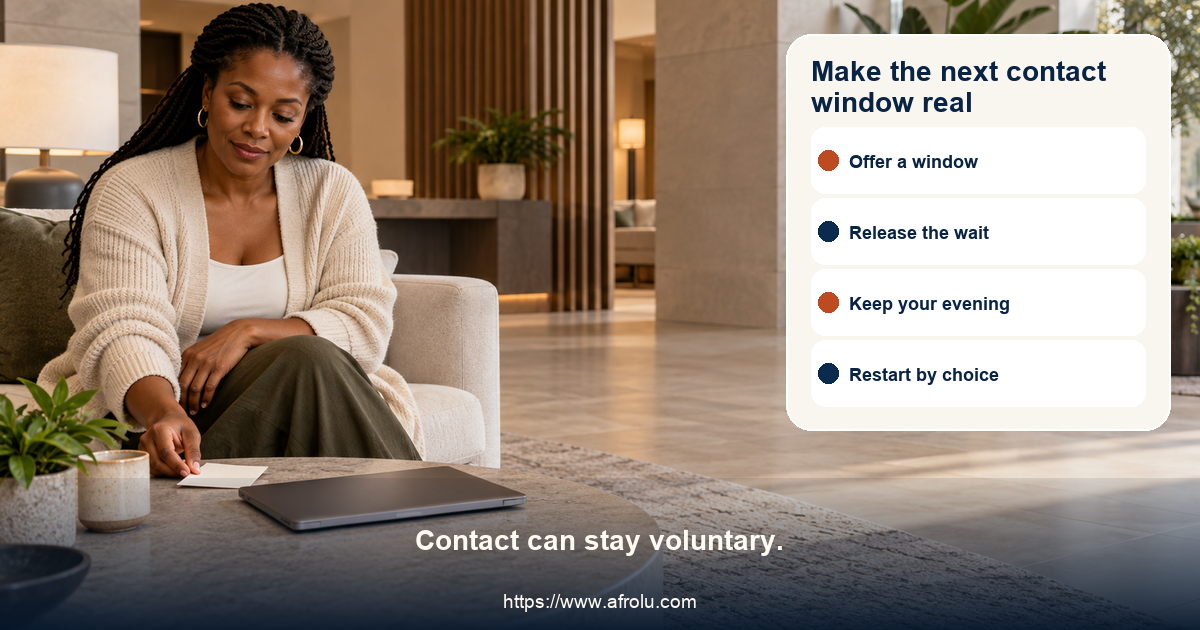
Bounded contact lets two full lives remain visible.
Keep systems separate
Money, documents, routes, accounts, and images do not prove trust.
Restart in increments
A new message gives you a choice, not a demand for immediate certainty.
distance can complicate a connection without making silence a puzzle you must solve
Start with the contact, not a story about geography or belonging
A quiet long-distance conversation can invite elaborate explanations. You may wonder whether a time difference, family obligation, work pattern, cultural expectation, community overlap, visit plan, or bad connection explains a missed call. Any of those things can be real. They also do not require you to abandon the simpler fact: a message, call, or plan was not carried forward. You can make a decision without assigning a motive to the distance.
Diaspora daters are not a single audience with one rhythm, one culture, or one obligation to be available. Familiarity can feel comforting, especially when a match understands a language, experience, or part of your history. It can also make a quiet gap feel personal because you imagine a shared context should have made clarity easier. Shared roots, family ties, or community connections do not turn a new connection into a duty or give either adult a right to more access.
Low pressure begins with a grounded description. Did the person miss one call, stop responding after a meaningful exchange, cancel a planned visit, return with a concrete repair, or only appear when they want emotional, financial, or private access? These are different patterns. A calm response comes from choosing an action that fits the evidence, rather than trying to make distance disappear through more messages, tracking, or self-blame.
You can care about a connection and still protect your attention. Set a reasonable time to wait for a call or confirmation, make your own plans, and keep the rest of your life available. A person who wants to continue can offer a specific next window. A person who does not may never explain fully. In both cases, your ability to choose a pause, a clearer invitation, or an ending remains more useful than a perfect answer.
make calls and messages fit two full lives
Use a shared time window rather than an endless availability test
Long-distance dating often needs some coordination, but coordination is not the same as constant access. You might agree on a short call, a broad day, or a time when each person can realistically reply. The purpose is to make space for mutual contact, not to create a record of who answered fastest. A missed window can be disappointing; it does not automatically mean you should chase an explanation through every channel.
Say what you can offer. “I can talk Sunday afternoon,” “I am offline during work,” or “If we miss this call, let us choose another time next week” are useful because they give both adults something concrete. You do not need to provide a live schedule, your exact location, screenshots, or a running account of why you are unavailable. A healthy connection can tolerate ordinary privacy around a busy life.
Notice whether planning makes contact calmer or more controlling. A workable match can reschedule, accept that a message will wait, and avoid turning online status into evidence. A concerning pattern may include demands for immediate calls, repeated checking across apps, accusations when you are unavailable, pressure to share location, or a claim that a time difference means you owe more access. The problem is not that someone misses you; it is whether your boundary remains an answer they accept.
If a call repeatedly does not happen, decide what you will do rather than staying on standby. You might offer one clear alternative, take a break from the conversation, or leave it. Low pressure does not mean accepting indefinite vagueness. It means choosing a rhythm that protects your sleep, attention, and ability to enjoy the people and places already present in your life.
treat an in-person plan as a new decision, not a reward for distance
Keep every visit or meeting public, specific, and freely revisable
When two people have been talking from a distance, an in-person meeting can carry a lot of expectation. It may feel as if the time invested in messages and calls should make the plan automatic. It does not. Decide the details as you would for any early date: a public setting, a time that works for you, independent movement where possible, a way to leave, and a plan that can change without one person having to manage the other’s disappointment.
Be clear about what has and has not been agreed. A visit does not automatically mean sharing a home, staying overnight, travelling together, meeting relatives, paying for another adult, giving documents, or becoming sexual. You can enjoy a meal, a walk, a call, or a short public meeting and choose something different next time. Current consent matters at every change in plan, even if someone travelled or spent money expecting more.
If someone changes the arrangement late, asks you to meet in a private place, pressures you to extend a plan, or says you are wasting their effort by declining, pause. Their inconvenience does not decide your access, route, or body. You can suggest a public alternative, postpone, or decide the connection no longer feels right. A respectful person can be disappointed without making their disappointment your emergency.
Keep practical decisions independent. Do not send money for travel, book a private stay you do not want, hand over account information, or make yourself responsible for another adult’s transport, documents, visa status, job, or family conflict. If a real concern arises, use independent official channels or trusted local support. A long-distance relationship possibility should not require you to become a financial, legal, or logistical solution before trust exists.
do not let a distance story become a financial or access shortcut
Keep money, documents, accounts, and work resources out of the connection
Distance can make a financial story sound especially urgent: a fare, a booking issue, a medical bill, a family emergency, a device problem, a visa question, a work opportunity, a delayed payment, or an account lock. The details may be moving, and they may be true or false. You do not need to decide which in order to keep your money, account access, and personal systems separate. Do not make a transfer or share a code as proof that you care.
Keep document and identity boundaries clear too. Do not share copies of identification, passports, banking screens, addresses, travel details, login codes, employer information, or private paperwork to support a connection. A person who needs help can use official, independent resources appropriate to their situation. You can offer empathy without becoming the route through which their problem is solved.
Notice how a person reacts to a no. A respectful match may be disappointed but will not bargain, shame you, imply you are disloyal to a community, threaten to disappear, or turn a future relationship into a promise of repayment. Pressure can show up as romance, guilt, cultural familiarity, urgency, or a story that seems too private to question. The form of the pressure matters less than whether your boundary is accepted.
If a request has already been made, do not try to repair the connection by giving a smaller amount, a code, a referral, or access to a personal system. Keep a concise boundary and step back. When financial pressure is paired with threats, blackmail, repeated contact, monitoring, or fear, prioritise safety and seek support. Your responsibility is to protect your choices, not to prove that you are generous enough for someone to remain interested.

Read the boundary beside the message.
a return after distance does not reset the pace
Let repair improve the next agreement before you offer more trust
Someone may return after a missed call or quiet period with an explanation about time, stress, distance, or circumstances beyond their control. You can listen without making an immediate promise. Notice whether they acknowledge what happened, offer a practical next contact point, and leave you free to say that you are not interested in restarting. A useful repair does not make you responsible for relieving their guilt or proving that you understand.
If you want to see whether the connection can continue, keep the next step modest. Choose a short call, a public meeting that is easy to leave, or a new agreement with a clear time window. Do not use the return as a reason to share more personal data, make a costly plan, send money, invite someone into a home, or agree to a level of intimacy you have not freely chosen. Trust can restart in increments.
Watch whether the person respects a boundary around pace. A grounded response may sound like, “I understand if you need time; here is a time I can genuinely offer.” Pressure sounds like, “You know how hard distance is,” “You owe me a chance after what we shared,” or “If you do not decide now, I will not be available again.” Scarcity is not a substitute for consent or compatibility.
You can decide that the silence changed what you want. A connection may have been meaningful, and the pattern may still be too unstable for your life. A brief ending is enough: “I am looking for more consistent contact, so I am stepping back.” If a person tries to bypass that decision through extra accounts, mutuals, monitoring, threats, or fear, reduce access and seek a response that protects you rather than trying to make the ending feel mutual.

A clear boundary crosses distance.
keep long-distance intimacy from becoming a map of your life
Share information gradually and keep digital boundaries visible
Long-distance contact can invite a lot of digital sharing. It may seem natural to send live location, show a room, share a work route, introduce friends on video, give a private number, reveal a home address, or send images that cannot be retrieved later. Pause before making disclosure the answer to uncertainty. You can be warm, curious, and honest while keeping details that would make you easier to locate, impersonate, pressure, or expose under your own control.
Do not use online activity as a substitute for communication. Checking when someone was active, asking them to prove where they are, searching friends’ profiles, or comparing time zones against a status can make distance feel more manageable for a moment while creating a monitoring pattern. You deserve clarity, but clarity that comes from surveillance is fragile. A person who cannot offer a workable contact rhythm may simply not be compatible with the rhythm you need.
Keep image and sexual boundaries explicit. A previous picture, flirtation, call, visit, gift, or agreement never means someone can demand more images, save material, share it, or threaten you with it. You can say no, stop, block, report, or seek support at any point. If you feel pressured to provide sexual content or afraid of what someone might do with existing material, treat that as a safety concern rather than a relationship test.
Where a person uses new accounts, repeated contact, location information, monitoring, image pressure, threats, blackmail, or fear to get around a boundary, protect your safety first. Adjust privacy settings, reduce channels, preserve information only if safe, report where relevant, tell trusted people, and seek local help when needed. You do not owe additional personal detail or an in-person conversation to prove that you are not being unfair.
let a low-pressure ending make room for the life you are already living
Choose an exit that does not require a cross-border explanation
For an ordinary quiet thread, you may choose no further message. Archive the conversation, turn off notifications, and return your attention to work, friends, rest, and the relationships already present in your life. If words help, keep them short: “I am looking for more consistent contact, so I am moving on.” The point is not to win agreement about what happened across the distance. It is to stop investing in a pattern you have assessed.
Avoid a detailed case file of missed calls, online activity, mutuals, cultural assumptions, or theories about why the person disappeared. A long message may create another conversation to defend or negotiate, which can leave you waiting again. State a decision once if you choose to state it, then let your actions match it: do not keep a time window open, do not send resources, do not share more private information, and do not accept an urgent plan you do not want.
If shared community spaces are part of your life, keep public courtesy separate from private availability. You can be civil without discussing the relationship, and you can ask people not to mediate or relay messages. Familiarity, shared history, or a sense that you should keep peace does not require access to your time. A healthy community boundary gives you room to remain present without being privately reachable.
When an ending is met with repeated unwanted contact, monitoring, coercion, threats, blackmail, image pressure, financial manipulation, or fear, choose protection over etiquette. Do not meet privately for closure merely because someone says the distance deserves a final explanation. Reduce access in the way that feels safest, seek trusted and relevant support, use reporting options where appropriate, and contact urgent local help if you believe you are at immediate risk.

Choose the move that keeps distance humane.
Eight long-distance moments after quiet contact
A promised call does not happen
Two adults agree on a call, but one misses it without a note and does not offer a new time.
Keep your evening, decide whether one clear alternative helps, and do not remain permanently on call.A person explains limited capacity with a new realistic window
A match says they cannot make the planned call, communicates before it starts, and offers another time that is workable.
Choose whether the new window fits your life; a change can be respectful without being ideal.Familiarity is used to make a boundary seem disloyal
A date says a shared language, culture, or community means you should be more available, trusting, or forgiving.
Keep the boundary; shared context does not create a relationship obligation.An in-person plan becomes a private or costly expectation
A person says that distance makes a private setting, lodging, extended time, or more intimacy automatic once they meet you.
Choose a public, specific, freely revisable plan or decline.A long-distance emergency becomes a transfer request
A match asks for money, a code, documents, account access, or a booking after a personal story about distance or urgency.
Do not transact or share access; use independent official channels for real concerns.A quiet match reappears and wants an immediate decision
After days of silence, a person asks for a long call, private details, or a costly plan right away to prove you are still interested.
Offer a smaller window, slow the pace, or choose not to restart.Online activity becomes proof that someone owes a reply
A dater watches app status or social posts and demands explanations for every time the other person was visible online.
Do not turn availability into surveillance; choose a contact rhythm or leave the pattern.An ending brings extra accounts, image pressure, or fear
Someone uses new profiles, location information, intimate material, threats, or repeated messages after being told the connection is over.
Prioritise safety, reduce access, preserve evidence only if safe, and seek relevant support.Signals about time windows, meetings, shared context, money, privacy, consent, and safety
They can coordinate a time window without expecting you to be permanently reachable or to document every absence.
They accept that diaspora experience is diverse and do not use shared background as a shortcut to trust or access.
They can miss a call, communicate a change, and offer a new realistic option without guilt or accusation.
They respect work, sleep, family time, rest, and offline hours even when contact happens across distance.
They make an in-person meeting public, specific, affordable, and easy for either adult to revise or leave.
They do not treat a visit, ticket, call history, or expense as consent to home access, lodging, sex, images, or more time.
They keep money, transfers, documents, accounts, codes, work referrals, and personal systems outside a developing connection.
They do not ask for live location, routes, screenshots, account access, proof of whereabouts, or private data to relieve distance anxiety.
They do not use cultural familiarity, community pressure, or a sense of obligation to make a no negotiable.
They can return after silence with a concrete repair and accept that a slower, smaller restart may be all you want.
They do not turn online status, social profiles, mutuals, or time differences into a monitoring tool.
They respect image, sexual, and digital boundaries as current choices rather than proof of long-distance trust.
They accept an ending without new accounts, repeated contact, threats, or recruitment of other people.
They never use financial manipulation, coercion, blackmail, intimidation, monitoring, or fear to keep access open.
Choose a proportionate next move
| Situation | What it may mean | What to do next |
|---|---|---|
| One call or message is missed | There may not yet be enough information to explain the gap. | Keep your plans and decide whether one clear alternative would serve you. |
| A person names a delay and a realistic new window | They may be offering limited but practical capacity. | Accept, decline, or propose a different time based on your own life. |
| Contact repeatedly stays vague across time windows | The rhythm may not be compatible with the contact you want. | Stop remaining on standby and let a concrete plan be the next evidence. |
| Shared background is used to pressure availability | Familiarity is being turned into an obligation. | Restate the boundary; no cultural or community link makes your no less valid. |
| A meeting plan turns private, costly, or urgent | The change may reduce your ability to decide about setting, money, or exit. | Choose public, postpone, keep decisions independent, or decline. |
| Someone asks for money, documents, account access, or codes | The request is about financial or personal systems, not a needed proof of connection. | Decline and use independent official help for any real issue. |
| A returning match asks for immediate trust or a large plan | Urgency may be substituting for a repair. | Keep the restart small, public where relevant, and easy to reconsider. |
| A person monitors statuses, routes, or social accounts | Distance anxiety may be becoming controlling digital contact. | Reduce information access and choose a boundary that protects privacy. |
| Contact continues through new profiles, mutuals, or repeated channels | The situation may have become unwanted pursuit. | Reduce access and use platform, trusted, or local support as appropriate. |
| You feel threatened, blackmailed, watched, or afraid | This needs a safety response rather than more relationship explanation. | Prioritise safety and seek urgent relevant help when needed. |
Twelve lines for contact windows, shared context, visits, privacy, returns, and endings
“I can talk Sunday afternoon. If that does not work, let us choose another time next week.”
“If we miss this window, I will make my evening plans and we can reconnect when we agree on another time.”
“I am not available during work and sleep hours, and I do not share live location.”
“A shared background matters to me, but it does not change my need for clear plans and boundaries.”
“If we meet in person, I prefer a public plan with my own transport and an easy end time.”
“I do not send money, share codes, or use my accounts or documents in dating.”
“I hear your explanation. I would only restart with a smaller, more consistent contact rhythm.”
“I am not making that plan now. If we continue, it needs to be public, specific, and workable for me.”
“I am not going to account for my online status. We can agree on a contact window or leave this.”
“I need more consistent, low-pressure contact, so I am stepping back.”
“I do not want further contact. Do not use other accounts, mutuals, or channels to reach me.”
“I am receiving online contact that feels coercive and need help choosing a safer response.”
Know the difference
A missed distance window, a clear rhythm, a repair, money or privacy pressure, and fear need different responses
A person can name a realistic window, accept offline time, plan a public meeting, respect shared context as voluntary, repair a gap, and let both adults revise access freely.
Always-on demands, familiar-context pressure, private shortcuts, money stories, document requests, status monitoring, image pressure, repeated contact, coercion, threats, blackmail, and fear make distance less freely chosen.
Low pressure is not lower standards. It is a way to keep distance, familiarity, and hope from deciding access for you.

Distance is context, not a contract.
Separate a missed window, a clear rhythm, a repair, pressure, and fear
| Type or dimension | What it describes | Best next question |
|---|---|---|
| One missed window | A single absence may have limited information and may need no immediate theory. | Keep your plans and decide later whether a concise alternative helps. |
| A named delay | Capacity is explained with a realistic next contact point. | Choose whether the offered rhythm fits your life. |
| An always-on expectation | Contact planning has become a demand for constant proof or availability. | Set an offline boundary and stop treating status as a relationship test. |
| A public meeting plan | Setting, transport, cost, and exit remain clear and revisable. | Decide whether it suits you without making distance override comfort. |
| A private or urgent shortcut | A plan is asking for more location, time, lodging, or intimacy than you freely chose. | Choose public, postpone, or decline. |
| A respectful return | The person acknowledges the gap and accepts a smaller restart. | Use a modest new agreement or decide not to reopen it. |
| A money or document request | A personal story is reaching for financial or identity access. | Do not transfer, share, lend, route, or provide documents or codes. |
| A digital boundary bypass | Extra accounts, monitoring, image pressure, or mutuals are being used to regain access. | Reduce channels, document only if safe, and seek support. |
| Fear or threats | The interaction has moved beyond ordinary distance or dating uncertainty. | Prioritise safety and seek relevant urgent help when needed. |
Keep long-distance contact low pressure and clear
Distance changes logistics
It does not make silence a problem you must solve through guesswork or surveillance.
Shared background stays voluntary
Familiarity can be meaningful without becoming an obligation to trust, disclose, or remain available.
A time window is enough
Specific, bounded contact lets both adults keep work, sleep, rest, and private life intact.
A meeting is a fresh choice
Calls, history, and expense do not decide venue, transport, lodging, privacy, intimacy, or exit.
Care is not financial access
Money, documents, accounts, codes, and work resources remain separate from a relationship hope.
Digital boundaries are relationship boundaries
Status monitoring, image pressure, repeated accounts, threats, and fear require protection rather than more proof.
Questions organised by purpose and depth
Choose a few prompts that fit the moment. This is a reference library, not a list to complete.
Name the gap
Keep distance from becoming a theory about your worth or belonging.
- What call, message, or plan actually happened?
- What am I assuming because of distance?
- What one action restores my attention?
Choose the rhythm
Make contact work around two complete lives.
- What window can I genuinely offer?
- What offline time do I protect?
- When will I release a missed plan?
Protect access
Keep an in-person plan and digital contact freely revisable.
- What setting, route, cost, or lodging choice is mine?
- What information stays private?
- What boundary keeps money and documents separate?
Check safety
Notice when distance is being used to pressure or monitor.
- Has someone demanded proof, money, location, or images?
- Has my no been bypassed?
- Who can help me take a safer next step?
Look more closely at distance, time windows, visits, money, returns, privacy, and escalation
Name the contact, not the theory
A missed call or quiet gap may be painful, but you can choose a clear action without attributing motive to geography or community.
Evidence limit: Do not turn distance into a reason to chase certainty through more access.
Use a window that protects two lives
A short, mutually workable contact point can be more sustainable than all-day availability or status checking.
Evidence limit: Do not make sleep, work, family time, or privacy proof of interest.
Make proximity a current choice
Public setting, independent movement, cost, lodging, intimacy, and exit can all remain separate decisions when people meet.
Evidence limit: Do not let travel effort or an old plan override present consent.
Keep help independent
Financial, document, account, code, and work requests need boundaries and outside verification rather than romantic urgency.
Evidence limit: Do not transfer or share access to preserve a connection.
Restart at the size of trust
A short call or public plan can show whether a returning person respects a clearer rhythm.
Evidence limit: Do not reopen private, financial, or intimate access because the explanation sounds moving.
Protect digital and personal boundaries
Monitoring, repeated accounts, image pressure, blackmail, coercion, threats, and fear call for a safety-focused response.
Evidence limit: Do not meet or provide more information in an effort to make someone stop.
Shortcuts that let distance or familiarity take more time, money, data, or access than they have earned
Trying to solve silence with geography
Time differences and distance can be real without giving you useful evidence about someone’s intention.
Treating shared background as a trust shortcut
Culture, language, or community overlap does not create an obligation to disclose, lend, visit, or stay available.
Remaining always on call
An unbounded contact rhythm can take sleep, work, rest, and privacy without becoming more connected.
Letting a meeting expense create a debt
Travel, tickets, lodging, or a visit do not purchase more access, time, sex, photos, or a private setting.
Responding to a money story with a smaller transfer
A reduced payment or code still turns a dating connection into a route through personal systems.
Using monitoring to reduce distance anxiety
Status checks, location demands, and social searching can create a controlling pattern instead of clarity.
Use a focused guide for long-distance plans, current consent, or taking a break from an unclear app pattern
Choose one resource to make distance practical, keep every access and intimacy decision current, or pause the app attention that is making a quiet connection feel larger than your life.
Explore the guide library
Show more related guides
Continue with Afrolu
Show more Afrolu guides
Sources used for this guide
Afrolu reviewed these health, research, safety, or public guidance resources while editing this page. They support the behaviour and safety guidance; they do not diagnose any individual described by a reader.
Questions about long-distance ghosting for diaspora daters
Should I assume a time difference explains ghosting?
No. It may affect logistics, but you can still respond to the actual missed contact or plan rather than guessing a private reason.
Can shared background make a connection safer or more serious?
It can feel meaningful, but it does not replace clear communication, voluntary trust, boundaries, or current consent.
How do I set a low-pressure call rhythm?
Offer a realistic time window, protect offline hours, and decide what you will do if the call does not happen.
What if someone expects a missed call to be explained immediately?
You can offer a practical new time or decide the demand for constant availability does not suit you.
Does a long-distance visit require a private setting or more intimacy?
No. Every plan, venue, transport, lodging, photo, touch, and level of intimacy remains a present choice.
What if a date needs money for travel or an emergency?
Do not send, receive, lend, invest, route money, share codes, or provide documents. Use independent official support for real concerns.
Should I share live location or account access to prove trust?
No. Trust can grow without live routes, passwords, codes, account screens, or detailed personal systems.
Can I restart after someone ghosts long distance?
Yes, if you want to. Keep the restart small and assess whether the new contact rhythm is clear and respectful.
How should I handle a shared community after an ending?
Keep public courtesy separate from private access and ask people not to relay messages or mediate the relationship.
When should I treat long-distance ghosting as a safety issue?
Repeated unwanted contact, monitoring, image pressure, coercion, threats, blackmail, financial manipulation, or fear need a safety-focused response.
One thing to do now
Choose a low-pressure ending that returns you to your own rhythm
Choose the smallest next action that protects your time, rest, community boundaries, money, documents, digital privacy, independent movement, current consent, support, and ability to end contact without negotiation.