Parents · First message
You know another parent from school. Should you message?
Keep the choice between adults
You may send a brief, respectful message through the dating app if its features allow it. Do not use a school contact list, school group chat or a child to carry a dating message. Avoid sharing children’s names, photos, schedules or school details. The other adult can decline or not answer. If you meet at a school event later, an ordinary greeting is enough; you do not need to discuss the app there.
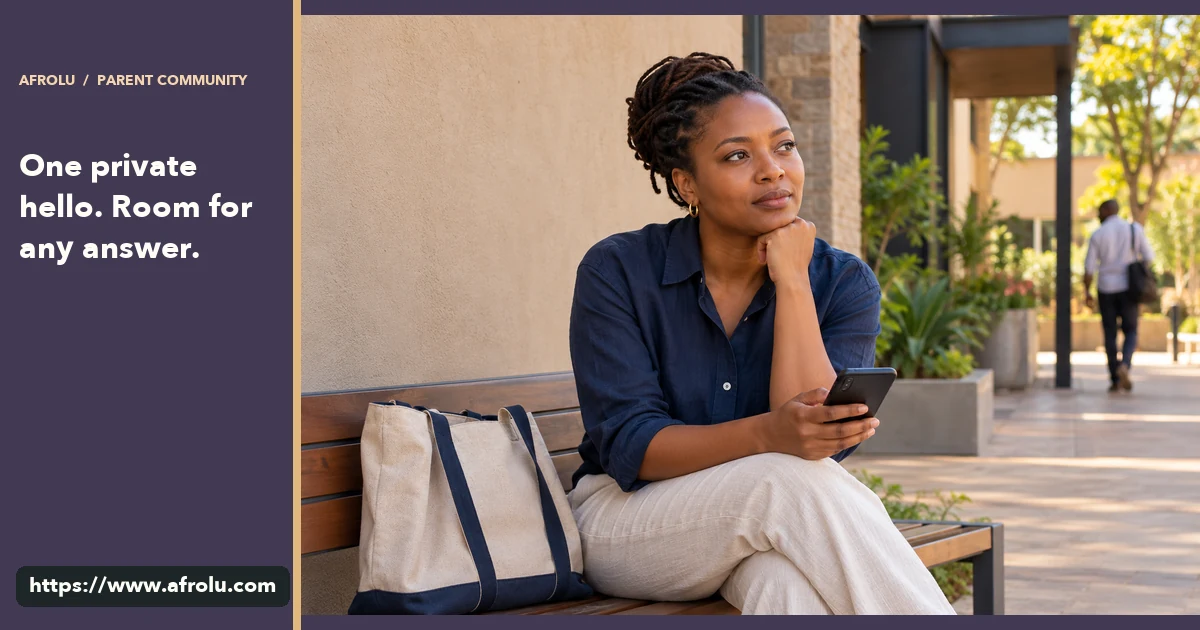
Nairobi parent Adisa sees a familiar adult, Tendo, on a dating app. They have spoken once at a school event, but do not know each other well. Adisa wonders whether a first message would be awkward because their families share a community. The decision is not whether Tendo's profile means interest in Adisa; it is whether Adisa wants to make one private, respectful invitation and accept the answer.
Use the dating channel for the dating choice
If the app allows Adisa to message, she can use it. A school list or parent group exists for school communication; it is not an invitation to turn another person's school contact details into a dating message. Children should not be asked to carry questions between adults.
eSafety advises minimizing information about children on dating profiles. The choice to keep school channels and children out of a dating invitation is Afrolu's practical example, not a rule stated by eSafety.
Before you press send
The channelUse the dating app, not a school directory or child's message.
The wordsAsk the adult a simple question without naming children.
The answerLeave room for yes, no or no reply.
Make the message answerable without naming children
Adisa can write, 'Hello Tendo. It was nice meeting you at a community event. Would you like to talk here?' She can leave out children's names, school activities and routines. Tendo can say yes, no or nothing.
A familiar face is not proof that Tendo wants a date. Love is respect recommends discussing expectations and respecting boundaries instead of assuming another person's wishes.
A simple first message
An invitation Tendo can decline
Invented app messages between adult parents Adisa and Tendo.
- Adisa
- “Hello Tendo. It was nice meeting you at a community event. Would you like to talk here?”
- Tendo
- “Hello. Thank you, but I would rather keep school and dating separate.”
- Adisa
- “I understand. Take care.”
The invitation stays between adults, and the no is accepted.
Let a no stay private
If Tendo declines, Adisa can say, 'Thanks for telling me. Take care.' She should not ask mutual parents or children to discover why. If there is no reply, she can leave the message there and keep the school event about the event.
At the next school gathering either adult can choose an ordinary greeting. They do not owe a public explanation or have to pretend they are close friends.
Respect the reply
What did the adult choose?
- They want to talk
Continue on terms both adults choose, keeping children's details private.
- They decline
Accept the answer without using school or children to reopen it.
- They do not reply
Leave the message and keep school interactions ordinary.
Keep children out of the first meeting
If both adults want to meet, they can plan a public place and their own transport. eSafety advises care with children's information when dating online; RAINN recommends public early meetings and control of travel as risk-reduction steps.
The adults can decide later what to share with family, guided by their own circumstances. One shared community does not replace getting to know a date.
Keep reading
Keep dating and family spaces clear
Sources and what they can tell us
Adisa, Tendo and their school meeting are invented. The sample message and school-channel boundary are Afrolu examples; families and communities differ.
- eSafety Commissioner: Online dating
It advises minimizing children's details and avoiding children's images on dating profiles.
Limit: It does not decide whether Adisa should message a school acquaintance. - Love is respect: Boundaries and expectations
It explains that expectations need discussion and personal boundaries should be respected.
Limit: It does not require Tendo to answer or accept a date. - RAINN: Tips for safer dating online and in person
It recommends public early meetings and control of travel as ways to reduce risk.
Limit: It does not guarantee safety or decide what families should share later.
Questions about a familiar parent
Does seeing a profile mean they want to date me?
No. A profile does not answer that question. The other adult chooses whether to reply.
Can I use the parent-group number instead?
A school contact channel is for its stated purpose. Use the dating app if you choose to make a dating invitation.
Must I avoid them at school after a no?
No. You may be civil at school without discussing the app or asking for an explanation.
Should children help arrange the first date?
No. Adults can make and decline their own plans without involving children.