Nairobi · Faith and first dates
Ask about values, and leave room for a real answer
Start here
Ask how faith shapes everyday choices, how each person handles disagreement, and what pace feels comfortable. Listen for a real answer rather than a label you hoped to hear. Meet in a setting where you can talk and leave easily. You may keep your values, say no to a second date, or take more time without defending yourself.
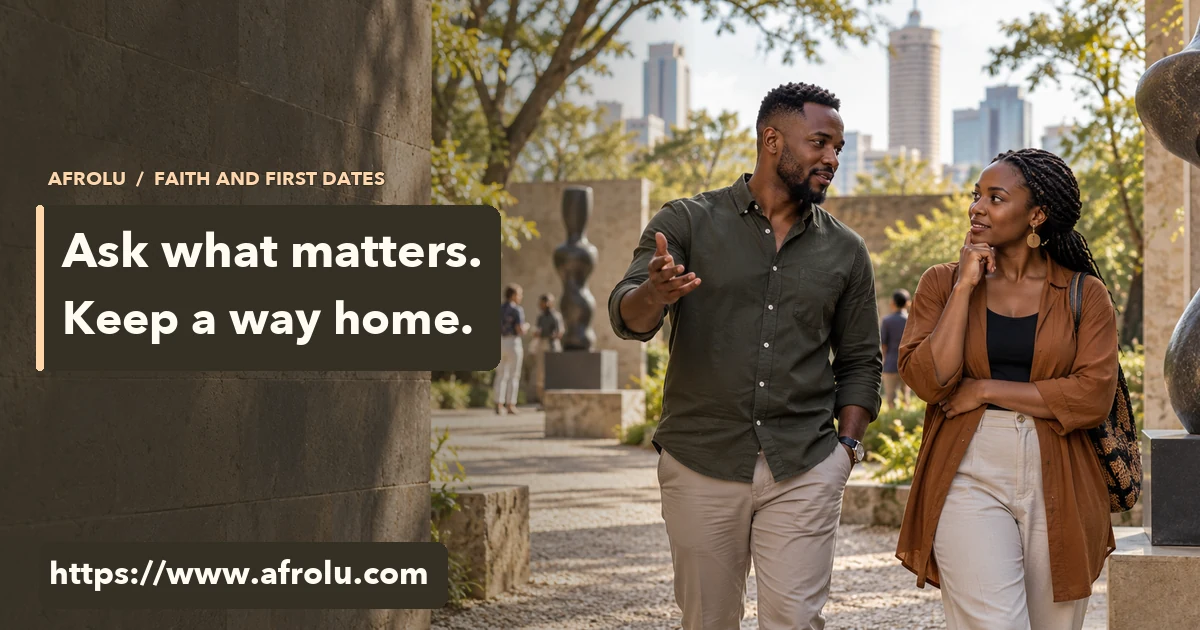
At a daylight art courtyard in Nairobi, adults Ruth and Daniel meet for tea. Both have said faith is part of their lives. Ruth wants to learn what that means on a normal Tuesday, not make Daniel recite the answer she has prepared.
Try questions a person can answer honestly
Ask, 'What part of your faith gives you strength in a busy week?' Then listen. You can also ask, 'When we disagree, how would you want us to talk?' and 'What kind of relationship are you looking for now?'
These questions invite a story and a choice. They do not ask someone to prove they are good enough in ten minutes. Share your own answer in plain words so the exchange goes both ways.
Example conversation
A question that opens a conversation
This invented exchange is between adult Nairobi daters Ruth and Daniel in a public courtyard.
This is an invented example.
- Ruth
- “What does faith change in your ordinary week?”
- Daniel
- “I make time to pray and help my aunt on Sundays. What about you?”
- Ruth
- “Community matters to me. I also need space to ask questions when we disagree.”
They describe actions and make space for difference instead of checking a label.
Ask about pace without promising yours
A first date is a good time to ask what a comfortable next step looks like. Ruth might say she likes meeting in public while she gets to know someone. Daniel can say what he prefers, and neither has to agree to a future plan on the spot.
Love is respect describes boundaries as personal limits that should be discussed and respected. If your values or comfort differ, a respectful no is a useful answer.
Choose a meeting you can leave
Pick a public place with people around and a time that suits you. Let a trusted person know your plan if this is someone you met online. Keep your own route home; a short date can be enough.
eSafety's adult online-dating guide recommends saving a match's profile before a meeting and telling someone where you will be. Afrolu's public-courtyard example is a practical setting, not a promise that any venue removes risk.
A person who presses for a private place after you name your plan is showing you how they treat a boundary. You can cancel or leave.
Hear what they do, not only what they call themselves
Faith labels can mean different routines, hopes and limits. Ask for one example: 'How do you make time for faith and family when work is busy?' If the answer is new to you, ask a follow-up rather than filling in the blank.
A first meeting cannot prove lasting compatibility. It can show whether you can speak openly and whether a question gets respect.
Choose from the answer
How did the conversation feel?
- You could ask and answer freely
Suggest another short meeting if you both want one.
- A value is different but respected
Take time to decide whether that difference works for you.
- Your pace or exit was challenged
Leave or decline the next meeting and tell someone you trust if needed.
End kindly and decide later
If you would like another conversation, say so with a real suggestion. If you are unsure, say you need time. If you know you do not want another date, a short honest answer is enough.
Your faith is part of your choice; it is not permission for someone else to pressure you. Love is respect says consent to one moment does not create consent to the next.
Keep reading
A related question
Sources and what they can tell us
Ruth, Daniel, their words and the courtyard are Afrolu examples. The linked sources address boundaries, consent and meeting preparation, not a rule for faith compatibility.
- Love is respect: What are my boundaries?
It says boundaries can reflect a person's values and comfort, should be communicated, and deserve respect once the other person knows them.
Limit: It does not supply a faith test or decide whether Ruth and Daniel share enough beliefs to date. - eSafety Commissioner: Online dating
Its adult pre-meeting advice says to keep a record of the person's profile and let a trusted person know the meeting plan, including where and when.
Limit: It does not certify the invented Nairobi courtyard or make any public meeting risk-free. - Love is respect: How consent works
It says people should feel comfortable with each activity and that agreement at one time never creates an obligation to agree again later.
Limit: It does not require a second date, a particular faith practice or any of the sample questions in this guide.
Questions you may still have
Should I ask about marriage on the first date?
You can ask about long-term hopes if it matters to you; let the other adult answer in their own time.
What if we share a faith but practise differently?
Ask how that difference appears in daily life. A shared label alone cannot settle it.
Do I owe a second date after a good talk?
No. Enjoying a conversation does not make a future meeting compulsory.
Can I leave early if I feel uneasy?
Yes. Keep your own way home and contact a trusted person if you want support.