Students · Relationship label
They posted us as a couple. What can I do?
Start here
If someone posts that you are a couple before you have agreed, you can ask them to remove the tag or post. Say which part you did not agree to: the photo, the label, the audience or all three. You may still like the person and want to talk about a relationship. That talk is separate from permission to share your image or call you a couple online. If they refuse your request, use the platform's privacy tools and decide whether you want another date.
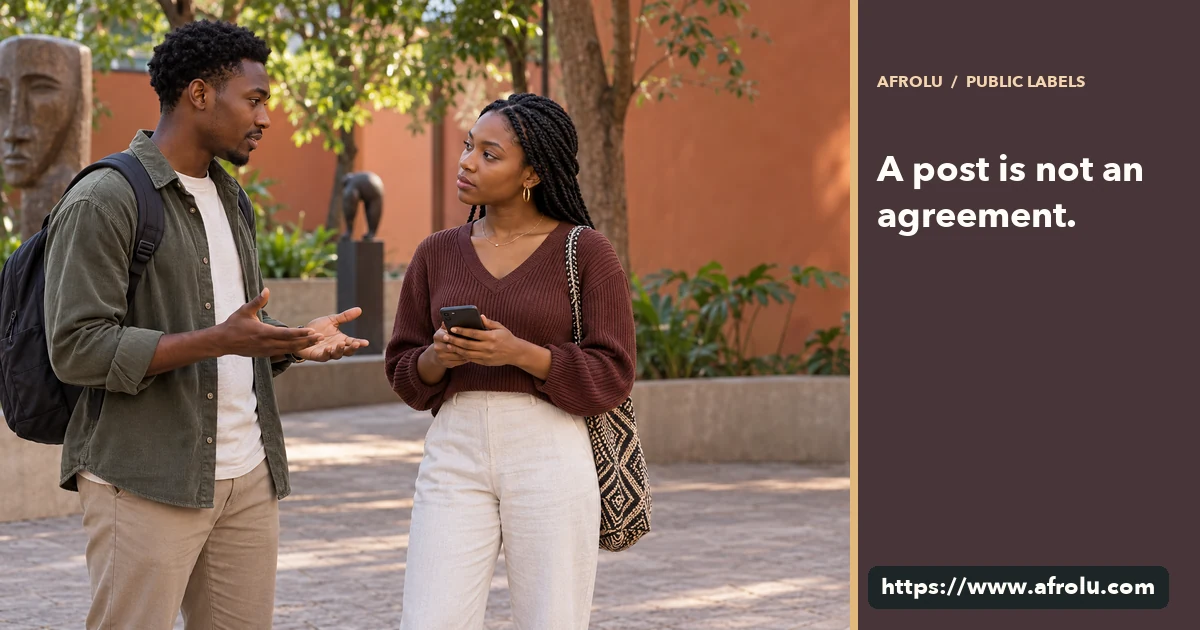
Amara, 26, has met Peter, 27, twice near their Nairobi campus. A friend sends her Peter's new public post: a photo of them at an art courtyard with the words 'my partner.' Amara enjoyed the dates, but they have never agreed to be a couple or to share the photo. She wants the post changed before she decides what their dating connection means.
Name the part you did not agree to
A photo, a tag and the word 'partner' are different choices. Amara may be comfortable with a private picture but not a public label. She can say exactly what she wants removed. Peter may not have meant harm; that does not make her permission automatic.
Love is respect treats social posts as digital boundaries people can discuss. It also notes that once something is posted, the sender loses some control over where it goes.
Amara can keep a copy of the post if she needs a record. She does not need to answer the comments or explain her dating life to classmates.
Separate the three choices
- The photo
- May this image be shared at all?
- The label
- Have you both agreed to be called a couple?
- The audience
- Who, if anyone, may see or tag the post?
Words after a post is live
A request about the post, not a verdict on the date
Invented message between adult students Amara and Peter after a public photo was posted.
- Amara
- “I saw the photo and the partner label. I did not agree to either being public. Please remove the post.”
- Peter
- “I did not ask first. I will remove it now.”
- Amara
- “Thank you. We can talk later about what we each want from dating and what, if anything, we share online.”
The online boundary is addressed first; a relationship label remains a separate conversation.
Ask for a change in one clear sentence
She can say, 'I did not agree to be tagged or called your partner online. Please remove this post today.' A clear request gives Peter a choice he can act on. It does not require Amara to decide whether they will be exclusive.
If a friend shared the post, she can ask that friend not to repost it. She can also check the platform's current tag and audience controls; the exact buttons differ by service.
Read the response
What does their response allow you to choose?
- They remove it and listen
You can talk about the relationship and future posting if you want to.
- They need time to find the control
Ask for a clear update and use your own tag or audience controls meanwhile.
- They refuse or post again
Use the platform tools available to you and decide whether to stop the connection.
- The post exposes a private place or detail
Ask for quick removal, protect the information you still control and seek help if you feel unsafe.
Discuss the relationship after the post is handled
They may both want to keep dating. They can ask whether either is seeing others, what 'partner' means to each, and whether either wants future photos online. No public audience needs to vote on the answer.
If Peter removes the post and listens, Amara may choose another date. If he calls her privacy request a test of love or posts again without asking, she can stop dating. A removed post does not erase every copy, but his response shows how he treats a stated limit.
Keep reading
Keep the next agreement clear
Sources and what they can tell us
Amara, Peter, the post and the exchange are invented. Sources support digital boundaries and privacy; the removal request and dating choices are Afrolu examples, not platform instructions.
- Love is respect: Digital boundaries
It treats posting about a relationship and sharing online material as choices partners should discuss.
Limit: It cannot remove Amara’s particular post or make a caption into an exclusivity agreement. - Love is respect: Boundaries and expectations
It supports saying what you are comfortable with instead of assuming a partner already knows.
Limit: It does not tell Peter which service button to press or decide whether Amara should keep dating him. - eSafety Commissioner: Online dating: how to stay safe
It advises checking privacy settings and limiting personal information shared through dating and social accounts.
Limit: It does not guarantee that deleting a post removes copies other people saved.
Questions after an unexpected couple post
Can I ask for a tag to come down even if I like them?
Yes. Liking a person does not grant permission to post your image or name you as a partner.
Does a public post make us exclusive?
No. Exclusivity is a mutual agreement between the adults, not a caption.
What if the post is already copied?
You may not control every copy. Ask for removal of the original and use current platform report or privacy tools where appropriate.
Do I have to announce why I asked?
No. You can keep the reason between the people involved.
Can we agree to post later?
Yes. Decide together what may be shared, by whom and with which audience.