Diaspora dating · low-pressure weekends
Diaspora Dating Red Flags for Low-Pressure Weekends
Diaspora dating red flags for low-pressure weekends: protect travel, time, community privacy, money, consent and a free route home without losing warmth.
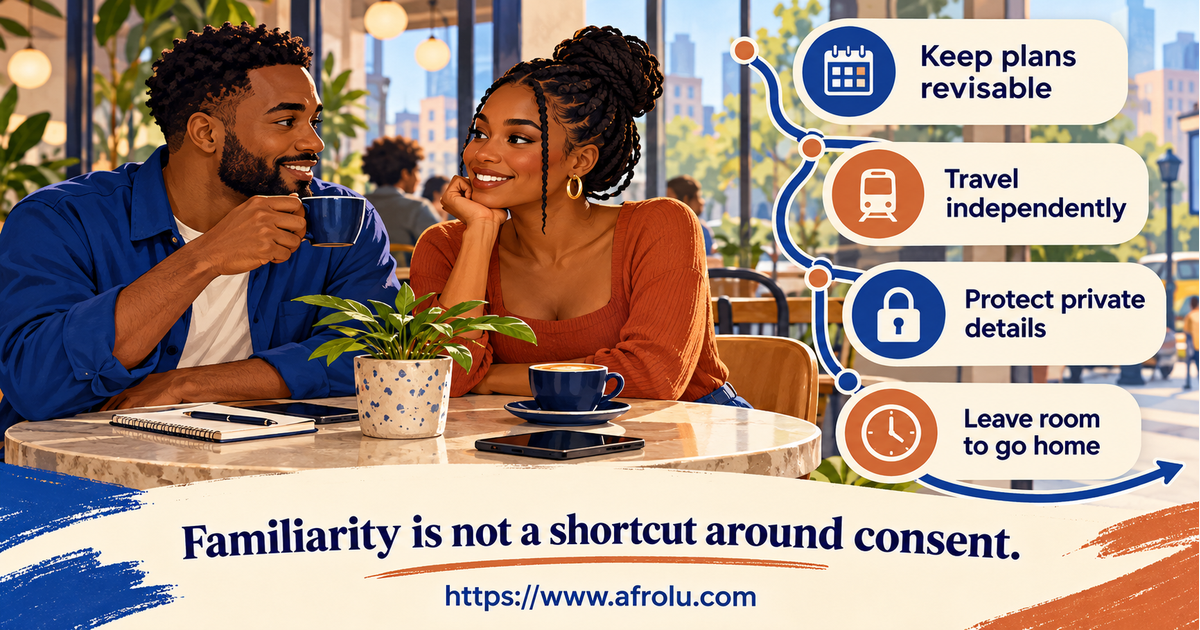
Shared roots never make your next choice overdue.
Written and edited by Tariro Ncube · Diaspora Dating Editor
Keep a diaspora dating weekend low pressure by choosing an ordinary public plan, independent travel and lodging, broad rather than detailed private information, a realistic contact rhythm, and no financial rescue. Shared roots can be meaningful without becoming a claim on trust. Repeated guilt, money urgency, monitoring, indirect community contact, coercion, threats, or fear call for less access and a more protected response.
Dating safety · Diaspora Daters
Does this weekend plan leave you able to choose travel, contact, privacy, community involvement, money, intimacy, and a route home freely, or is familiarity being used to rush access?
Diaspora dating red flags are observable behaviours that make travel, time, money, community, privacy, consent, or an exit less voluntary. They can include pressure disguised as cultural familiarity, monitoring across time zones, financial urgency, location demands, indirect contact through others, coercion, threats, or fear. The phrase describes conduct, not a culture, community, migration story, or diagnosis of a person.
Leila feels an immediate ease with a match who understands family spread across countries, then notices that a weekend trip, live calls, mutual friends, and a travel expense are being treated as proof of trust. She separates recognition from obligation, proposes a smaller public plan, keeps travel and money independent, and watches the response. That gives her a way to learn without making belonging the price of her own judgement.
diaspora dating · low-pressure weekends
Leila keeps connection across distance from becoming a claim on travel, money, community, or privacy
This guide treats diaspora dating as human connection shaped by practical distance, not as a stereotype. It separates warmth and recognition from pressure that shrinks a dater's choices.
Make a weekend revisable, clarify distance logistics, protect community boundaries and private information, separate money from care, keep consent current, and choose a next step that fits the observed pattern.
Keep the plan revisable
A good invitation leaves both adults able to change it without debt.
Make logistics visible
Travel, time, lodging, cost, and a route home deserve plain facts.
Protect social privacy
Shared contacts cannot become a channel around a direct boundary.
Choose the safer scale
Slow down, reduce access, or seek support when pressure or fear appears.
Let a weekend be an invitation, not a test of belonging
Low pressure starts when a plan leaves both adults able to choose it again tomorrow
Leila matches with someone who also has family across borders. Their messages are easy, and he suggests that she fly to a nearby city for the weekend because they already have so much in common. Leila does not need to prove that she values the connection by turning it into travel. She asks what each person expects from the visit, keeps her own transport and accommodation options, and decides whether a shorter public plan tells her more than a full weekend away.
Weekend dating can be delightful precisely because it is limited: a coffee after errands, a gallery visit, a daytime market, a walk in a well-used public space, or one planned call across a time difference. A low-pressure plan has an ordinary ending point, a route home that remains yours, and no hidden requirement to become more intimate, spend money, share an address, meet relatives, or prove seriousness because the calendar is inconvenient.
Be wary when cultural familiarity is used as leverage. A date may say that someone from your community should not be so cautious, that refusing a late invitation is disrespectful, or that you ought to trust them because of a shared origin. Those statements turn identity into a shortcut around present consent. A compatible person can appreciate common ground while accepting that you decide the pace, the place, the level of disclosure, and whether there is another date.
If a weekend plan leaves you anxious about money, travel, a private address, being stranded, being introduced before you are ready, or disappointing a wider social circle, let that practical information count. You can choose one public hour, propose a different week, decline without an explanation, or stop the connection. Low pressure is not a style of wording; it is the real room to say no without losing safety, dignity, or control of your next day.
Make distance visible before emotion makes it expensive
A relationship across cities or countries needs practical agreements about communication, travel, cost, privacy, and what either person is actually offering now
A time difference can make one person’s evening another person’s workday or rest time. Talk about a contact rhythm that does not turn delayed replies into accusations. A useful agreement might name broad windows, the right to miss a call, and what each person will do instead of repeatedly ringing, checking a location, demanding a live video, or recruiting friends to verify where the other adult is. Availability is not proof of affection when lives already span more than one routine.
Travel decisions deserve their own conversation. Before booking anything, ask who pays for what, whether each adult has independent transport, where each person will stay, what happens if the chemistry is different in person, and whether the visit can end early without a financial or emotional penalty. A considerate invitation does not require you to share a room, surrender your passport or device, depend on a ride, reveal a private address, or accept a last-minute change that makes leaving harder.
Do not let migration paperwork, currency differences, family obligations, or a dramatic border story create urgency around money. A person can have a real difficulty and still not be someone you should fund, sponsor, receive payments for, lend documents to, or add to an account. Pause, verify independently through channels you control, and keep financial and identity information private. Compassion and a financial boundary can exist in the same sentence.
Distance also changes what reassurance should look like. Consistent conduct, clear plans, respectful curiosity, and a willingness to accept a slower meeting are more useful than constant access. If someone refuses reasonable questions, uses unexplained emergencies to demand transfers, makes a weekend visit the price of continued interest, or becomes angry when you keep a separate plan, reduce access. You do not have to settle a global future before deciding whether the next local step is safe and freely chosen.
Keep a shared community from becoming a surveillance network
Diaspora social worlds can be close-knit, but no introduction, mutual contact, group chat, workplace link, family connection, or community event gives a date ownership of your information
A mutual acquaintance may feel reassuring, yet it is not a background check or a waiver of boundaries. People can know the same restaurant, school, employer, neighbourhood, community group, or family friend and still be strangers to one another. If a date says that everyone knows they are trustworthy, asks who else you have spoken to, or uses a shared contact to pressure you into a private meeting, return to observable behaviour. The relevant question is whether your current no is respected.
Set a simple information rule with friends when needed: please do not pass on my location, schedule, address, screenshots, or messages, and please do not mediate an ending for me. This is not an accusation against the community. It protects people from being pulled into a conflict they did not choose and makes it harder for a date to turn social warmth into a route around a direct boundary.
Be especially cautious with digital proximity. Shared diaspora groups can expose photos, event attendance, work announcements, travel plans, and relatives’ comments in one place. Review audiences, remove unnecessary public details, avoid posting a current location in real time, and keep dates out of group-chat entertainment. If you learn that private information has been spread, save what is safe to save, reduce visibility, tell one trusted person, and choose whether a direct response would lower or raise risk.
A respectful person does not make you choose between dating them and belonging to your community. They do not threaten gossip, hint that they can ruin a reputation, contact relatives, wait at familiar gatherings, or demand that you perform closeness in public. If social overlap starts to feel like monitoring, pressure, or fear, take it seriously. A quieter plan, different venue, blocked contact, platform reporting, or local support may be more useful than trying to persuade a crowd that your boundary is reasonable.

Read the response to your boundary, not shared background alone.
Offer a broad truth before a detailed map of your life
Early trust does not need your exact location, immigration documents, employer, flight details, family schedules, account screens, live location, or private images
You can say that you are in a general area, that you have family commitments, that you travel sometimes, or that a weekend does not work without naming a building, route, ticket, address, employer, airport, document, or calendar. A calm date can take the answer at its scale. Someone who responds with interrogation, mockery, or a demand for proof is showing that they view access as an entitlement rather than something you decide together.
Keep account recovery codes, banking notifications, identity documents, residence details, travel confirmations, device passcodes, cloud albums, private call links, and location-sharing settings out of early dating. A request can sound practical—help me check in, prove you are travelling, send the booking, let me use your account—but pressure often begins where a small piece of access is treated as proof of trust. Use a different route for logistics that does not require surrendering control.
Video calls can be useful without becoming surveillance. Choose a time and backdrop you freely want, and remember that declining a live call or turning off a camera does not make you deceptive. Do not record or share intimate conversations without consent. If someone repeatedly demands visual proof, screenshots, private photographs, or access to people around you, name the limit once if it is safe and reduce the channel rather than creating more material for them to hold.
If you have already shared a detail that now feels too exposed, do not let shame make you give more. Change passwords or settings from a safer device when relevant, remove public travel information, ask trusted people not to relay details, and consider support if unwanted contact grows. Restoring privacy is a practical decision, not a confession that you made a mistake by enjoying a conversation or trusting someone at the time.

You can be warm without giving up a route home.
Keep travel, gifts, and rescue stories outside the proof of care
A paid ticket, meal, transfer, hotel offer, gift, immigration story, or family emergency does not make you responsible for another adult’s access, debt, body, time, or future
Long-distance and diaspora dating can invite plausible financial stories: a cancelled journey, a currency problem, a stranded relative, a document fee, a health concern, a business opportunity, or a request to receive funds. You do not need to decide whether every detail is false in order to keep your money separate. Do not transfer funds, share a code, lend an account, accept a payment for forwarding, send identity documents, or commit to travel because someone says immediate action proves love.
A generous date can offer to cover a meal or a ticket and still accept a no. The concern begins when spending is counted afterward: you owe a private room, an overnight stay, an introduction to family, sex, a loan, an extension of the trip, or another chance to explain yourself. Keep enough independent money, charge, transport, and lodging options for a visit to end. Declining an offer is not an insult, and accepting a small kindness is not consent to a larger arrangement.
If money is genuinely part of a relationship conversation, make it slow, factual, and separate from intimacy. Two adults may have different budgets, remittance responsibilities, or travel capacity. That is a compatibility question, not a character failure. The red flag is secrecy, leverage, repeated urgency, a shifting story, or an attempt to make your resources the price of continued affection. A person who values you can discuss limits without turning them into shame.
When an exchange has already happened and it feels concerning, move toward recovery rather than private negotiation. Contact the relevant bank, payment service, account provider, platform, or professional support route promptly if useful; preserve relevant information where safe; and avoid meeting alone to settle a debt or promise. You can stop participating in a financial pattern without proving a complete theory about the person who asked.
Keep a visit, a call, and intimacy open to revision
A booked plan is not a completed obligation, and an earlier yes does not settle the next touch, room, photograph, call, or night
Travel and anticipation can make a person feel responsible for salvaging a plan after the mood changes. You are not. If you arrive and want a public activity instead of a private one, want to leave earlier, do not want physical intimacy, or do not want to continue the visit, choose the option that protects your ability to go. A partner may feel disappointed; they do not get to block a door, hold a device, threaten exposure, withhold transport, or make safety depend on changing your mind.
Talk about sexual health and personal limits voluntarily, not as a price of access. Adults can name what they want, what they do not want, and what information is relevant to their current informed choice. They do not owe photos, medical records, a history audit, or agreement while exhausted, isolated, intoxicated, or under financial pressure. A person who calls a pause an insult is showing why the pause matters.
Build exits before they are needed. Meet publicly while you are still learning about one another, keep control of your phone and transport, tell a trusted person a broad plan when that adds safety, and avoid sharing accommodation because someone says it is more convenient or romantic. These choices do not accuse every new date. They make it possible to act on a change of mind without first winning an argument about why it changed.
If there are threats, coercion, unwanted sexual contact, image pressure, stalking, or fear, stop treating the situation as an invitation problem. Use a protected exit, preserve information if safe, contact emergency assistance if you are in immediate danger, and seek trusted, specialist, health, legal, security, or local support that fits your circumstances. A dating guide cannot judge a specific risk, but it can affirm that fear is enough reason to make the plan smaller and get help.

Choose the action that keeps your weekend and exit yours.
Judge a connection by the room it leaves around your life
Before increasing time, travel, intimacy, disclosure, or money, ask whether the relationship is making ordinary routines more workable or more difficult to keep
After a few conversations, review the practical facts. Can you decline a weekend without an argument? Can you keep independent travel, lodging, money, and a route home? Can you talk about community overlap without being monitored through it? Can you keep documents, location, family, work, and private images private? Can you end a call or visit without being punished, pursued, or made to feel responsible for another adult’s disappointment? Those answers are more useful than intensity or shared background.
A steady pattern may include clear plans, an accepted no, an apology that changes the next action, respect for different schedules, and generosity with no claim attached. An amber pattern may be a mismatch in availability, travel budget, or desired pace. A red pattern includes repeated pressure, financial urgency, monitoring, threats, indirect contact, coercion, or fear. The categories are not moral labels; they point to different choices about access and support.
Choose one action that fits the evidence rather than attempting to solve the entire future. You may propose a daytime local plan, keep a conversation on the app, postpone travel, decline to share a document, ask a direct scope question, stop transfers, tell a trusted person, pause, or end contact. If you need support, you do not have to explain every cultural detail perfectly before using it. Your safety and free choice are enough reasons to seek a practical next move.
Belonging should expand your life, not narrow it. A connection that lets you sleep, work, visit people you trust, manage money, move through a weekend, and say no without dread may be worth learning about. If the connection turns warmth into obligation or community into surveillance, a smaller plan can be the clearest form of care for yourself. You can value shared roots and still insist that your present choices remain entirely your own.
Eight diaspora weekend dating moments

A shared background becomes a rushed trip
A new match says they will pay for Dara's flight because people from the same community should not need so much caution.
Dara declines the trip for now and suggests one bounded public call, watching whether the decision is accepted without guilt.A time difference is treated as secrecy
Jonah misses a late call because it is the middle of his workday, then receives repeated demands for a live video and location proof.
Jonah states a realistic contact window and reduces access if ordinary unavailability is repeatedly punished.A mutual contact is recruited to persuade
After an unanswered message, a date asks a mutual friend to tell Priya where he is and why she should give another chance.
Priya asks the friend not to relay information and treats indirect contact as a boundary issue rather than community gossip.Travel cost becomes a claim on a private room
A visitor says booking separate lodging would be insulting after they paid for dinner and made the trip.
The host keeps accommodation separate and ends or changes the plan if a no is turned into an emotional debt.A practical question becomes identity access
A match asks Sami to send a passport image to prove that a future journey is real.
Sami shares no document and keeps logistics at the broad level that feels safe.Urgency arrives with a transfer request
A person says a relative needs immediate money and that a small transfer will prove Nia is serious about the relationship.
Nia sends no funds or codes, checks independently if appropriate, and ends contact if leverage continues.Two adults want different travel rhythms
One person enjoys occasional video calls and local dating; the other needs frequent visits and daily contact.
They name the mismatch without using culture, distance, or sacrifice to make either preference a defect.A public visit becomes a private demand
At the end of a museum date, an adult decides they want to go home rather than continue to a private flat.
They use their own transport, leave, and treat resistance to the changed plan as meaningful information.Signals about travel, time, community, privacy, money, consent, and a route home
They can enjoy shared background without making it evidence that you owe trust, travel, intimacy, or a faster pace.
They treat a delayed reply across work, rest, caregiving, or time zones as a reason for a conversation, not surveillance.
They accept a public plan, separate accommodation, and independent transport without making caution sound disrespectful.
They use mutual friends, group chats, family, or community events to gather information or pressure you after you asked for space.
They ask for a general location and can accept that an address, route, ticket, or schedule stays private.
They request money, transfers, account access, documents, codes, travel funding, or help receiving funds before trust is established.
They can discuss different budgets, travel capacity, and family obligations without treating resources as proof of affection.
They accept that a booked visit, meal, gift, or previous intimacy does not decide what happens next.
They make a specific repair after a mistake instead of using an apology to reopen the same demand.
They do not threaten gossip, reputation harm, family contact, or community exclusion when you decline access.
They keep private calls, images, messages, and disclosures out of group conversations and social media.
They do not make a private room, live video, location sharing, or instant reply a condition of continued warmth.
They do not use changing travel stories, urgency, or guilt to make independent verification feel like betrayal.
They do not leave you afraid to decline a weekend, end a call, go home, block contact, or attend a familiar community space.
Choose a proportionate next move
| Situation | What it may mean | What to do next |
|---|---|---|
| They want a quicker visit | A different pace can be ordinary until your boundary becomes something to defeat. | Offer only the local or public plan you freely want, or decline. |
| They call repeatedly across a time difference | A missed call is normal; persistent demands for proof can become monitoring. | Name a broad contact limit and reduce the channel if it is not respected. |
| They offer to pay for travel | Generosity is safe only when declining does not create a debt. | Keep independent transport, lodging, and money or postpone the trip. |
| They ask for a document or booking proof | A logistical question can become identity or location access. | Keep documents and detailed itineraries private; use broad facts only. |
| They ask a mutual contact about you | Social overlap can become a route around a direct boundary. | Ask others not to relay details and limit exposed routine information. |
| They need urgent financial help | A compelling story can be real and still be a request you should not carry. | Do not transfer funds, codes, documents, or account access; verify independently. |
| They are disappointed by a boundary | Disappointment is not the issue; retaliation or bargaining is. | Keep the boundary and watch whether conduct stays respectful. |
| They want a private end-of-date plan | A changed itinerary may make leaving harder when you have travelled or are tired. | Use independent transport and choose a public or homeward route. |
| They threaten gossip or family contact | Reputation pressure can turn community warmth into coercion. | Preserve information if safe, tell one trusted person, and reduce access. |
| You feel afraid to say no | Fear changes the task from dating clarity to safety planning. | Prioritise a protected exit and appropriate urgent, specialist, or local support. |
Twelve lines for travel, location, money, community, and an ending
“I am not travelling for a first meeting. I am open to a public plan where I can leave independently.”
“I do not answer on demand across my work and rest hours. We can choose a time that works for both of us.”
“I am comfortable naming the area, not my address, route, or live location.”
“I do not share identity documents, bookings, account details, or verification codes with someone I am dating.”
“If I visit, I will arrange my own place to stay and my own way home.”
“I do not send money, receive transfers, or use my accounts for a dating connection.”
“Please do not ask people around me for information or involve them in this conversation.”
“I am leaving after this part of the date. I am not continuing somewhere private tonight.”
“Our travel and contact expectations do not fit, so I am stepping back from this connection.”
“I asked for space. Do not keep calling, use other accounts, or contact people around me.”
“I do not want to continue this connection. Please do not contact me again.”
“I am not meeting privately to discuss this. I am getting support and need no further contact.”
Know the difference
A shared connection, a distance mismatch, and pressure for access need different responses
A person can enjoy common ground, name a travel or contact preference, accept a slower plan, keep money and privacy separate, and make an ordinary repair without reducing your ability to choose.
Guilt about belonging, travel leverage, money urgency, location demands, monitoring, indirect community contact, threats, or fear turn connection into a claim on access you have not freely offered.
Shared background and future promises do not decide the risk. The observed pattern and your freedom to leave do.

The pattern and freedom decide the next move, not the promise.
Separate warmth, a practical mismatch, and access pressure
| Type or dimension | What it describes | Best next question |
|---|---|---|
| Shared recognition | A common background creates warmth while both adults keep their own pace and boundaries. | Enjoy the connection without treating it as proof of trust. |
| Belonging pressure | Identity or community is used to make caution, privacy, or a no seem disloyal. | Return to the current boundary and reduce access if guilt continues. |
| A travel invitation | A visit has independent transport, lodging, cost clarity, and a real option to leave. | Choose only the plan you can revise safely. |
| Travel leverage | A ticket, distance, or expense is used to demand a room, intimacy, money, or more time. | Keep plans separate and end the visit if pressure appears. |
| A contact mismatch | Two adults want different call or visit rhythms and can name that without punishment. | Clarify or leave the arrangement. |
| Monitoring | Delayed replies, live location, calls, or video proof are used to narrow ordinary freedom. | Keep devices and location private; seek support if it continues. |
| Free generosity | A meal or gift carries no later claim on access, sex, money, or a future trip. | Accept or decline while keeping your exit independent. |
| Financial leverage | Urgent travel, document, or family stories are used to secure money or account access. | Pause, verify independently, and make no transfer under pressure. |
| Safety concern | Threats, stalking, coercion, unwanted contact, or fear require more than a dating discussion. | Use a protected exit and appropriate support. |
Start with the weekend you can freely revise
Familiar is not the same as safe
Shared roots can be meaningful without deciding what access you offer today.
Distance needs logistics
Travel, cost, lodging, timing, privacy, and a way home are relationship information, not boring obstacles.
Community needs consent
A mutual contact cannot become a route around a direct boundary.
Privacy can be broad
An honest answer does not need an address, document, schedule, or live map.
Money needs a pause
Urgency is not evidence that a transfer, code, or account access is safe.
A weekend can stay small
A short public plan can reveal more than a high-stakes trip designed to force certainty.
Questions organised by purpose and depth
Choose a few prompts that fit the moment. This is a reference library, not a list to complete.
Weekend audit
Use before agreeing to a visit.
- Can I leave independently?
- What cost or lodging detail needs clarity?
- What would I decline without apology?
Distance audit
Use when future plans start sounding urgent.
- What is actually offered today?
- What travel, money, or document detail stays private?
- Can we accept a slower route?
Community audit
Use when social overlap feels complicated.
- Who can see my routine?
- Who should not relay information?
- Would a shared setting make an ending harder?
Safety audit
Use if access begins to feel less free.
- Can I say no without retaliation?
- What record is safe to keep?
- Who can help me make the next move?
Look more closely at travel, time zones, community, money, technology, and endings
Build a visit that can end early
Discuss transport, costs, lodging, public plans, and a no-fault way home before booking or accepting a trip.
Evidence limit: A public plan cannot guarantee safety in every situation.
Communication is not surveillance
Choose a realistic rhythm instead of treating delayed replies, missed calls, or camera-off moments as proof of deception.
Evidence limit: A guide cannot determine another person’s intent from one message.
Recognition needs consent
Keep friends, relatives, groups, and shared spaces from becoming information routes after a boundary.
Evidence limit: Community support varies; choose the safest trusted person or local route.
Compassion and a financial boundary can coexist
Pause requests for transfers, codes, documents, accounts, travel funds, or forwarding payments and verify independently.
Evidence limit: A concerning request does not prove every person is committing fraud.
Digital access travels farther than a weekend
Review location, images, audience settings, accounts, calls, and travel posts when unwanted contact begins.
Evidence limit: Change settings carefully if another person could notice and escalate.
Risk changes the amount of discussion you need
Use a concise end for mismatch and a more protected route when pressure, threats, unwanted contact, or fear appear.
Evidence limit: Blocking alone may not resolve every safety concern.
Shortcuts that can turn familiar connection into pressure
Treating shared background as a safety certificate
Mutual culture or community can be meaningful without replacing a present boundary or independent judgement.
Letting distance create false urgency
A future visit or relocation idea does not require immediate travel, money, disclosure, or intimacy.
Using friends as investigators
Gathering gossip can escalate a conflict and is not required before you reduce access.
Trading private proof for reassurance
Documents, tickets, live locations, account details, and images can make an exit harder instead of building trust.
Paying emotional debt for a trip
A ticket, gift, or meal does not cancel your right to change a plan or go home.
Letting shame delay support
Threats, reputation pressure, money requests, or repeated unwanted contact are easier to address early with trusted help.
Choose one resource that fits the fact in front of you
Use a guide for a clearer travel or communication boundary, a safety plan for concerning conduct, or a slower route when you still want to learn about the connection.
Explore the guide library
Show more related guides
Continue with Afrolu
Show more Afrolu guides
Sources used for this guide
Afrolu reviewed these health, research, safety, or public guidance resources while editing this page. They support the behaviour and safety guidance; they do not diagnose any individual described by a reader.
Questions about diaspora dating red flags and low-pressure weekends
Are dating red flags different in diaspora dating?
The core question is the same: does conduct reduce your free choice? Distance, travel, shared community, documents, money, time zones, and family ties can add practical access points that deserve extra clarity.
Is it rude to decline a weekend trip?
No. You can decline travel, choose a shorter public plan, arrange separate lodging, or wait. A considerate person can be disappointed without making caution a loyalty test.
Can I ask for proof before visiting someone abroad?
You can ask questions and verify through independent routes, but keep your own documents, money, itinerary, and exit options private. Do not rely on a date’s explanation alone for safety-critical choices.
What if a date says shared culture means I should trust them?
Shared culture can create warmth, not entitlement. State the current boundary and look at how they respond rather than arguing about what your community should mean.
Should I send money for a travel or family emergency?
Do not transfer funds, share codes, lend accounts, or provide documents to create early trust. Pause and independently verify where appropriate; compassion does not require financial access.
How do I handle a time-zone mismatch?
Name a contact rhythm that fits both adults’ work, rest, and responsibilities. A mismatch can be ordinary; repeated demands for instant replies, video proof, or location access are different.
Can mutual friends make a date safer?
They can offer context, but they are not a safety guarantee. Do not let friends become messengers, monitors, or a route around a direct no.
Do I need to share my address or travel details?
No. Broad information can be honest while an exact address, route, booking, document, or live location remains private until sharing is freely chosen.
What if a person threatens gossip or family contact?
Treat reputation pressure seriously. Preserve information if safe, tell a trusted person, reduce visibility and contact, and seek support if fear, threats, or unwanted contact continue.
How can I keep a weekend low pressure?
Use an ordinary public plan, independent travel and funds, a clear ending point, no obligation to extend, and permission for either adult to change their mind.
One thing to do now
Let every weekend leave your plans, privacy, and route home in your own hands
Choose the smallest next action that protects independent travel, money, lodging, private information, community boundaries, current consent, a realistic contact rhythm, trusted support, and a way to go home or end contact.