Adult student life · non-exclusive dating
Date more than one person without making promises you cannot keep
Adult students can date non-exclusively with honest terms, realistic time and money limits, clear sexual-health conversations and a fair way to change course.
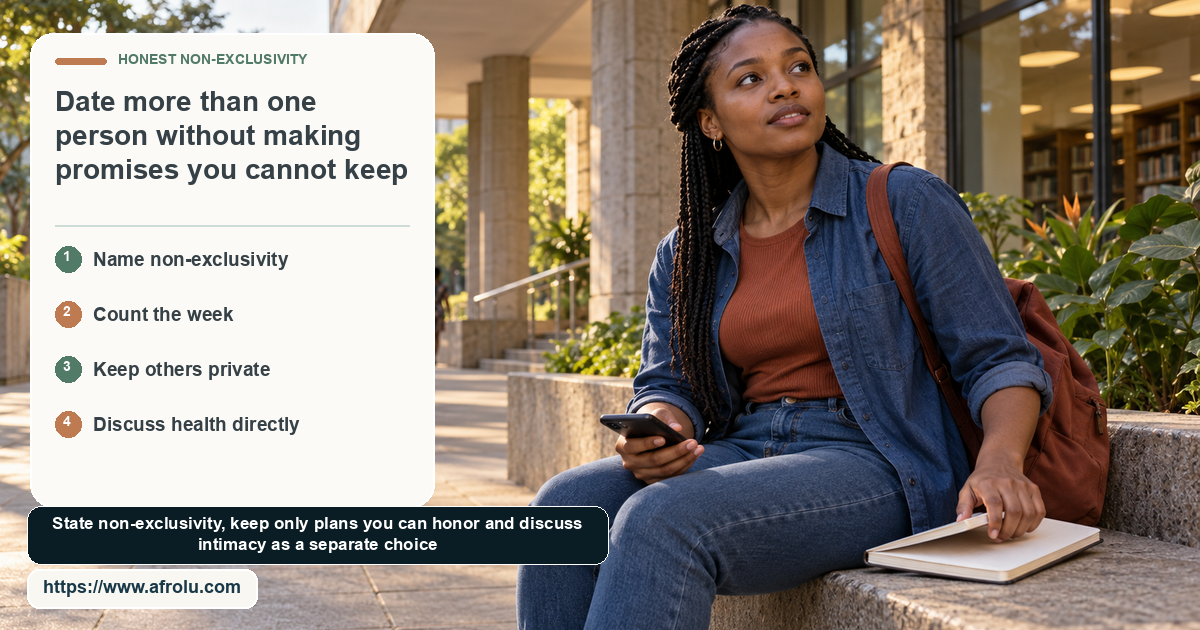
Honesty about non-exclusivity works with realistic capacity and separate health choices.
Written and edited by Liya Bekele · Horn of Africa Editor
Decide how many conversations and dates your actual week can hold, and tell someone you are dating non-exclusively before your conduct leads them to assume otherwise. You do not owe a roster of other people's names, but you should answer honestly about terms that affect their choice. Keep study time, transport and spending within your limits. If intimacy may occur, discuss consent, protection and testing directly rather than treating 'casual' as a sexual-health agreement. Revisit exclusivity when someone wants it, and accept that another adult may decline the arrangement.
Dating ethics · Students
How do I date more than one person without implying exclusivity, overbooking my week or turning private health choices into guesses?
Dating multiple people means maintaining more than one potential romantic connection at the same time. It can be ethical when present terms are understood and freely chosen; it does not imply sex, unlimited availability or a promise that every connection will continue.
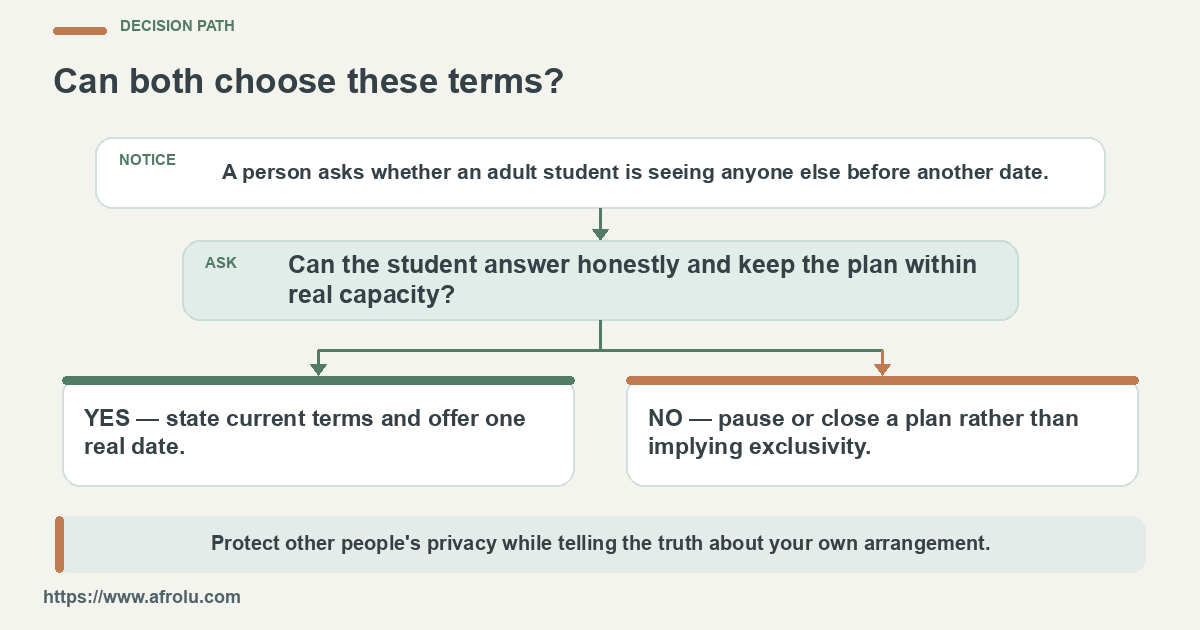
Illustrative scenario: An adult student in Nairobi enjoys meeting two people over several weeks. One asks whether the student is seeing anyone else before another date. The student answers yes, explains that no exclusive agreement has been made, and asks whether that works for the other person. They also notice that two dates plus classes and transport already fill their week, so they stop opening new chats.
Capacity and consent
The fair arrangement is one people can actually choose
A student's limited calendar makes vague promises costly. The aim is clear terms and real follow-through, not an impressive number of dates.
Name the current non-exclusive arrangement, protect other people's privacy, and check time, spending and sexual-health decisions separately.
Say what is true
Non-exclusive is a current fact, not a hidden option.
Count the week
Classes and rest belong on the calendar too.
Protect everyone
No one owes a roster of another person's details.
Talk directly
Consent, protection and testing are their own choices.
Tell the truth early
Non-exclusive cannot live only in your head
A first coffee does not automatically create exclusivity, but several affectionate dates can build different expectations. When the question becomes relevant, state whether you are also seeing others. If the other adult asks directly, answer directly. You can protect the names and personal stories of those other adults while being honest about the arrangement that affects this person's choice.
love is respect's dating-definitions resource observes that casual relationships may or may not be exclusive. That is U.S.-based guidance on discussing ground rules, not a rule that everyone must date in one style. Avoid asking the other adult to infer your terms from an app profile or the fact that no label was spoken.
If someone wants exclusivity, hear the request as a choice about fit. You may accept and agree when it starts, decline because you want to continue non-exclusively, or take time without asking them to remain available. Do not imply a future commitment simply to keep a date that would otherwise end.
Count real capacity
Several dates compete with study, rest and fare money
Look at an ordinary week with classes, paid work if any, assignments, friends and sleep. Add the travel and cost of each proposed meeting. You may have room for two conversations but only one date, or for no new dating while exams approach. That is a capacity decision, not an assessment of anyone's worth.
Avoid making duplicate tentative plans for the same evening so you can choose later. If a time is uncertain, say that before the other adult reserves it. A modest public date may fit better than expensive outings, but nobody should have to lend money, skip essential costs or travel beyond comfort to maintain a casual connection.
When chats begin to blur together, stop adding new ones. Recall what each person actually told you rather than sending identical messages or pretending to remember details. A smaller number of conversations can be more respectful to everyone, including you, if it lets you make and keep real choices.

A count of matches cannot measure fairness.
Keep health explicit
Dating overlap does not tell you what anyone has chosen sexually
Seeing more than one person does not mean having sex with any of them. Likewise, an exclusive dating label does not prove a person's sexual-health status. If physical intimacy is a possibility, talk about what each adult wants, contraception where relevant, STI testing and protection before a decision is made. Each encounter still requires consent.
The U.S. Centers for Disease Control and Prevention advises testing and correct condom use as ways to reduce STI risk, and notes that many infections have no symptoms. The advice is medical guidance from the U.S.; local clinicians can help with individual testing and care in Kenya. Do not infer status from someone's appearance, relationship label or a reassuring promise.
You need not disclose another person's name or private medical history to discuss your own recent choices and the protection you want. If you are not ready for that conversation, you may decide not to be intimate. A person who pressures you past a stated condition is giving you information about whether the encounter is freely chosen.

Do not imply later exclusivity to retain the date.
Avoid a contest
People are not candidates on one shared scoreboard
It can be tempting to rank replies, gifts or looks when several conversations are open. That framework obscures whether you enjoy and respect each person on their own terms. A delayed reply may reflect class or work, while an expensive invitation may still be unsuitable. Ask whether the actual connection and arrangement fit you rather than awarding points for performance.
Do not tell one adult private details about another to provoke jealousy or extract a commitment. If one relationship is becoming more important, consider what you want before asking anyone to change terms. You can date non-exclusively and still be responsible for your own words, plans and emotional boundaries.
The other adults may also date elsewhere unless exclusivity is agreed. If that possibility troubles you, say what you would prefer. You are free to seek an exclusive arrangement and they are free to decline it. Ambivalence is a reason for a conversation or pause, not for monitoring another person's messages.
Change the agreement
Exclusivity begins with a conversation, not a feeling
After several dates you may want to focus on one person. Tell them what has changed and ask whether they want the same arrangement. Do not call yourselves exclusive before both have agreed, and do not keep other dates as a secret fallback after agreeing. If the answer is no, decide whether you still freely choose the present terms.
If you stop seeing someone, a short kind close is more useful than fading away after plans have been made. You need not compare them with another date or offer feedback they did not ask for. Cancel chosen meetings clearly so their time and fare are not wasted, and leave room for them to feel disappointed without bargaining for a different answer.
You can also decide that several connections are too demanding and take a break from all of them. The useful measure is not how many choices remain open; it is whether your conduct matches what you have said and leaves each adult able to choose. That standard still matters when your semester, health or hopes change.

Cancel real plans clearly if stopping.
A student week with more than one date
A date asks about other people
The student is seeing more than one person and has not agreed to exclusivity.
Answer yes without revealing another person's identity.Three chats seek meetings
Study and sleep leave no room for every proposed date.
Offer only a time that exists or close a thread.Two tentative plans occupy Friday
Neither other adult knows their time is being held as a fallback.
Choose and confirm one plan; release the other promptly.A second date exceeds fare budget
The student likes the person but cannot fund the proposed outing.
Offer an affordable public alternative.Someone assumes casual means sex
The dating label cannot answer consent or sexual-health choices.
Discuss what each adult wants and prevention separately.One connection becomes more serious
The student wants to focus on one person; the other may or may not agree.
Ask when exclusivity would start before closing other plans.Fairness you can put on the calendar
The student answers honestly when asked about other dating.
Non-exclusivity is explained before a false expectation grows.
Other adults' names and private details are not shared.
Classes, work and sleep remain visible in the calendar.
Two people are not kept as backups for one slot.
Fare and venue costs stay within the student's means.
Dating overlap is not equated with sexual activity.
Consent, testing and protection are discussed when relevant.
Choose before you promise time
| Situation | What it may mean | What to do next |
|---|---|---|
| Another match appears | A profile is an option, not a commitment. | Check whether real time remains before opening it. |
| Exclusivity is asked about | The answer affects the other adult's choice. | State current non-exclusive terms directly. |
| Names are requested | Another adult's privacy matters too. | Share the arrangement, not their personal details. |
| A date is suggested | Travel and cost may strain a student budget. | Offer a feasible public option. |
| Intimacy is possible | Dating terms do not settle health or consent. | Talk about choices, testing and protection. |
| Someone wants exclusivity | The proposed terms are changing. | Answer yes, no or ask for time without reserving them. |
Say non-exclusive without naming others
“I am meeting other people and have not agreed to exclusivity.”
“I can talk about my own dating terms, but I will not share their details.”
“Would you be comfortable continuing on that basis?”
“Saturday afternoon is free for a public walk if that appeals.”
“Before intimacy, I want us to discuss testing and protection.”
“My preference has changed; would you want to discuss dating only each other?”
Know the difference
Honest non-exclusive terms versus silent assumptions
The other adult knows dating is non-exclusive and can accept, ask or decline.
Affection and repeated dates are allowed to imply exclusivity that was never discussed.
Protect other people's privacy while telling the truth about your own arrangement.

When terms change, ask before acting.
Informed terms versus silent assumptions
| Type or dimension | What it describes | Best next question |
|---|---|---|
| Several chats | Conversations that may not be dates. | Keep only what attention permits. |
| Non-exclusivity | A current dating term affecting choice. | Say it when relevant. |
| Another person's story | Private information that is not yours to disclose. | Keep names and details private. |
| Student budget | Money needed for travel, study and essentials. | Choose affordable activities. |
| Consent | A specific voluntary decision about intimacy. | Ask without pressure each time. |
| STI status | A health fact not visible from a label or appearance. | Discuss testing with a clinician as needed. |
Keep study, fare and choice intact
Honesty need not expose others
You can state non-exclusivity without naming the people you meet.
Capacity has a cost
A date uses fare, travel time and attention as well as an open calendar square.
More options can reduce presence
When chats blur, stop opening new ones and attend to real choices.
Casual does not mean sexual
Sexual activity, consent and prevention need their own conversation.
Changing terms requires two
Wanting exclusivity does not make it a shared agreement.
Questions before another match or date
Choose a few prompts that fit the moment. This is a reference library, not a list to complete.
Before another match
Check finite capacity.
- What classes and work are fixed?
- Can I attend to this conversation?
- Can I afford another date?
Before another date
Make terms available to choose.
- Have I answered honestly about exclusivity?
- Have I protected others' privacy?
- Is the public plan real?
Before intimacy
Separate health from the label.
- Do we both want this?
- What protection will we use?
- What testing information do we need?
What relationship and health sources support
Non-exclusive terms
love is respect says casual dating may or may not include exclusivity or sex.
Evidence limit: People must describe their own arrangement.
Choice and limits
love is respect distinguishes specific boundaries from assumptions.
Evidence limit: U.S. education, not a rule about how many people to date.
Sexual health
CDC advises testing, protection and direct discussion to reduce STI risk.
Evidence limit: U.S. medical guidance; a local clinician can advise an individual in Kenya.
Early meetings
RAINN describes public meetings and independent return options.
Evidence limit: Risk-reduction suggestions, not a guarantee.
Messaging terms
love is respect suggests discussing digital expectations.
Evidence limit: It does not define a required message pace for students.
Where casual becomes careless
Hiding behind no label
An unspoken term can still mislead a person making a choice.
Naming other dates
Their private information is not required for honest disclosure.
Double booking
It holds another adult's time as an unchosen fallback.
Overspending to keep pace
A date should not displace fare, food or study essentials.
Assuming casual means consent
Every intimate choice remains separate and voluntary.
Make one honest plan within your week
Pair truthful terms with consent, a real calendar and a clear close when needed.
Explore the guide library
Continue with Afrolu
Dating terms and sexual-health sources
Afrolu reviewed these health, research, safety, or public guidance resources while editing this page. They support the behaviour and safety guidance; they do not diagnose any individual described by a reader.
Questions about overlap and exclusivity
Is it wrong to date more than one person?
The key is truthful present terms, each adult's choice and plans you can actually honor.
When should I mention non-exclusivity?
Say it when it affects the other adult's decision and answer directly when asked.
Must I disclose who else I date?
No. State your arrangement while protecting other people's names and private stories.
Does casual mean sex is expected?
No. Any intimate choice needs its own voluntary conversation.
How many chats are too many?
There is no universal number. Stop adding them when you cannot pay attention or keep plans.
Can I suggest a cheap date?
Yes. Offer a public activity that fits both adults' budget and travel comfort.
Do multiple dates require an STI conversation?
Dating overlap alone does not imply sex. Before intimacy, discuss testing and protection with each relevant partner.
What if I change my mind about one person?
Ask whether they want new terms; your feeling alone does not establish exclusivity.
One thing to do now
Tell the truth and keep one real plan
Be truthful about non-exclusivity, then limit the number of commitments to what your time, money and attention can honor.