Heartbreak · parenting · casual terms
Date again without making a new person your repair plan
A parent returning to dating after heartbreak can set honest casual terms, protect a child's stability and notice when grief calls for time rather than a date.

Choose a pace that leaves space for grief and parenting without assigning a new date a repair role.
Written and edited by Ruth Akinyi · Local Dating Editor
You do not need to be perfectly healed to meet someone, and a date should not have to carry the work of repairing a past relationship. Notice whether you can be present, hear a no and describe your current terms without hoping the other adult will rescue you or wait for you to become ready. Keep a child's routine and introductions separate from early casual dating. If grief overwhelms every meeting, pause and seek support beyond the person you have just met.
Starting over · Parents Returning To Dating
Can I enjoy a new connection while I am still hurt, and what do I need to say about the kind of dating I can offer?
Dating after heartbreak as a parent means choosing an adult connection while still making room for grief and family responsibilities. Casual dating is a present agreement to be discussed; it is not a promise of eventual commitment or permission to be vague.
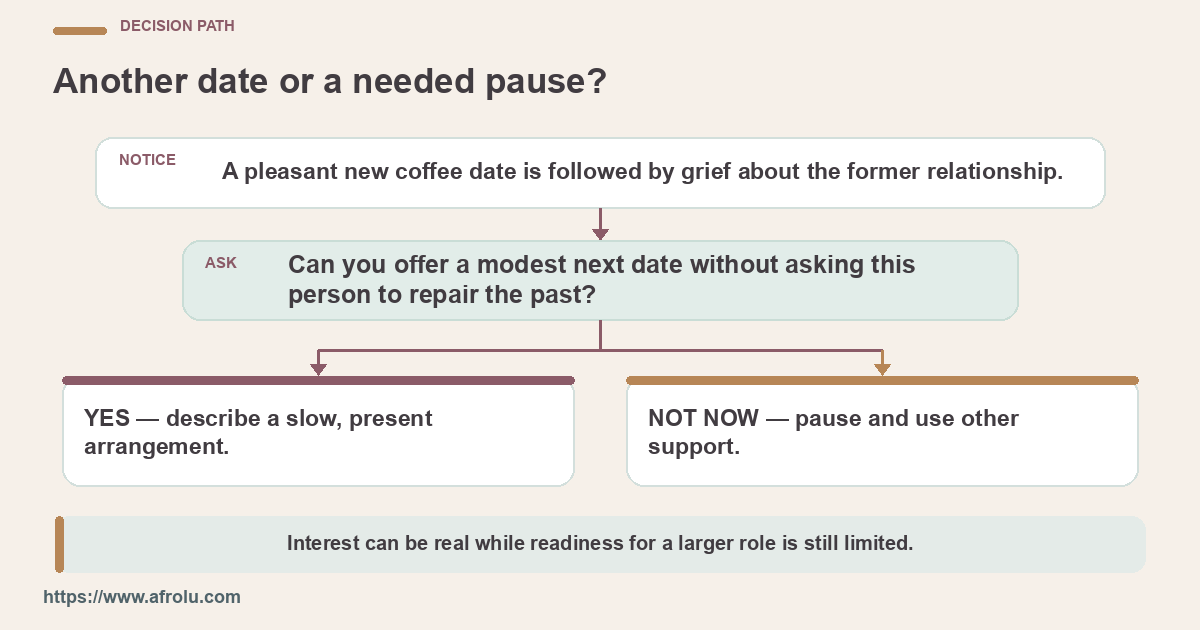
Illustrative scenario: After a breakup, a parent enjoys coffee with someone new and feels unexpectedly hopeful. That evening, a reminder of the former relationship brings sadness. Instead of sending the new date a long account of the breakup or disappearing, the parent takes a day to reflect and then says they would like to meet again at an unhurried, non-exclusive pace. The child is not drawn into the meeting.
Two lives in view
Make room for grief without recruiting a new date to solve it
Wanting company and feeling sad can coexist. The useful question is what kind of contact you can choose and sustain today.
Check your emotional capacity, name the current dating arrangement, and leave child involvement as a separate later decision.
Give it support
Use trusted people or professional care when a new date cannot hold it.
State the present
Slow and non-exclusive need plain meanings.
Keep a boundary
An enjoyable adult date gives no new family role.
Accept an answer
The other adult can want something different now.
Notice what is present
Sadness need not be hidden or handed to a stranger
A breakup can change routines, confidence and the future you imagined. Feeling sadness after an enjoyable new date does not prove you made a mistake. Equally, a rush of relief with a new person does not mean the old pain has disappeared. Let both facts exist before promising a pace you may not want next week.
The American Psychological Association describes loss of self and distress after breakups, while its discussion of coping does not set a universal timetable for new relationships. Your decision is personal and practical: can you be interested in this person as they are, listen to their answer and take care of yourself between meetings?
A new date can know that you are dating after a hard ending without becoming the person who processes every memory with you. If conversations repeatedly turn into updates about the former partner, use a friend, counsellor or another appropriate support space. That protects your own recovery and gives the new adult room to be met on their own terms.
Describe the offer
Casual should describe conduct, not conceal uncertainty
Before another date, decide what you mean by casual. You may want occasional adult company, non-exclusive dates, time before any label or no current capacity for a committed relationship. Those are different arrangements. Say the part that affects the other adult's choice rather than assuming they will hear the same meaning in one word.
love is respect's dating-definitions and boundary guidance says that relationship words matter less than the boundaries and ground rules people discuss. This is U.S.-based relationship education, not a rule that casual dating must include sex or non-exclusivity. Ask about the actual agreement, and revisit it if either person's preference changes.
Do not hint that patience will earn commitment later if you cannot make that promise. If a new person wants exclusivity now, acknowledge the mismatch. You can be genuinely drawn to them and still decline a relationship you cannot presently offer. An honest no is kinder than leaving them to infer a future from your warmth.

No score or arbitrary healing timeline is implied.
Protect family space
Your child does not need to test the new connection
A parent may need to arrange care, end a date at a certain time or decline a last-minute invitation. You can explain the broad limit without sending a child's school, photographs, exact handover schedule or the story of your co-parenting relationship. A new adult can decide whether the available dating time suits them without receiving a child's private details.
Australia's eSafety Commissioner advises protecting identifying information and images about children, including clues to location. That advice is not Kenyan family-law instruction; it supports a simple privacy choice while someone is still new. An introduction, if one ever becomes appropriate, is a later decision shaped by the child and family context, not a reward for several pleasant dates.
Notice if heartbreak makes you eager for a replacement household or for someone to reassure you that your family is whole. Those longings deserve compassion, but an early date cannot responsibly be assigned that role. Let the adult connection become known over time; keep childcare, financial support and emotional parenting separate from a casual invitation.

An ex-partner's private story is not required to answer.
Handle a difficult moment
A reminder of the past can change tonight's capacity
A song, message from a former partner or child-related handover may unsettle you before a planned date. Take a moment to decide whether you still want to go. If you need to cancel, tell the other person before they travel, without giving details you do not wish to share. Offer another real time only if you would choose it.
If you feel able to meet but need a gentler evening, propose a shorter public activity. The other adult can accept or prefer to reschedule. Avoid treating their disappointment as proof they are unsympathetic; they may have arranged their own time and money. Clear information lets both adults make a choice.
If the same pattern repeatedly prevents you from being present, a pause may be the more caring decision. love is respect's readiness questions include whether time and emotional capacity fit a relationship, but they do not deliver a pass or fail score. Use your lived pattern to decide whether to continue, slow down or rest.
Check the next date
You can continue slowly, or stop without a dramatic reason
If you can enjoy this person's company without asking them to repair the past, invite one modest next meeting and restate any relevant casual terms. Notice whether the arrangement leaves room for parenting and life beyond dating. A connection may grow later, but the present agreement should be enough for both people today.
If one person begins wanting exclusivity, more contact or child involvement, discuss that change explicitly. Neither a third date nor physical closeness quietly rewrites earlier terms. If the desired arrangements diverge, close with care instead of offering a conditional future that would hold the other adult in place.
If you decide not to date now, that choice does not erase the good parts of the meeting. Tell the person you are stepping back and seek companionship or support through people and spaces better suited to what you need. You can return to dating when you choose, without proving that all sadness has vanished.

Revisit terms only when wishes truly change.
When a new date meets an old ache
Hope arrives before certainty
The parent enjoys a new person and later feels sad about the old relationship.
Check capacity before promising another date.A new date receives a full breakup history
The conversation begins to make them responsible for processing grief.
Move the deeper story to trusted support.One expects exclusivity
The parent meant a slow, non-exclusive pace but did not say so.
Explain current terms before the next meeting.The new adult asks to meet the child
An adult connection is still too new for that separate decision.
Keep early dates adult-only and decline a timetable.Dating repeatedly feels unavailable
The parent cannot be present despite genuine curiosity.
Step back and use other support without a return promise.Signs of present capacity
The parent can enjoy this person's company without asking them to cure sadness.
Grief has support outside the new date.
The present non-exclusive or slow terms are stated plainly.
Child information stays outside early dating conversations.
A family duty can be named broadly without a child's timetable.
A changed plan is communicated before the other person travels.
A pause remains an honest, available response.
Choose the next adult step
| Situation | What it may mean | What to do next |
|---|---|---|
| After a good date | Hope and sadness can coexist. | Check what you can offer next, not whether all grief is gone. |
| Past memories arise | The former relationship still needs attention. | Use support outside the new date for deeper processing. |
| Casual is proposed | The word may hide different assumptions. | State non-exclusivity and pace in ordinary words. |
| An introduction is asked for | That is a family decision beyond early adult dating. | Decline or defer without a promised date. |
| Grief interrupts a plan | The meeting may no longer be kind to either adult. | Update promptly; shorten, replace or cancel. |
| The parent steps back | Stopping can be honest without disowning a good meeting. | Close the connection and seek appropriate support. |
Words for a slow invitation or pause
“I liked talking with you over coffee.”
“I am dating slowly at the moment.”
“I have not chosen an exclusive arrangement.”
“Would another coffee next week suit you on those terms?”
“I am not ready to involve my child in dating.”
“I am stepping back from dating for now and will not leave this open.”
Know the difference
A present adult invitation versus a repair promise
The parent can enjoy a new person and explain today's pace and non-exclusive terms.
A new adult is asked to cure grief or become family before either has chosen that role.
Interest can be real while readiness for a larger role is still limited.

Respect a different need for commitment.
A date cannot be a repair plan
| Type or dimension | What it describes | Best next question |
|---|---|---|
| Sadness | A feeling after loss, not automatic proof dating is wrong. | Notice what action is possible today. |
| Support | A place to process grief beyond a new date. | Use trusted people or qualified care as appropriate. |
| Casual contact | The present terms the adults choose. | Specify pace and exclusivity. |
| Child introduction | A separate family choice with broader consequences. | Leave it for a later decision. |
| New commitment | A changed agreement both adults choose. | Discuss before acting as though it exists. |
Keep these boundaries in view
Mixed feelings are possible
A date can be enjoyable while grief still appears later that evening.
A new person is not a cure
Curiosity about them should have room beside the parent's own recovery.
Children have another timetable
A promising adult date does not create a family role.
A pause can be generous
Stopping when presence is impossible avoids offering an empty invitation.
Questions for grief, terms and family
Choose a few prompts that fit the moment. This is a reference library, not a list to complete.
Before another date
Check presence, not a healing score.
- Am I curious about this adult?
- Can I hear their no?
- What can I offer this week?
Before describing casual
Make the arrangement understandable.
- Am I seeing others?
- What contact pace fits?
- What am I unable to promise?
When grief interrupts
Choose a fair update.
- Can I still be present?
- Is there a real replacement?
- Would a pause be kinder?
What breakup guidance supports and where it stops
Breakup experience
APA discusses distress and identity shifts reported after relationship endings.
Evidence limit: Research summary does not set a recovery timetable for this parent.
Readiness questions
love is respect asks about emotional presence and commitments.
Evidence limit: Questions are prompts, not a clinical test or a waiting period.
Dating terms
love is respect says casual relationships may or may not be exclusive.
Evidence limit: Both adults must specify their own present ground rules.
Child information
eSafety recommends protecting children's identifying details and images.
Evidence limit: Australian privacy guidance, not Kenyan legal advice.
Changing limits
love is respect distinguishes boundaries from pressure to move them.
Evidence limit: No source can decide whether one reader is ready for a new partner.
Promises grief cannot make
Making a new date the grief counsellor
It assigns a role the person did not choose.
Using casual as a shield
The other adult still needs to know present terms.
Introducing a child to test chemistry
A family decision should not be an early dating experiment.
Disappearing after a trigger
A booked date deserves a timely update.
Offer a date that fits your present life
Keep grief support, the adult invitation and child privacy in their own places.
Explore the guide library
Show more related guides
Breakup, boundaries and child-privacy sources
Afrolu reviewed these health, research, safety, or public guidance resources while editing this page. They support the behaviour and safety guidance; they do not diagnose any individual described by a reader.
Questions about dating after loss
Must I be fully over my ex to date?
There is no universal test. Ask whether you can be present, honest and fair about the contact you offer now.
Should I explain the entire breakup on a first date?
Share what you choose, but a new date need not become your main place for processing grief.
Is casual dating automatically non-exclusive?
No. Say explicitly whether exclusivity is or is not part of the present arrangement.
What if I feel sad after a good date?
Mixed feelings can coexist. Check what you want next rather than interpreting sadness as a verdict.
When should my child meet someone new?
That is a separate later family decision; an early date does not require an introduction.
How do I cancel when grief resurfaces?
Tell them before travel, give only the explanation you wish and offer a new time only if real.
Could a break be unfair to them?
A clear pause is often fairer than an indefinite invitation you cannot honor.
One thing to do now
Make only the invitation you can hold
Offer only the pace and terms you can hold now; give grief other places to be heard and keep parenting decisions separate.