Adult students · casual terms · Nairobi
Keep a casual date light without leaving the terms blurry
Adult students in Nairobi can date casually with clear expectations, consent, shared-circle privacy, a budget and an independent way home from each meeting.
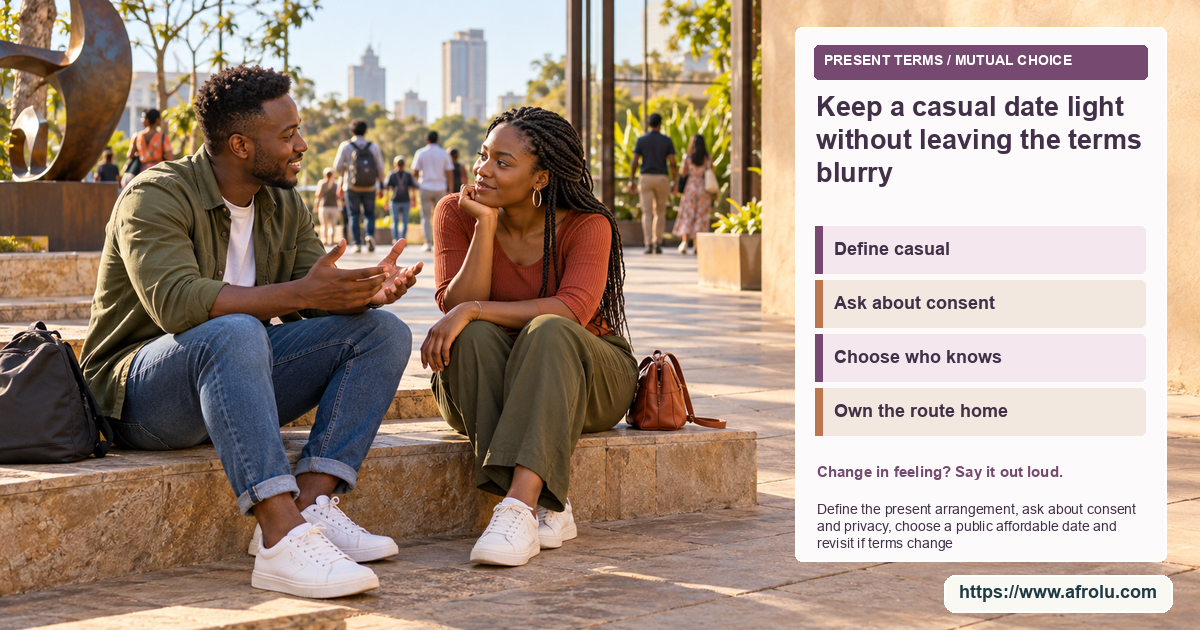
Casual is an invitation to define terms, not permission to assume intimacy or public sharing.
Written and edited by Ruth Akinyi · Local Dating Editor
Say what casual means to you now: perhaps occasional dates without exclusivity or a commitment promise. Ask what the other adult means, because the label may hide different expectations. Agree separately on intimacy, contraception or STI questions that matter to you, photos and social sharing, and a date you can afford and leave independently. You may both change your minds, but a change deserves a new conversation rather than a quiet rule change. A casual arrangement can be caring and honest; it is not a reason to keep someone guessing or to accept pressure.
Dating styles · Students
How do I say I want something casual without sounding evasive or assuming the other person wants the same thing?
Casual dating describes an adult connection without an assumed commitment or exclusive future. The term does not settle whether people see others, have sex, text daily or introduce one another to friends; those are separate choices.
Illustrative scenario: Two adult students meet at a public café after class. One says they are open to occasional dates but not exclusivity this term. The other thought 'casual' meant exclusive dates without a relationship label. They spend a few minutes clarifying those meanings before deciding whether a second meeting makes sense. Neither has to agree simply because the first outing was pleasant.
A clear small agreement
Casual is a starting word, not a complete deal
The useful conversation has four parts. None requires a lifelong promise, and each gives the other adult room to decline without being called demanding.
Discuss present terms before the next outing, then make the meeting affordable and easy to leave.
What is offered?
Say whether you want occasional dates, exclusivity or neither.
What is wanted now?
Consent and sexual-health choices remain separate from a label.
Who will know?
Ask before a campus photo, tag or group-chat story.
How will you leave?
Choose public arrival, your budget and your own return.
Before the next date
Ask what casual means to each of you
A person can say 'casual' because they want one date at a time with no future label; another may mean they are meeting several people; a third may want exclusive companionship without planning marriage. None of those meanings appears automatically in the word. Tell the other adult what you mean in plain present tense, then let them describe what they heard. The aim is shared information, not a clever phrase that keeps every option open.
The conversation can be short. 'I enjoy this, and I am not offering exclusivity this term' gives the other adult something real to accept or decline. If they hope for a committed relationship, do not answer with a vague 'maybe later' merely to keep the date. You may later want something different, but you cannot use a possible future change as today's agreement.
Separate the body
An arrangement label never answers a consent question
A casual date does not imply sex, kissing or a private visit. WHO describes sexual health as requiring respectful, pleasurable and safe experiences free from coercion. love is respect likewise says consent is specific and can be withdrawn. Those principles guide the conversation; they do not tell you what two particular adults should choose. Ask in the moment, accept no and decide together what information or protection you need before any sexual activity.
Do not let a shared student budget become pressure. Paying for a meal or transport does not buy intimacy; agreeing to one activity does not settle the next. If you want time to discuss contraception or STI testing, say so before moving into a private setting. If either person feels unable to ask or answer freely, slow down or end the encounter rather than trying to rescue the mood.

The visual must not compress the questions into a green score.
Four choices inside one label
- Terms spoken
- Both adults can state today's non-exclusive or exclusive terms.
- Consent specific
- Each activity receives a separate, freely chosen answer.
- Sharing agreed
- Photographs, tags and shared-circle stories are discussed.
- Own return
- The date is affordable with a route each controls.
Keep in mind: Four separate choices prevent the word casual from doing work it cannot do.
Shared spaces
A campus can make a private date public quickly
Students may share a lecture, workplace, club or group chat after a date. A photo from a public café can circulate farther than either adult expected. Ask whether a picture may be taken or posted and whether friends can be told. This does not require secrecy: it lets the people in the connection decide their own audience. Do not assume that your comfort with being tagged extends to another person's name or location.
Australia's eSafety Commissioner recommends minimizing personal details on dating profiles, and love is respect treats digital sharing as a boundary to discuss. Those are general online-safety resources rather than Nairobi campus rules. The local application is simple: avoid revealing another student's timetable, accommodation or real-time location without permission. If a friend wants gossip, you can say the date is private for now without inventing a relationship status.
A person may also want to remain private because they are unsure or because disclosure could carry social costs. Ask what privacy means and whether it is mutual. Privacy is different from asking someone to deny their existence while you make public claims that they have never accepted. If you cannot agree on what may be shared, name the conflict before the next event or group outing.

Do not promise a future committed relationship.
Words before a second date
An optional way to say it
I like spending time with you, and I am not looking for exclusivity this term. What would casual dating mean to you? We can decide whether that fits before making another plan.
What the line does
- Say what you like
- Name present terms
- Ask their meaning
- Leave room for no
Keep in mind: State no exclusivity this term, then ask what casual means to the other adult.
Meetability
Make the Nairobi outing easy to afford and easy to leave
For an adult student, a seemingly small change of venue can double the transport cost or end after the last convenient ride. Decide what you can spend before agreeing to a plan. A daytime public meeting near a route you know may be more enjoyable than a late, expensive detour. Tell the other adult if you need to finish at a particular hour; a respectful date can work within a real budget.
RAINN recommends public early meetings and independent transport as risk-reduction options, while warning that no checklist guarantees safety. Adapt that advice to the actual Nairobi journey. Arrange a way to leave that you control, and let someone you trust know the plan if useful. You do not owe the date your room address or a ride in their vehicle to prove you are relaxed about the arrangement.
When terms shift
A new feeling deserves a new conversation
After several dates, one adult may begin to want exclusivity while the other still wants an occasional connection. That does not make the first agreement dishonest. Say what has changed now and ask whether the other person wants the same. They may decline, and you may decide the original terms no longer work for you. Continuing while privately expecting a different deal usually creates more pain than a clear pause.
The same is true if one person begins dating someone else. If non-exclusivity was discussed, tell the truth without sharing another person's private details. If it was never discussed, clarify before relying on an assumption. Sexual-health and consent choices can require further discussion regardless of the relationship label. Keeping a light arrangement honest sometimes means having a slightly uncomfortable conversation.
A clean answer
End kindly when the arrangement no longer fits
You do not need a dramatic breach to stop dating someone. If the terms, intimacy pace, cost or social exposure no longer work, say you will not continue and cancel any specific plans promptly. You can be brief without making the other person guess whether Saturday is still booked. If direct contact feels unsafe, use distance and support rather than staging a final meeting for politeness.
A useful ending separates appreciation from a promise: 'I enjoyed meeting you, but I do not want to keep dating. I am cancelling our plan for Friday.' Avoid offering friendship you do not want merely to soften the moment. The other adult is entitled to their disappointment, and both of you are entitled to a clear next week.

Public meeting and own transport remain options.
Let changed terms be spoken
- Define termsSay whether exclusivity is offered today.
- Choose the meetingUse a public place, budget and own ride home.
- Revisit a changeNew feelings need a new conversation.
- End clearly if neededCancel actual plans when the terms no longer fit.
Keep in mind: define the present arrangement, ask about consent and privacy, choose a public affordable date and revisit if terms change
Four meanings hidden in a light label
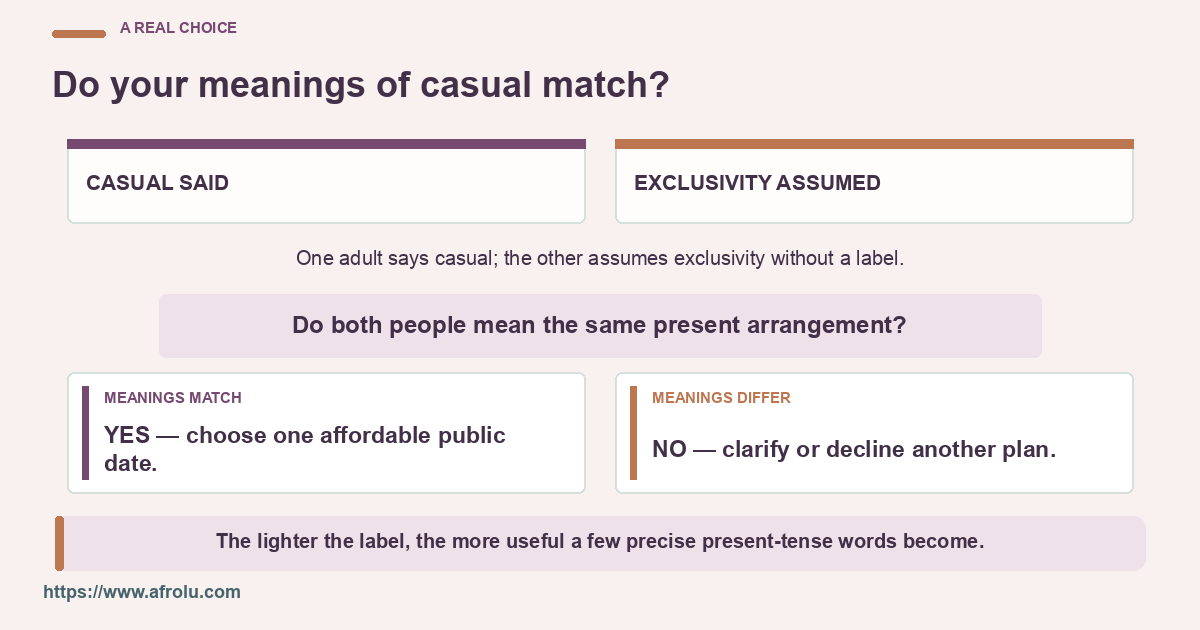
Do your meanings of casual match?
- What happened
- One adult says casual; the other assumes exclusivity without a label.
- Question to ask
- Do both people mean the same present arrangement?
- YESchoose one affordable public date.
- NOclarify or decline another plan.
Keep in mind: The lighter the label, the more useful a few precise present-tense words become.
One adult says casual and the other hears exclusive
The label has concealed two present agreements.
Ask what each adult means before another plan.A friend wants to post a picture from the date
A shared social circle can distribute private information quickly.
Ask the other adult before posting or tagging.The date moves to a distant private place
The cost and independent return have changed.
Keep the public original plan or decline.One adult begins wanting exclusivity
A new wish can be discussed without retroactively rewriting the old terms.
State the new wish and hear the answer.Choices that stay separate from casual
Both adults can state whether exclusivity is offered now.
A physical activity receives its own freely chosen answer.
Posting or telling a shared circle is discussed before it happens.
The cost and route home are chosen, not improvised under pressure.
A changed feeling is spoken instead of enforced silently.
Before the next public outing
| Situation | What it may mean | What to do next |
|---|---|---|
| The label sounds easy | Casual may mean different things. | Define current exclusivity and contact expectations. |
| Intimacy is suggested | The relationship label settles nothing physical. | Ask for the specific choice and relevant sexual-health information. |
| A photo is offered | The image may enter a common class or work circle. | Agree on audience before sharing. |
| Transport becomes expensive | The new location changes the adult's budget and exit. | Suggest a known public place or say no. |
| One person wants more | The original arrangement may no longer fit. | Discuss new terms; do not assume a quiet upgrade. |
A clear present-tense invitation
“I enjoy seeing you. I am not offering exclusivity this term; how do you understand casual dating?”
“I would rather keep our date off the group chat. Are you comfortable with that?”
“I have started wanting exclusivity. I know that was not our agreement; is that something you want to discuss?”
Know the difference
Casual by agreement versus casual by ambiguity
Occasional dates, no exclusivity this term, with consent and privacy discussed separately.
One person keeps the other guessing while accepting benefits of a promise they have not made.
The lighter the label, the more useful a few precise present-tense words become.

Consent is outside both labels.
Agreement or ambiguity?
Clear present terms
Occasional dates, no exclusivity this term, with consent and privacy discussed separately.
Terms left unclear
One person keeps the other guessing while accepting benefits of a promise they have not made.
Questions that clarify the difference
- Exclusivity?
- Intimacy choice?
- Who may know?
- Cost and return?
Keep in mind: The lighter the label, the more useful a few precise present-tense words become.
Agreement or ambiguity
| Type or dimension | What it describes | Best next question |
|---|---|---|
| Casual and clear | Present terms are spoken and both can decline. | Choose the next date with shared information. |
| Casual and vague | One person keeps the other's hope unresolved for convenience. | Ask directly before continuing. |
| Consent | Each activity has a separate answer. | Stop if there is no freely given yes. |
| Privacy | The audience for photos and stories is chosen. | Do not use a public setting as permission to post. |
Let the date stay affordable
No future debt
An enjoyable date does not promise exclusivity or another meeting.
Light can be kind
Clear terms let an adult say yes to the actual offer.
Campus overlap matters
A small public post can reach a shared lecture or work circle.
Questions when feelings change
Choose a few prompts that fit the moment. This is a reference library, not a list to complete.
Before the next date
Find the places where the label is doing too much work.
- Is exclusivity offered?
- What can be shared?
- Can I leave on my own?
If feelings change
Treat the old agreement fairly while asking about a new one.
- What changed for me?
- Have I said it aloud?
- Can I hear a no?
The limited job of safety and consent sources
Sexual health
WHO frames sexual health around respect, safety and freedom from coercion.
Evidence limit: It does not set casual-dating rules or determine an individual's medical choices.
Consent
love is respect explains consent is activity-specific and revocable.
Evidence limit: A relationship label is not permission for intimacy.
Meeting options
RAINN recommends public early meetings and independent transport as possible risk reducers.
Evidence limit: U.S. guidance; routes and services vary in Nairobi.
Dating privacy
eSafety describes privacy risks from sharing identifying details and photos on dating platforms.
Evidence limit: Australian online guidance, not a Nairobi campus rule.
Posting
love is respect recommends talking about digital boundaries, including tagging and social sharing.
Evidence limit: It does not require secrecy; each person's audience needs a choice.
Where vagueness costs the other person
Letting casual mean 'guess'
The word does not tell someone whether you see others.
Treating a paid ride as access
Transport help does not buy intimacy or a private visit.
Posting without asking
A date's public location does not erase their audience choice.
Say today's terms before another date
Occasional and non-exclusive can be honest when both adults hear the same terms and each physical choice remains separate.
Explore the guide library
Continue with Afrolu
Sexual health, consent and safer-meeting sources
Afrolu reviewed these health, research, safety, or public guidance resources while editing this page. They support the behaviour and safety guidance; they do not diagnose any individual described by a reader.
Questions about casual dating as an adult student
Does casual mean non-exclusive?
Not automatically. Say whether you are seeing or may see other people and ask how the other adult understands the term.
Does agreeing to a casual date imply sex?
No. Every physical activity requires its own freely given consent; a relationship label is not a substitute.
Should I post a photo from our date?
Ask first. A shared campus or work circle can make a public image more consequential than it appears.
What if I begin to want commitment?
Say that your wish has changed and ask whether they want to discuss new terms. Do not assume they agreed to a future upgrade.
Can I end casual dating without a long explanation?
Yes. Be clear about any confirmed plan you are cancelling and avoid a promise to reconnect that you do not mean.
One thing to do now
Make the next answer freely chosen
State the arrangement you can offer, ask for their version, and keep consent, privacy and the trip home as separate decisions.