Casual dating · adult students · long-distance clarity
Distance and study schedules need clear boundaries, not constant availability
Handle casual long-distance dating as an adult student: set a contact window, protect study time, and keep travel, money, consent and account access separate.
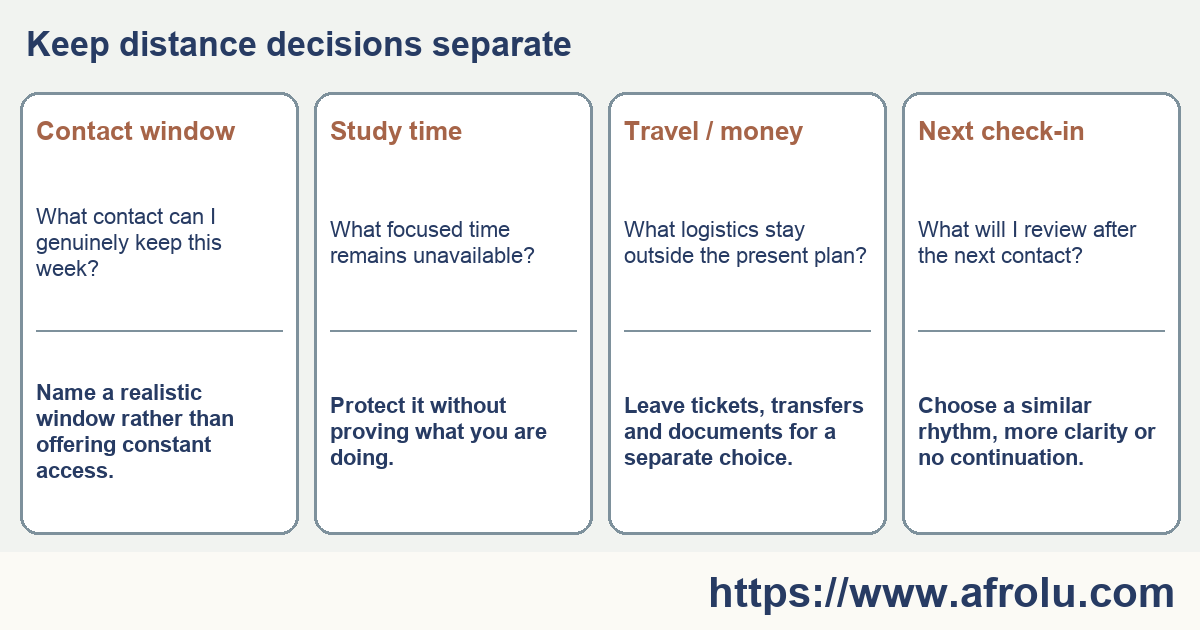
Keep distance decisions separate
A long-distance connection can be clear without using availability or access as proof.
- Contact window
- Study time
- Travel / money
- Next check-in
Read the four questions and actions
-
Contact window
Ask: What contact can I genuinely keep this week?
Choose: Name a realistic window rather than offering constant access.
-
Study time
Ask: What focused time remains unavailable?
Choose: Protect it without proving what you are doing.
-
Travel / money
Ask: What logistics stay outside the present plan?
Choose: Leave tickets, transfers and documents for a separate choice.
-
Next check-in
Ask: What will I review after the next contact?
Choose: Choose a similar rhythm, more clarity or no continuation.
Keep private A long-distance connection does not need a class schedule, grade, campus location, live location, video proof, account access, money, ticket, document or intimate answer.
Let contact capacity, study time, travel or money and each permission have separate answers; choose a rhythm you can freely maintain without offering access as proof.
Written and edited by Ruth Akinyi · Local Dating Editor
Choose a contact window you can actually sustain and state what a missed reply does—and does not—mean. An adult student does not owe a live location, class schedule, video call, login, grade, travel plan or money to show interest. Keep a future visit, spending and physical intimacy separate from the present contact rhythm. If a request becomes urgent or asks for more access than you want, pause, respond to that request directly or choose not to continue.
When an answer changes the plan
- The contact rhythm works for both adultsTry the agreed window and review the next relevant question.
- Someone asks for proof or more accessRepeat the limit, reduce the request or pause.
- The distance arrangement does not fitChoose a clear no without a future forecast.
How can I be clear in a casual long-distance connection while protecting study time and avoiding a proof test around replies, calls, travel or private access?
Casual long-distance dating for an adult student means choosing a present amount of contact without treating course work, response speed, distance, a call or travel as proof of commitment, safety or identity. Student is a self-description of an adult reader; it does not imply youth, a campus, dependence or a particular schedule.
Student status does not decide age, access or availability
A casual connection can feel difficult across distance because ordinary gaps become easy to interpret. Rather than defending every delay, name a contact window that fits your actual week. You might say you can message after a course, speak once on a weekend or check in when an assignment is finished. The useful part is not the perfect schedule; it is that the plan is truthful and can be revised.
Do not let the word student make the reader seem younger, less autonomous or more available than they are. This guide is for adults. It does not assume a campus, financial situation, relationship experience or living arrangement. A request for a class timetable, a grade, a live location or proof that you are studying is still a separate request you may decline.

When a reply becomes a test
Open full-size visualA delayed response is treated as proof that the connection does not matter.
What contact can I genuinely offer?- A clear windowstate it and keep it realistic.
- A demand for proofrepeat the boundary or pause.
A call can be invited without becoming proof
You can ask for a communication rhythm, but leave room for a different answer. Perhaps one adult likes frequent voice notes and the other prefers a scheduled call. Perhaps both want fewer messages during a busy period. The agreement can stay casual and kind as long as it is stated rather than assumed. If the rhythm does not fit, that tells you something about the arrangement, not necessarily the person's motives.
eSafety's online-dating guidance suggests limiting identifying details and considering privacy, report and block controls. It is Australian guidance and cannot verify a person, a video call or a platform feature. Its narrow relevance is that a reader need not trade passwords, account recovery information, a live location, a screen share or an intimate image for a sense of connection.

Four things distance cannot verify
Open full-size visual- Identity
- A call is not identity proof.
- Intent
- A reply is not a motive report.
- Safety
- Distance is not a safety score.
- Future fit
- A ticket is not a forecast.
The four-choice distance check
Use this privately before accepting a new request. It does not assess the other adult.
- 01
What contact window can I genuinely keep?
- 02
What study time remains unavailable?
- 03
What travel, money or document question stays separate?
- 04
What will I review after the next check-in?
Keep this separate A long-distance connection does not need a class schedule, grade, campus location, live location, video proof, account access, money, ticket, document or intimate answer.
A delayed reply is not a relationship verdict
Distance can make uncertainty louder, but it does not turn access into evidence.
Set the contact rhythm first, then keep study capacity, travel and privacy as separate decisions.
- Contact
Choose a window you can keep
A clear rhythm is more useful than constant availability you cannot sustain.
- Study
Protect focused time
A course, assignment or rest period does not need live proof to count.
- Travel
Leave logistics for a separate choice
A visit, ticket or transfer is never required to make a connection sincere.
Long distance does not make a ticket, transfer or itinerary the next required step
Sometimes distance creates a false choice: either make a large gesture or accept that the other person does not care. There are many other options, including another call, a smaller conversation about expectations or no continuation. You can say you are not planning a visit without being required to forecast when you will be ready. The absence of a travel plan is information, not a moral failure.
KE-CIRT's public guidance about sensitive information and urgent credential or financial requests supports a limited safety practice: do not share codes, account access, documents or money because a relationship story makes the request feel time-sensitive. It does not establish that a long-distance dater is unsafe or that every travel suggestion is a scam.

A contact window that protects study time
Open full-size visualI can talk on Sunday evening for about thirty minutes. During study time I am offline, and I am not making travel or spending plans at this stage.
- Name the window
- Keep study time private
- Leave travel for later
Study time, a late-night call or distance never decide physical or digital access
WHO frames sexual health through respect and freedom from coercion, discrimination and violence. It does not direct an adult student's dating pace or define a long-distance relationship. The relevant boundary is narrower: physical intimacy and intimate images require current voluntary agreement, whether adults are in the same place, on a call or discussing a possible visit.
The ODPC describes data-subject rights in organizational processing contexts, not interpersonal dating. That distinction is useful when a connection blends into requests for a device, messages, documents or location: no guide, app, date or relationship label makes those details automatically owed. Decide what you want to share based on the particular request, not on pressure to appear trusting.

Agreement or proof test?
Open full-size visualContact agreement
Names a workable window and allows each adult to revise it without surrendering private access.
Proof-of-interest test
Uses replies, calls, study time, travel or spending to demand certainty, identity proof or commitment.
- Contact
- Capacity
- Privacy
- Travel

Check whether the rhythm protects study time
Open full-size visual- Window workedKeep the agreed contact slot around study time.
- Reply demandedReset the schedule; do not promise instant access.
- Booking raisedDecide tickets and spending later, on separate terms.
- Pressure persistsPause or end contact if the window is ignored.
Check whether the rhythm protects study time
Let contact capacity, study time, travel or money and each permission have separate answers; choose a rhythm you can freely maintain without offering access as proof.
Editorial next reads These are clearly labelled editorial links, not affiliate buttons, and they do not make a dating decision for you.
Sources for distance, contact and private details
eSafety offers privacy context; ODPC distinguishes organizational data rights; KE-CIRT supports pausing sensitive requests; WHO supports current voluntary intimacy choices only. None verifies identity, safety or commitment through a reply or call.
Questions about study schedules and long-distance contact
Do I need to reply during class or study time?
No. You can name a contact window that fits your life. A delayed reply does not require a live explanation or proof.
Does a video call prove someone is safe or serious?
No. A call may be a choice you enjoy, but it cannot verify identity, safety, intent or future commitment.
Can I keep my study schedule private?
Yes. You can say when you are available without sharing a timetable, course, grades, location or screen.
What if the other person wants to book travel soon?
You can say you are not planning a visit. A travel discussion, ticket or transfer should be considered separately, not as proof that the connection matters.
Can a casual long-distance connection include consent boundaries?
Yes. Every physical, digital and intimate choice needs a current voluntary answer regardless of distance, labels or previous calls.