Casual dating · parents · family and work boundaries
Casual dating can stay light while family and work details stay private
Keep casual dating clear as a parent with a full work life: choose a small plan, protect family and work details, and decide each next step freely, too.
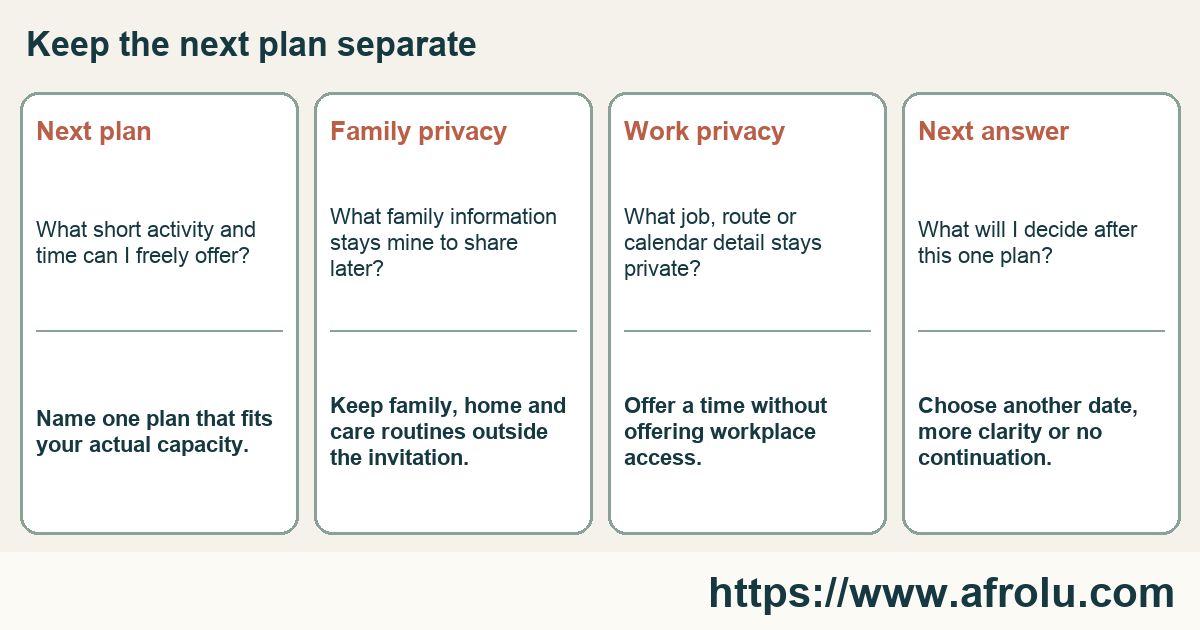
Keep the next plan separate
A casual invitation can be specific without asking for family or workplace access.
- Next plan
- Family privacy
- Work privacy
- Next answer
Read the four questions and actions
-
Next plan
Ask: What short activity and time can I freely offer?
Choose: Name one plan that fits your actual capacity.
-
Family privacy
Ask: What family information stays mine to share later?
Choose: Keep family, home and care routines outside the invitation.
-
Work privacy
Ask: What job, route or calendar detail stays private?
Choose: Offer a time without offering workplace access.
-
Next answer
Ask: What will I decide after this one plan?
Choose: Choose another date, more clarity or no continuation.
Keep private A date does not need family details, home access, a household routine, work access, live location, a calendar, credentials, money or a physical promise.
Let an invitation answer only the next plan. Keep family privacy, home details, work routines, account access, money and physical intimacy as separate choices that never become a price of seeming interested.
Written and edited by Amina Wanjiru · Senior Dating Apps Editor
Start with one plan you can genuinely offer: an activity, a time window and a way for each adult to arrive or leave independently. A parent identity does not require a new date to know family members' details, your home routine, a household schedule or your workplace. A work-heavy week does not require a calendar screenshot, live location or proof of availability. If any request shifts toward those details, answer that request separately and keep the date plan as small as you need.
When an answer changes the plan
- The plan fits and boundaries are possibleChoose the small plan you actually want.
- The plan needs family or work accessOffer less detail, change it or decline.
- The arrangement does not fitChoose a clear no without a biography.
How can I make a casual plan when I am a parent with work responsibilities, without turning family or career access into evidence of interest?
Casual dating for a parent with career boundaries means choosing a present connection without treating access to family information, a home, household routines, workplaces, accounts or schedules as part of the arrangement. Parent and career are reader descriptions, not predictions about availability, maturity or what another adult may ask for.
A casual plan does not need family or career access
An invitation can be warm and specific while giving the reader control over what is not part of the invitation.
Separate the next plan from family privacy, work privacy and the later question of whether you want another meeting.
- Plan
Name one manageable interaction
A short activity and time window give both adults a real choice.
- Family
Keep family information voluntary
No early connection needs family details, home routines or care commitments.
- Work
Keep a job separate from proof
An availability boundary can be clear without a workplace, route or calendar.
A parent identity does not make a first invitation a family introduction
When a person says they are a parent, some daters may immediately ask about family members, a home routine or the time a household is empty. Those questions can be meaningful later, but they are not required to decide whether two adults want one coffee, walk or gallery visit. Start with the information the plan needs: the activity, a time window and a meeting point you are comfortable naming.
A modest invitation can also be kind to your own capacity. You do not need to promise a late night, weekly rhythm or a future introduction before a first meeting has happened. If someone wants a different pace, that can be a useful mismatch. It does not require you to make family privacy negotiable in order to prove that you are open to connection.

When a simple invitation asks for more access
Open full-size visualA date offer shifts into questions about family routines or a workplace.
What does this plan actually need?- Only a meetingoffer the time and activity you choose.
- Sensitive accessdecline, suggest less detail or pause.
The four-lane plan check
Use this privately before accepting or offering a date. It does not assess another adult.
- 01
What activity and time window can I genuinely offer?
- 02
What family information stays private for now?
- 03
What work, route or calendar detail stays private?
- 04
What answer will I choose after this one plan?
Keep this separate A date does not need family details, home access, a household routine, work access, live location, a calendar, credentials, money or a physical promise.
Availability is not a request for workplace access
It can help to distinguish an explanation from a disclosure. Saying that Sunday afternoon works is enough to make a plan; showing a work calendar, naming a client, sharing a commute route or inviting someone near a workplace is more detail than the invitation needs. You can choose to share those things later, but they do not verify your intentions in the present.
WHO's material on mental health at work discusses workload and healthy work conditions. It does not establish a correct dating schedule or tell a reader what a job says about relationship capacity. Its narrow relevance is that work demands are real context, so a plan that fits your actual energy and time is more honest than a performance of constant access.

Four details a casual plan does not require
Open full-size visual- Family information
- Family details remain voluntary.
- Home routine
- A meeting point can replace an address.
- Work access
- A time can replace a calendar or office.
- Account details
- Warmth never needs a code, PIN or login.
Warm conversation does not make family, location or accounts available
Requests often arrive as convenience: an offer to pick you up, a question about when the house is quiet, a request for a calendar screenshot or a suggestion to send money for a plan. The relevant question is not whether the request reveals a hidden motive. It is whether it belongs in the arrangement you want. You can offer a smaller alternative, say no or stop engaging.
The Office of the Data Protection Commissioner describes rights connected to organizational data processing; it does not govern ordinary dating conversation. KE-CIRT's warning about personally identifiable information, credentials and urgent financial requests offers a narrower reminder: keep sensitive details outside romantic urgency and independently check any claim that makes them seem immediately necessary.

A clear boundary with a workable plan
Open full-size visualI can meet for an hour on Sunday afternoon. I will make my own way there, and I keep family and work routines private while I get to know someone.
- Name one time
- Keep family and work private
- Leave room to decide later
Choose your next answer without turning one date into a verdict
Try separating enjoyment from fit. You may have liked the conversation yet notice that the logistics or boundary response did not work for your life. You may want another hour but not a faster pace. A short message can state that truth without diagnosing anyone: offer the next plan you freely want, or say you are not continuing. You do not need to negotiate yourself past your own limits.
WHO describes sexual health through a respectful approach to sexuality and sexual relationships, free from coercion, discrimination and violence. It does not define casual dating or direct a parent toward any outcome. Here it supports only a current voluntary choice: previous warmth, family disclosures or a date never decide a new answer about touch, sex or intimate images.

Check what stayed separate after the date
Open full-size visual- Another planIf privacy held, suggest one bounded public meeting.
- Family requestKeep names, routines and home details out of the plan.
- Work requestOffer a time without sharing your shift or office.
- Repeated pushEnd contact if the same limit keeps being tested.

Plan or access request?
Open full-size visualBounded invitation
Names one activity and time while leaving family, home and work details optional.
Request for access
Treats interest as a reason to disclose family information, routines, a workplace, a route or an account.
- Time
- Family privacy
- Work privacy
- Future choice
Check what stayed separate after the date
Let an invitation answer only the next plan. Keep family privacy, home details, work routines, account access, money and physical intimacy as separate choices that never become a price of seeming interested.
Editorial next reads These are clearly labelled editorial links, not affiliate buttons, and they do not make a dating decision for you.
Sources for privacy, work and a smaller first plan
WHO gives limited workload and voluntary-consent context; eSafety covers privacy choices; ODPC describes organizational data rights; KE-CIRT supports pausing sensitive requests. None makes a date, a parent identity or a workplace a proof of safety, intent or fit.
Questions about casual dating as a parent
Do I need to say I am a parent before a first casual date?
Share that information when and how you want. A first plan only needs enough detail for two adults to choose whether it fits.
Can I keep family details private?
Yes. You can keep names, household routines, photos and access to family life private while still making a clear dating plan.
What if a date asks to collect me from home or work?
You can decline or offer a meeting point you prefer. Independent travel can simply keep the plan flexible; it does not prove anything about either adult.
How do I say work is busy without sounding uninterested?
Name one time you can genuinely keep. You do not need a calendar, employer detail or explanation of every responsibility to make that answer clear.
Does a good first date mean I should share more next time?
No. Decide each detail separately. A pleasant experience can support another plan without deciding access, family information, sex, images or a future label.