Casual dating · late comers · long-distance safety
Long-distance dating can stay hopeful without giving up your safety choices
Date long-distance after returning to dating: protect personal details and money, choose a contact rhythm, and make each next step optional and reviewable.

Do not let distance compress several decisions into one: choose the contact rhythm, keep money and identifying details separate, and decide about a meeting only when you choose it.
Written and edited by Ruth Akinyi · Local Dating Editor
Choose a contact rhythm you can sustain, keep identifying details and money separate, and make any meeting plan public and independently changeable. A profile, video call, job story or affectionate message does not verify who a person is or what they intend.
How can I explore a long-distance connection while protecting my information, money, time and freedom to change my mind?
Long-distance safety is a set of choices that preserve options while you learn more. It is not a promise that a person is safe, a prediction that a connection will work, or a requirement to become suspicious of every adult you meet online.
Let a warm conversation be a conversation, not verification
Long-distance contact can create a quick sense of familiarity because messages and calls fill in the spaces between meetings. That feeling is real as your experience, but it does not certify the information you have received or obligate you to move faster. Keep a simple distinction in view: you can say that you enjoyed a call without saying that the call verified a person. This reduces pressure to trade personal details, funds or travel plans for reassurance.

Four distance observations
Open full-size visual- Call as proof
- Keep a call separate from verification.
- Urgent money request
- Do not send funds to resolve urgency.
- Demand for constant contact
- Name a rhythm you can choose.
- Changeable meeting plan
- Keep public logistics independently changeable.
Observe what is asked of you; choose your next boundary without diagnosing the person.
Urgency is a reason to pause, not a reason to prove affection
The FTC source in this guide supports a narrow precaution: do not send money or certain forms of payment to an online love interest. It does not prove that any request is a scam. You do not need to investigate someone before saying no; you can simply decline. The same applies to requests for a private location, financial detail or identity document. A connection can continue at the pace you choose, and you can leave it if the request becomes the centre of the conversation.
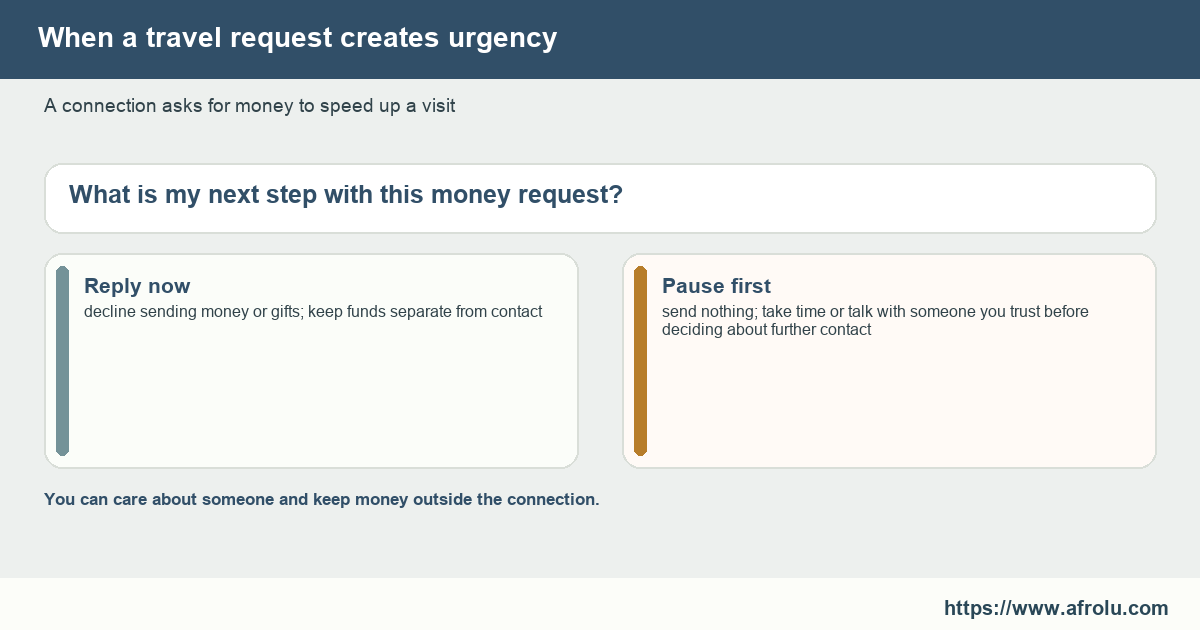
When a travel request creates urgency
Open full-size visualOpen full-size phone visualA connection asks for money to speed up a visitWhat is my next step with this money request?
- Reply now
- decline sending money or gifts; keep funds separate from contact
- Pause first
- send nothing; take time or talk with someone you trust before deciding about further contact
You can care about someone and keep money outside the connection.
The Distance Safety Sequence
Separate the decision you can make today from the decision someone wants you to make quickly.
- 01
Contact
What rhythm works for me? Choose a pace you can sustain.
- 02
Details
What stays private? Keep address, routine and documents contained.
- 03
Money
Am I being asked to send funds? Decline transfers, gifts and urgent payment requests.
- 04
Meeting
Do I want to plan one now? Choose public, changeable logistics or wait.
Distance does not require money, location access or constant availability.
Reply speed is not a measurement of care or seriousness
A long-distance connection may involve time zones, work, family obligations or simply different ways of using a phone. Rather than reading every delay as a hidden message, say what rhythm feels possible for you: a call on a certain evening, a message when you have time, or a pause during a busy week. This does not solve uncertainty about the other person. It gives you a pattern you can consent to and makes it easier to notice when the contact no longer feels like a choice.

A sustainable long-distance boundary
Open full-size visualI enjoy talking with you, and I want to keep the pace steady; I do not send money or share private location details, but we can choose a time for another call next week.
- Name your rhythm
- Keep funds separate
- Leave meeting open
A clear contact window can be kinder than a promise of constant access.
Travel, a public place and a next date deserve separate answers
A meeting can help you learn whether you want more contact, but it does not settle identity, intent or compatibility in advance. Decide the location, transport and end time for yourself. Avoid making a visit dependent on sending funds, sharing a home address or accepting pressure for intimacy. If the plan changes, you can change it too. The useful outcome is that you retain a real choice, not that you create a flawless test of a person you are getting to know.

Choose the next distance step
Open full-size visual- Continue contact
- Keep the rhythm that you choose.
- Ask again
- Clarify one request before accepting it.
- Pause
- Slow down if urgency or pressure increased.
- End
- Stop contact if you no longer want it.
Your options matter more than performing certainty.
Hope does not need to outrun your options
A long-distance connection can be meaningful while your next choice remains reversible.
Separate contact, personal data, money and a possible meeting rather than asking one to prove the others.
- Contact
Choose a sustainable rhythm
Frequency is a preference, not a verification method.
- Money
Keep funds outside the connection
Urgency does not turn a transfer into a relationship test.
- Meeting
Decide later and independently
A future public plan can be assessed without surrendering your present privacy.

Connection versus verification
Open full-size visualConnection
I can enjoy messages and calls at a pace I choose.
Verification
A profile, call or story cannot prove identity, intent or safety for me.
Let contact be contact rather than treating it as a safety certificate.
Choose the next distance step
Do not let distance compress several decisions into one: choose the contact rhythm, keep money and identifying details separate, and decide about a meeting only when you choose it.
Editorial next reads These are clearly labelled editorial links, not affiliate buttons, and they do not make a dating decision for you.
Sources and limits
Sources offer limited fraud, privacy and consent context; they do not verify a person or certify a meeting plan.
Questions to carry forward
Does a video call prove someone is who they say they are?
No. A call can be part of getting to know someone, but it does not verify identity, intentions or safety for you.
What should I do if someone asks for travel money?
You can decline. The source shelf supports not sending money or certain payment types to an online love interest; a refusal does not require an investigation.
Is it okay to prefer fewer messages?
Yes. State the rhythm you can choose. Reply speed is not a reliable measure of care or commitment.
When is it safe to meet in person?
No guide can certify that. If you choose to meet, use logistics that remain public and changeable, and keep your own ability to leave.
Should I share my address so a visit feels serious?
Only if you want to, and a serious claim does not create an obligation to do so. A public plan can be a separate choice.