Casual dating · faith-led adults · present-tense clarity
Faith-led values can support clear casual terms without deciding the future
Use faith-led values to clarify a casual connection: state one present boundary, keep consent and privacy current, and avoid treating belief as proof of fit.
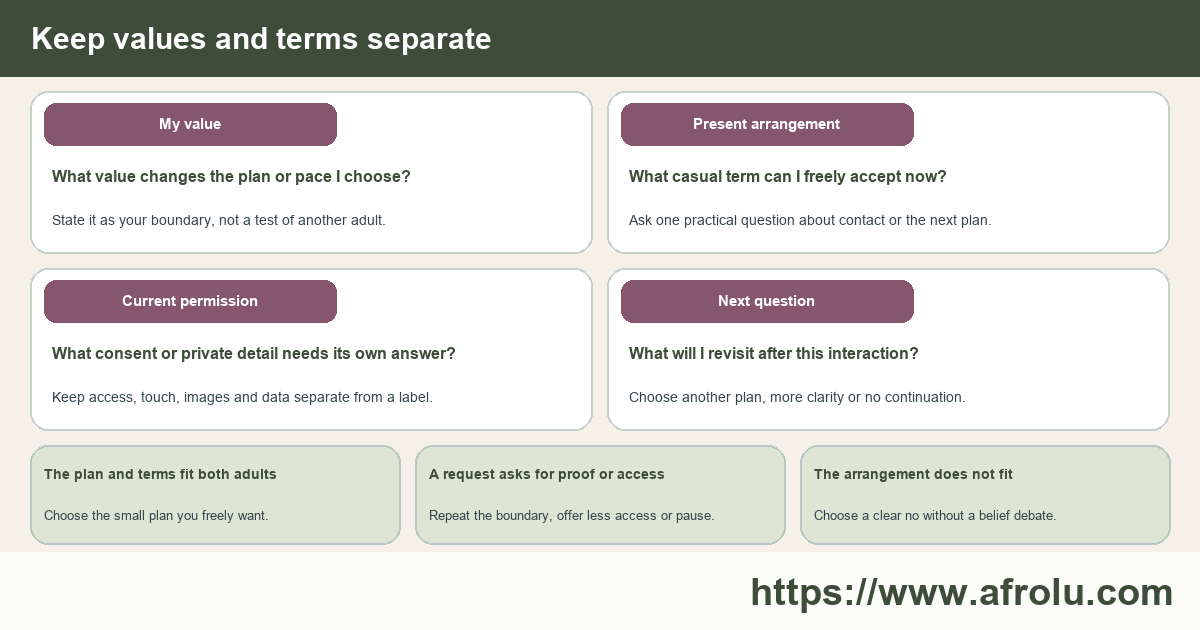
Let your values guide your own next choice while keeping the present arrangement, consent, private details and future direction as separate voluntary decisions.
Written and edited by Miriam Otieno · Senior Kenya Editor
Name the value or boundary that changes the present choice: perhaps a slower pace, a daytime meeting, privacy around home details or a preference to revisit labels later. That can be clear without requiring another adult to share your belief or promise a future. A casual arrangement still needs current consent, private-data limits and a practical next plan. If the answers differ, treat the mismatch as information instead of trying to negotiate access, disclosure or affection into proof.
Keep values and terms separate
A value can guide a current choice without turning faith or a label into proof.
- My value
- Present arrangement
- Current permission
- Next question
If the casual terms change
- The plan and terms fit both adultsChoose the small plan you freely want.
- A request asks for proof or accessRepeat the boundary, offer less access or pause.
- The arrangement does not fitChoose a clear no without a belief debate.
Read the four questions and actions
-
My value
- Question
- What value changes the plan or pace I choose?
- Action
- State it as your boundary, not a test of another adult.
-
Present arrangement
- Question
- What casual term can I freely accept now?
- Action
- Ask one practical question about contact or the next plan.
-
Current permission
- Question
- What consent or private detail needs its own answer?
- Action
- Keep access, touch, images and data separate from a label.
-
Next question
- Question
- What will I revisit after this interaction?
- Action
- Choose another plan, more clarity or no continuation.
Keep this separate A faith-led casual plan does not need a doctrine test, home access, live location, account access, money, intimate image or physical promise.
How can I use my own values to clarify a casual connection without turning belief, boundaries or a good conversation into proof of compatibility or commitment?
Faith-led casual dating means an adult lets their own values guide choices while recognising that another adult may hold different beliefs, practices or boundaries. It is a reader's self-description, not a doctrine, a character score, a consent shortcut or a prediction of a relationship outcome.
Which value changes your next choice?
Values can show up in practical choices: a preference for a daytime plan, no private-home visits early, a slower pace around physical intimacy or a wish to keep family details private. Those preferences can be expressed as your own choices. They do not require a universal rule or a conclusion about the motives of someone who prefers something else.
A shared faith label can be meaningful, but it cannot do all the work of getting to know someone. People may share language and differ on contact, privacy, casual dating, family expectations or commitment. People may differ in belief and still have a respectful conversation. Let the actual plan and boundary response help you decide what fits rather than treating belief as a shortcut to certainty.

When a value becomes a proof demand
Open full-size visualA values conversation shifts into a promise, access request or character judgement.
What does the present choice need?- A small planname the boundary and invitation you choose.
- A proof testrepeat the limit, offer less access or pause.
A boundary can be clear without becoming a doctrine test
The goal is not a perfect shared definition; it is enough clarity for two adults to choose the present arrangement freely.
Name one practical value, then separate it from consent, access and later relationship questions.
- Value
Say what guides your choice
A reader can describe a pace without asking another adult to perform belief.
- Present
Ask what casual means today
A label can start a conversation about contact and plans without promising a future.
- Permission
Keep each yes current
Faith, chemistry or warmth never decides touch, images, data or physical access.
Ask one question about the arrangement
You might ask whether each of you wants another date, what contact rhythm is comfortable, whether other dates need a conversation or how you will respond if one person wants a different pace. Keep the question proportionate. It is not necessary to debate a whole relationship philosophy before a first or second plan. A modest, honest answer is often more useful than a polished label.
If the answer does not fit, you can decide that the arrangement is not for you. You do not need to turn disagreement into a case for why your values are better or why the other adult lacks sincerity. A clear mismatch can protect both people from performing a version of casual dating that neither freely chooses.
For example, ‘I enjoy seeing you and I would like to keep this casual for now. Would another daytime date suit you?’ names a present invitation rather than borrowing certainty from a faith label. If the answer is no, both adults have learned something practical without having to defend their beliefs or predict a future together.

A values-led casual terms question
Open full-size visualMy values shape the pace I choose. I am comfortable with a short public plan, and I would like to keep privacy and future labels as separate conversations.
- State your pace
- Ask one current term
- Keep privacy and consent separate
Let the answer guide the next step
Keep this separate A faith-led casual plan does not need a doctrine test, home access, live location, account access, money, intimate image or physical promise.
Permission stays specific
WHO frames sexual health around respect and freedom from coercion, discrimination and violence. It does not prescribe a faith-led dating rule or decide what casual should mean. Its narrow relevance here is current voluntary agreement: a shared belief or a connection that feels meaningful cannot substitute for a present answer about physical intimacy or intimate images.
eSafety's online-dating guidance discusses limiting identifying details and considering privacy, report and block controls. It is Australian guidance, not a faith rule or Kenyan law. Applied narrowly, it means an early connection does not need a home address, account code, password, document or live location to demonstrate honesty or interest.

Four things shared values cannot verify
Open full-size visual- Safety
- Belief is not a safety score.
- Consent
- Permission needs a current answer.
- Compatibility
- Shared language is not full fit.
- Future commitment
- A plan is not a future contract.
Review fit before writing a future story
It can help to ask whether the plan left room for your own answer, whether your boundary remained possible and whether you would freely choose a similar pace again. These questions focus on your experience rather than a prediction about another adult. You might be interested and still want to slow down, or appreciate someone and decide the arrangement does not fit.
When a request becomes urgent around a code, money, documents or account access, step out of the romantic frame. KE-CIRT's public guidance supports pausing and independently checking sensitive credential or financial claims. It does not establish that a person with a different belief, label or pace is unsafe or dishonest.

Boundary or proof test?
Open full-size visualValues-led boundary
States the reader's own pace or privacy choice and leaves room for another adult's answer.
Proof test
Uses faith or a casual label to claim certainty about character, consent, safety or future commitment.
Values can guide a clear present choice without becoming proof about another person.
- Value
- Present term
- Consent
- Privacy

Review after the plan
Open full-size visual- RepeatOffer another similar plan.
- ClarifyAsk the next relevant question.
- Slow downReduce pressure and access.
- StopA brief no is enough.
Review after the plan
Let your values guide your own next choice while keeping the present arrangement, consent, private details and future direction as separate voluntary decisions.
Editorial next reads These are clearly labelled editorial links, not affiliate buttons, and they do not make a dating decision for you.
WHO supports current voluntary intimacy choices only; eSafety gives privacy context; ODPC describes organizational data rights; KE-CIRT supports pausing sensitive requests. None decides doctrine, character, safety or future fit.
Can casual dating fit my faith-led values?
It can if the present arrangement fits the values and boundaries you freely choose. You do not need a universal rule or another adult's agreement with every belief.
Should I ask about another person's beliefs before a date?
Ask only if the answer affects your choice, and leave room for privacy. An invitation does not require a faith interview or a performance of doctrine.
Does shared faith mean we are compatible?
No. Shared beliefs may matter to you, but they do not decide consent, communication, privacy, safety, commitment or fit.
Can I say I am open to serious dating while keeping this casual?
Yes. State the direction you may want over time and ask what the present arrangement means. Neither statement is a future contract.
What if a boundary is treated as a lack of trust?
You can repeat the boundary, offer a smaller plan or decide not to continue. A boundary is a choice about your access, not a judgement of someone else's motives.