Casual dating · diaspora · long-distance clarity
Long-distance clarity can protect connection without asking for proof of belonging
Keep long-distance casual dating clear as a self-described diaspora reader: set contact terms, protect disclosure, and separate travel or money choices.
Start with the current contact rhythm you freely want: perhaps a call window, a message pace, or a decision to revisit after a few interactions. You can describe diaspora in your own way, share no origin or personal history at all, and keep documents, exact location, travel, tickets, money, accounts, codes and intimate material separate from connection. Distance can make logistics more visible, but it does not turn a call into identity proof or a future promise. If a request asks for more access than you want, make the boundary clear, choose less, or pause.
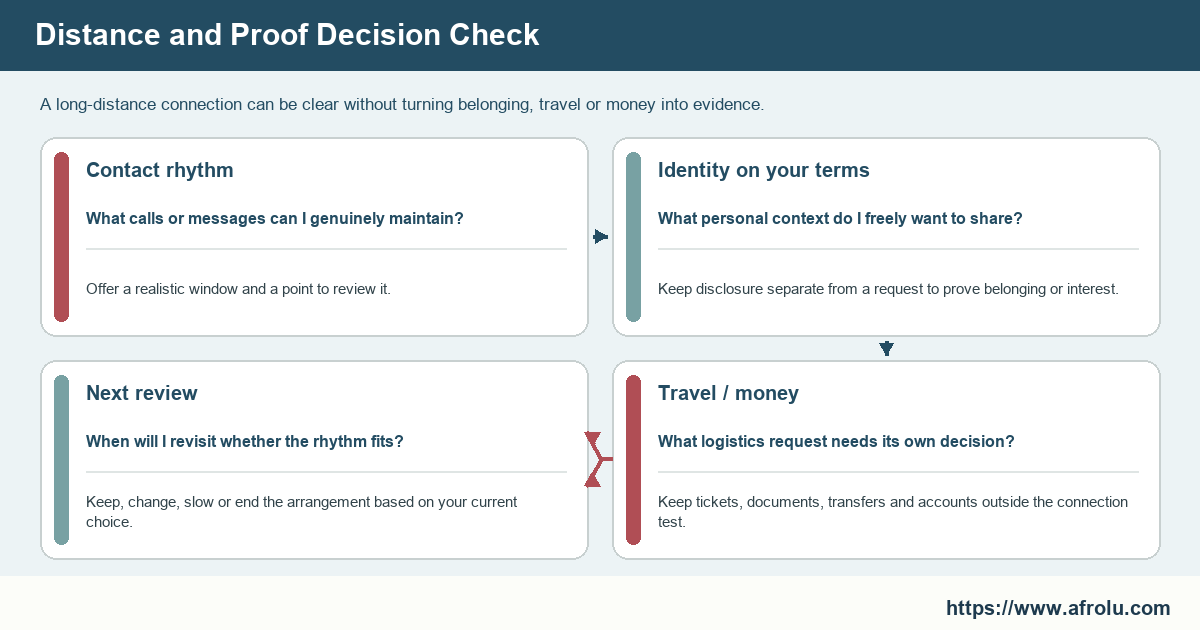
Keep distance and proof in different lanes
A long-distance connection can be clear without turning belonging, travel or money into evidence.
- Contact rhythm
- Identity on your terms
- Travel / money
- Next review
Choose the next action
- The contact rhythm feels voluntary and workableKeep the current plan and review it when you said you would.
- A request asks for disclosure, travel or money as proofState the boundary, reduce access or pause the exchange.
- The distance arrangement no longer fitsChoose a clear change or stop without turning identity into a debate.
Read the four questions and actions
-
Contact rhythm
- Question
- What calls or messages can I genuinely maintain?
- Action
- Offer a realistic window and a point to review it.
-
Identity on your terms
- Question
- What personal context do I freely want to share?
- Action
- Keep disclosure separate from a request to prove belonging or interest.
-
Travel / money
- Question
- What logistics request needs its own decision?
- Action
- Keep tickets, documents, transfers and accounts outside the connection test.
-
Next review
- Question
- When will I revisit whether the rhythm fits?
- Action
- Keep, change, slow or end the arrangement based on your current choice.
Keep this separate A long-distance connection does not need origin proof, a document, live location, account access, ticket, money, intimate image or physical promise.
Keep contact rhythm, identity disclosure, travel or money, private access and future direction as separate answers; choose only the connection you freely want now.
Written and edited by Ruth Akinyi · Local Dating Editor
How can I make a long-distance casual connection clearer while using diaspora as my own description, without turning contact, personal disclosure, travel or spending into proof?
Long-distance casual dating for a self-described diaspora reader means choosing a present contact arrangement while keeping identity, travel, spending, privacy and future direction distinct. Diaspora is a reader-owned term, not a claim about origin, movement, culture, documentation, resources, safety or relationship goals.
A long-distance connection can be clear without constant access
Distance makes gaps easier to notice, and it can tempt adults to fill those gaps with a story. A deliberate rhythm gives less room for that guesswork. You might agree to a call after work on one day, a short check-in on another, or a point at which you will ask whether the pattern feels useful. Those are invitations, not monitoring arrangements.
If another adult wants more contact than you freely want, the difference is worth naming. You can offer a different rhythm, take more time, or decide it does not fit. The goal is not to demonstrate devotion through availability. It is to make the current connection legible enough that neither person has to infer it from silence or pressure.
A workable call rhythm can be as simple as one agreed window and a way to reschedule. If one person misses it, ask about the next possible window before drawing a conclusion about interest. The pattern over time offers more useful information than a demand for live access to every ordinary day.

When a contact plan becomes a proof request
Open full-size visualA call rhythm shifts into demands for documents, travel or money to make connection feel real.
What does the current connection actually need?- Contact termsname a rhythm you can keep.
- Proof or logisticskeep it separate, reduce access or pause.
Let the answer guide the next step
Keep this separate A long-distance connection does not need origin proof, a document, live location, account access, ticket, money, intimate image or physical promise.
A diaspora description is not a document request
Distance can make people curious about where someone is from, how they moved, what they speak, or what their life is like. This guide does not assume any answer to those questions. Curiosity can be answered with a boundary, a small detail, or no detail at all. A date does not need a genealogy, document, home view or live location to participate in a respectful conversation.
This is also a useful distinction when a request is framed as reassurance. Identity disclosure and relationship interest are different decisions. You may want more connection while still keeping personal information close. You may share a story and still decline a later request. Neither choice makes the other adult responsible for deciding your identity or intent.

Four things distance cannot prove
Open full-size visual- Identity
- A call is not identity proof.
- Belonging
- A label does not require a backstory.
- Safety
- A plan is not a safety guarantee.
- Future fit
- Travel is not a forecast.
Clarity starts with the next contact choice
A reader's diaspora description can matter personally without obligating them to explain identity, history, geography, travel plans or resources to make a connection real.
Set the contact rhythm first, then keep disclosure, logistics and future direction in their own lanes.
- Rhythm
Choose contact you can sustain
A workable call or message window is more useful than a promise of constant presence.
- Disclosure
Keep identity self-directed
A reader can share context when it is wanted, not because distance creates proof pressure.
- Logistics
Separate travel and money
A possible visit does not require a ticket, document, account or financial transfer today.
A possible visit does not make logistics an obligation
Long distance can make a future visit feel like the obvious next milestone. It is still a separate decision. You can discuss whether a visit is imaginable without booking it, decline to send money, or say that travel is not something you are considering. A call or a message is not a down payment on travel, and a trip would not prove compatibility or commitment either.
eSafety discusses privacy choices around online dating and is Australian guidance, not a rule for long-distance travel. The ODPC describes organizational data rights, not a date's entitlement to documents or accounts. KE-CIRT supports pausing urgent credential and financial requests; it does not prove that a particular distant adult is dishonest or unsafe.
Before a possible visit becomes a commitment, name the parts separately: who would travel, where each adult would stay, which costs each would choose, and what happens if either changes their mind. A video call or warm conversation does not settle those practical choices or require anyone to transfer money.

A sustainable long-distance line
Open full-size visualI enjoy talking with you and can make time for two calls this week. I keep personal documents and travel plans separate, and would like to review the rhythm later.
- Name the rhythm
- Keep disclosure self-directed
- Separate travel and money
A connection can remain honest while its direction is still unknown
A useful review asks whether the contact pattern is voluntary and workable, whether you felt free to keep your own disclosure boundary, and whether the next interaction still appeals. It does not ask you to predict a whole relationship from a call. You may value a connection and decide the logistics are not right; you may be uncertain and prefer another small interaction.
WHO frames sexual health around respect and freedom from coercion, discrimination and violence. It does not define long-distance dating or diaspora. Its narrow relevance is present consent: distance, a call, a photo or travel discussion never makes an intimate image, physical activity or personal disclosure owed.

Review the rhythm before escalating logistics
Open full-size visual- KeepUse the rhythm that fits.
- AdjustAsk one focused question.
- Slow downKeep travel and access separate.
- StopA clear no is enough.

Agreement or proof-seeking?
Open full-size visualContact agreement
Names a sustainable rhythm while identity, travel, spending and private access remain voluntary.
Proof-seeking arrangement
Treats distance, identity disclosure, a document, ticket or transfer as evidence that connection is real.
Distance can be managed through current terms without making belonging or logistics a proof test.
- Contact
- Disclosure
- Logistics
- Next review
Review the rhythm before escalating logistics
Keep contact rhythm, identity disclosure, travel or money, private access and future direction as separate answers; choose only the connection you freely want now.
Editorial next reads These are clearly labelled editorial links, not affiliate buttons, and they do not make a dating decision for you.
eSafety gives limited privacy context; ODPC distinguishes organizational data rights; KE-CIRT supports pausing sensitive requests; WHO supports current voluntary intimacy choices only. None interprets diaspora, distance, identity, safety or future fit.
Do I have to explain what diaspora means to me?
No. It is your self-description. You may explain it, use it without elaborating, or keep identity context private.
How often should we talk long distance?
There is no required rhythm. Choose contact you can maintain, make it explicit, and revisit it if it stops fitting.
Does a video call prove who someone is?
No. A call can be one interaction, but it does not establish identity, safety, compatibility or a future outcome.
Should I send money or documents to make a visit possible?
Treat money, documents and travel as separate decisions. Do not let urgency or romance make access feel required.
Can I be interested and still decline travel plans?
Yes. Interest, contact, travel and spending are different choices. You can continue a conversation without planning a visit.