Parent dating · distance and clarity
Breadcrumbing and Long-Distance Dating for Parents
A parent-focused guide to breadcrumbing at a distance: ask for consistency, protect family privacy, keep travel independent, and leave vague contact behind.

A message can be warm without becoming a workable offer.
Written and edited by Nia Kato · Profile Advice Editor
Treat intermittent warmth as a message, not a relationship offer. Ask one direct question about a regular call and a practical next step, then decide from the answer and follow-through. Keep children, home, money, documents, travel, lodging, and an exit route separate from a new or inconsistent connection.
Mixed signals · Parents Returning To Dating
How can a parent respond to breadcrumbing from a long-distance match without making family life, child privacy, money, or emotional peace wait on vague contact?
Breadcrumbing is a common term for intermittent contact that gives small signals of interest without reliable follow-through. It is not a diagnosis of motive. For parents dating long distance, the useful question is whether a person can offer enough present consistency, respect for family boundaries, and independent practical planning to fit a real life.
Nadia receives a warm message every few weeks from a distant match who never turns the conversation into a reliable call or practical plan. She asks once for a consistent rhythm, keeps her child and home outside the connection, and refuses a travel-money request. When the person returns to vague future talk, she chooses the pattern she actually receives rather than the future it keeps hinting at. Her decision creates more room for family life and a connection that could eventually be real.
parent dating · distance and clarity
Nadia asks for a present offer instead of keeping a family life on hold for distant fragments
Long-distance messages can feel meaningful without becoming a relationship that fits around parenting. This guide helps parents recognise the pattern, ask one clear question, and keep family, travel, and safety boundaries adult-led.
Read the contact pattern, protect parenting rhythm and child privacy, make distance practical, ask one clarity question, keep access independent, and choose the next move from real follow-through.
A message is not an offer
Occasional warmth can be welcome without being enough to plan around.
Keep access adult-led
A child, home, and daily routine remain outside early uncertainty.
Make logistics visible
Calls, travel, money, lodging, and exits need practical independence.
Ask once, then observe
A direct question lets the present offer become clear.
Read the contact pattern before you chase its meaning
Intermittent messages can keep a connection alive without making it usable
Nadia is raising a child and living in a different city from someone she met online. Every few weeks he sends a warm message, mentions how much he has been thinking about her, and asks why she has gone quiet. When she replies, the conversation becomes affectionate for a day or two, then he fades before they have made a call or agreed on a realistic next step. The contact is not nothing, but it is not yet a relationship offer she can plan around.
Breadcrumbing is a common term for intermittent contact that gives small signals of interest without consistent follow-through. The label does not establish a motive. A person may be busy, unsure, lonely, avoiding a direct ending, keeping options open, or unable to offer more. Nadia does not need to choose among those explanations before she notices the practical result: she is repeatedly asked to reopen emotional space while the connection remains too vague to fit around her family rhythm and real obligations.
Long distance can make a pattern especially hard to read because a warm voice note, a late-night call, or a future travel idea may feel more significant when there is little shared daily life. Nadia gives more weight to whether the person can name a time to speak, explain a changed plan without disappearing, and make a proportionate next move. She does not require constant contact. She does require enough reliability that a conversation does not repeatedly interrupt her life without becoming mutually workable.
Her starting rule is deliberately modest: a message can be welcome without becoming a commitment. She may respond when she wants to, ask one direct question, or leave the thread closed. She does not have to supply the energy that turns occasional attention into a relationship. That distinction lets her keep her interest honest without making her peace, parenting time, or emotional availability depend on someone else's unpredictable reappearance.
Keep parenting time and a child's privacy outside the uncertainty
A new match is not entitled to family access because they send a warm message
Nadia's family rhythm includes school routines, meals, illness, childcare, work, and time she wants to protect for herself. A person who only appears when it suits them may still be disappointed that she cannot answer immediately, but disappointment is not a claim on her time. She can say that she is available for a call on one evening, not explain every household detail, and observe whether the person treats an ordinary limit as information or as a reason to withdraw until they want attention again.
She separates the new connection from her child. Early dating does not require photos, names, school information, home address, daily location, introductions, or access to a family routine. A long-distance match may talk about meeting the child early, ask to send gifts, or present themselves as unusually good with families. Nadia can acknowledge the thought while keeping the boundary. A person does not need access to her child in order to demonstrate respect for her as a parent.
This separation protects the relationship too. Nadia wants to discover whether adult communication, pace, logistics, and values fit before a child has any reason to know the person exists. If a connection remains intermittent, that fact is already enough information; it is not a problem her child should help solve by adding pressure, affection, or a sense of obligation. A respectful adult understands that a parent moves carefully because the stakes of access are shared.
Nadia also permits herself to want romance, rest, and a life that is not only caregiving. Low-pressure dating does not mean she must accept low-effort treatment. It means she chooses plans that fit the actual week and keeps the connection from consuming time she cannot freely give. A partner who is compatible with family life will not need her to create chaos at home in order to prove that she is interested.

A direct question can protect a whole week of waiting.
Treat long distance as a practical reality, not a screen for fantasy
Contact, travel, money, time zones, and future claims need small agreements
Nadia does not ask a distant match to be available all day. She asks whether they can choose one regular call window that respects both schedules, whether they can send a clear update when a plan changes, and whether they are honestly interested in making time for an eventual public meeting. The answers may be imperfect. What matters is whether they become more concrete over time or remain a stream of affectionate messages with no shared reality behind them.
Travel deserves its own boundary. A future visit can be exciting, but it should not be a substitute for knowing how someone behaves in smaller moments. Nadia does not fund a ticket, receive money, arrange accommodation in her home, surrender documents, or promise a child introduction because someone says a visit will prove their feelings. Each adult keeps travel, lodging, identification, spending, and an exit route under their own control when the time is genuinely right.
She separates an ordinary conflict in schedules from a repeating failure to follow through. A missed call can happen because life is complicated. A respectful person says so, offers another time, and eventually creates a rhythm that does not leave Nadia waiting every weekend. A person who disappears after every specific question, makes her feel unreasonable for wanting a plan, or returns only when she stops responding may be showing that the connection cannot currently offer the kind of reliability she needs.
Nadia gives the connection a practical horizon rather than an endless emotional lease. She might say, 'I enjoy talking with you, but long distance only works for me when we can keep one consistent call and make a realistic plan over time.' If the person cannot or does not want to offer that, she can close the thread without calling them a villain. The lower-pressure path is not waiting forever; it is asking for enough clarity to decide whether further waiting is kind to herself.

A delayed call and repeated vagueness are different patterns.
Ask one question that can receive a real answer
A clear request changes vague hope into information
Nadia chooses one question instead of sending multiple anxious follow-ups: 'I enjoy hearing from you, and I am looking for a connection with more consistency. Are you available for a regular call and a gradual plan to meet, or is that not what you want right now?' The question tells the truth about her preference without demanding that he become someone he is not. It also gives him room to answer honestly rather than perform interest through another vague compliment.
She pays attention to the answer and the follow-through. A person may say, 'I cannot offer weekly calls during this season,' which can be disappointing but clear. Another may say, 'Of course,' then never suggest a time or repeatedly vanish. Nadia does not need to litigate the gap between words and action. She can decide that the offer she actually receives is not enough for her, even if the explanation is sympathetic or the messages are affectionate.
A response window protects her from waiting indefinitely. She may give someone until the end of the week to answer a direct question, or decide that if a planned call is missed without a follow-up, she will not keep rescheduling it herself. The purpose is not to create a secret test. It is to stop the connection from using every free moment in her mind while a distant person remains free from any visible responsibility to show up.
Clarity also means accepting a no, a maybe, or a limited offer as real information. Nadia may prefer more than the person can give, and neither of them has to be wrong for that. Her task is not to persuade a breadcrumbing pattern into becoming a relationship. It is to choose whether the present pattern fits a parent, a life, and a heart that needs steadier space than occasional reappearance can provide.
Keep privacy, money, and family safety separate from intermittent attention
A sparse connection has not earned access that is hard to take back
Nadia does not share a home address, child's routine, school details, live location, documents, bank information, or passwords with a match who cannot yet keep a predictable call. She may share a broad city, a general parenting value, or a story about her week. The difference is that she decides what is meaningful to reveal, rather than responding to pressure that says a new relationship needs more proof, more access, or more urgency to be real.
She treats money requests with particular clarity. A long-distance match might say that a fare, visa fee, emergency transfer, investment link, or package is the only barrier to seeing her. None of those stories require Nadia to become financially involved. She does not send, receive, hold, borrow, lend, or move money for an online contact. If the request is concerning, she saves it, uses platform reporting, blocks when appropriate, and talks to someone she trusts rather than managing the pressure alone.
She also keeps a future visit independent. If two adults eventually decide to meet, each person can arrange their own transport, lodging, spending, identification, and exit. A child does not need to be present, a home does not need to be offered, and an expensive trip does not need to become a proof of commitment. If a plan falls apart because one person will not give up those safeguards, it was not a plan that allowed a free yes in the first place.
When contact crosses into threats, impersonation, blackmail, repeated unwanted messages, stalking, or fear, Nadia stops treating the person as a possible partner and starts protecting safety. She can document relevant information, tell a trusted person, use blocking and reporting tools, seek local specialist assistance, or call emergency services when needed. Her decision to protect her family does not require the other person to agree that the behavior was serious.
Let a low-pressure choice be complete
You can continue with structure, step back, or end the thread without a dramatic verdict
Nadia reviews the contact after she has asked for clarity. Does the person make a specific time and keep it? Do they offer an update when life intervenes? Are messages reciprocal, respectful, and able to coexist with her family schedule? Or does every conversation leave her waiting for the next burst of attention? She does not judge herself for feeling attached. She notices whether the attachment is being met with enough behavior to be safe and sustainable.
If she wants to continue, she chooses a small agreement: one call every week or two, no expectation of constant messaging, a public meeting only when both adults can plan independently, and no access to her child or home. She does not require a five-year plan. She does require a present pattern that reduces confusion rather than using distance as a reason for perpetual vagueness.
If she wants to step back, she can say, 'I need more consistency than this connection is offering, so I am not going to continue it.' She does not need to catalogue every missed call or prove that the person intended to breadcrumb her. If a reply will invite more pressure or make her feel unsafe, she can block without sending a final note. A boundary is not less valid because the other person prefers a different version of the story.
Nadia's decision honours both parts of her life: she is a parent with practical limits and an adult who deserves a relationship that can hold more than occasional attention. A compatible long-distance connection will not demand that she reserve emotional space forever while it offers only fragments. It will slowly become more concrete, more respectful, and easier to fit around the people and responsibilities she already loves.

Choose the next move that leaves family life stable.
Keep your support network involved in the real world
A distant connection should not become the only place you process loneliness or hope
Nadia talks to one trusted friend about the pattern instead of carrying every reappearance privately. She does not ask the friend to decide whether the match is good or bad. She asks them to help her remember what she said she wanted: a relationship that can coexist with parenting, not one that demands emotional availability whenever someone feels lonely from a distance. Hearing the sequence aloud can make a pattern more visible than reading another warm message alone.
She protects support for herself as well as for her child. That might mean adult friendship, family time, rest, practical childcare support, a community activity, or appropriate professional care. Long-distance attention can feel especially powerful when a parent has little unclaimed time. Creating even a small part of the week that does not depend on a distant notification makes it easier to decide from preference rather than scarcity.
If sadness, anxiety, sleep disruption, fear, or concentration problems are growing, qualified health or local support services can help. A dating guide cannot diagnose the effect of a relationship pattern or tell Nadia what a person intends. It can remind her that prolonged uncertainty is not a private test she must pass, and that help can be appropriate before a situation becomes a crisis.
Nadia's final question is not whether she can make someone text more often. It is whether the contact she receives supports a life that feels stable, safe, and open to real intimacy. She can want connection without accepting scraps. She can be patient without becoming indefinitely available. And she can protect her child, her time, and her own heart while leaving space for a relationship that has enough consistency to enter them honestly.
Eight ordinary parent and long-distance dating moments
A distant match reappears after two quiet weeks
A warm message may be welcome, but it does not erase the earlier lack of follow-through.
Respond only if you want to, then ask one direct question.A match wants a call during a child's evening routine
A caregiving limit is a real part of Nadia's life, not a lack of interest.
Offer the available time once and observe the response.Someone says they will visit someday but will not discuss practical timing
Future language may keep hope alive without creating a usable plan.
Ask for one present step, such as a regular call.A new match wants photos, names, or an introduction early
Family access has not been earned by intermittent attention.
Keep the adult connection separate from the child.A planned call is missed without a follow-up
Life can interrupt anyone; the repair shows whether the rhythm is workable.
Wait for the other person to suggest a concrete new time.A distant match asks for money for travel or an emergency
The request creates financial risk before trust and logistics exist.
Do not send funds; save, report, and block if appropriate.A proposed visit assumes accommodation in Nadia's home
Private lodging can remove boundaries and introduce family access too quickly.
Keep travel and accommodation independent or postpone.A closed thread returns through new accounts
Persistence after a clear boundary can become unwanted contact.
Preserve records, block, report, and seek support if safety changes.Signals that distance, family privacy, or a safety boundary needs attention
Warm messages arrive after silence but do not lead to a planned call, repair, or practical next step.
A person asks why you have gone quiet while ignoring the last plan they did not keep.
Future travel talk replaces a present conversation about time, money, logistics, or consent.
Your parenting schedule is treated as an obstacle you should overcome to prove interest.
A match seeks your child's name, photos, school, home, routine, or introduction before the adult relationship is stable.
A direct question about consistency makes the person disappear or return later with more vague affection.
You keep rescheduling calls that the other person misses without offering a concrete repair.
The connection leaves you checking your phone during family time or waiting for a weekend message.
A distant match asks for money, documents, passwords, live location, or help moving funds.
They ask you to keep the connection secret from people who could offer perspective.
They expect a future visit to include your home, your child, dependent travel, or financial support.
They turn your wish for a reliable call into a claim that you are demanding or difficult.
They threaten, impersonate, blackmail, or return through new channels after you close contact.
You feel more responsible for keeping the connection alive than the other person does.
Choose a next move from the contact you actually receive
| Situation | What it may mean | What to do next |
|---|---|---|
| A message returns after silence | The person may be interested, lonely, unsure, or unable to offer more. | Treat it as a message, not a relationship promise. |
| You want consistency | Your preference is real even if the other person cannot meet it. | Ask for one regular call and a present answer. |
| A call is missed | Life can interrupt; the follow-up reveals the practical offer. | Let them suggest a specific alternative before rescheduling. |
| They talk about visiting | A future idea is not yet travel, safety, or relationship readiness. | Keep logistics, cost, lodging, and exit independent. |
| They ask about your child | Curiosity does not create a right to family access. | Keep names, routines, and introductions out of early dating. |
| They want a home stay | Private accommodation may create pressure and bring family access too early. | Choose separate lodging or postpone. |
| They ask for money | This is a financial and safety concern, not a proof of care. | Do not send, receive, or move funds; report and block. |
| A boundary brings guilt | They may dislike the limit or may be trying to make you abandon it. | Repeat the limit once and judge the pattern. |
| The pattern remains vague | The current offer may not fit the relationship you want. | Close the thread without assigning a diagnosis. |
| Someone becomes threatening | The situation has moved beyond dating ambiguity. | Prioritise family safety, preserve evidence, and seek appropriate help. |
Twelve short lines for family rhythm, clarity, travel, and safety
“My evenings have a family routine, but I can offer this call time.”
“I enjoy hearing from you, and I am looking for a more consistent rhythm. Is that something you can offer?”
“We missed the time we planned. If you still want to speak, please suggest a time you can keep.”
“I keep my child's details and introductions separate from early dating.”
“I am open to seeing whether distance can work, but I need practical steps over time.”
“If we ever meet, I will arrange my own travel, lodging, and way home.”
“I do not send, receive, lend, or move money for people I meet online.”
“I am not comfortable hosting or sharing my home routine early in dating.”
“I do not keep new dating plans secret from people who support me.”
“It sounds as though you cannot offer the consistency I need, and I respect that.”
“This connection is too intermittent for me, so I am not continuing it.”
“I have asked for no further contact. Do not contact me again.”
Know the difference
A busy season, intermittent contact, distance planning, and access pressure are different facts
A family limit, a repaired missed call, a regular rhythm, or independent future travel can be handled with specific agreements and room for both adults to choose.
Repeated silence, child-access demands, dependent travel, money requests, ignored limits, threats, and coercion need a firm boundary, preserved evidence, and appropriate support.
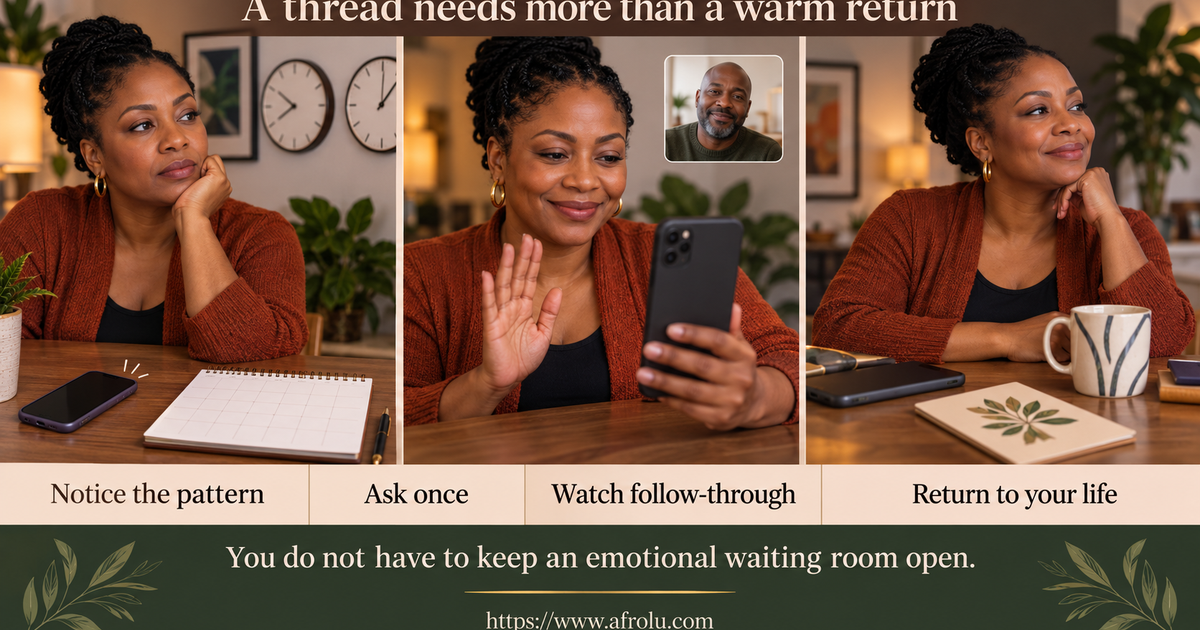
Name the actual pattern before choosing the next move. A distant message does not need to become an endless emotional waiting room.

Name the pattern before choosing the next move.
Separate busy lives, breadcrumbing, distance plans, and access pressure
| Type or dimension | What it describes | Best next question |
|---|---|---|
| A busy season | Includes a clear limit, a return point, and some follow-through. | Use the stated rhythm and revisit it after evidence. |
| Breadcrumbing | Offers intermittent warmth while avoiding a usable plan or repair. | Ask one direct question, then decide from the answer. |
| A realistic long-distance plan | Names contact, practical next steps, cost, and separate logistics gradually. | Keep each step voluntary and independent. |
| A future fantasy | Uses someday promises without a present action or workable detail. | Bring the conversation back to one current offer. |
| Parenting privacy | Protects child information and routines while adults learn about each other. | Share only broad context until trust is well established. |
| Family access pressure | Treats a child, home, or schedule as proof that the connection is serious. | Reassert the adult-only boundary or end contact. |
| A missed call with repair | Acknowledges the change and offers a specific new time. | See whether the new time is kept. |
| A missed call with silence | Leaves you doing the emotional and practical rescheduling. | Stop chasing and wait for a concrete offer. |
| A money request | Asks you to assume financial risk before stable trust exists. | Do not send or receive funds; report if concerning. |
One clear question before another waiting weekend
A message is not an offer
Occasional warmth can be meaningful without creating a workable relationship pattern.
Parenting limits are ordinary
Family routines do not need romantic justification or full disclosure.
Distance needs logistics
Contact, travel, money, lodging, and an exit route are practical conditions of consent.
Clarity can be one question
A direct request for a present offer is kinder than indefinite monitoring.
Child privacy is protective
Early adult dating does not require a child to become visible, involved, or available.
Ending can be enough
You can close an intermittent connection without proving what the other person intended.
Questions organised by purpose and depth
Choose a few prompts that fit the moment. This is a reference library, not a list to complete.
Pattern check
Use when a distant message reappears after silence.
- What has the person actually offered since the last contact?
- Was a previous plan repaired?
- Do I want to reopen this thread today?
Parenting check
Use before sharing family information or agreeing to a time.
- Does this fit my household rhythm?
- Am I sharing a private detail a new match does not need?
- Would a smaller adult-only step be enough?
Distance check
Use before a call, travel plan, or future promise.
- Can we name one realistic present action?
- Would each person remain financially and physically independent?
- Can either adult change their mind without penalty?
Clarity check
Use after one direct request for more consistency.
- Did I receive a real answer?
- Did conduct match the answer?
- What choice gives me more peace and room for life?
Look more closely at patterns, child privacy, travel, and support
Separate intermittent attention from a workable offer
Notice contact, repair, planning, and whether the connection becomes more concrete over time.
Evidence limit: No label can reliably establish another person's intent.
Keep family boundaries adult-led
Protect child information, routines, introductions, home access, and caregiving time while adults learn about fit.
Evidence limit: A parent can date without making a child part of early uncertainty.
Make logistics visible
Talk about calls, travel, cost, lodging, documents, and independent exits before a future visit becomes emotionally loaded.
Evidence limit: A plan is not safer because it feels romantic.
Ask for a present answer
Use one question about regular contact and one practical next move instead of decoding every message.
Evidence limit: You cannot make another adult choose a different offer.
Keep access difficult to reverse
Money, location, documents, home, and family details remain private when a connection is intermittent or new.
Evidence limit: A guide cannot replace local safety, financial, or emergency support.
Reduce isolation outside the phone
Trusted people and qualified care can offer perspective when a distant thread takes up too much emotional space.
Evidence limit: Support should strengthen your choice, not take it over.
Common ways intermittent contact consumes too much space
Treating every reappearance as a reset
Warmth after silence can erase the pattern unless you return to what has actually been offered.
Explaining a parenting limit in full
Private family information is not needed for a new match to hear a boundary.
Letting a child create pressure to continue
A child should not be asked to stabilise an adult connection that is still uncertain.
Accepting someday as a plan
Long-distance hopes need present actions and independent practical detail.
Funding a future visit
Money and dependent travel can make a free no much harder to exercise.
Trying to solve vague contact through constant checking
Monitoring adds mental work without creating reciprocity or reliability.
Choose one resource that matches the present pattern
Start with the guide that fits what is actually happening: intermittent contact, long-distance logistics, or a safety concern that should not remain inside relationship interpretation.
Explore the guide library
Show more related guides
Continue with Afrolu
Show more Afrolu guides
Sources used for this guide
Afrolu reviewed these health, research, safety, or public guidance resources while editing this page. They support the behaviour and safety guidance; they do not diagnose any individual described by a reader.
Questions about breadcrumbing and long-distance dating as a parent
Is breadcrumbing always deliberate?
No. Intermittent contact can have many explanations. You do not need to prove a motive before deciding whether the actual pattern gives you enough consistency.
How much contact is enough in a long-distance connection?
There is no universal number. Enough contact is a rhythm both adults can realistically keep, with clear updates and repair when a shared plan changes.
Can I ask for more consistency without sounding demanding?
Yes. State what you prefer and ask whether it is available now. A direct question gives both people room to answer honestly.
Should I share my child's details with someone I am dating long distance?
Not early. A new adult connection does not need a child's name, photos, school, routine, home, or introduction to prove interest.
What if a distant match wants to visit?
Treat travel as practical logistics. Each adult should retain their own money, transport, lodging, identification, and way to leave. A child and home do not need to be part of an early visit.
What if someone misses a planned call?
Life can interrupt anyone. Notice whether they acknowledge it, offer a concrete new time, and develop a more reliable pattern rather than leaving you to do all the rescheduling.
Should I send money for travel or an emergency?
No. Do not send, receive, borrow, lend, invest, or move money for a new online match. Pressure around funds is a safety concern, not a test of care.
How do I end an intermittent connection?
Say that you need more consistency than the connection is offering and you are not continuing it. You do not need to argue about whether the person intended to breadcrumb you.
What if they contact me after I close it?
Block and report unwanted contact. Preserve relevant records and seek appropriate local support if the contact becomes threatening, coercive, or makes you fear for family safety.
Can I keep dating as a parent without making it a family project?
Yes. You can protect adult time, family routine, and child privacy while gradually learning whether a new person offers the consistency and respect you need.
One thing to do now
Choose the relationship offer that can fit the life you already protect
Choose the next step that protects family rhythm, child privacy, independent money and travel, clear consent, an easy exit, and your right to stop waiting for a vague offer.