New to dating · weekend clarity · steady pace
Anxious Attachment for Adults New to Dating: A Weekend Guide
Feel nervous before or after a date? Use a low-pressure weekend plan, one clear follow-up and practical boundaries without turning a feeling into a diagnosis.

A new dating experience is not a test you have to pass.
Written and edited by Nia Kato · Profile Advice Editor
Being new to dating is not a diagnosis or a race to catch up. Choose a public meeting you can leave independently, decide what to share, and notice how the date feels. If you want to meet again, send one clear invitation; then choose from the answer and your own experience rather than hidden tests or pressure.
Attachment styles · New Relationship Starters
How can I date for the first time or after a long gap without treating every nervous feeling or message gap as a verdict?
An anxious dating cue is a moment of worry about rejection, closeness, or uncertainty. It is a signal to notice and care for, not a diagnosis or a reliable forecast about another person's intent.
Kofi has little dating experience and feels nervous before a Saturday coffee. He chooses a public place, sets a time limit, and arranges his own ride. Afterward he sends one message asking whether the other person would like to meet again. The answer and his own comfort help him decide whether to continue.
First dates · nervous moments · choice
Take one steady step at a time
A new dating experience can be meaningful without being a performance test.
Plan for comfort, observe conduct, ask clearly and decide at your own pace.
Keep it manageable
Choose a public place and an exit you control.
What felt comfortable?
Separate your experience from a prediction.
Do I want another date?
Make one direct invitation if you do.
What fits now?
Continue, adjust, pause or end.
experience · emotion · context
Being new to dating does not mean you have a problem to fix
A first date can bring unfamiliar choices: what to wear, how long to stay, how much to share, and when to follow up. Those questions can feel intense because the situation is new. You do not have to identify a psychological label before deciding what would make the meeting comfortable and respectful.
Adult attachment anxiety is discussed as a dimension in relationship research, not a diagnosis that can be assigned from a first-date reaction. Someone may feel settled in friendships and uncertain in dating, or become more comfortable after a few clear experiences. A general label cannot predict how this particular date will behave or what you should choose.
Kofi has not dated much and feels a rush of worry before a Saturday coffee. He cannot tell whether it is attraction, fear of awkwardness, or a concern about the plan. He chooses a public place, gives himself an hour, and arranges his own trip home. Those practical choices help him take part without demanding that the nerves disappear first.
There is no required age, number of dates, or speed for learning. You can say you are new if you want to, but you do not owe a personal history before you feel ready. A thoughtful match can answer a question, respect a pause, and let you make choices at a pace that fits your comfort.
place · time · exit
Make the first meeting small enough to choose freely
A first meeting can be a short coffee, walk in a public place, or another simple activity you both choose. Pick a location where you can arrive and leave independently. Tell a trusted person the broad plan if that feels useful. These steps support agency; they cannot guarantee how a stranger will act.
Decide in advance what you are willing to share. A brief answer about interests, work, or family may be enough. You do not need to disclose private trauma, account details, home location, sexual history, or identifying information about relatives to make the conversation meaningful. Curiosity can grow over time when trust is earned through conduct.
If a plan changes, ask for the detail that matters before you agree. “Can we meet inside the café instead?” or “I can stay until five” is direct and sufficient. A person who responds respectfully gives you useful information. If they mock the limit, insist on a private location, or make your ride dependent on them, you can leave or cancel.
You are allowed to enjoy the meeting and still decide not to schedule another one. You are allowed to feel uncertain and take a day before answering. A date is an opportunity to learn about fit, not an exam with a correct performance or an obligation to deliver a relationship outcome.

Respect is visible in the way a boundary is received.
message · expectation · evidence
Do not let a quiet Saturday turn into a hidden test
People differ in how quickly they message after a first date. Some send a warm note that night; others wait until the next day or prefer a direct second-date invitation. If you did not agree on a check-in, there is no universal deadline that makes one response proof of interest or rejection.
You can send a simple message if you want: “I enjoyed meeting you. Would you like to get coffee again next weekend?” That shares your interest and gives the other person room to answer yes, no, or not now. You do not have to perform indifference or send multiple hints to protect your dignity.
After sending one clear message, do something else with your evening. Put the phone away for a chosen window, meet a friend, or return to an activity that matters to you. This is not a tactic to make the other person chase you. It is a way to keep one uncertain conversation from taking over the rest of your weekend.
If they do not reply, the lack of response is information about their communication and interest at this moment, though it may not explain the reason. You can decide not to follow up again. If they reply later, compare the actual offer with what you want instead of treating any answer as a prize you must accept.
pause · regulate · reconnect
Give the feeling a moment before deciding what it asks you to do
A racing thought can make immediate action feel necessary. Before sending a second or third message, notice what is happening in your body and what would help you feel steadier. Take a short walk, breathe slowly, write the question down, or contact a trusted friend. Select a response that fits you rather than copying a rule from a dating checklist.
Research on emotion regulation considers how people use different strategies in different circumstances; it does not require a particular exercise or imply that an anxious person cannot date. Sometimes self-soothing is enough. Sometimes a clear question is more useful. A flexible response can include both: settle the urgency, then ask when the answer affects your decision.
Avoid turning the pause into self-criticism: “I am too much” or “I should know how to do this.” Try “This is a new situation and I can take one step at a time.” If dating distress is affecting sleep, work, or daily life, qualified support can help you explore it. Seeking support is optional, not a test of readiness.
A dating partner is not responsible for regulating every feeling, and you are not responsible for making all uncertainty disappear alone. Healthy contact can include asking for reassurance and also having time away from the phone. Notice whether both people can name needs and limits without ridicule or punishment.

The next step belongs to both adults and can remain undecided.
interest · next date · pace
Ask for the next step without asking for a forecast
Early dating often leaves large questions open: whether there will be another date, whether you are compatible, and what each person hopes for. Trying to resolve all of them after one meeting can create pressure. Start with the decision at hand: whether you would both like to meet again and when a realistic window exists.
You might say, “I had a good time. Would Saturday afternoon work for another short date?” If the person is unsure, ask what they know rather than bargaining for certainty. You may be okay waiting a few days, or you may prefer a clear answer now. Both are choices you can state honestly.
A second date is not a promotion to exclusivity, and another enjoyable meeting does not promise long-term compatibility. If you want to date only one person, ask whether the other adult wants the same agreement. Do not assume a shared attraction or a series of weekend plans quietly changes the relationship terms.
If the reply is no, you can thank them and stop. If it is yes, plan the meeting and keep your own boundaries. If it remains vague, decide how long that uncertainty works for you. Your goal is not to win a particular answer; it is to get information that lets you make a fair choice.

A follow-up can invite a choice without demanding certainty.
public place · money · consent
Keep your privacy and safety decisions independent of attraction
Meet somewhere public, keep your own return route, and avoid sharing a home address or precise routine with a new match. Keep passwords, verification codes, banking details, and intimate images private. These boundaries apply whether the person seems familiar, faith-aligned, attractive, or very attentive, at every stage of dating.
Do not send money to an online romantic interest for travel, an emergency, a gift card, a wire transfer, cryptocurrency, or an investment opportunity. Consumer guidance explains that romance scammers may build trust before making a financial request. If a request comes with pressure or secrecy, pause and ask someone you trust to review it.
Consent applies to a second date, a phone call, a photograph, touch, and intimacy. You may say no or change your mind without providing a reason that satisfies the other person. A respectful date can hear the answer and decide whether your boundaries fit theirs without escalating pressure.
If a meeting starts to feel uncomfortable, you may leave, ask venue staff for help, or contact someone you trust. If there is an immediate threat, seek local emergency assistance. A dating guide cannot predict a stranger's behaviour or replace support for a specific safety concern.
enjoyment · respect · next step
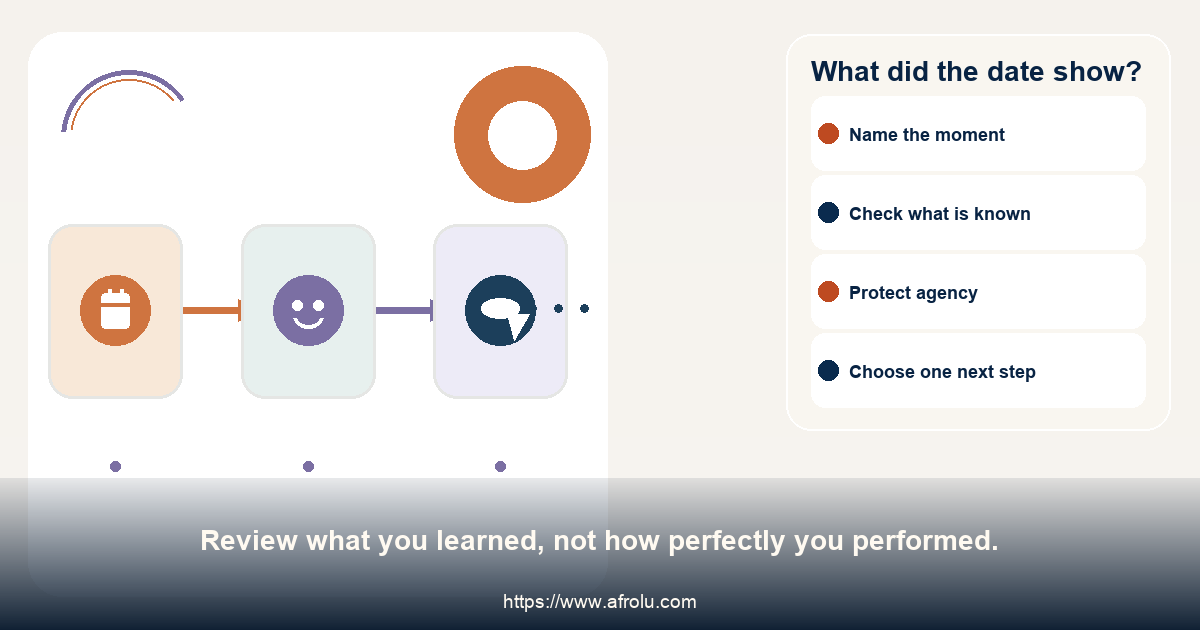
Review what you learned instead of scoring your performance
After the date, note what you enjoyed, what felt uncomfortable, and what you still want to know. Did both people get a chance to speak? Was a limit respected? Did you feel able to leave or slow down? Were the plans and costs as described? These observations are more useful than deciding whether you seemed perfectly confident.
You can continue if interest and respect are present, adjust the next plan if one detail would help, pause if you need time, or end if the connection does not fit. You do not need to label the other person or yourself to make any of those choices. One pleasant date is enough to consider another, not enough to promise a future.
If you want feedback, ask yourself a neutral question: “What would make the next meeting more comfortable?” Perhaps a shorter time, a daytime venue, a clearer plan, or a different activity. Keep what helped and change only what you choose. You are learning your own preferences, not completing a test everyone else has already passed.
Dating experience accumulates at different ages and speeds. Your worth does not depend on how many relationships you have had, and you do not owe a match a timeline. Choose the next step from the life you have now, with room to update your preference as you learn more.
Eight new-dater weekend moments
Nerves arrive while choosing clothes
A new situation can feel uncertain without predicting a bad outcome.
Choose a simple plan and give yourself time.The match asks to switch to a private home
A new date can keep the meeting public and independently arranged.
Offer a public alternative or cancel.You do not know how much personal history to share
Interest does not require immediate access to private details.
Answer at the level you choose.You want to send another message that evening
A clear follow-up can show interest without demanding a forecast.
Ask once whether they would like another date.No reply arrives by Sunday morning
A message gap cannot reveal a full reason or future.
Decide whether one direct follow-up suits you.A yes feels like a promise of exclusivity
Another meeting does not automatically change the agreement.
Keep present terms explicit.A new match asks for help with travel
Online romance requests can carry financial risk.
Do not send funds or payment codes.You want to leave before the date ends
You can close a meeting when your comfort changes.
Leave using the route you arranged.Fourteen signs of a respectful first connection
The meeting place is public and the route home is your own.
You can ask a question without trying to sound like an expert dater.
The other adult lets you finish a thought and asks with reciprocity.
You may decline to share personal history before you are ready.
A plan change is discussed rather than treated as your obligation.
A no or a short meeting window is accepted without ridicule.
You can express interest in another date directly.
The other person can answer yes, no, or unsure without being chased.
One message gap is not made into a hidden test of worth.
A second meeting does not silently change exclusivity terms.
Money, passwords, images and home access stay private.
Both adults can keep the first meeting low stakes.
You can decide to pause or leave after noticing how you feel.
Your dating history is not used to rank your value or readiness.
From nervous cue to chosen action
| Situation | What it may mean | What to do next |
|---|---|---|
| I feel nervous | The situation is new or important; the feeling does not predict its outcome. | Choose one practical support before the date. |
| The venue changes | The new plan may affect privacy or comfort. | Offer a public alternative and own transport. |
| I am asked about my history | The person may be curious, but you control the detail. | Share only what you want today. |
| I want another date | Interest can be expressed without promising a future. | Ask a concrete, answerable question. |
| No reply yet | The reason and intention are still unknown. | Choose whether one follow-up fits your preference. |
| A second date is planned | You both chose another meeting, not necessarily exclusivity. | Keep the current agreement separate. |
| I feel overwhelmed | The meeting may need a pause or an ending. | Use your own exit and contact support if needed. |
| Money is requested | An online relationship may be used to create financial urgency. | Do not send funds to the match. |
| An attachment label comes up | A broad term cannot diagnose a new date. | Return to the behavior and the question. |
| I am unsure about continuing | A pause can help you decide without pressure. | Give yourself a chosen review window. |
Twelve short scripts for first dates
“I can meet for coffee in a public place for about an hour.”
“I prefer to keep those details private until we know each other better.”
“Could we stay somewhere public for this first date?”
“I enjoyed meeting you. Would you like to meet again next weekend?”
“I am not sure yet; can I let you know tomorrow?”
“I have sent my question and will leave room for your answer.”
“I would like another date before discussing exclusivity.”
“I do not send money to a person I have met online.”
“I am going to end the date now; I have arranged my own ride.”
“Please do not keep asking after I have said no.”
“I am new to dating and would like to take this at a measured pace.”
“I do not want to continue dating, but I wish you well.”
Know the difference
Anxious prediction versus what one date can show
I felt nervous, so the date went badly; no message means I was not worth another date.
How the meeting felt, whether boundaries were respected, and whether the person answered a clear follow-up.
Review your experience; do not grade your worth.

One date offers observations, not a verdict on your value.
Prediction versus what one date can show
| Type or dimension | What it describes | Best next question |
|---|---|---|
| First date | A short introduction, not a relationship promise. | Choose a public, manageable plan. |
| Second date | A choice to meet again, not automatic exclusivity. | Ask what each person wants now. |
| Slow dating | The adults take time before changing terms. | Agree how you will stay in touch. |
| Casual dating | Present commitment may remain limited. | Define contact, intimacy and exclusivity. |
| Serious dating | Long-term direction can remain a hope. | Ask which commitment exists today. |
| Online dating | Messages begin the connection. | Protect details and arrange a public meeting. |
| Weekend-first | Dates fit around work and life routines. | Set a real start and finish window. |
| Exclusive dating | Both adults agree to stop other romantic dates. | Name when that choice begins. |
| Dating pause | Someone may need time before another decision. | Say whether and when you will reconnect. |
A simple plan you can use today
New is not broken
Dating experience is not a measure of worth or a diagnosis.
A date is information
One meeting can help you notice comfort, interest and fit.
You control disclosure
A match does not earn private details by asking.
One follow-up is enough
A clear message can express interest without a hidden test.
A second date is not exclusivity
Keep the present agreement explicit as you learn.
Safety stays practical
Public plans, independent travel and private accounts protect options.
Questions organised by purpose and depth
Choose a few prompts that fit the moment. This is a reference library, not a list to complete.
Before meeting
Make a small plan that protects your choices.
- Where will we meet?
- How long can I stay?
- How will I get home?
After meeting
Review your experience rather than your performance.
- What felt comfortable?
- What did I learn?
- What remains unknown?
Follow-up
Decide whether you want another date before checking your phone again.
- Do I want to meet?
- What would I ask?
- What answer can I accept?
Next choice
Choose continue, adjust, pause or end.
- What fits me now?
- What boundary matters?
- What support do I want?
What deserves a closer look
A dimension is not a dating verdict
Adult attachment research studies patterns in closeness and emotion regulation; it does not diagnose a person from one date.
Evidence limit: Individual behaviour still needs to be understood in context.
Nerves can have more than one explanation
A systematic review found an association between adult attachment insecurity and social anxiety in the studies it reviewed.
Evidence limit: The reviewers note that limited longitudinal work prevents conclusions about direction of effect.
Different moments may need different responses
A 2024 study examined flexible emotion-regulation strategies in romantic relationships using survey and experience-sampling designs.
Evidence limit: The study does not prescribe an exercise for every person or first date.
Ask a clear question instead of testing
A daily-diary study explored reassurance seeking and trust in romantic couples.
Evidence limit: Its findings do not mean that any single reassurance request is unhealthy.
Keep transfers separate from interest
Federal consumer guidance warns that online romantic contacts may request money after building trust.
Evidence limit: That information is a caution pattern, not proof about one individual.
Find help if distress is disrupting daily life
A qualified mental-health professional can discuss anxiety and relationships with a person in their own context.
Evidence limit: The guide does not assess symptoms or replace clinical care.
Shortcuts that make a new date feel harder
Treating nerves as a prediction
Feeling uncertain cannot determine how a date will behave.
Trying to sound experienced
A scripted persona makes it harder to learn what you like.
Sharing too much to earn trust
Disclosure should remain voluntary and paced.
Using silence as a test
A hidden test cannot create a clear agreement.
Making a second date mean exclusivity
The two choices require separate conversations.
Ignoring a boundary to be polite
Comfort and consent remain valid during a first meeting.
Make your next dating decision manageable
This guide is editorial information, not diagnosis, therapy, legal advice or emergency support. Use qualified local help when a concern needs it.
Explore the guide library
Show more related guides
Continue with Afrolu
Show more Afrolu guides
Sources used for this guide
Afrolu reviewed these health, research, safety, or public guidance resources while editing this page. They support the behaviour and safety guidance; they do not diagnose any individual described by a reader.
Questions for adults new to dating
Is it normal to feel anxious before a date?
Many people feel uncertain before a new social situation. The feeling alone cannot diagnose you or predict what will happen.
How do I date if I have little experience?
Start with a simple public plan, decide what you want to share, and ask questions that help you notice whether the meeting works for you.
Should I tell someone I am new to dating?
Only if you want to. You can share a little context without giving a full dating or personal history.
How soon should I text after a first date?
There is no universal clock. If you want another date, say so directly and choose a follow-up that feels like you.
What if they do not reply?
A nonresponse does not explain every reason, but you can decide not to pursue further. Your value does not depend on their answer.
Does a second date mean we are exclusive?
No. Exclusivity is a separate agreement that both adults need to discuss.
How can I make a first date safer?
Meet publicly, arrange your own return, keep sensitive details private, and tell someone your broad plan if you choose.
Should I send money to someone I met online?
No. Do not transfer money or share payment codes with an online romantic contact.
Can I leave a date early?
Yes. You may end the meeting when you want. Arrange your own transport and seek help if you feel threatened.
Do I need therapy before dating?
This guide does not set that requirement. You can seek qualified support if distress is affecting daily life, whether or not you date.
One thing to do now
Choose a next step that fits you
Make a small, safe plan; notice your comfort and the other person's conduct; ask directly for the next information you need; and choose whether to continue, adjust, pause, or end without grading your worth.