Faith-led dating · career · steady contact
Make space for faith, work and dating without a constant test
For faith-led daters with demanding careers: set realistic contact, discuss personal practices, respect time boundaries, and assess shared effort across weeks.
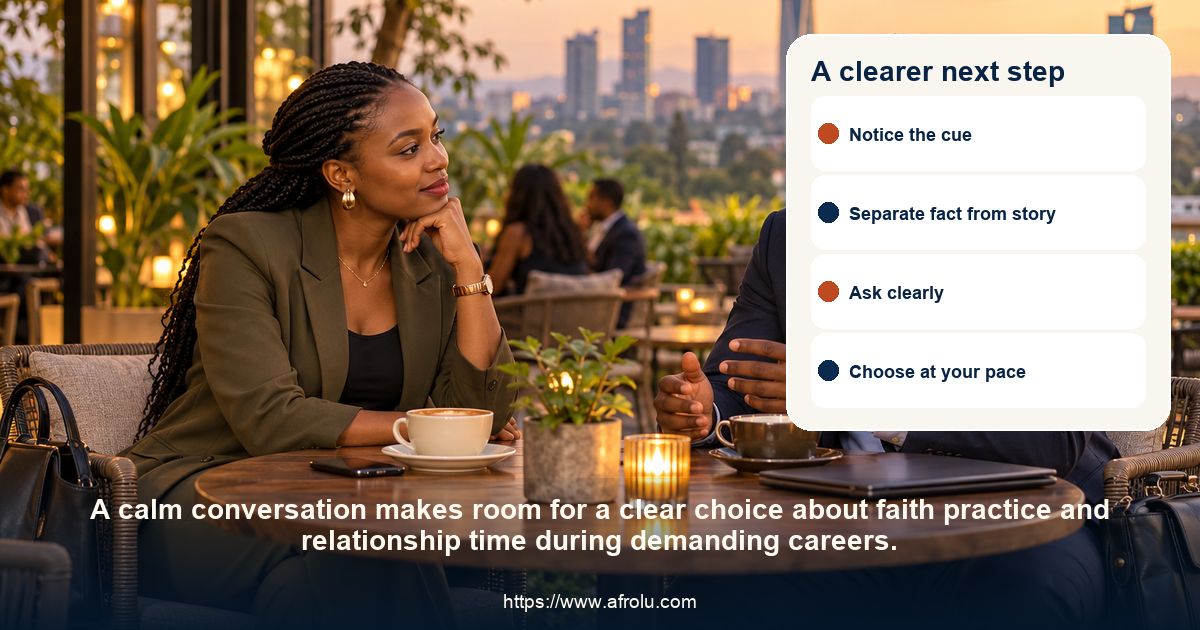
Notice the cue, ask what is true, and choose a workable next step for faith practice and relationship time during demanding careers.
Written and edited by Adwoa Boateng · Dating Safety Editor
Be honest about the hours you can offer, explain the practices and commitments that matter to you, and ask what the other adult can sustain. Agree on a small contact rhythm and a way to repair changes. Mutual effort is more useful evidence than instant replies or a shared calendar that neither can keep.
Attachment styles · Faith-Led Daters
How can I make room for a relationship when work and faith both shape my weekly schedule?
Attachment anxiety is a non-diagnostic lens some people use for heightened concern about closeness or rejection. Work pressure and spiritual practice can create uneven availability, but neither explains another person’s intent. Use clear agreements and repeated conduct to assess whether a relationship fits both lives.
Kendi’s hospital shifts change weekly, while Daniel’s consulting role often crosses time zones. Both value faith, but they practice differently and cannot promise the same evenings. Instead of treating missed calls as a test, they choose a short Sunday check-in and agree to send a simple update when a shift or deadline changes. After a month, they review whether the plan still works.
Capacity · practice · mutual effort
Build a rhythm around lives that already matter
Work and faith can both be important without requiring a partner to stay on call.
Map real availability, state what practice means to you, agree one routine and review how it feels.
What can I offer?
Include shifts, deadlines and rest.
What do I value?
Explain personal routines without prescribing them.
What if plans change?
Send an update and propose a new time.
Does this fit both?
Assess effort after ordinary weeks.
work · practice · rest
Map ordinary capacity before promising a routine
Look at the next two ordinary weeks, including shift patterns, commute, deadlines, worship, study, family care and time you need to recover. Mark the windows when you can be present without multitasking. A relationship plan built only around ideal days can create avoidable disappointment when normal responsibilities return.
If your schedule changes, say what is known and what remains uncertain. You might offer a short call after a late shift rather than promise an entire evening. A clear limit is easier to trust than a broad assurance that you will ‘make time’ without knowing what your calendar can hold.
Ask the other adult for their practical capacity too. Their work may be confidential, seasonal or unpredictable, and they may not be able to share every detail. You still can discuss the effect on dating: which windows are possible, what notice is reasonable and when you will reconnect.
Do not treat a declined call as proof of low interest when no time was agreed. Likewise, a job title does not excuse repeated promises that are never repaired. Compare what each person realistically offered with what happened, while leaving room for a demanding season to change.
practice · values · difference
Explain your own practice instead of assigning one to a partner
Tell the other person which practices shape your week and which values you hope to carry into dating. That could involve prayer, worship, service, family time, food or a quiet day, but it does not mean every person with the same label observes those commitments identically. Specific examples make the conversation personal rather than prescriptive.
Invite the other adult to explain what matters in their own life. They may share your tradition yet have a different schedule, or they may hold a different belief while respecting yours. Listen for curiosity and room to disagree, not a performance that imitates your language.
Discuss which practices you hope to share and which remain individual. A partner might join an occasional event without adopting every routine. You can ask for respect around an important observance while recognizing that attendance, belief and personal devotion cannot be demanded as proof of affection.
If a difference is central to your future, name the specific decision it affects. Family expectations, children, holidays and daily practice may each need their own discussion. You do not need to resolve all of them during an early date, but you can avoid hiding a condition that matters deeply to you.
updates · windows · flexibility
Choose contact that connects without interrupting every day
Agree on one or two contact windows that are easy to remember and realistic to keep. A brief check-in, an unhurried call or a voice note may work, depending on what both adults enjoy. There is no research-based universal quota that turns a specific number of messages into proof of commitment.
Decide what happens when a deadline, shift or practice changes the plan. A short update and an alternative time can prevent uncertainty from turning into a guessing game. Ask how much notice is feasible rather than demanding an immediate explanation while someone is caring for a patient or finishing urgent work.
Avoid messaging during a meeting, a service or sleep simply because a phone is technically available. Set a channel that lets both people return when they are present. A boundary around work or worship is compatible with warmth; it does not require either adult to apologize for having a life.
After the routine has played out, ask whether each person feels connected and whether the effort is shared. If one person always plans or initiates, discuss one practical change. If the available time is too small for what you want, acknowledge that difference instead of adding pressure to an already full week.

Name the need, ask one direct question and leave space for an honest answer about faith practice and relationship time during demanding careers.
need · request · answer
Ask for reassurance in a form someone can realistically answer
When anxiety rises after a busy day, ask what information would actually help. You might say, ‘I know your week is full; could we choose a time for our call tomorrow?’ That request seeks a plan. It does not require a person to stay online all night or guarantee that the relationship will never change.
If you want clarity about direction, ask separately from scheduling: ‘Are you interested in building a committed relationship, or are you keeping dating casual right now?’ A call time cannot answer the commitment question, and a relationship label cannot solve a calendar conflict. Keep each discussion focused on one decision.
Listen to the response and notice whether it includes a workable alternative. An adult may say no to your first proposal while still showing interest through another time. Repeatedly asking in different words after receiving a clear answer can create pressure without providing new information.
You may also name a boundary: ‘I do not plan dates during my protected rest period’ or ‘I keep my worship time private’. The other adult can offer a different option or decide the arrangement does not suit them. Both people retain a choice without being shamed for capacity.

Look for initiative, clear updates, repair and respect across a pattern of faith practice and relationship time during demanding careers.
deadlines · shift work · transitions
Treat career changes as logistics that need communication
Deadlines, travel, a new role, exams or rotating shifts can change the availability that existed last month. When something moves, send a concise update as soon as you reasonably can and suggest a new time if you want the conversation. Avoid promising a replacement window you already know will be difficult to keep.
Ask how long the intense period may last and what contact remains possible while it continues. You do not need a detailed workplace explanation, especially if confidentiality applies. A rough review point can help both people decide whether the temporary routine is acceptable without pretending to know the exact future.
If a person repeatedly cancels without communicating and refuses any repair, look at the pattern rather than attributing it automatically to ambition or stress. A career can explain a constraint while leaving each adult responsible for saying what they can offer. You may need more presence than that role allows.
Make major job, location or study decisions for your own reasons. A partner’s encouragement or shared prayer does not make a career sacrifice a mutual plan. Discuss how a possible move would affect each person, then seek advice from people who understand your work and finances as well as your relationship.
support · privacy · consent
Discuss family and community involvement on your own terms
Ask when each person typically includes family or community in dating. Some want early introductions; others wait until their intentions are clearer. Neither preference is automatically more faithful or more serious. Explain what feels supportive to you and hear whether the other adult can meet you there.
Work pressure can already limit privacy and energy, so do not add a public announcement before both people are comfortable. Ask before forwarding messages, sharing a photo or describing private concerns to a group. Advice can be useful, but the decision about whether to continue belongs to the adults dating.
If a relative expects access to the relationship’s schedule, finances or intimate details, discuss what you are willing to share. A partner’s family deserves respect, but respect does not require disclosing passwords, work records or personal history. Agree what information remains between the two of you.
If faith leaders or mentors provide guidance, each adult can choose an adviser they trust. No adviser should be used to override a clear no or force a schedule that harms work, health or safety. You can seek counsel privately and still make your own decision about compatibility.
mutuality · wellbeing · decision
Review whether work, faith and dating can coexist
After several normal weeks, look at the calls that happened, the changes that were communicated and the times each person initiated. Ask whether the contact feels warm enough, whether faith practices are treated respectfully and whether work boundaries remain possible. Use examples rather than comparing the relationship with another couple’s routine.
Notice your wellbeing. If you are losing sleep before shifts, hiding a relationship from everyone you trust or sacrificing all rest to stay available, consider what needs to change. A qualified counselor may help you reflect; this guide cannot diagnose anxiety or decide how much contact should be enough.
If the other adult wants a different rhythm, discuss whether a smaller or more predictable plan could work. A compromise should leave both people able to choose it freely. It should not ask one adult to violate a core practice, risk work consequences or become constantly reachable to reduce uncertainty.
Choose from the routine that exists, not an ideal version that depends on future career changes. You can continue, set a review date, take a pause during a demanding season or end the connection. A sincere decision can honor your faith, your work and your own limits at the same time.

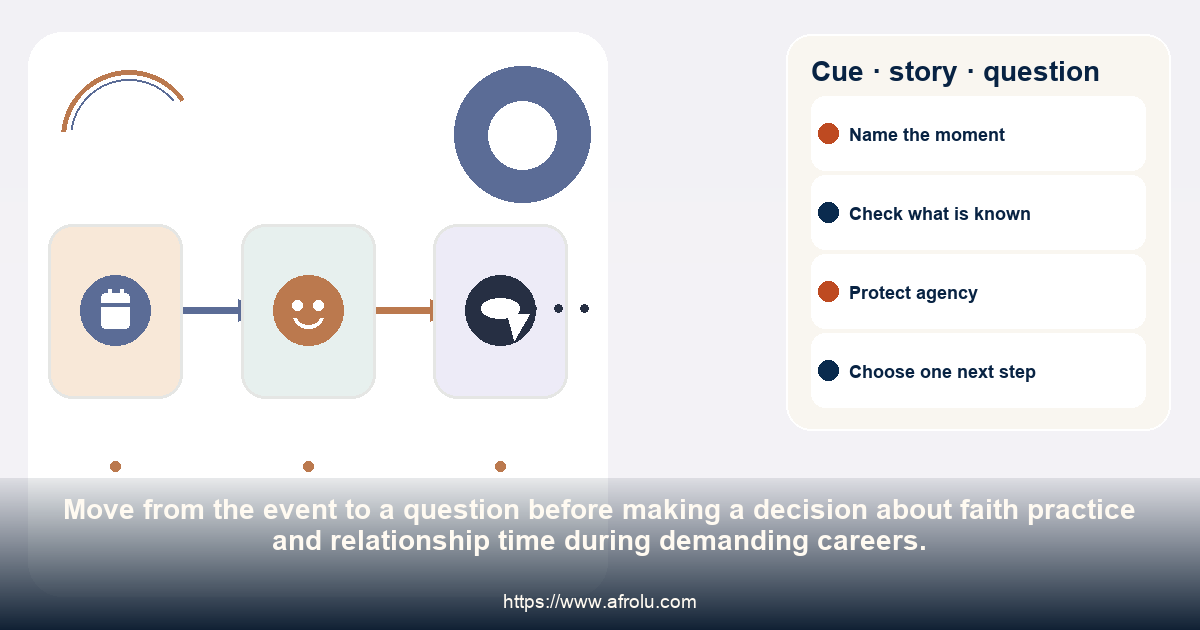
Pause, state the need, observe the response and choose a next step for faith practice and relationship time during demanding careers.
Eight moments in faith practice and relationship time during demanding careers
A message arrives later than expected
Check the agreed window and the context before assigning a motive. Consider how this applies to faith practice and relationship time during demanding careers.
Ask one specific question about faith practice and relationship time during demanding careers, then choose a response that respects your own limits.A planned call has to move
Ask for a practical update and decide whether the replacement time works. Consider how this applies to faith practice and relationship time during demanding careers.
Ask one specific question about faith practice and relationship time during demanding careers, then choose a response that respects your own limits.Two adults use the same word differently
Translate the label into present-day choices about contact and exclusivity. Consider how this applies to faith practice and relationship time during demanding careers.
Ask one specific question about faith practice and relationship time during demanding careers, then choose a response that respects your own limits.A trip is mentioned without dates or costs
Discuss budget, transport, lodging and a public first plan before booking. Consider how this applies to faith practice and relationship time during demanding careers.
Ask one specific question about faith practice and relationship time during demanding careers, then choose a response that respects your own limits.One person wants more contact than the other can offer
Compare real availability and decide whether the difference is acceptable. Consider how this applies to faith practice and relationship time during demanding careers.
Ask one specific question about faith practice and relationship time during demanding careers, then choose a response that respects your own limits.A person declines a request for private information
Notice whether the limit is respected without bargaining or punishment. Consider how this applies to faith practice and relationship time during demanding careers.
Ask one specific question about faith practice and relationship time during demanding careers, then choose a response that respects your own limits.A job or travel plan alters the original idea
Ask what is still true now instead of relying on an old assumption. Consider how this applies to faith practice and relationship time during demanding careers.
Ask one specific question about faith practice and relationship time during demanding careers, then choose a response that respects your own limits.The same question returns without new information
Choose whether to ask once, seek support or step back from checking. Consider how this applies to faith practice and relationship time during demanding careers.
Ask one specific question about faith practice and relationship time during demanding careers, then choose a response that respects your own limits.Fourteen observable signs of a workable agreement
Both adults can describe the current agreement in their own words. Check how it appears during faith practice and relationship time during demanding careers.
Contact expectations account for work, sleep, care and travel. Check how it appears during faith practice and relationship time during demanding careers.
A moved plan receives a clear update when practical. Check how it appears during faith practice and relationship time during demanding careers.
Each person sometimes initiates a conversation or date. Check how it appears during faith practice and relationship time during demanding careers.
Questions about exclusivity receive direct, current answers. Check how it appears during faith practice and relationship time during demanding careers.
A person can say no without being punished or persuaded. Check how it appears during faith practice and relationship time during demanding careers.
Privacy choices remain available throughout the connection. Check how it appears during faith practice and relationship time during demanding careers.
Travel and accommodation are planned without assumed access. Check how it appears during faith practice and relationship time during demanding careers.
Neither adult is expected to finance the other's urgent request. Check how it appears during faith practice and relationship time during demanding careers.
A phone indicator is not treated as proof of intention. Check how it appears during faith practice and relationship time during demanding careers.
A visit includes an independent route home and a workable end time. Check how it appears during faith practice and relationship time during demanding careers.
Future hopes are separated from promises already made. Check how it appears during faith practice and relationship time during demanding careers.
Each person can keep friends, work and restorative routines. Check how it appears during faith practice and relationship time during demanding careers.
Repair follows a repeated disruption rather than endless apology alone. Check how it appears during faith practice and relationship time during demanding careers.
A cue-to-choice decision map
| Situation | What it may mean | What to do next |
|---|---|---|
| A reply is late | The timing alone does not establish a change of interest. The relevant context is faith practice and relationship time during demanding careers. | Compare it with the contact plan and ask if the plan changed. Choose a response that fits your own needs around faith practice and relationship time during demanding careers. |
| A call is missed | A disruption may need a repair, especially if it repeats. The relevant context is faith practice and relationship time during demanding careers. | Ask for an update and a replacement window. Choose a response that fits your own needs around faith practice and relationship time during demanding careers. |
| A label feels vague | People can give a word different meanings. The relevant context is faith practice and relationship time during demanding careers. | Ask what it means for exclusivity and contact today. Choose a response that fits your own needs around faith practice and relationship time during demanding careers. |
| A visit is proposed | Travel creates costs and logistics for both adults. The relevant context is faith practice and relationship time during demanding careers. | Agree on dates, budgets, lodging and a public meeting. Choose a response that fits your own needs around faith practice and relationship time during demanding careers. |
| A request feels too large | A need can be valid while a proposed action is not workable. The relevant context is faith practice and relationship time during demanding careers. | Offer a smaller request or state the boundary clearly. Choose a response that fits your own needs around faith practice and relationship time during demanding careers. |
| A profile claim is uncertain | Online information may be incomplete or false. The relevant context is faith practice and relationship time during demanding careers. | Verify gradually; do not send money or documents. Choose a response that fits your own needs around faith practice and relationship time during demanding careers. |
| An answer disappoints | An honest no can still be useful compatibility information. The relevant context is faith practice and relationship time during demanding careers. | Decide whether the terms offered fit you. Choose a response that fits your own needs around faith practice and relationship time during demanding careers. |
| Anxiety rises again | A familiar feeling may return without new evidence. The relevant context is faith practice and relationship time during demanding careers. | Ground first, then ask only if an answer would change your choice. Choose a response that fits your own needs around faith practice and relationship time during demanding careers. |
| One person carries planning | A single invitation is not a complete pattern. The relevant context is faith practice and relationship time during demanding careers. | Notice initiative and repair across a realistic period. Choose a response that fits your own needs around faith practice and relationship time during demanding careers. |
| A boundary is ignored | Repeated pressure affects trust and practical safety. The relevant context is faith practice and relationship time during demanding careers. | Reduce access, end contact or seek suitable local support. Choose a response that fits your own needs around faith practice and relationship time during demanding careers. |
Twelve ways to ask clearly and set limits
“What kind of contact can we both keep during a normal week?”
“If one of us needs to move a call, can we send an update and suggest another time?”
“Are we exclusive today, or are we still meeting other people?”
“What kind of relationship are you open to building right now?”
“Could we choose the dates, budget and public meeting place before booking?”
“I prefer to keep my address and itinerary private while we are getting to know each other.”
“I do not send money to someone I have only met online.”
“I like this conversation and want to take the next step slowly.”
“I feel unsure about what we agreed; can we describe it in plain terms?”
“A short update when plans change would help me organise my day.”
“I am not comfortable with that plan; I can meet in public instead.”
“This arrangement no longer fits what I want, so I am ending it here.”
Know the difference
An anxious interpretation and observable evidence in faith practice and relationship time during demanding careers
A strong emotion deserves care, while its explanation may still be uncertain.
The words, actions and agreement that both adults can describe.
Care for the feeling, check what is known, then decide whether to ask or act.

Care for the feeling, check the facts and make your own decision about faith practice and relationship time during demanding careers.
Feeling, interpretation and evidence
| Type or dimension | What it describes | Best next question |
|---|---|---|
| Casual dating | Present involvement may be warm while long-term direction remains open. The detail may matter differently in faith practice and relationship time during demanding careers. | State whether you are seeing others and what you can offer now. Keep the discussion specific to faith practice and relationship time during demanding careers. |
| Exclusive dating | Both adults agree whether they will date other people. The detail may matter differently in faith practice and relationship time during demanding careers. | Name the agreement directly and revisit it if circumstances change. Keep the discussion specific to faith practice and relationship time during demanding careers. |
| Long-distance dating | Contact and visits happen across separate places and schedules. The detail may matter differently in faith practice and relationship time during demanding careers. | Plan a repeatable rhythm, costs and independent travel. Keep the discussion specific to faith practice and relationship time during demanding careers. |
| Weekend-first dating | Dates fit into limited days off or a short visit. The detail may matter differently in faith practice and relationship time during demanding careers. | Choose one realistic plan with a clear end time. Keep the discussion specific to faith practice and relationship time during demanding careers. |
| Slow dating | The relationship develops without a rushed deadline. The detail may matter differently in faith practice and relationship time during demanding careers. | Agree what information you need before taking another step. Keep the discussion specific to faith practice and relationship time during demanding careers. |
| Online dating | A profile or message begins contact but cannot verify every claim. The detail may matter differently in faith practice and relationship time during demanding careers. | Protect personal details while trust develops. Keep the discussion specific to faith practice and relationship time during demanding careers. |
| Committed partnership | Adults may share a defined direction and responsibilities. The detail may matter differently in faith practice and relationship time during demanding careers. | Discuss practical expectations rather than relying only on a label. Keep the discussion specific to faith practice and relationship time during demanding careers. |
| Open-ended dating | The next stage is not yet agreed by both people. The detail may matter differently in faith practice and relationship time during demanding careers. | Decide when to revisit the question and what remains open meanwhile. Keep the discussion specific to faith practice and relationship time during demanding careers. |
| Visit-based dating | In-person meetings happen during trips between places. The detail may matter differently in faith practice and relationship time during demanding careers. | Keep flights, lodging, spending and time independently manageable. Keep the discussion specific to faith practice and relationship time during demanding careers. |
A simple plan you can use today
A cue is incomplete
An event in faith practice and relationship time during demanding careers can trigger worry without proving what another adult intends.
Labels need translation
Define the actual behaviour behind casual, serious, exclusive or long-distance.
Capacity changes
Work, sleep, travel and family obligations can shift without changing care.
Boundaries protect choice
A clear limit does not need to be justified by a diagnosis.
Repair is observable
An update and a workable alternative give more information than apology alone.
Fit is mutual
A person can be kind and still want a different kind of relationship.
Questions organised by purpose and depth
Choose a few prompts that fit the moment. This is a reference library, not a list to complete.
What is known?
Separate an event from the story you attach to faith practice and relationship time during demanding careers.
- What happened?
- What do I know?
- What remains a guess?
What should I ask?
Choose information that would actually change your decision.
- Which term is unclear?
- What answer do I need?
- When can we talk?
What can I offer?
Describe a contact or meeting plan that fits real capacity.
- Which days work?
- What is my boundary?
- What is optional?
What is my next move?
Use the agreement and repeated conduct rather than an imagined guarantee.
- Continue?
- Revise or pause?
- End the connection?
What deserves a closer look
Attachment anxiety is a lens
Attachment research can describe patterns of worry and reassurance seeking in relationships.
Evidence limit: It is not a clinical diagnosis or an explanation for another person's motive.
Responsiveness is not constant availability
Long-distance communication studies examine how channels and responsiveness relate to satisfaction.
Evidence limit: Associations in a study sample do not prescribe a universal reply schedule.
Distance creates asynchronous routines
Transnational family research describes how lives in separate places can develop different daily timings.
Evidence limit: That evidence does not predict the outcome of an individual dating connection.
Ask for behaviour you can observe
A practical request can clarify whether a plan, update or boundary is mutually workable.
Evidence limit: A clear answer cannot guarantee every future choice.
Romantic urgency is not verification
Official consumer guidance warns about online romance contacts who request travel or emergency money.
Evidence limit: Use local reporting channels and do not send funds to a new online match.
Choose from present fit
Assess words, actions and boundaries within faith practice and relationship time during demanding careers.
Evidence limit: A general guide cannot make the relationship choice for you.
Common shortcuts that add uncertainty
Using read receipts as a relationship measure
A status indicator cannot explain another person's intention.
Building a future from a label
People can mean different things by the same word.
Overloading a first visit
More activities do not guarantee comfort or compatibility.
Sending travel or emergency money
A compelling online story is not independent verification.
Withholding a reply as a test
A hidden test makes the agreement less clear.
Accepting a plan that feels unsafe
Travel cost or politeness does not remove your right to leave.
Choose what would help with faith practice and relationship time during demanding careers
This guide is editorial information, not diagnosis, therapy, legal, financial, travel-security or emergency advice. Check current local guidance and qualified support where needed.
Explore the guide library
Show more related guides
Continue with Afrolu
Show more Afrolu guides
Sources used for this guide
Afrolu reviewed these health, research, safety, or public guidance resources while editing this page. They support the behaviour and safety guidance; they do not diagnose any individual described by a reader.
Questions about faith practice and relationship time during demanding careers
Does a late reply prove someone lost interest?
No. A delay is one observation. Compare it with the agreement and the wider pattern, then ask directly if a plan changed. In this guide, apply that answer to faith practice and relationship time during demanding careers and make the choice that fits your own agreement.
Is anxious attachment a diagnosis?
No. This guide uses attachment anxiety as a non-diagnostic lens, not a clinical assessment or a fixed identity. In this guide, apply that answer to faith practice and relationship time during demanding careers and make the choice that fits your own agreement.
How often should long-distance daters message?
There is no universal frequency. Choose a rhythm that suits both schedules, communication preferences and the present agreement. In this guide, apply that answer to faith practice and relationship time during demanding careers and make the choice that fits your own agreement.
Can I ask for reassurance?
Yes. Ask for specific information or a workable action. Notice whether the same question is being repeated after a clear answer without new evidence. In this guide, apply that answer to faith practice and relationship time during demanding careers and make the choice that fits your own agreement.
Should a first date include a full weekend?
No. A short, public plan with a clear end is enough for a first meeting; extend it only if both people want to. In this guide, apply that answer to faith practice and relationship time during demanding careers and make the choice that fits your own agreement.
Do we have to be exclusive if we travel to meet?
No. Travel does not create exclusivity. Ask whether either person is dating others and agree on terms explicitly. In this guide, apply that answer to faith practice and relationship time during demanding careers and make the choice that fits your own agreement.
Should I pay for a match's flight or emergency?
Do not send money to a romantic contact you have only met online. Verify independently and use official consumer-protection guidance. In this guide, apply that answer to faith practice and relationship time during demanding careers and make the choice that fits your own agreement.
What if I want a more serious relationship?
Say so and ask what the other person wants. You may leave a casual agreement that no longer fits. In this guide, apply that answer to faith practice and relationship time during demanding careers and make the choice that fits your own agreement.
How can we make a visit safer?
Choose a public first meeting, keep your own transport and accommodation, and share the broad plan with a trusted person if that helps. In this guide, apply that answer to faith practice and relationship time during demanding careers and make the choice that fits your own agreement.
When should I pause or end contact?
Pause or end when the arrangement no longer fits, important boundaries are repeatedly ignored, or you feel unsafe. Seek local support for specific threats. In this guide, apply that answer to faith practice and relationship time during demanding careers and make the choice that fits your own agreement.
One thing to do now
Choose the next step that fits
Describe your real schedule and the parts of faith practice you want a partner to understand. Ask what contact and time the other adult can genuinely offer, agree how changes will be communicated and review the pattern after ordinary work weeks. Decide from fit, not an ideal routine no one can sustain.