Faith-aware dating · attachment cues · clear terms
Anxious Attachment in Faith-Led Dating: Feelings, Faith and Clear Terms
Use an attachment cue as information, not a diagnosis. Separate faith, dating intention, current terms and consent with clear scripts and safety boundaries.

An attachment cue can prompt a question without deciding the answer.
Written and edited by Adwoa Boateng · Dating Safety Editor
Treat an attachment cue as information, not a diagnosis or proof about another person's intent. Separate the event from the story, make one specific request, and observe the response over time. Describe faith through lived choices, keep a serious hope distinct from current casual terms, and protect consent, privacy, and money in every structure.
Attachment styles · Faith-Led Daters
How can I care for anxious feelings, honour faith as a personal practice, and still describe the dating agreement that exists today?
Anxious attachment in dating is a non-diagnostic lens some adults use to reflect on worry about rejection, closeness, or uncertainty. It cannot determine another person's motive, establish compatibility, or replace direct questions and safety boundaries.
Amina hopes for a faith-aligned committed partnership but is currently dating non-exclusively. After a quiet afternoon, she worries that Daniel has changed his mind. Instead of treating the feeling as proof or dismissing it as unfaithful, she checks their current plan, asks one direct question, and decides whether the answer and repeated conduct work for her.
Feeling · faith · present agreement
Use the cue to ask a clearer question
Attachment language can help you notice a moment without defining either person.
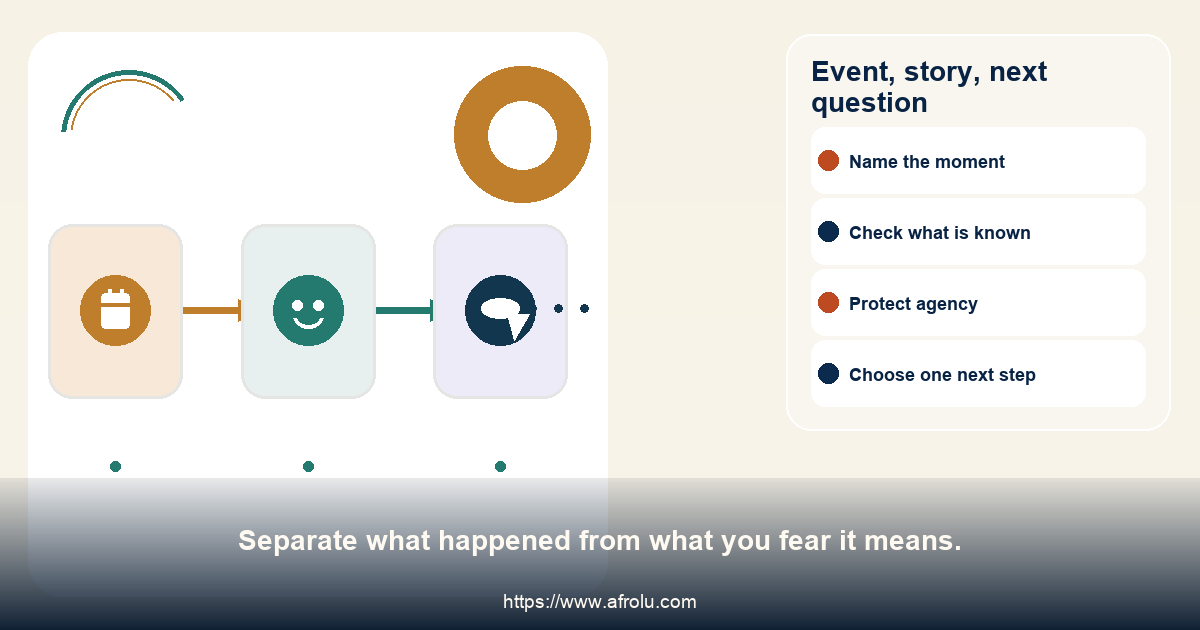
Separate the event, the interpretation, the current terms, and the choice that belongs to you.
What happened?
Write the observable event before adding a story.
What do the terms mean?
Keep long-term hopes beside today's agreement.
What do I need to know?
Make one direct request that another adult can answer.
Does the pattern fit?
Decide from conduct, consent and compatibility.
pattern · context · choice
Use attachment language as a lens, not a verdict
Adult attachment research often measures anxiety and avoidance as dimensions of relationship experience. That language can help someone notice a recurring response, but it is not a clinical diagnosis or a permanent identity. The same person may feel steadier with one partner, more activated in a new connection, or simply unsure because the agreement is genuinely unclear.
Notice the moment before naming it: a reply takes longer than expected, a plan is not confirmed, or the other person mentions seeing people casually. Record the observable event first. Then write the prediction your mind supplied, such as “they have changed their mind.” The prediction may be possible, but it is not yet the same thing as a fact.
Amina is faith-led and open to a serious partnership, while Daniel says he is dating casually and not exclusive. A quiet afternoon makes her worry that he has lost interest. Their stated terms still matter more than her fear or a hopeful interpretation. She can ask whether the present arrangement still works without demanding a promise about the future.
If the other person repeatedly lies, ignores consent, threatens you, or pressures you for money, treat that conduct directly. Do not use attachment language to explain away a safety concern or to blame yourself for noticing it. A useful lens creates more choice and clearer questions; it does not require you to stay, disclose private information, or accept an arrangement that does not fit.
feeling · fact · open question
Separate the feeling from the evidence without dismissing either
Before sending another message, take a short pause that feels realistic for you: drink water, step outside, pray or reflect if that is part of your own practice, or speak to someone you trust. The aim is not to suppress the feeling. It is to make the next action deliberate enough that it expresses a need rather than a demand for instant certainty.
Use three lines in a note: what happened, what I am afraid it means, and what I can ask or observe next. “They have not replied since lunch” is an event. “They are rejecting me” is an interpretation. “Does our Friday plan still work?” is a question with an answer you can use. Keep these categories separate while you wait.
Prayer, spiritual counsel, journaling, community, or therapy may each be helpful to different people; none should be imposed as proof of faith or as a substitute for consent. Choose support that respects your autonomy and confidentiality. If advice turns into pressure to accept unwanted contact, intimacy, surveillance, or a rushed commitment, you can set that advice aside.
Self-regulation does not mean agreeing to a communication rhythm that leaves you persistently unsettled. Once you are calmer, you may still decide that a weekly check-in or clear plan is important. If the other person cannot offer it, their answer is useful compatibility information. You do not need to turn a personal need into a moral failing to make a decision.
reassurance · repair · reciprocity
Ask for reassurance in a way that can be answered
A specific request is easier to discuss than repeated tests. You might ask for a brief update when a shared plan changes, or for a direct answer about exclusivity. Research on reassurance-seeking and trust describes associations inside couples; it does not establish that every request is unhealthy or that one partner must satisfy unlimited checking.
Try: “When plans shift, could you tell me directly and suggest another time if you still want to meet?” Then allow the other person to answer honestly. They may agree, offer an alternative, or say they cannot sustain that rhythm. The useful information is both the words and the repeated follow-through, not a single reassuring sentence taken as a guarantee.
If you have already asked and received a clear answer, pause before repeating the same question in a new form. Ask yourself whether new evidence appeared, whether the agreement changed, or whether the uncertainty itself is hard to sit with. You can seek support elsewhere for the feeling while reserving relationship questions for genuine changes in the arrangement.
The other adult also gets to name limits. They can say they are unavailable during worship, work, caregiving, or sleep and offer another time. That boundary does not automatically mean rejection. A respectful response still matters: both people should be able to state a need, hear the answer, and decide whether the proposed rhythm is workable without punishment or spiritual pressure.

A direct request protects both clarity and choice.
belief · practice · compatibility
Discuss faith through lived choices, not assumptions
Faith may shape time, family life, community, intimacy, ceremonies, or plans for marriage, but individuals practise differently. Ask which parts matter in this season instead of inferring them from a profile, family background, name, or place of worship. You can describe your own practice with equal specificity and say where your decisions are still forming.
A useful conversation separates direction from present agreement: “I hope for a committed relationship, and I am currently dating without exclusivity. What does casual mean for you today?” If intimacy is being considered, discuss consent, health, and boundaries separately. A religious word, a serious intention, or a family introduction does not silently answer those questions for either person.
If one person wants a faith-led courtship and another wants a casual connection, neither label makes someone deceptive by itself. The practical question is whether each has described the terms honestly and whether the other can freely accept them. Do not accept casual dating as an unspoken promise of marriage, and do not use a serious hope to imply exclusivity that has not been agreed.
Some daters welcome family or community input early; others want privacy while they learn about a match. Decide together who may know, what may be shared, and when an introduction feels appropriate. An adviser can help you reflect, but cannot choose the relationship for you. No one should use belief, obedience, shame, or fear of exclusion to override a direct no.

Use patterns of behaviour rather than a label to judge fit.
messages · plans · capacity
Agree on a contact rhythm that fits real life
People have different work hours, prayer or reflection routines, caregiving duties, data access, and preferences for calls or messages. No universal reply window proves interest. If daily contact matters to you, say so as a preference. If it does not, explain what updates you still need when a date or shared plan changes.
You might choose a simple arrangement: one message most evenings when both are free, and a direct update if a planned date needs to move. A lighter rhythm can also work when both people like it. The test is not whether the pattern matches another couple; it is whether these two adults can describe it, follow it, and revise it without guessing games.
When a message arrives at a difficult time, you may acknowledge it and offer a later window: “I have seen this and want to answer properly after work tomorrow.” That communicates care without promising immediate access. A dating partner can have privacy and offline time. You can also decide that a connection with very little contact does not meet your needs.
Avoid using silence, jealousy, app monitoring, or an ultimatum as a substitute for a direct request. If the agreed rhythm fails once, check what happened before drawing a broad conclusion. If it fails repeatedly and the other person does not want to repair it, make your choice from that pattern. Faith or attachment language should not be used to shame either person into availability.
privacy · money · autonomy
Keep ordinary safety and consent boundaries intact
For an early meeting, choose a public setting and a way home that remains under your control. Share only the broad plan with a trusted person if that helps. Keep verification codes, banking details, intimate images, and passwords private. You do not have to send financial help, a screenshot, or private proof to show that you trust someone.
Long distance can make a compelling story feel urgent, especially when you hope to meet. Consumer guidance warns against sending money to an online romantic contact for travel, emergencies, gift cards, wire transfers, or cryptocurrency. A request for funds is a financial decision to decline; you do not need to prove the person is a scammer before protecting your accounts.
A boundary can be brief: “I do not send money or share codes with someone I am newly dating.” If the request returns through another channel, pause contact and use the platform's reporting tools. If you feel threatened or controlled, seek appropriate local support. An editorial page cannot assess a person, guarantee safety, or replace emergency help.
Consent remains specific and revocable in every dating structure. A serious goal does not promise sex or marriage; a casual agreement does not reduce the right to say no. You can change your mind about a conversation, meeting, photograph, family introduction, or relationship. Respect is shown by accepting the boundary, not by asking you to justify it repeatedly.
continue · revise · pause · end
Review the connection from conduct and fit
After several dates or a clear change, compare what you each hoped for with what is happening. Are casual terms still honest? Is faith discussed with respect? Do plans receive updates? Can both people say no? Is reassurance mutual and proportionate? These questions describe the relationship you have rather than the label you fear or want it to become.
Continue when the arrangement is clear enough, enjoyable, and respectful to both. Revise one specific term if a workable change could help, such as when to check in or how to handle a changed plan. Pause if you need room to reflect. End when your non-negotiable values conflict or a boundary is repeatedly ignored.
If you want exclusivity, ask directly rather than waiting for the connection to imply it. If the answer is no or uncertain, decide whether that current arrangement fits you. Do not treat a hoped-for future as a deposit that obliges you to stay. A clear answer may disappoint and still protect both people from investing under different assumptions.
If anxious thoughts or relationship distress are affecting sleep, work, safety, or daily life, a qualified mental-health professional may help you explore them. That is one option, not a condition of dating or proof that the problem belongs to you. You can seek confidential support while also expecting honesty, care, and consent from the person you date.

A review creates choice without promising a particular outcome.
Eight moments where faith and anxious cues meet
A quiet afternoon feels like rejection
The feeling is real, while the meaning still needs checking.
Ask whether a shared plan remains current.A serious hope meets a non-exclusive present
Long-term direction and today's agreement answer different questions.
Describe both without implying a promise.A weekly observance changes availability
A schedule detail need not become a test of belief.
Offer a realistic alternative window.The same question returns after an answer
No reply can guarantee every future outcome.
Check whether new evidence appeared first.A relative wants an early introduction
Outside advice and public relationship status are separate choices.
Agree what may be shared and when.A label is treated as consent
Relationship direction does not replace present consent.
Pause and ask what each person wants now.A distant date requests travel funds
A compelling story does not remove financial risk.
Do not send money; contact the platform if needed.A no is answered with spiritual pressure
A value claim cannot make an unwanted choice voluntary.
End the negotiation and seek support if necessary.Fourteen signs of respectful clarity
Each person can describe the current agreement without relying on a future hope.
A reply delay is checked against the actual plan rather than treated as proof by itself.
A direct reassurance request can receive an honest, bounded answer.
Neither person is expected to guarantee every future feeling or outcome.
Faith practice is described personally rather than inferred from a label.
Both adults can explain how casual, serious, and exclusive terms differ today.
A contact preference is stated without covert tests or punishment.
A date can offer another time when a schedule changes.
Family or community involvement is chosen by both adults.
Consent, intimacy, and health are discussed as current choices.
Money, passwords, private images, and verification codes remain separate from trust.
A boundary is heard without shame, ridicule, or spiritual pressure.
Repeated conduct matters more than one unusually reassuring message.
Either person can revise terms or close the connection clearly.
A cue-to-choice map
| Situation | What it may mean | What to do next |
|---|---|---|
| I feel alarmed | Something matters, but the cause is not yet certain. | Name the event before interpreting it. |
| A reply is late | Availability, preference, or interest may have several explanations. | Check any shared plan and the agreed rhythm. |
| I want reassurance | A specific answer may help; certainty cannot be guaranteed. | Ask once for a clear behaviour or term. |
| We say serious | One person may mean marriage, commitment, or eventual partnership. | Ask what changes in the current agreement. |
| We say casual | People may differ on exclusivity, intimacy, and contact. | Define what the word includes today. |
| Faith affects time | A practice or community commitment may shape availability. | Discuss the schedule without judging belief. |
| Family asks to meet | An introduction may reveal private information or expectations. | Choose audience and timing together. |
| Money is requested | Urgency can increase the chance of financial loss. | Do not transfer funds to an online love interest. |
| A no is pressured | The conversation now concerns respect and consent. | Stop bargaining and leave if needed. |
| Terms no longer fit | The connection may need a change or a clean ending. | State the present decision directly. |
Twelve scripts for terms, faith and boundaries
“I hope for a committed relationship, and I am dating non-exclusively today.”
“When you say serious, what would change for us this month?”
“What does casual include or leave open for you right now?”
“Which parts of your practice shape an ordinary dating week?”
“Could you update me when a shared plan changes?”
“I am offline during this part of my week; can we talk tomorrow?”
“Please ask me before sharing our names or plans with anyone.”
“Before we decide, I want us to discuss consent and health directly.”
“I do not send funds or codes to someone I am newly dating online.”
“My answer is no; please do not keep asking tonight.”
“Would you like to keep this casual, change a term, or stop?”
“Our current expectations do not fit, so I am ending this connection.”
Know the difference
A feeling can inform the conversation without deciding it
Anxiety may rise when a plan is uncertain, a reply is delayed, or a value feels important.
Repeated follow-through, clear terms, respect for consent, and repair show how this connection works.
Care for the feeling, then choose from the facts and the agreement.

An inner cue and an observed pattern answer different questions.
Inner cue versus observed pattern
| Type or dimension | What it describes | Best next question |
|---|---|---|
| Faith-led dating | Personal practice may shape routines and future hopes. | Ask what matters to each adult now. |
| Casual dating | Current commitment may be limited while honesty remains. | Define meetings, contact, and exclusivity. |
| Serious dating | A long-term intention is not automatic current commitment. | Ask which action changes today. |
| Exclusive dating | Both adults choose to stop romantic dates with others. | Agree when the term begins. |
| Slow dating | People allow more time before changing the arrangement. | Set a voluntary review point. |
| Online dating | The channel begins the connection, not the agreement. | Keep privacy and meeting choices deliberate. |
| Community introduction | A connector cannot consent or decide for either dater. | Talk directly and privately afterward. |
| Dating pause | One person may need time or reduced contact. | Say whether and when you will reconnect. |
| Faith difference | Shared labels do not guarantee matching practice. | Discuss lived choices without ranking anyone. |
A simple plan you can use today
A label is a lens
Attachment language can name a pattern without diagnosing a person.
A feeling is not a forecast
Anxiety deserves care while the prediction still needs evidence.
Direction differs from agreement
A serious hope does not silently create exclusivity.
Practice is personal
Ask what faith means in daily choices rather than assuming.
Reassurance has limits
A direct request may help, but no partner can remove all uncertainty.
Safety remains separate
Belief, distance, or affection never makes money or access owed.
Questions organised by purpose and depth
Choose a few prompts that fit the moment. This is a reference library, not a list to complete.
The cue
Separate what happened from what you fear it means.
- What did I observe?
- What story did I add?
- What would I ask?
Present terms
Write what exists now before naming the future you hope for.
- Are we exclusive?
- What does casual mean?
- What remains undecided?
Faith in practice
Describe your own routines without guessing the other adult's.
- Which practices shape time?
- What boundaries matter?
- What may be shared?
Next step
Choose an action that protects both honesty and agency.
- Continue?
- Revise one term?
- Pause or end?
What deserves a closer look
Dimensions describe patterns, not diagnoses
Research commonly measures adult attachment anxiety and avoidance as dimensions that relate to how people respond to stress in close relationships.
Evidence limit: The studies cannot identify a person's motive or determine whether a match is safe.
Choose a response that fits the moment
A 2024 experience-sampling study examined how attachment dimensions relate to the flexible use of emotion-regulation strategies in romantic relationships.
Evidence limit: The sample and study design do not establish a universal dating rule.
Ask for support while preserving choice
A daily-diary study examined reassurance-seeking and trust within romantic couples, which supports treating requests and partner responses as relational context.
Evidence limit: An association does not mean every reassurance request is excessive or harmful.
Make values specific to the adults involved
This guide uses faith as an individual life context and avoids treating a broad religious identity as a reliable predictor of conduct.
Evidence limit: The page does not interpret theology, marriage law, or a particular community's rules.
Keep emotional and financial choices distinct
Consumer guidance describes romance scams that build trust online and later request travel, emergency, or investment money.
Evidence limit: That guidance identifies a risk pattern; it does not prove that any specific match is fraudulent.
Seek qualified care when distress needs it
A trained mental-health professional can help someone explore recurring distress, relationship patterns, or other concerns in context.
Evidence limit: This editorial is not a diagnosis, therapy plan, or substitute for urgent local support.
Shortcuts that confuse a feeling with a fact
Calling a feeling proof
The feeling matters, but one event may not explain another person's intent.
Treating a label as a diagnosis
A dating guide cannot clinically assess either person.
Using a serious hope as a promise
The other adult may understand the current agreement differently.
Treating faith as a character test
A shared label cannot guarantee honesty, consent, or compatibility.
Repeating reassurance tests
Repeated checking can obscure whether any new information appeared.
Explaining away pressure
Attachment or belief language should never excuse coercive conduct.
Put today's agreement beside the future you hope for
This guide is editorial information, not diagnosis, therapy, religious ruling, legal advice or emergency support. Seek qualified local help when a concern needs it.
Explore the guide library
Show more related guides
Continue with Afrolu
Show more Afrolu guides
Sources used for this guide
Afrolu reviewed these health, research, safety, or public guidance resources while editing this page. They support the behaviour and safety guidance; they do not diagnose any individual described by a reader.
Questions about faith-led anxious dating
Is anxious attachment a diagnosis?
No. Attachment anxiety is a research and self-reflection concept, not a diagnosis this guide can assign. A qualified clinician can assess mental-health concerns in context.
Does a slow reply mean someone is losing interest?
A reply gap alone does not establish intent. Check the plan and the communication rhythm you have both discussed, then ask directly if the answer matters.
Can I want marriage and date casually now?
You can hold a long-term hope while describing the current arrangement honestly. Define exclusivity, intimacy, and contact rather than asking a future goal to speak for today.
Does sharing faith mean we are compatible?
Not automatically. Ask what each person's practice, boundaries, and future hopes mean in daily life, and decide whether those choices fit.
How often should I ask for reassurance?
There is no universal number. Make a specific request, hear the answer, and revisit it when new information or a changed agreement gives you a reason.
Should I stop dating until I feel secure?
This guide does not set that requirement. You can date at a pace that respects your needs and seek support if distress is affecting daily life.
Is a family introduction proof of commitment?
No. Decide together what the introduction means, who may know, and whether each person is ready for that visibility.
What if someone uses faith to pressure me?
A belief claim does not override your consent. Restate the boundary, end the interaction if needed, and seek suitable support if you feel unsafe.
Should I send money to a distant romantic match?
Do not send money to an online love interest. If you have already paid, contact your financial institution promptly and report the account to the platform.
When should I end the connection?
Consider ending when the current terms do not fit or a boundary is repeatedly ignored. You do not need a diagnosis or a moral verdict to leave.
One thing to do now
Choose the arrangement both adults can describe
Name the cue, separate observed facts from interpretation, ask for the specific information that matters, and decide from the current terms and repeated behaviour. Continue only while the arrangement respects both people's values, boundaries, consent, and choice.