Dating later · Nairobi · money and choice
Settle the bill without turning it into a debt
Adults dating later in Nairobi can agree a date budget, handle split or treating offers, keep transport independent and separate payment from obligation.
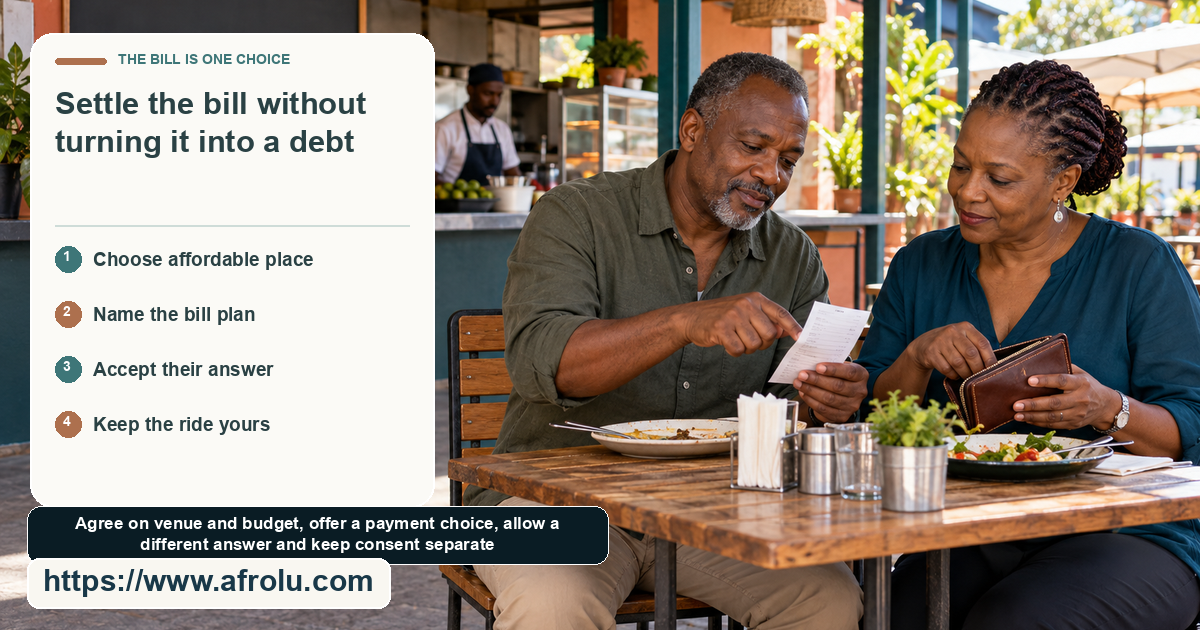
Paying for a meal is a practical choice, never a purchase of another person's access.
Written and edited by Liya Bekele · Horn of Africa Editor
No gender or age rule has to decide the bill. Pick a venue and spending limit you can afford, then make the arrangement explicit: each pays their own, split the shared cost, or one person freely treats. Check that the other adult can decline an offer without embarrassment. Keep the trip home within your own means. Paying for food or transport does not purchase another date, affection or physical access; if a gift becomes a claim on you, treat that as pressure rather than etiquette.
Dating etiquette · Late Entrants
Who should pay for a date, and what does an offer to treat actually mean?
A date-payment agreement is a practical choice about a specific expense. It may express generosity, convenience or budget preference, but it does not create romantic or sexual consent and should not silently decide future bills.
Illustrative scenario: Two adults in Nairobi choose an ordinary lunch counter. One offers to buy lunch; the other says they would rather each pay for their own meal and cover their own ride home. The offer can be accepted, adjusted or declined without a lecture. A later date can use a different arrangement if both want it.
The bill is one decision
Make the price visible before it becomes emotional
A graceful offer is one the other adult can accept or decline. The best arrangement fits actual budgets rather than an unspoken role.
Choose an affordable place, say the payment plan plainly, and let the other adult keep a genuine answer and independent departure.
Know the likely cost
A modest place may make both adults freer to choose.
Use a clear sentence
Treating, splitting and separate orders mean different things.
Allow a different preference
A declined treat is not a personal insult.
No debt of access
Money never buys another date or physical consent.
Before ordering
Choose a place your own wallet can tolerate
If you are returning to dating after many years, you may have learned old customs about who pays. The other adult may have learned different ones. Start with a venue where you can cover your own meal and return journey if needed. This is a practical safeguard for your budget and autonomy, not a judgment on whether someone else is generous.
A low-pressure Nairobi date might be a short daytime meal or another public outing. Check the likely cost before agreeing, including transport and any entry fee. If the suggestion exceeds your budget, offer a simpler location. A respectful date can prefer the first place without demanding you spend beyond your means.
At the counter
An offer should have a real exit
'I'd like to get lunch today, if that works for you' makes the offer plain. 'I would rather pay for my own, thank you' makes a different preference plain. Splitting a shared total or paying separately may fit another pair. Ask the vendor for separate payments if that is feasible, or settle between yourselves without turning a public counter into a negotiation stage.
Avoid an assumption that the inviter, the older person, the man or the higher earner must pay. An inviter can choose to offer a treat, but the other adult can decline. If someone wants to alternate later, treat that as a new agreement, not an invisible debt recorded after the first meal.
The precise payment method matters less than whether both can say yes or no without ridicule. If a card fails or a transfer is delayed, address the bill directly and modestly. Do not let a minor logistics problem become evidence that the relationship has passed or failed a character test.
If payment was never discussed before ordering, deal with this bill rather than inventing a permanent rule at the counter. Say what you can cover, ask what the other adult prefers, and agree how to settle any shared item. If separate payments are unavailable, a specific transfer can solve the practical expense. It does not decide whether either of you wants another meeting.

Do not invent prices or payment-platform mechanics.
Four money-and-choice checks
- Venue affordableChoose a place both can afford without a treat.
- Offer explicitSay whether you mean split, separate or one person treats.
- Decline acceptedA declined offer can stay a plain answer.
- Transport independentEach adult can keep an independent journey home.
A sensible first-date bill fits both budgets and does not create a hidden romantic obligation.
After paying
A receipt cannot purchase closeness
A person who treats may hope for another date. They are free to ask; the other person is free to say no. Paying does not create a promise of a kiss, a private visit or sex. love is respect explicitly states that accepting a gift, drink or date is not consent, and that suggesting someone owes an act because of material spending is a warning sign.
The same principle protects a person who paid. If they feel disappointed that interest is not mutual, they can end the evening politely. They should not claim reimbursement for a voluntary treat as punishment for a declined romantic advance. If a repayment agreement was made beforehand, that is a different practical matter to discuss plainly.
If you feel pressured, you do not have to keep explaining etiquette. End the meeting, use your own return plan and speak with someone you trust. A disagreement about who pays can be solved; a claim that money gives one adult control over the other's body or movement is a safety concern.

No one owes an income disclosure.
A simple payment sentence
Optional wording
That place looks good to me. I can cover my own lunch and ride; would you be comfortable with each of us paying for ourselves?
Adapt it in four moves
- Name your budget
- Suggest separate
- Hear preference
- Keep it practical
One sentence can settle separate payment before the bill becomes a public performance.
When budgets differ
Let the lower spending limit shape a shared plan
One adult may be ready for a costly restaurant while the other prefers a simple lunch. The person proposing the expensive option can offer to treat, but the other adult might still dislike the imbalance or have a travel cost. Listen to that answer. A cheaper shared setting often solves more than repeated reassurances about money.
If you are the one with a smaller budget, you can say, 'That is outside what I want to spend on a first date; could we choose the public lunch counter instead?' You have given a workable alternative. You do not need a financial biography. love is respect treats income and financial details as yours to share at your own pace. If the other person makes your limit embarrassing, that reaction is useful information about fit.
For the next date
A good first bill does not set a permanent rule
Maybe you paid separately at lunch and one person wants to invite the other to a ticketed event. State the new cost before anyone books. If one adult offers to cover admission, the other can accept, pay their own way or suggest a different date. An arrangement that worked once need not govern every future outing.
As trust grows, budgets and reciprocity may become more personal topics. The point is still mutual choice. One adult can enjoy treating sometimes while also wanting a partner who initiates affordable plans; another can prefer splitting and still be generous in other ways. No single receipt measures care.
The next date should be chosen because both people want another meeting. When a bill is settled without pressure, it can return to its proper size: a practical detail of an hour together, not an invoice for affection or evidence that either person's future choices were somehow bought.

Money does not establish romantic consent.
Leave the receipt at the table
- Check full costCount lunch, travel and any entry fee beforehand.
- Agree this billChoose this bill's arrangement out loud.
- Settle without debtMoney settles the receipt, never physical access.
- Revisit next timeAgree a new plan if another date is wanted.
agree on venue and budget, offer a payment choice, allow a different answer and keep consent separate
Three bills with different meanings
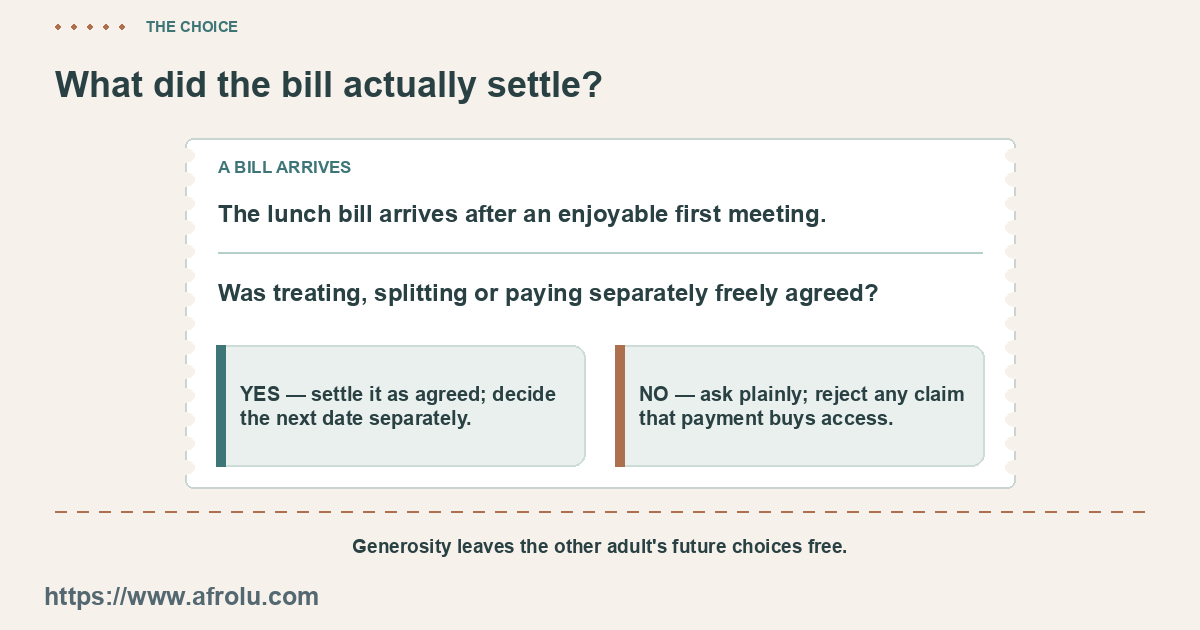
What did the bill actually settle?
- Notice
- The lunch bill arrives after an enjoyable first meeting.
- Ask
- Was treating, splitting or paying separately freely agreed?
- YESsettle it as agreed; decide the next date separately.
- NOask plainly; reject any claim that payment buys access.
Generosity leaves the other adult's future choices free.
Each adult orders and pays for their own
The arrangement is practical and needs no apology.
Settle the bill and choose future contact separately.One offers lunch and the other accepts
The offer covers this meal only.
Thank them without promising another date.One suggests a restaurant beyond the other's limit
The venue, not the person's worth, needs adjusting.
Offer a simpler public place.The payer asks for physical access afterward
Payment is being turned into a claim on consent.
End the interaction and use an independent exit.Checks before the receipt arrives
The venue fits what you can spend, including the return fare.
Treating or splitting is an explicit offer, not an assumed role.
A declined treat is accepted without embarrassment.
No one asks for income or account details to justify a modest choice.
The bill is not used to claim another date or intimacy.
Agree only this expense
| Situation | What it may mean | What to do next |
|---|---|---|
| A costly venue is proposed | The whole outing may exceed your limit. | Suggest an affordable public alternative. |
| One adult offers to treat | Generosity is possible if refusal stays easy. | Accept or decline in plain words. |
| The bill arrives unexpectedly | No arrangement was made in advance. | Ask how to settle this one expense. |
| A treat is used as leverage | A practical payment has become pressure. | Reject the access claim and leave if needed. |
| Another date is considered | The first receipt sets no permanent rule. | Discuss its new cost before booking. |
A sentence for the counter
“That lunch counter suits me. I can pay for my meal and ride; would each paying our own work for you?”
“I would like to get lunch today if that feels good to you. It is also fine to pay separately.”
“That restaurant is more than I want to spend on a first date. Could we try the public lunch counter instead?”
Know the difference
A welcome treat versus a debt of access
One adult offers to buy lunch and accepts yes or no without conditions.
The payer later demands a kiss, private visit or another meeting in return.
Generosity leaves the other adult's future choices free.

Keep examples clear and non-sensational.
Treat versus access claim
A free offer
One adult offers to buy lunch and accepts yes or no without conditions.
An entitlement claim
The payer later demands a kiss, private visit or another meeting in return.
Questions that separate them
- Cost known?
- Choice real?
- Return fare?
- No access debt?
Generosity leaves the other adult's future choices free.
A treat and a claim are different
| Type or dimension | What it describes | Best next question |
|---|---|---|
| Separate orders | Each adult handles their own meal. | No later accounting needed. |
| Split a shared total | Both agree to divide this bill. | Clarify the actual amount together. |
| A voluntary treat | One covers the meal without conditions. | Keep future choices open. |
| An access debt | Payment is used to demand romance or touch. | End the pressure; seek support if necessary. |
Keep money in its proper place
Affordability is agency
A modest venue can make yes and no easier.
Offers need exits
Generosity stops being free when declined payment is punished.
Future is separate
Another date requires another invitation, not a settled receipt.
Questions for the next invitation
Choose a few prompts that fit the moment. This is a reference library, not a list to complete.
Before the venue
Know what this one outing costs.
- Can I cover my meal?
- Can I get home independently?
- Would a smaller plan fit better?
At the receipt
Keep the offer and future separate.
- What was agreed?
- Can either adult decline?
- Is anyone implying an access debt?
What finance and consent sources support
Financial limits
love is respect says financial boundaries include income and account details shared at one's own pace.
Evidence limit: No universal payment custom or Kenya-specific pricing claim follows.
No obligation
love is respect says gifts, drinks and dates are not consent and warns against claims that material items create a debt of intimacy.
Evidence limit: Applies to consent, not to a separately agreed reimbursement.
Mutual expectations
love is respect encourages discussing expectations rather than assuming an arrangement.
Evidence limit: The source sets no gender, age or inviter payment rule.
Independent return
RAINN suggests control over transportation for early dates.
Evidence limit: U.S. practical advice, not a guarantee or a local ride-provider recommendation.
Where payment becomes pressure
Using a gender rule
The other adult may never have chosen it.
Making a private ledger
A voluntary treat should not become later leverage.
Confusing bill and consent
A receipt cannot buy physical or romantic access.
Agree this bill, then leave it there
A date budget can be practical and generous without buying a future yes.
Explore the guide library
Continue with Afrolu
Financial boundaries, consent and first-date safety
Afrolu reviewed these health, research, safety, or public guidance resources while editing this page. They support the behaviour and safety guidance; they do not diagnose any individual described by a reader.
Questions about paying on a date
Does the inviter always pay?
There is no rule that settles every pair. Make a clear offer or agree to split before the bill becomes awkward.
Is splitting unromantic?
It can be a comfortable choice. Treating can also be welcome when both adults freely choose it.
Do I owe another date if they treated?
No. Payment for lunch does not create a promise of future time or intimacy.
Should I disclose my income to explain a cheap venue?
No. State the budget or kind of place you prefer without sharing private financial details.
Does one bill decide future dates?
No. Discuss a new arrangement when the next plan and its cost are known.
One thing to do now
Choose another date because you want it
Choose a bill arrangement that both can afford and freely accept; keep transport and consent separate from the receipt.