Diaspora · Sharing a bill
The bill has a service charge. What are you splitting?
Read the line first
Ask the staff member to explain the charge and show you the itemized bill before you decide how to share it. Then agree whether you will split the total equally, pay for your own orders plus an agreed share of the charge, or use another arrangement. Do not assume a charge is optional or required: rules and menus vary. Keep enough for your own journey home. A payment does not buy anyone another date or physical contact.
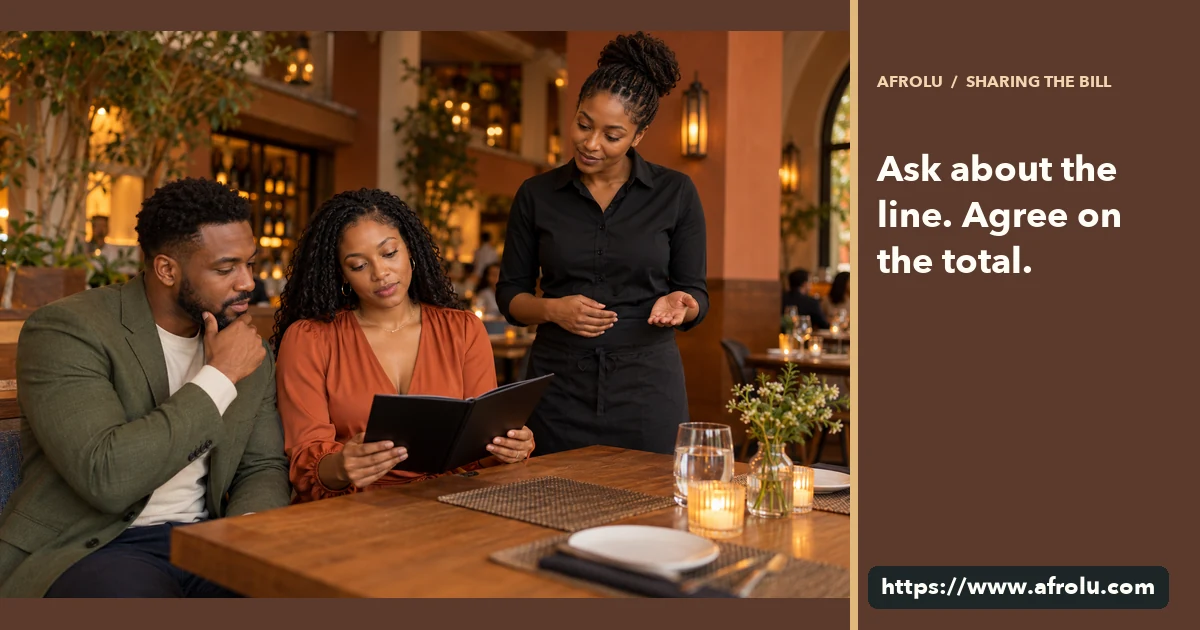
Diaspora dater Juma and his date Lela order tea and a meal at a public restaurant. The bill lists their food and a separate service charge. Juma has not seen this line before. They had agreed to share the bill but did not say whether 'share' meant half the total or each person's order. They can ask a simple question before taking out their cards.
Ask what the line means
Juma can say to the staff member, 'Could you explain this service charge and show us the itemized total?' He can also ask where the charge was shown when they ordered. A calm question is useful even when the charge is correct.
The staff member can explain the venue's bill. Whether a charge is required, optional or disputed depends on the place and circumstances. This guide does not decide local law or tell anyone to leave a valid bill unpaid.
A small bill example
A simple total
Invented amounts in one currency: Juma's order is 1,200, Lela's is 800, and the stated charge is 200.
- Juma
- “Could you explain the 200 service charge?”
- Staff member
- “It is listed as a separate charge on this bill.”
- Lela
- “The total is 2,200. If we split it equally, that is 1,100 each.”
The calculation is 1,200 + 800 + 200 = 2,200; half is 1,100. The example does not say whether a real charge is lawful or optional.
Two ways to discuss the same bill
- Half the total
- Each pays half after you agree what the total includes.
- Own orders plus charge
- Each pays their own order and an agreed share of the extra line.
If you disagree, solve the bill first
Lela may prefer an equal split while Juma expects each person to pay for their own order. They can state those preferences without making either person prove affection. If they cannot agree, ask staff what payment arrangements the venue accepts and settle the bill responsibly.
Juma can later decide whether a second meeting suits him. One awkward money discussion does not prove Lela intended to take advantage of him.
Agree on the total
What do you know before paying?
- The line is clear and you agree
Pay using the method you both chose.
- The line is unclear
Ask staff for an explanation before deciding your shares.
- You disagree about the split
Discuss the actual total and ask staff about accepted payment arrangements.
Keep your own way home
Plan transport separately from the restaurant total. RAINN recommends keeping control of transport for early dates as one way to reduce risk. If either adult pays more, the other still has the same right to say no to another meeting or touch.
Keep reading
Keep money and consent clear
Sources and what they can tell us
Juma, Lela, the staff member and amounts are invented. The arithmetic is Afrolu's example; charges and local rules vary.
- MoneyHelper: How to split rent and bills fairly
Its bill-sharing guidance says to account for a tip or service charge when sharing a restaurant bill.
Limit: It does not establish the legal status of Juma's particular charge. - Love is respect: Boundaries and expectations
It recommends discussing expectations rather than assuming both people mean the same thing.
Limit: It does not choose a payment split for the two adults. - RAINN: Tips for safer dating online and in person
It recommends retaining control of transport as a way to reduce risk on early dates.
Limit: It does not guarantee safety or explain restaurant charges.
Questions about an unfamiliar charge
Is every service charge compulsory?
No universal answer fits every place. Ask the venue and check applicable local guidance if you need it.
Does an equal split mean half the food only?
Say what you mean. It may include the whole total; agree before either person pays.
Must I add another tip?
Practices vary. Ask what the listed charge covers and decide according to the venue and local context.
Does paying create a duty to meet again?
No. Each adult keeps the right to choose another date or decline.