Weekend-first · low-pressure · realistic capacity
Types of Dating for Professionals: Low-Pressure Weekend-First Dating
Plan low-pressure weekend dating around time, work boundaries and rest. Clarify contact, exclusivity, public dates and rescheduling before expectations drift.

Choose a real window and agree what low-pressure means.
Written and edited by Miriam Otieno · Senior Kenya Editor
Count the complete weekend window, including travel and recovery. Then translate low-pressure into a specific cadence, contact rhythm, and present agreement about exclusivity. Meet publicly, keep work systems private, and judge cancellations by notice, alternatives, and follow-through. Review after a few real dates; continue, adjust one term, pause, or end.
Dating basics · Professionals
Can a weekend-first dating rhythm feel intentional and low-pressure while staying honest about time, contact, and present commitment?
Weekend-first dating is a practical pace that uses planned weekend windows; low-pressure describes how the adults choose to handle contact, commitment, and future decisions.
Kendi wants to date with intention but works late several weekdays and has one dependable Saturday afternoon free twice a month. She offers that rhythm instead of promising spontaneous evenings. Sam prefers a weekly Friday dinner. They compare what each can sustain, agree to two public dates, and revisit the cadence rather than treating a work calendar as a test.
Weekend capacity · clear terms · protected rest
Plan from the calendar you control
A demanding work week changes logistics, not the need for honest expectations.
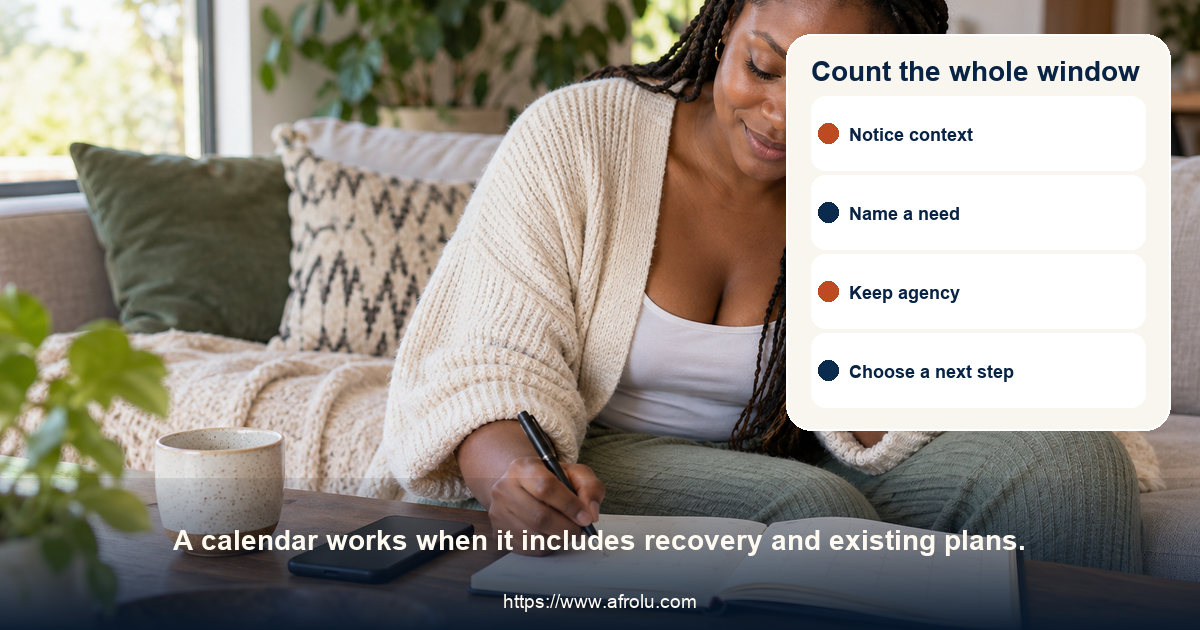
Count the whole window, define low pressure, keep plans independent, and review repairs.
What time is usable?
Include travel, preparation, and recovery.
What does low pressure mean?
Name contact, dates, and exclusivity separately.
Which systems stay closed?
Share times without employer calendars or client details.
How are changes handled?
Look for notice, alternatives, and reciprocity.
time · energy · choice
Build a weekend plan from the time you actually control
Weekend-first dating can make planning easier when weekdays are unpredictable, but Saturday is not automatically free. Begin with a calendar you control and mark existing commitments, travel time, recovery, and the time you want to keep for yourself. A person who protects Sunday morning or needs a quiet evening is describing capacity, not rejecting dating.
Choose one window that can survive an ordinary work interruption. If client calls, shift changes, or family obligations regularly reach into weekends, describe that uncertainty before another person reserves the day. You do not owe a new match your work roster, client names, office location, or a screenshot of your calendar to make your limit believable.
Kendi can offer one Saturday afternoon a fortnight, including enough time to get home without rushing. She tells Sam that this rhythm is realistic for the next month and asks what he can offer. Sam wants spontaneous Friday evenings. Neither is wrong; the useful question is whether their actual schedules can support an arrangement both enjoy.
Make the first plan easy to keep and easy to leave: a public venue, an agreed end time, independent transport, and a clear way to reschedule. A modest first meeting can still be thoughtful. The goal is not to maximise the number of weekend hours together; it is to make one promise you can meet without borrowing from sleep or recovery.
label · conduct · expectations
Translate low-pressure into specific, fair expectations
People use low-pressure to mean different things: fewer messages, shorter dates, no immediate exclusivity, less future planning, or simply a calm first meeting. Say which meaning you intend. Otherwise one person may hear “take our time” while the other hears “stay available without asking what this is.” The phrase only helps when both can translate it.
A workable description might be: “I would like one planned date most weekends I am in town, a short check-in during the week, and no exclusivity until we discuss it.” The details can differ. What matters is that an adult can decide whether the current offer meets their needs without guessing from affectionate messages or a polished profile.
Low pressure does not mean no responsibility. If you invite someone to hold a weekend, confirm the plan, give notice when it changes, and offer another time only when you mean it. If the connection is casual, say whether dates with others continue. If you are seeking partnership, describe that direction without promising that this particular match will become one.
When both adults want a quieter pace, choose a review date instead of leaving expectations suspended. After several meetings, talk about frequency, exclusivity, and the role work will keep playing. A review is not a promotion owed for attendance. Either person may discover that the arrangement is too little, too much, or exactly right.
availability · recovery · privacy
Keep work contact and personal recovery in their own lanes
Some professionals can leave work at the office; others have on-call duties, rotating shifts, care work, or deadlines that move. A job title does not reveal which applies. State the pattern that affects dating in broad terms and choose contact windows you can keep. You can explain a late reply without making a new match a participant in confidential work.
Do not share company logins, client documents, internal meeting names, employee schedules, or location tracking as proof that you are busy. A new date needs a clear plan, not access to employer systems. If you use a shared calendar, send two times you can meet instead of granting a view into colleagues’ information or your whole week.
Rest is part of capacity. A date that ends late before an early shift may look possible once but become costly as a weekly pattern. Decide what recovery time you need before agreeing, then say it directly. You can be interested and still decline an invitation that turns your only free morning into another obligation.
The International Labour Organization’s work-time material discusses working hours and arrangements in relation to work-life balance; it does not prescribe a dating schedule. Use your own experience to choose the boundary. If a match repeatedly treats your quiet hours as a test of affection, explain the rhythm once and decide whether the response fits you.
venue · transport · accounts
Make weekend meetings public, independent, and reversible
For an early date, choose a place you can reach without relying on the person you are meeting. Tell a trusted person the broad plan if that supports your comfort. Arrange your own return and keep control of your phone, money, and travel. These steps are practical boundaries, not an accusation about someone whose character you have not assessed.
Do not move a first meeting to a private home, isolated location, hotel room, or unfamiliar trip because one person says a weekend slot is hard to find. A public coffee or walk can fit a short window and still allow conversation. If you want to change venues, make sure both people can choose freely and leave on their own.
Keep digital access separate from work and dating. Do not share a one-time password, unlock code, private work account, or personal documents to prove identity or seriousness. CISA recommends general practices such as unique passwords and multifactor authentication. Those habits protect accounts; they do not verify who a match is or guarantee an interaction is safe.
A request for money, cryptocurrency, an investment, or urgent travel support can appear persuasive when two people are planning a long-awaited weekend. You can refuse to send funds and pause the date without deciding what the person's motive is. If a platform conversation begins to feel coercive, use its reporting tools and contact suitable local support.
notice · alternatives · reciprocity
Read a changed plan by looking at notice and repair
A professional may need to cancel when a shift changes or urgent work appears. Notice when the person tells you, whether they acknowledge how the change affects your time, and whether they offer a specific alternative they can keep. Those actions give more useful information than a dramatic reason, a job title, or a request for private work evidence.
Repeated last-minute cancellations without another date can leave one person holding every open weekend. You do not have to prove that the other person is lying before you decide the arrangement does not work. Treat the practical result as sufficient: plans rarely happen, the effort is uneven, or your own rest keeps being spent on uncertainty.
A reschedule is more credible when it includes a realistic date and follows through. If you are the person cancelling, send the message as soon as you know, apologize without overexplaining confidential details, and offer a time you can actually keep. Avoid saying “soon” when you cannot name a week or asking the other person to stay on standby.
At the end of a month, list plans made, plans kept, changes communicated, alternatives completed, and who initiated. That small review is not a scorecard for someone’s worth. It helps you see whether the current structure fits both calendars. Revise once if a concrete change could help; release the connection if waiting has become its main activity.

Watch how both people handle a changed plan.
scripts · clarity · consent
Use short conversations about pace, messages, and money
Try: “I am interested in seeing you. I can plan Saturday afternoons twice this month, and I am quiet during work.” That sentence communicates attraction and capacity together. You do not need to apologise for having a job or make an impossible promise to prevent someone from feeling disappointed.
For contact, propose a pattern rather than a rule: one call midweek, a brief message when plans change, or a longer conversation on Sunday. Ask whether it suits the other person. Different preferences are not automatically red flags; repeated pressure after a clear answer is a different kind of information.
Discuss payment before either person relies on an assumption about income, gender, or professional status. Choose a venue both can afford and agree how to handle the bill. A costly dinner does not purchase another date, a longer evening, physical intimacy, a ride home, or access to work and family details.
If a boundary is ignored, do not keep finding more polished explanations. Say the limit once more if you choose, end the date, and leave. Preserve messages if unwanted contact continues, use platform tools, and seek help appropriate to your location if you feel unsafe. Work pressure and dating pressure should not combine into a demand for personal access.

Offer a time you can answer and ask what suits the other person.
continue · adjust · end
Review the weekend structure before it becomes a silent promise
After a few weekends, compare the original offer with the lived pattern. Did both people get a meeting cadence they could enjoy? Were changes communicated in time? Did anyone expect constant weekday availability or access to workplace tools? Did the dates leave enough recovery for the coming week? Answer from observed events rather than promised future capacity.
Continue when the arrangement is sustainable and both adults can describe it the same way. Adjust one variable if the connection feels good but the logistics do not: choose an earlier time, shorten a date, or plan two weekends ahead. Do not change the terms silently and assume the other person has accepted a new level of commitment.
Pause if your work season has removed every reliable window. State whether you are ending dating or asking to reconnect later; do not leave someone waiting without a time frame. End when the only workable plan requires sacrificing rest, hiding your true availability, or accepting persistent ambiguity that does not meet your needs.
A short closing line can be kind and clear: “I enjoyed meeting you, but our schedules and expectations do not fit enough for me to continue.” No final work explanation is required. If the person asks for feedback, share only what feels useful and safe. Your weekend belongs to your life, whether or not it becomes a date.

Review whether the arrangement fits the week that follows.
Eight weekend-first dating situations
One Saturday is free after a demanding week
Preparation, travel, and recovery all occupy the same window.
Offer the time that remains usable.A roster changes late in the week
Some schedule uncertainty may be unavoidable.
Describe the pattern and agree how updates work.One person means short dates; another means no commitment
The phrase has no single shared definition.
Name frequency, exclusivity, and review.A match expects replies during work
Availability is being used as a measure of interest.
Suggest one contact window you can keep.An urgent task moves the date again
The repair matters more than a polished explanation.
Ask for a specific alternative once.A private plan is suggested for convenience
A limited weekend does not require less control.
Choose a public place and independent transport.A new date asks for emergency travel funds
An emotional story does not require a transfer.
Decline, pause, and report suspicious requests.Both have kept the agreed cadence
A manageable pattern may be ready for discussion.
Ask whether to continue or change one term.Fourteen signs of sustainable low-pressure dating
The proposed weekend window includes travel and recovery time.
Both adults can explain what low-pressure means in this arrangement.
A plan has a venue, start time, and reasonable end time.
Each person can reach the meeting and return independently.
Work availability is described without exposing employer systems.
Messages are not treated as a test of professional or romantic loyalty.
A changed plan is communicated before the other person is left waiting.
The person who cancels takes a turn proposing the next date.
Future hopes are kept separate from current exclusivity.
Date costs are discussed without status or gender assumptions.
A request for money or account access can be refused without punishment.
Rest and personal commitments remain legitimate parts of the calendar.
Both adults can request more or less contact directly.
A month-end review leads to a clear decision rather than indefinite standby.
A decision map for time, plans, and expectations
| Situation | What it may mean | What to do next |
|---|---|---|
| Only Saturday is open | The available window may be narrow but genuine. | Offer it with an end time. |
| The roster changes often | Some dates require a confirmation point. | Agree when the plan becomes firm. |
| Low pressure stays vague | Each person may be imagining different terms. | Define cadence, exclusivity, and follow-up. |
| Replies arrive next day | Work may limit phone use during hours. | Ask about a preferred contact rhythm. |
| Plans are cancelled repeatedly | The structure may not be operationally available. | Review notice, alternatives, and follow-through. |
| Employer proof is requested | Private work information is being pulled into dating. | Share availability, not internal records. |
| A private venue is preferred | Convenience may reduce independent choice. | Keep early meetings public and reversible. |
| Money is requested urgently | The request may put finances at risk. | Do not transfer funds to a new online match. |
| A date runs past your limit | Your time and exit preference need restating. | Leave at the agreed time. |
| One person always plans | Weekend effort may be uneven. | Ask for reciprocal initiative, then observe. |
Twelve scripts for weekends, work, and contact
“I can offer Saturday afternoon twice this month.”
“Can we confirm by Thursday evening?”
“I do not reply during client work, but I can call after seven.”
“When you say low-pressure, which expectations do you want to keep light?”
“I am dating toward partnership, though we are not exclusive now.”
“Work changed my plan; I can meet next Saturday or Sunday afternoon.”
“I do not share my roster or work calendar, but I can offer two times.”
“I prefer a public cafe where we can both travel independently.”
“Could we choose somewhere that fits both of our budgets?”
“I cannot meet late before an early shift.”
“I have answered about money; please do not ask again.”
“Our weekend availability does not fit, so I am closing this connection.”
Know the difference
Low-pressure pacing versus unclear availability
The adults choose a real cadence, say what is not agreed, and review after a few meetings.
One person leaves weekends open while the other receives no reliable plan or status answer.
A lighter pace still needs a clear offer, mutual choice, and a review point.

Compare a mutual cadence with an open-ended wait.
Low-pressure pacing versus unclear availability
| Type or dimension | What it describes | Best next question |
|---|---|---|
| Weekend-first | Meetings use planned weekend windows. | Count travel and rest before offering a time. |
| Slow dating | Decisions are spaced out. | Agree what happens between dates. |
| Casual dating | Current commitment may stay limited. | Say whether either person dates others. |
| Serious dating | Long-term direction is part of the conversation. | Do not imply exclusivity before agreement. |
| Exclusive dating | Both choose to stop other romantic dates. | Discuss scope and start date. |
| Online dating | Contact begins through a platform or profile. | Protect private account and work details. |
| Long-distance | Travel becomes part of the plan. | Keep cost and visit decisions mutual. |
| After-work dating | Meetings may fit weekdays instead. | Compare energy and reliability with weekends. |
| Dating pause | No regular free window exists today. | Say whether you are ending or pausing. |
A simple plan you can use today
Count the whole window
Travel, preparation, and recovery change how much time a date uses.
Low pressure needs terms
Name contact, exclusivity, cadence, and review instead of leaving them implied.
Work privacy is normal
Offer availability without employer systems, client information, or roster screenshots.
A reschedule needs repair
Notice, a real alternative, and follow-through make plans usable.
Rest is part of capacity
A repeated date should fit the week that follows.
A review has no promised outcome
Either adult may continue, revise, pause, or end.
Questions organised by purpose and depth
Choose a few prompts that fit the moment. This is a reference library, not a list to complete.
Calendar
Use a real month, including recovery and existing commitments.
- Which hours are mine?
- What can interrupt them?
- When am I rested?
Low pressure
Translate the label into practical conduct.
- How often will we meet?
- Are we seeing others?
- When will we review?
Repair
Observe how plans change, not only how they begin.
- Was notice timely?
- Was another date offered?
- Who planned next?
Privacy
Share enough to plan without exposing work systems.
- Which details stay private?
- What time can I offer?
- How will I leave?
What deserves a closer look
Use real capacity
ILO material examines work hours and arrangements in relation to work-life balance; personal schedules still differ.
Evidence limit: It does not prescribe how often someone should date.
Protect disconnection
Work-life guidance discusses boundaries between paid work and personal time, including disconnecting at specified times.
Evidence limit: The page is broad guidance, not individualized employment advice.
Separate contact from access
Remote work can blur availability, so a person can state contact windows without sharing employer systems.
Evidence limit: Specific workplace rules vary by employer and jurisdiction.
Use account protections
CISA suggests unique passwords, MFA, updates, and awareness of phishing attempts.
Evidence limit: These steps do not verify a dating profile.
Decline urgent transfers
FTC guidance cautions against sending money to an online romantic contact or following investment pitches.
Evidence limit: The consumer agency and reporting process are U.S.-based.
Keep an independent exit
A public meeting and separate transport leave each adult able to end a date when they choose.
Evidence limit: Use local emergency support if immediate safety is at risk.
Shortcuts that turn work into ambiguity
Calling every weekend busy
The label hides which windows are genuinely possible.
Promising next month will be easier
A future schedule cannot replace present capacity.
Using silence as a test
Work reply speed does not define romantic interest.
Sending a calendar screenshot
It can reveal work and colleague information unnecessarily.
Making the other person plan every time
A limited window does not excuse one-sided effort.
Letting a costly date create debt
Money cannot buy time, intimacy, or another meeting.
Make the next weekend plan clear and easy to keep
This guide is editorial information, not employment, legal, security, medical, or emergency advice. Check applicable workplace rules and seek qualified local support where needed.
Explore the guide library
Show more related guides
Continue with Afrolu
Show more Afrolu guides
Sources used for this guide
Afrolu reviewed these health, research, safety, or public guidance resources while editing this page. They support the behaviour and safety guidance; they do not diagnose any individual described by a reader.
Questions about weekend-first dating
Does weekend-first mean I am not serious?
No. Weekend-first describes timing. Explain your relationship direction separately from present exclusivity.
How often should professionals date?
There is no required frequency. Offer a cadence you can sustain without losing needed rest.
What if my roster changes often?
Set a confirmation point, communicate early, and offer a specific alternative when possible.
Is a slow reply a sign of disinterest?
Not by itself. Ask about a realistic contact rhythm and judge the broader pattern.
Should I show a match my work calendar?
No. Share selected available times instead of employer systems or colleague details.
Can low-pressure dating become exclusive?
It can if both adults discuss and choose exclusivity; time together does not create it automatically.
What if my date keeps cancelling?
Review notice, alternatives, and follow-through. You may leave if the practical pattern does not meet your needs.
Who should pay for a weekend date?
Agree on a venue and payment approach that works for both; cost buys no further access or commitment.
What if a new match asks for travel money?
Do not transfer money to a new online romantic contact. Pause, report suspicious requests, and seek local advice if needed.
How can I end weekend dating kindly?
State that the current availability or expectations do not fit and that you are ending the connection.
One thing to do now
Choose a weekend structure you can actually keep
Offer a real weekend window, define what low-pressure changes, and protect work privacy and recovery. Continue when the cadence is mutual and reliable. Revise if one concrete adjustment could help; pause or end when plans stay indefinite or one person carries every repair.