Diaspora readers · casual dating · clear choices
Choose a low-pressure dating format by what both adults can actually agree to
A diaspora dater can compare casual, exclusive, long-distance and exploratory dating without letting travel or distance create unchosen promises for both.
Choose the arrangement that matches present consent, availability, privacy and a free exit; do not let a label, distance or family narrative make additional promises for you.
Written and edited by Liya Bekele · Horn of Africa Editor
Start with the present arrangement, not the category that sounds most impressive. A useful format lets both adults answer four questions: how often do we want contact, are either of us seeing other people, what information stays private, and how can either person pause or leave? Casual dating can include care and honest communication; it does not automatically include exclusivity, sex, financial help, travel, family introductions or constant access. Distance can make calls and visits part of the arrangement, but it does not make either adult responsible for crossing a border, hosting, paying or proving their identity. Choose one small agreement that fits today and revisit it when circumstances change.
Which type of dating fits what I can offer now, without treating diaspora identity, travel or a casual label as a promise about the future?
Types of dating are conversational shorthand for different current arrangements—such as exploratory, casual, exclusive or long-distance—not fixed identities or universal stages. The same word can mean different things to different adults, so its useful content is the specific agreement underneath it.
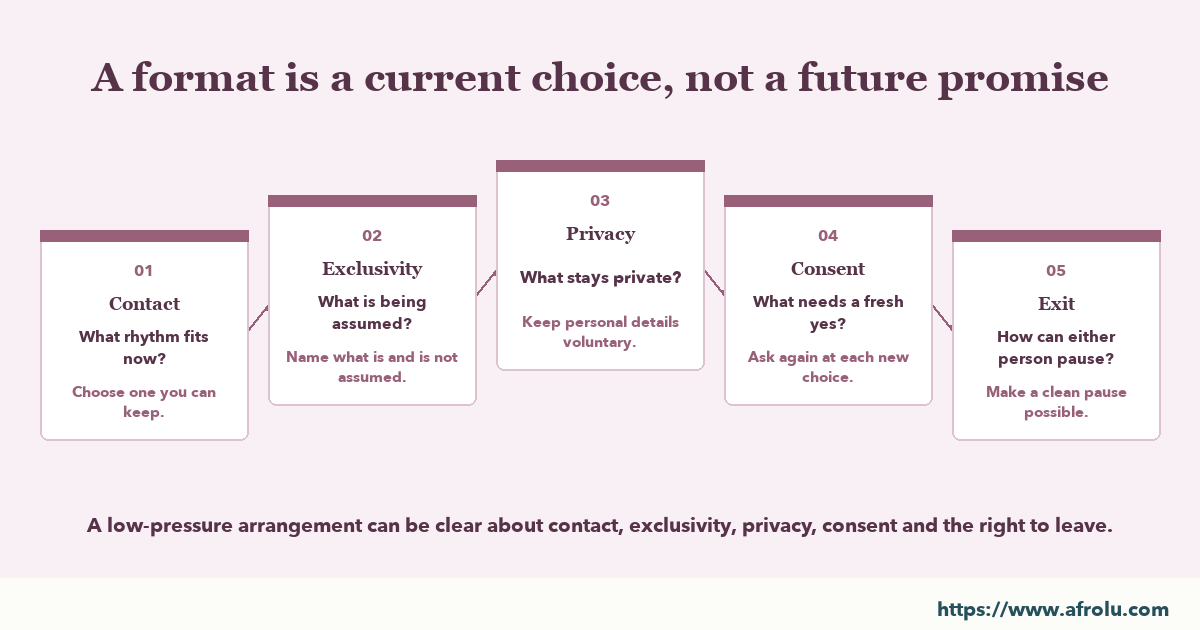
A format is a current choice, not a future promise
A low-pressure arrangement can be clear about contact, exclusivity, privacy, consent and the right to leave.
-
Contact
- Question
- What rhythm fits now?
- Action
- Choose one you can keep.
-
Exclusivity
- Question
- What is being assumed?
- Action
- Name what is and is not assumed.
-
Privacy
- Question
- What stays private?
- Action
- Keep personal details voluntary.
-
Consent
- Question
- What needs a fresh yes?
- Action
- Ask again at each new choice.
-
Exit
- Question
- How can either person pause?
- Action
- Make a clean pause possible.
Make the agreement smaller than the story around it
Diaspora, travel and family context can affect what is practical, but they do not decide what either adult owes. A chosen format works when its terms are plain enough to accept, change or decline.
Try describing the arrangement without using any label. If you cannot say what contact, privacy, exclusivity and exit mean, the label is doing more work than the agreement.
- Contact
What rhythm is actually enjoyable?
Calls, messages and dates may be optional choices, not attendance records.
- Exclusivity
Are other dates in or out?
Do not assume casual means non-exclusive or that distance means exclusive.
- Privacy
What remains yours?
Travel plans, family location, accounts and documents do not become shared by naming a format.
- Exit
How can either person stop?
A clean no or pause belongs in every arrangement, including an enjoyable one.
Say the arrangement in verbs, not just labels
'Casual,' 'exclusive,' 'seeing each other,' 'long-distance,' and 'serious' can each sound clear while meaning different things in practice. One person may mean occasional dates with no expectation of daily contact; another may hear casual as a sexual arrangement, non-exclusivity or an invitation to share nothing personal. Rather than argue over the best label, ask what the person means by it and say what you mean. A direct answer can be short and still be respectful.
A diaspora reader may feel extra stories attached to a label: perhaps a return visit, family visibility, a move or an expectation of financial help. Those stories do not make the label more binding. If they matter, name them as separate questions. The date can then accept, decline or propose another arrangement without either person being asked to represent a culture, a country or a whole future.

A label and a usable agreement
Open full-size visualThe label alone
Words such as casual or long-distance can carry assumptions that neither adult has checked.
The usable agreement
Both adults state contact, exclusivity, privacy and exit choices they can freely make now.
- Contact rhythm
- Exclusivity
- Private information
- Free exit
Choose the format by present terms, not by travel or family expectations.
A low-pressure format needs a free yes and a free no
You might agree to meet once a week, to message when it feels natural, and to say if either person begins seeing someone else. Or you might decide that none of those terms fit. The important part is that neither adult silently fills the gaps with rules about response time, physical intimacy, public posts, family introductions or money. If one person wants more than the other can offer, a mismatch can be acknowledged without making anyone a villain.
WHO describes sexual health in terms that include respect and freedom from coercion. That health framing does not tell anyone whether casual dating is right for them, and it does not stand in for local medical care or legal advice. It supports the narrower point that a category does not create ongoing permission for sexual activity. Separately, this guide treats a yes to a date or call as distinct from later social, digital or physical choices; each person can change their mind.

Name the arrangement without a cultural stereotype
Open full-size visualI enjoy spending time with you and I am looking for something casual for now. I am not agreeing to exclusivity or sharing my travel and family details, but I will be direct if that changes. Does that work for you?
- What I enjoy
- What I can offer
- What I am not promising
A limited honest offer is more useful than a grand label with hidden terms.
Test a dating format against four present questions
A short answer is enough. Blank answers indicate a topic to discuss, not a rule to guess.
- 01
Contact
What rhythm of dates, calls or messages actually fits?
- 02
Exclusivity
Are either of us dating other people, and what would we say if that changes?
- 03
Privacy
Which family, travel, account and location details remain private?
- 04
Exit
How can either person pause or leave without pressure?
Let the answer guide the next step
- Both adults can state compatible termsChoose the smallest agreement and revisit it if circumstances change.
- One adult wants more or lessName the mismatch and decline or adjust without forcing a label.
- A request involves money, credentials or pressureKeep that decision separate, pause and verify independently.
Keep this separate A format name never gives another adult a right to your home, family, itinerary, money, account or identity documents.
Calls and visits can be chosen without becoming evidence
Holtzman and colleagues found associations between texting patterns and reported relationship satisfaction in a cross-sectional self-report online survey of 647 Canadian undergraduate students aged 18–25; 36.5% were in long-distance relationships. The study cannot show that more messages create a better relationship, represent Kenyan adults, decide how often you should text, or say what a new date intends. Use it as a reason not to turn message counts into a quality score. A communication rhythm should be something both adults can keep, not a surveillance tool.
eSafety advises limiting personal information, including location, work and information about children, and notes that some verification features do not establish someone's identity. That is Australian guidance and it does not guarantee safety. For a reader choosing any cross-border format, the practical point is to keep plans small enough to reverse: a public meeting, independent transport and private account decisions. You do not need a passport image or full travel plan to explain what type of date you want.

Four questions beneath every format
Open full-size visual- Contact
- Choose a rhythm you can keep.
- Exclusivity
- Do not assume what casual means.
- Privacy
- Keep travel and account details yours.
- Exit
- Make a clean no possible.
A useful dating type is something both adults can describe plainly.
A casual label does not lower the boundary on personal data
ODPC explains that Kenyan data subjects have rights including being informed about use of personal data, access, objection, correction and deletion of false or misleading data. Those rights are about how controllers and processors handle data. They do not require a dating app to solve every interpersonal issue and they do not oblige you to share a data request, screen or password with someone you are seeing.
If a person asks for money, a PIN, account credentials, identity documents or an urgent transfer as a test of trust, pause rather than trying to judge the story from the emotional pressure. KE-CIRT's public advice warns against revealing financial information or passwords and encourages independent checking of urgent requests. It cannot identify a particular person's intent, but it supports a clean boundary: no private credential or payment is required to keep a dating conversation respectful.
The useful agreement has a way to end or evolve
Set a small review point if that helps: after a visit, after a month, or when one person wants to date others differently. The point is not to create a deadline for feelings. It is to make uncertainty discussable before someone starts using pressure or silence to manage it. A direct 'this no longer fits me' can be enough, especially when more detail would invite argument or feel unsafe.
A format can become more serious, stay casual, become long-distance, or stop. None of those outcomes is a moral grade. The meaningful question is whether the current agreement remains freely chosen and safe enough for the people in it. If it does not, choose a smaller arrangement, a pause or an ending rather than trying to keep a label alive after its terms have disappeared.

What does this label actually ask of us?
Open full-size visualA casual date is enjoyable while a visit is possible.
Can both adults name contact, exclusivity, privacy and exit terms now?- Compatible termschoose a small agreement.
- Different termspause or leave without a pressure test.
A category helps only when the agreement underneath it is spoken.

Keep the agreement smaller than the story
Open full-size visual- Say the termsUse verbs instead of assumptions.
- Keep consent currentEach choice needs its own yes.
- Protect privacyDo not share proof under pressure.
- Revisit or leaveChange the format when it no longer fits.
Distance or diaspora identity cannot make a promise for either adult.
Keep the agreement smaller than the story
Choose the arrangement that matches present consent, availability, privacy and a free exit; do not let a label, distance or family narrative make additional promises for you.
About these links These information links are not affiliate buttons and are clearly labelled. They do not promise a match, identity check or relationship outcome.
What can support a format choice—and what cannot
WHO provides a respect and coercion-free frame; eSafety addresses practical online privacy; ODPC describes data rights; the texting study is limited non-Kenyan association evidence; KE-CIRT supports pausing credential or money pressure. None picks a format for the reader.
Questions about casual dating, distance and privacy
Can casual dating still be respectful and caring?
Yes. Casual describes a current scope, not a lack of care. It still needs clear boundaries, a free no and honest communication.
Does diaspora or travel make a connection long-distance by default?
No. Distance may affect logistics, but people still need to decide whether they want a long-distance arrangement and what it actually involves.
Does casual automatically mean non-exclusive?
No. The word does not settle exclusivity. Ask directly what each person means and whether either person is seeing others.
Should I share my itinerary so they know I am serious?
No. You can arrange a public meeting without sharing a full itinerary, family address, accommodation, documents or account access.
Can a video call prove someone is who they say they are?
No. It may be one part of getting to know someone, but it cannot prove identity, intent or safety. Keep plans proportionate.
How do I end a casual arrangement?
A brief direct message can be enough: say the arrangement no longer fits and reduce contact. You do not need to negotiate an ending if that would feel unsafe.