Dating later · weekend plans · repair
Can your relationship hold an imperfect weekend?
For adults dating later, secure relationship signs show up in honest plans, room for difference, respected boundaries and repair when a weekend changes.

Security is visible in how ordinary friction is handled, not in a flawless weekend photograph.
Written and edited by Ruth Akinyi · Local Dating Editor
Look beyond how peaceful photographs or good Saturdays feel. A workable relationship makes room for honest plans, separate friends and rest, a no that is not punished, and a specific repair when either person changes an agreed plan. Disappointment is allowed. The question is whether both can speak and respond without fear or scorekeeping. One awkward weekend does not diagnose an attachment style; repeated silencing, control or retaliation tells you more than a string of polished dates.
Healthy relationships · Late Entrants
How can I tell whether this relationship is secure if we mainly see each other on weekends and neither of us handles every change perfectly?
A secure relationship here means a pattern in which two adults can express needs, remain separate people, disagree respectfully and repair ordinary misses. This article offers observations, not an attachment diagnosis or a safety guarantee.
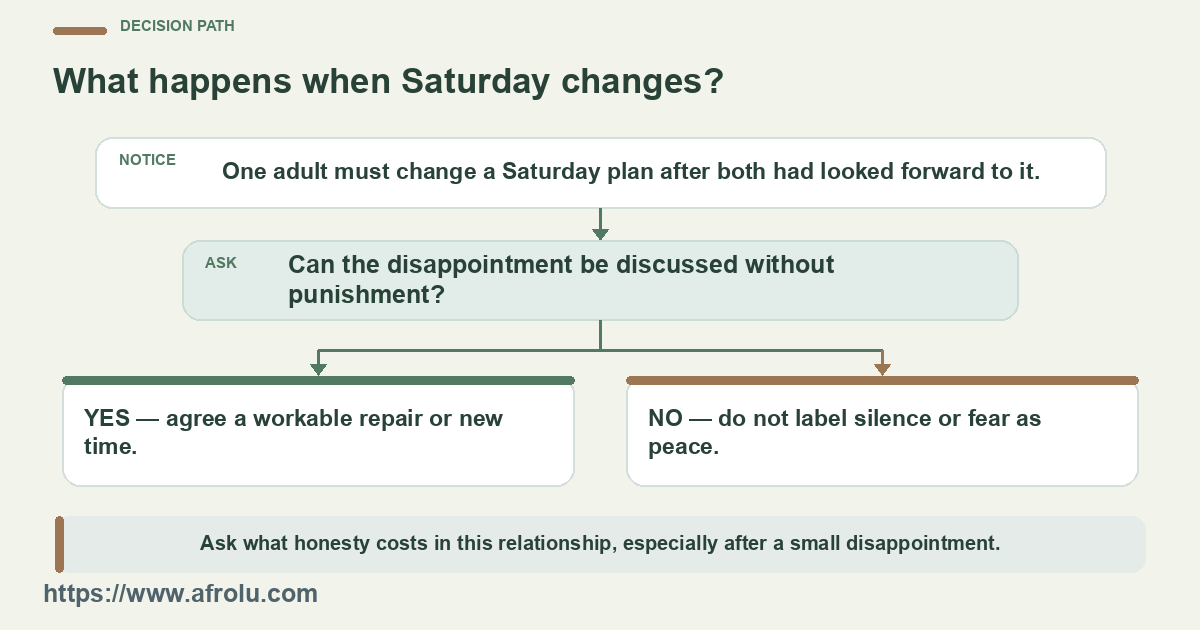
Illustrative scenario: Two adults in their fifties usually spend Saturday walking through a community garden. One must care for a relative this week and cannot meet until Sunday afternoon. The other is disappointed, says so, and asks whether a shorter Sunday walk is possible. The changed plan becomes evidence: can both tell the truth and design another choice without punishment, or must one hide a need to preserve the peace?
The imperfect-weekend lens
Look for safety in the way a plan changes
Later-life dating can include grown families, established friendships, work and long-held routines. Secure connection has to make room for those realities.
Use one actual small disappointment to observe truth, response, repair and independence across more than one occasion.
Can a change be said?
A person need not invent an excuse for a real care duty.
Can both feel?
Disappointment can be spoken without punishment.
Is there a new choice?
A feasible alternative matters more than a perfect apology.
Does life stay broad?
Friends, family and solitude do not vanish to prove love.
Start with truth
A steady weekend allows a real change of plan
A relationship may feel easy because both adults have similar preferences. It may also feel easy because one always rearranges work, family or rest to avoid the other's disappointment. To tell the difference, consider a real Saturday that did not go as expected. Could the change be spoken plainly, or did one person need an elaborate excuse to make the truth acceptable?
The love is respect material on boundaries and expectations describes how unspoken assumptions can hurt and how discussing them can support trust. It does not say that every missed date is a warning. A late arrival, care duty or changed energy level needs context. What matters is whether the couple can describe the effect and decide what to do now without a demand for secrecy or submission.
A later-life partner may have relatives, work commitments and routines that predate this relationship. You can ask for reliability without asking them to abandon those ties. If a particular weekend pattern no longer meets your needs, name it as a real compatibility question rather than testing whether the other adult can read your mind.
Make room for difference
A no should not cost someone their dignity
Suppose you want the whole Saturday together and your partner wants an afternoon alone before meeting. Both wishes can be spoken. One may be disappointed, and the pair may seek a shorter outing or discover a genuine mismatch. Respect means the answer is heard without ridicule, punishment or a demand for proof that solitude is justified.
The love is respect conflict resource treats disagreement as normal while drawing a line at insults, fear and control. That distinction is more useful than a rule that secure couples never argue. A different opinion about a garden trip is ordinary friction. Being afraid to state a preference because it will provoke humiliation or retaliation is different information.
Watch your own part too. Can you hear a limit without treating it as rejection of the entire relationship? Can you state what you need without claiming ownership of the other adult's time, phone or friendships? The aim is neither constant agreement nor emotional detachment, but enough room for both people to remain honest.

No one has to surrender family or rest to prove closeness.
Observe repair
A changed plan needs action after the apology
If someone cancels at the last minute, an apology may acknowledge the disruption, but the useful next question is whether they can offer a workable alternative. Perhaps they can choose a shorter Sunday walk, buy back a ticket they asked you to purchase, or accept that you made other plans. Repair depends on what occurred, not on a memorised phrase.
A single scheduling mistake is not a relationship verdict. Notice whether the person tells the truth, takes their part seriously and changes a preventable pattern over time. Repeated apologies followed by the same avoidable harm can leave one adult carrying the cost. Conversely, a person who makes a counteroffer and follows through is offering present evidence of care.
You may also be the one who changes plans. If so, name the impact, offer what you can genuinely do and let the other person choose whether the replacement suits them. A secure pattern has room for reciprocal repair; it does not depend on one partner always forgiving and the other always being excused.

No scripted apology is presented as a cure for repeated harm.
Keep a broad life
Closeness should not require shrinking everything else
A comfortable weekend relationship can include time with grown children, neighbours, faith communities, hobbies or simply solitude. You may enjoy a standing Saturday breakfast while keeping a separate Sunday tradition. The question is whether each adult can say what matters outside the relationship and have it considered, not whether all hours are shared.
Digital privacy works the same way. love is respect describes choices about devices, passwords, posting and communication as boundaries to discuss. A partner can reasonably ask how you will stay in touch when apart; they do not acquire the right to read your phone or monitor your location because you have become closer. A private device is not proof of disloyalty.
If one adult repeatedly treats friends as rivals, demands a password or makes family care a punishable offence, the issue is larger than a weekend calendar. You need not label their psychology to recognise that the arrangement narrows your life. Seek trusted support if fear or coercion is involved, rather than trying to produce a more reassuring schedule.
Review the pattern
One good Sunday cannot answer every question
Think of a few ordinary changes: a late bus, a relative who needs help, a wish to see a friend, an evening when one person is tired. Do both people know how to speak, listen and repair? The pattern is more informative than a photograph of a lovely outing or one difficult conversation. It also leaves space to notice improvement when both people choose it.
If you need a more reliable rhythm, say what that means in concrete terms: confirmation by Friday, notice when a plan changes, or a reserved afternoon once a month. The other adult can agree, suggest a version that fits or decline. A clear mismatch is painful but better understood than peace sustained by unspoken resentment.
If truth regularly brings intimidation or retaliation, do not keep testing the relationship by sacrificing another weekend. Speak with a trusted person and choose practical support as needed. Where both adults can tell the truth, honour boundaries and repair misses, a weekend can become a place for real companionship rather than a performance of perfection.

Leave if honesty consistently brings fear or retaliation.
Ordinary weekends that reveal a pattern
A relative needs care on the usual walk day
Care and disappointment can both be real.
Offer a feasible Sunday alternative and hear the answer.One adult keeps a long-standing Sunday visit
Separate ties can remain part of a close life.
Discuss shared time without making friendship a rival.A plan changes too late for the other adult
An apology alone may leave transport or time costs.
Name the impact and make a practical repair.No one argues because one person never says no
Peace may depend on self-silencing.
Ask what an honest difference costs.What security permits both people to do
A changed plan can be spoken without an invented excuse.
Disappointment can be expressed without threats or ridicule.
A missed commitment leads to a specific repair where possible.
Both adults can keep friends, family and private device boundaries.
Neither needs a flawless weekend to feel allowed to return.
Read a changed Saturday fairly
| Situation | What it may mean | What to do next |
|---|---|---|
| The Saturday plan changes | A real obligation has collided with chosen time together. | Say the change before the other adult travels. |
| The other adult is disappointed | Their feeling can be heard without surrendering every limit. | Ask what alternative would help. |
| Someone says no | The answer tests whether both have room for separate wishes. | Accept it without punishment or surveillance. |
| A miss has costs | Time or fare may have been spent. | Offer a repair matched to the actual effect. |
| Fear becomes the rule | The relationship is asking for self-silencing. | Seek trusted support and reassess the connection. |
Name a miss and make a repair
“I need to care for family on Saturday. I know this disrupts our walk; would a shorter Sunday afternoon suit you?”
“I was looking forward to Saturday and am disappointed. I can do Sunday if we confirm by tomorrow.”
“I am keeping my Sunday visit with a friend. I would like us to choose another time together.”
“We have changed plans late three times and I have paid fare twice. I need earlier notice or I cannot keep arranging these weekends.”
Know the difference
A secure weekend versus a conflict-free performance
Each adult can speak honestly, hear a no and repair a changed plan.
The weekend stays peaceful only while one person's needs or friends disappear.
Ask what honesty costs in this relationship, especially after a small disappointment.

Avoid attachment-type diagnosis from one interaction.
Security has room for friction
| Type or dimension | What it describes | Best next question |
|---|---|---|
| A changed plan | One real Saturday cannot proceed as expected. | Discuss timing and a replacement. |
| A repeated miss | The same avoidable cost keeps landing on one person. | Ask for a change in conduct, not another apology alone. |
| A respectful no | One adult wants a different amount of time. | See whether another rhythm fits. |
| Punishment for no | A boundary leads to ridicule, monitoring or threats. | Prioritise safety and support. |
| Separate friends | A continuing life beyond the couple. | Make shared plans without requiring isolation. |
Look for honesty with dignity
Honesty has a cost
Ask whether both can say an inconvenient truth without losing dignity.
Repair is an action
A workable alternative should address the actual missed commitment.
Autonomy belongs inside closeness
Separate friends, family and privacy can coexist with a chosen weekend.
Questions about truth and outside life
Choose a few prompts that fit the moment. This is a reference library, not a list to complete.
After a small miss
Use a particular event to examine repair.
- Who absorbed the cost?
- Was an alternative offered?
- Did the next plan actually happen?
Across weekends
Look beyond the single best or worst day.
- Can each say no?
- Do outside ties stay intact?
- Does honesty lead to fear?
How relationship sources define respect
Respect
love is respect describes trust, equality and respect as parts of a healthy relationship.
Evidence limit: Education about dynamics, not a certified measure of this couple.
Disagreement
love is respect says disagreement can be normal and names respectful conflict practices.
Evidence limit: It does not excuse threats, insults or coercion as ordinary friction.
Boundaries
love is respect says expectations should be discussed and limits respected.
Evidence limit: A different weekend preference is a question about fit, not proof of a disorder.
Digital privacy
love is respect describes choices about devices, posts and contact.
Evidence limit: Private accounts and outside friendships can be healthy, not evidence of disloyalty.
When calm hides a cost
Calling silence security
One adult may be hiding every inconvenient need.
Diagnosing after one miss
A changed weekend alone cannot establish an attachment pattern.
Accepting apology without repair
The same practical cost may continue.
Try one honest repair
The next changed plan can reveal whether both adults have room to speak and choose.
Explore the guide library
Continue with Afrolu
Respect, conflict and boundary sources
Afrolu reviewed these health, research, safety, or public guidance resources while editing this page. They support the behaviour and safety guidance; they do not diagnose any individual described by a reader.
Questions about a secure pattern
Do secure couples ever disappoint each other?
Yes. The useful question is whether they can speak about a miss, hear the impact and repair where possible.
Is a changed weekend a bad sign?
One change needs context. Repeated late changes without practical repair deserve more attention.
Can needing time alone be healthy?
Yes. Both adults can discuss how solitude and shared time fit, without treating a no as disloyalty.
What if we never argue?
That may feel easy, but ask whether both people can safely voice a difference. Silence alone does not establish security.
Does a secure relationship require shared passwords?
No. Device and account privacy can be discussed and respected without surveillance.
What if disagreement brings fear?
Threats, insults and retaliation are not ordinary conflict to work through by sacrificing another weekend. Seek trusted support.
One thing to do now
Let the next weekend be real
Judge the pattern by what honesty costs and how ordinary misses are repaired, not by the absence of disagreement.