Second date · work schedules · honest terms
A second date starts with a choice, not a clue
After one date, busy professionals can read useful second-date signals, offer a feasible plan, and keep long-term hopes separate from a casual first meeting.

A second-date sign becomes useful when either person can choose a real next meeting.
Written and edited by Amina Wanjiru · Senior Dating Apps Editor
A warm goodbye, a long reply or a compliment can be encouraging, but none books a second date. If you want to meet again, offer one public plan you can actually keep and leave room for a yes, a workable counteroffer or a no. A busy person may need to check their week; a concrete later answer is more informative than speed. One more date is simply one more date. If serious partnership is your eventual aim, keep that hope honest without assigning it to someone who has agreed only to a casual first meeting.
First dates · Professionals
Did that good first date lead to real mutual interest in a second meeting, or am I reading too much into warmth?
A useful second-date sign is an observable action that helps two adults choose another meeting: an invitation, acceptance, feasible alternative or respectful decline. It is not a score of attraction or a promise about exclusivity.
Illustrative scenario: After a relaxed Saturday walk through a Nairobi flower market, two working adults say they would like to see each other again. On Monday, one remembers a conversation about growing herbs and suggests visiting the public garden next Sunday at 11. The other can accept, offer a different afternoon or say they do not want a second date. The answer is clearer than trying to decode a laughing emoji.
The next-meeting test
Turn a pleasant ending into an answerable invitation
Professionals can enjoy a date while still needing calendars, rest and freedom to choose. The strongest signal is a plan both people actually want.
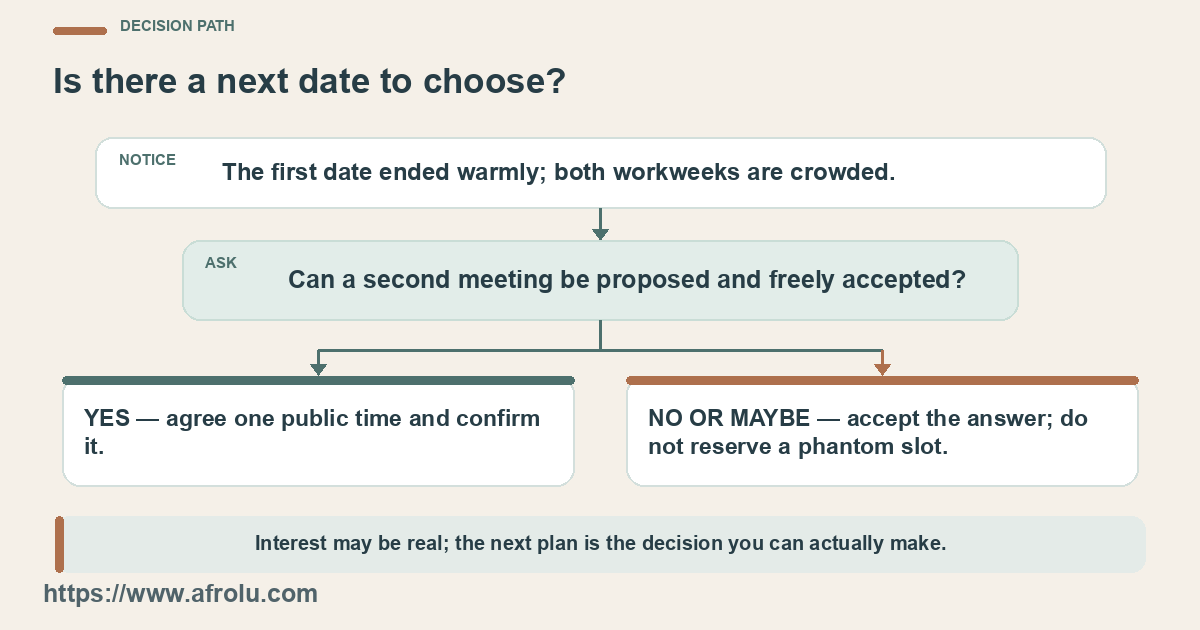
Move from your own interest to one realistic invitation, then let the other person's answer set the next step.
Start with yours
Do you genuinely want another meeting?
Use a real slot
Offer a day you will not have to cancel for work.
Leave three exits
Yes, counteroffer and no are all legitimate.
Keep dates distinct
A second date does not silently establish exclusivity.
Read the actual signal
Warmth matters, but a plan answers a different question
A person who lingered to finish a conversation, remembered a small detail or wrote to say they got home may well have enjoyed the evening. Those are real experiences, and you need not dismiss them. They still do not tell you whether the person wants to spend another afternoon together. If that is your question, look for a freely offered or accepted next plan.
Some people leave a date warmly and later realise they do not want a second one. Others are interested but face a crowded Monday. Neither possibility can be resolved by measuring how many minutes passed before a reply. Notice whether the conversation can move toward an answerable invitation, and do not assume a slower workday response reveals a hidden motive.
The distinction also protects the other adult. They can appreciate your company without owing another date, and you can ask without needing evidence that your invitation will succeed. This is a smaller, kinder decision than trying to decide whether an attractive person is already a future partner after one afternoon.
Make it feasible
A real Sunday beats a vague 'sometime'
Before texting, check the work and rest you have already promised. If Sunday morning is open, suggest a modest public meeting that connects to the first date. 'Would you like to walk through the garden next Sunday at 11?' can be answered. 'We must do something soon' transfers the planning burden to the other person and can leave both waiting.
Leave the slot loose enough for a counteroffer. A person who cannot do Sunday but suggests the following Saturday has made a useful choice; a person who needs to check a shift may give a date when they will know. You can decide how long your own calendar stays open. Do not call repeated indefinite maybes a confirmed plan because the first date felt special.
A safe, public plan and separate arrival are sensible early-date options, especially when you do not know someone well. The invitation need not buy an expensive experience or justify itself with a career biography. Its purpose is to learn whether another hour together appeals to both people, not to prove earning power.

A crowded workweek can explain delay without requiring endless waiting.
Keep terms honest
Wanting seriousness later does not change today's agreement
You may date with the hope of finding a lasting partner while choosing to meet this particular person once more without a label. Those are different levels of commitment. The love is respect resource on dating definitions notes that casual relationships can have different ground rules, including whether they are exclusive. Two adults must establish their own terms instead of assuming a second invitation answers that question.
If you are also seeing other people and the other adult asks, answer honestly. If you want exclusivity soon, you may say that you are eventually looking for it without presenting Sunday as a hidden audition. Likewise, if this person says they only want occasional casual dates, decide whether that present offer fits you instead of hoping they will change after enough weekends.
Physical intimacy, a public meeting and romantic commitment are separate choices. A yes to the garden does not imply consent to the rest. Keep each next step voluntary and discuss a new term when it becomes relevant to either adult's decision. That is clearer than trying to read a whole future from one lovely afternoon.

No seriousness claim is smuggled into a second-date request.
Use the reply
A counteroffer is more useful than a quick emoji
When the reply arrives, look at its content. 'Yes, Sunday at 11' creates a plan that can be confirmed. 'I am on shift; could we do the next Saturday afternoon?' keeps the invitation alive with a workable alternative. 'Maybe one day' may be pleasant, but until someone offers an actual opening, you need not hold every weekend available.
A busy person may genuinely need to check a rota. You can say, 'No problem; let me know by Thursday if that Saturday works, otherwise we can leave it.' This is a boundary for your own time, not a deadline intended to extract affection. If they decline, thank them for saying so and make other plans.
Avoid creating a loyalty test from delay or demanding an explanation after a no. One clear invitation and one practical follow-up can be enough. If the person repeatedly cancels without offering a workable alternative, you may decide the arrangement does not fit, regardless of whether interest exists somewhere in the background.
After another date
Let the next meeting create its own information
If you meet again, attend to the actual hour together. Do you enjoy speaking with this person when no first-date novelty has to carry the conversation? Can both ask questions and name practical limits? Someone may be thoughtful in person and still have a different relationship aim. That is useful information, not a failure of the second date.
If a third meeting appeals, propose it with the same honesty about time and terms. If hopes begin to diverge, have a direct conversation about the arrangement rather than using a sequence of dates as a substitute for it. The right time for that conversation is when an unanswered term affects what either person will choose, not an arbitrary number of outings.
A professional life contains work, friendship and rest as well as dating. You need not keep a person on a calendar because the first afternoon was impressive, and you need not hide that you would ultimately like a serious relationship. The useful next decision remains concrete: another chosen meeting, a clear discussion or a kind end.

The reader can stop after any step.
When warmth becomes a real invitation
They say the market walk was fun
Both may have enjoyed it without choosing another date.
Ask once if you want to meet again.Your chosen Sunday is already occupied
A generous invitation requires a slot you can honour.
Offer another real day or wait until you know.They cannot do Sunday but suggest Saturday
The answer contains an active next step.
Confirm whether that Saturday fits.They like the idea but name no opening
Warmth has not become a plan.
Release the slot and continue your week.Signs that answer the next-date question
The other adult responds to a specific invitation rather than only to banter.
A counteroffer contains a day or a time they could actually keep.
Both can decline without a demand for justification.
A changed work shift is named before the meeting, not after a missed arrival.
No one treats one more date as an exclusive agreement.
Move from interest to one plan
| Situation | What it may mean | What to do next |
|---|---|---|
| You enjoyed the first date | Your own interest is enough to make an invitation. | Choose a public place tied to what you shared. |
| The work calendar is crowded | A beautiful idea can still be impossible this week. | Offer only an open slot. |
| They suggest another day | A real alternative is more useful than reply speed. | Check and confirm the substitute. |
| They say maybe indefinitely | There is no current second date to hold. | Make other plans without a chase. |
| They decline | Their choice settles this invitation. | Thank them and let the contact close. |
Words for the second invitation
“I liked our herb conversation. Would you enjoy a garden walk next Sunday at 11?”
“I cannot do Sunday, but I am free the following Saturday afternoon if you would like that.”
“No problem if this week is not possible. I will make other plans; tell me if you want to propose a day later.”
“I enjoy meeting slowly, and I am eventually looking for a committed relationship. What are you hoping for now?”
Know the difference
A second-date plan versus pleasant afterglow
A specific invitation meets an acceptance or a practical alternative both can keep.
Compliments and fast replies feel good but never turn into a chosen meeting.
Interest may be real; the next plan is the decision you can actually make.

Use work availability and consent as checks, not reply-speed rules.
A plan is more useful than afterglow
| Type or dimension | What it describes | Best next question |
|---|---|---|
| A compliment | The first evening was enjoyed. | Receive it without treating it as a booking. |
| A proposed day | A second meeting is possible. | Check the place and time together. |
| A useful counteroffer | The first proposed slot does not fit. | Confirm the alternative if you want it. |
| A vague future | No date has been chosen. | Keep your work and rest plans. |
| A serious hope | One person's eventual goal. | Discuss it when it affects present choices. |
Keep the next choice small
The invitation is information
A direct request can be made without certainty of a yes.
Calendar repair counts
Naming a work change and offering a real alternative shows how a plan is handled.
One date stays one date
Another meeting does not decide exclusivity, intimacy or the future.
Questions for your calendar and terms
Choose a few prompts that fit the moment. This is a reference library, not a list to complete.
Before inviting
Find a plan that both adults can freely choose.
- Do I actually want another meeting?
- Which opening can I keep?
- Does a public venue suit this stage?
After the answer
Let the reply set the calendar, not your prediction.
- Was a time accepted or counteroffered?
- Am I holding a slot no one chose?
- Are we assuming an unspoken label?
What relationship guidance supports
Dating terms
love is respect explains that casual dating and exclusivity are separate arrangements.
Evidence limit: U.S. education, not evidence that a second date means serious commitment.
Time to date
love is respect asks readers to reflect on other commitments before dating.
Evidence limit: A reflection prompt, not a universal threshold or profession-based rule.
Expectations
love is respect encourages explicit expectations and respect for boundaries.
Evidence limit: The page does not prescribe a number of messages or dates.
Consent
love is respect explains freely chosen consent and the right to change one's mind.
Evidence limit: A yes to meeting again never implies consent to intimacy or exclusivity.
Ways an invitation becomes a test
Reading a future in a goodbye
Kindness after one date has a smaller meaning than a commitment.
Offering time you cannot keep
It turns the next date into an avoidable cancellation.
Holding every weekend for maybe
An unchosen plan can crowd out the reader's own life.
Choose one next meeting
If you want another hour together, use an actual open slot and accept the answer.
Explore the guide library
Continue with Afrolu
Dating, boundaries and consent sources
Afrolu reviewed these health, research, safety, or public guidance resources while editing this page. They support the behaviour and safety guidance; they do not diagnose any individual described by a reader.
Questions after a good first date
Is a warm text a sign of a second date?
It can be a sign the first date was appreciated. A second date still needs an invitation and a freely chosen answer.
What if work prevents a quick reply?
A person can check their schedule. Look for a later specific answer rather than treating reply speed as a universal test.
Does a counteroffer count as interest?
It is an observable effort to make another meeting possible. You can accept it if the new time fits you.
Should I say I want something serious?
You can state your eventual aim honestly. Do not imply that one more casual date creates commitment.
How many follow-ups are fair?
One clear invitation and one practical clarification are often enough. You may release an unconfirmed slot.
What if they decline?
Thank them for telling you and make other plans. You need not seek a hidden explanation.
One thing to do now
Ask for another meeting if you want one
Offer one meeting you can keep; read the answer as a choice about that meeting, not a prediction of the relationship.